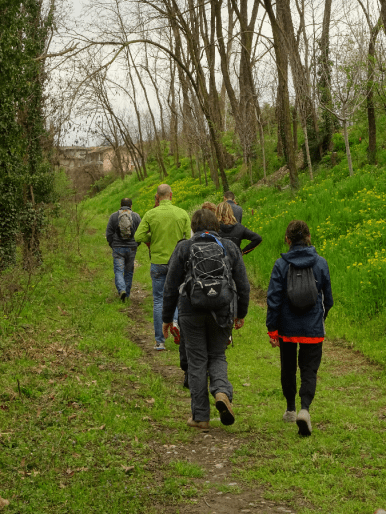
This article has now been moved to Walks and directly at Parco Spino Verde: Walking the Border Back to Como
This article has now been moved to San Donato to Camnago Volta: Opening up a Circular Route to and from Como

Hitler and Mussolini Streetscape Art – 2016, on the Teatro Sociale
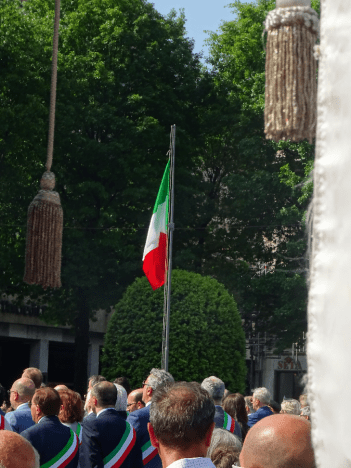
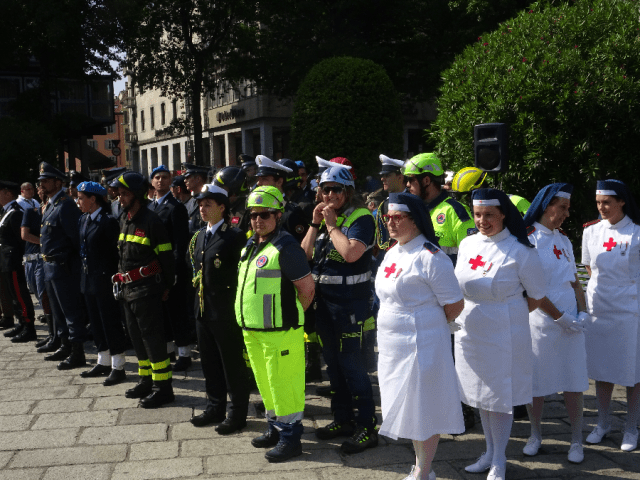
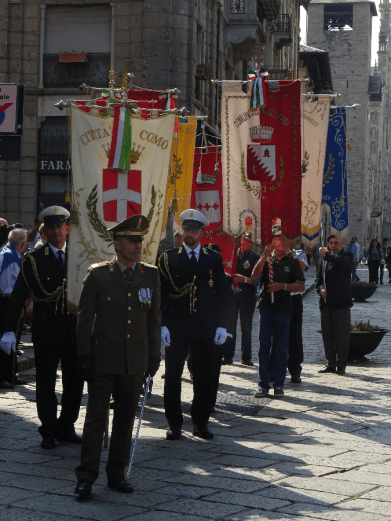
Today is Liberation Day – a public holiday celebrating the end of the Second World War in the Nazi-occupied half of Italy. That date seventy three years ago marked the culmination of a two year period following the dismissal of Mussolini when the territory was under the nazifascist regime of the two dictators. It was a tragic but immensely inspiring period when the antifascist alliance of partisans, workers, and others courageously and ultimately successfully defeated totalitarianism and racism. A celebration of their huge contribution in regaining the honour of Italy and laying the foundations of the current democratic constitution was held this morning on the lakeside with wreaths laid at the Monument to European Resistance. The speeches made afterwards stressed the unique cross-party collaboration in the antifascist alliance whilst the representative from ANPI (National Association of Italian Partisans ) spoke eloquently for ever greater European unification and ongoing antifascist resistance to combat the increase in both explicit and implicit fascist attitudes and the corresponding growth in racist and nationalist rhetoric.
From 1st to 8th March 1944, the call for a general strike supported by the Committee for National Liberation (CLN) but organised primarily by the Italian Communist Party (PCI) made clear the determination of the workers in the occupied part of the country to stand up to the authorities and to work alongside the partisans’ armed struggle in liberating the country – something they achieved a year later in the general industrial and armed insurrection on April 25th seventy three years ago. Workers in factories in the city and province of Como took an active part in these strikes paying dearly through imprisonment of the organisers and deportation into Nazi labour camps of many others.

Plaque commemorating 4 out of the 6 workers deported to German labour camps following the strike in Tintoria Comense. 3 died in Mauthausen, 1 died shortly after returning to Como due to bad health induced by the prison regime. The other 2 (both women) survived.
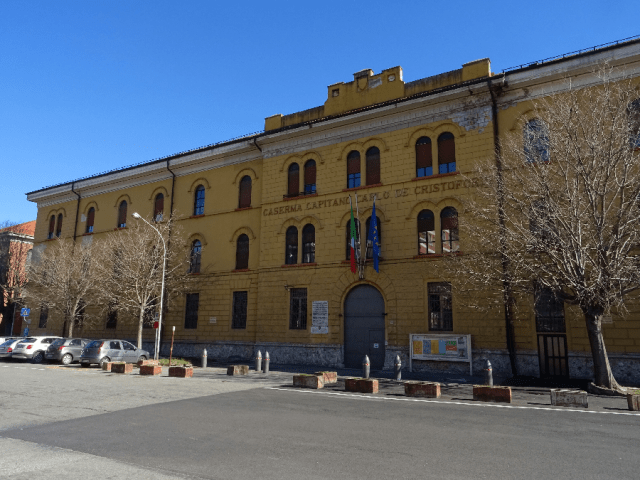
On April 25th 1945, at 5.00am the Como workers got up as usual and went to catch the trams out to the factories on the edge of town or in the province. The factory sirens sounded as usual to signal the start of the working day. However leaders of the Como branch of the CLN (Committee for National Liberation) got the trams to wait on standby to ferry the workers back into town since the sirens soon sounded again to start a general strike. The trams thus carried all back for a mass demonstration in Piazza Duomo scheduled for 10.00am. A group of workers were delegated to go up to the De Cristoforis army barracks to arm themselves with seized weapons. Meanwhile Mussolini on this very same day left Milan which was now witnessing a general insurrection following four days of strike action. He and his wife stayed the night in Como where hostile crowds were gathering. He left the following morning in his bid to escape Italy hidden within a column of retreating German soldiers. (See 25th April Liberation Day – Como’s Role in the Insurrection for details of Mussolini’s flight from Como). The long war and the even longer period of Italian fascism thus ended – on Liberation Day.

‘De Cristoforis’ Barracks – Como. Now used as a military documentation repository but soon to close.
Yet Italian fascism should have ended on 26th July 1943 when King Vittorio Emanuele III dismissed Mussolini, only to have him re-imposed on the Italians by Hitler on September 8th as head of the puppet state known as the Republic of Salò (RSI – Socialist Republic of Italy). But his government was perceived by many as entirely illegitimate. The invasion by the Germans and the return of Mussolini were conjoined in the word ‘nazifascist’ and so readily rejected maybe because the nationalism nurtured by Italian fascism since 1922 could hardly be reconciled with the country’s occupation by a foreign power. This was just one contradiction too many for fascism to overcome. Opposition to the regime came from all sectors of society – royalists, many Catholics, socialists and most definitely the communists. On September 8th 1943 opposition to German occupation became associated with an opposition to fascism itself. The formation of partisan groups started immediately recruiting the ex-soldiers of the ‘royal’ armed forces. Other ‘royal’ organisations like the border police (Guardia di Finanza) could never be trusted by the nazifascists and even came to be banned from patrolling the Swiss-Italian border outside Como (see Como’s ‘Viaggi della Salvezza’ – In Memory of the Holocaust for more details).

Luigi Canali (Battlename, Capitano Neri) and girlfriend Giuseppina Tuissi (Battlename, Gianna), lovers and partisan members of the 52nd Brigata Garibaldi. Both killed in mysterious circumstances in May 1945 outside of Cernobbio after involvement in the capture of Mussolini.
Industrial unrest had always been present even in the original period of Fascist rule – back in March 1943 a series of strikes under the banner of ‘Peace and Bread’ started out in the FIAT factory in Turin quickly spreading to the heavy industry based in the Milanese suburb of Sesto San Giovanni – in the factories of Falck, Pirelli and Ercole Marelli. By 1944 however, living conditions under the RSI were rapidly deteriorating. The cost of living was forever increasing; reduced working was often imposed due to shortages of raw materials or even due to the lack of coal to generate power or run the trains that were vital in transporting workers to the factories. (Many factories had been relocated out of Milan into the provinces of Como, Lecco and Varese to reduce the risk of damage from the intense allied bombing over the northern cities. The workers thus had to commute from Milan. Como was spared the worst of allied bombing maybe due to the proximity of the Swiss border and the allies’ fears of accidentally bombing a neutral country.)

300 workers went on strike at Ceramiche Piccinelli at Mozzate in January 1944 prior to the General Strike in March.
The PCI (Communist Party) organised strikes in Milan, Genoa and Turin in December of that year seeking wage increases and more generous rationing provision. January 1944 saw a massive increase in prices and a couple of strikes in the Como Province – the first involving 300 workers at Conte Piccinelli Ceramiche in Mozzate and the other involving 600 workers at Filatura di Turate. These were both factories whose workers lived in Milan but were transported out to the Province in a daily commute.

Carabinieri at the Memorial to European Resistance, Como – Liberation Day, 2018
The PCI and the CLN then started to combine the PCI-led industrial action with the CLN’s more general civil and military resistance. They agreed to organise a general strike commencing 1st March 1944 across Liguria, Piedmont and Lombardy. The theme of this agitation was anti-nazi but based on demands for higher wages and better provisions. The welfare of workers and their families was linked to their continuing employment since ration cards were issued through work as well as clothing allowances and, most importantly, one or two meals a day at the factory canteens. Loss of employment did not just mean a loss of wages. The worsening economic situation and the ongoing increase in temporary and permanent redundancies went to fuel increasing militancy within the factories encouraged by the clandestine cells set up by the PCI. The authorities for their part responded with a mixture of repression and a bogus anti-capitalist and anti-bourgeois campaign known as ‘pacificazione sociale’ claiming they would put worker representatives on to management boards. Paolo Porta, the chief fascist ideologue based in Como, made the following press statement in Cantu:

Paolo Porta
Fascism will show that it is not the armed guard of wealth and privilege and that the traitors and saboteurs who think themselves invulnerable because they feel protected by wealth, will instead be hit where they are weakest – in their wallets and bank accounts.
However the campaign did not win over the working class. Fascism had lost any form of credibility by this stage and Mussolini’s attempt to restyle himself and his regime as militantly socialist fooled very few.

HQ in Milan of Salmoiraghi and Vigano, the inheritors of Filotecnica Salmoiraghi which moved out of Milan in 1943 to avoid allied bombing
The strikes began on 1st March and continued until the 8th with their epicentre in Milan where the PCI were at their strongest. The first factories to follow in Como Province had direct links with colleagues back in Milan – such as F.A.C.E. at Grandate where 150 workers stopped work at 14.00 and took the train back to Milan. The next day 400 workers who lived in Milan but worked at the Filotecnica Salmoiraghi in Cantù stopped work. On the same day at the Seriche Italiane at Mariano Comense 700 workers went on strike in solidarity with Milanese colleagues.

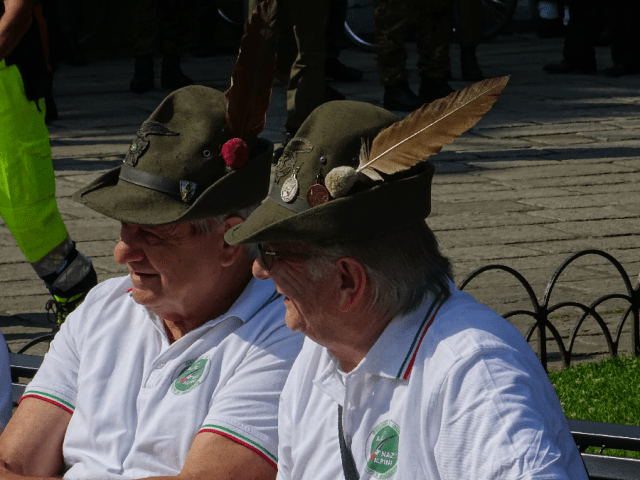
Ex-partisan Associations, Memorial to European Resistance, Como – Liberation Day 2018
On 3rd March 1944, 180 workers at the Cartiera Burgo in Maslianico went on a strike organised by a communist cell that had first led a strike at the factory on 26th July 1943 when they wanted the workers to be free to join a mass rally in Como celebrating the dismissal of Mussolini from government. Two of the March strike organisers were later sent to German labour camps. A division of the factory was later closed down and its machinery moved to Poulz in Austria with the workers told either to move to Austria or be dismissed.

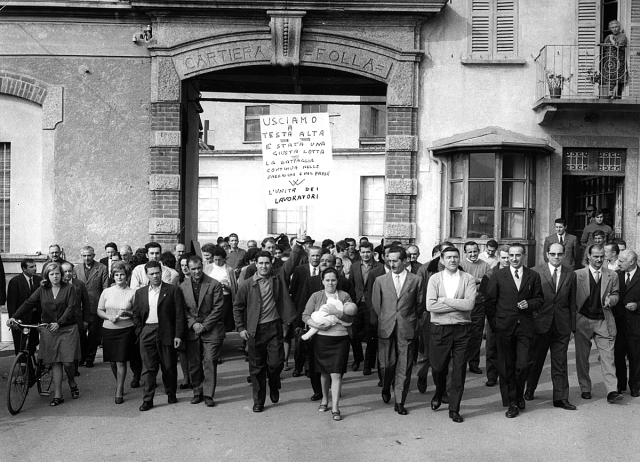
‘We leave with heads held high’ – workers abandon a 130 day sit-in against redundancies in October 1969 at Cartiere Burgo
The strikers’ demands, submitted to the fascist authorities against the advice of the PCI organisers, reveal the concerns of the workforce. They were as follows:

Ex-site of the Tintoria Castagna on Viale Varese
On 6th March 1943 there were stoppages at two silk factories in Como. The first involved 200 workers at the Tintoria Castagna. Leaflets had been circulated the day before advising of the strike and that it was supported by the CLN. The strike started the next day. Three non-communist workers who were found with the leaflets were deported to the German Labour camps of Gusen and Mauthausen. None of them returned alive. The Communist strike organiser was imprisoned for a year.

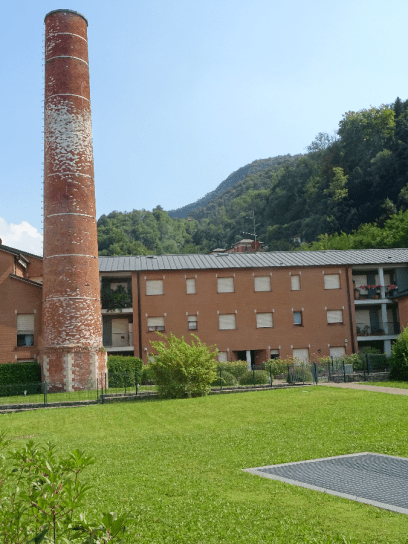
Chimney of the ex-Tintoria Comense, subsequently renamed Ticosa and now a derelict site off Viale Roosevelt.
The second strike involved 1500 workers at Como’s largest fabric factory – the Tintoria Comense, later known as Ticosa. This was organised by a communist cell but also with internal assistance. The fate of some of the workers including Ines Figini is told in our article about Ines and her time in Auschwitz Labour Camp. Most of those deported to Germany died in the labour camp of Mauthausen. The two women deportees, Ines and Ada Borgomainerio, both managed to get home. One other worker returned home only to die shortly after due to his poor state of health brought about by the prison regime.
There was also a failed strike in the fabric factory Bruno Pessina off Via Borgo Vico. Again leaflets were brought into the factory by a communist cell member, Enrico Caronti and he initially got a unanimous agreement to strike the next day. However a fervent fascist in the workforce so frightened colleagues with stories of the reprisals that would follow – mass deportation to Germany, imprisonment, loss of rations etc – that the workforce changed its mind.

Chimney and site of the ex-Tintoria Bruno Pessina off Via Borgo Vico
Other strikes in the Province included 600 women strikers at Cattaneo Luigi in Rovellasca, at the Orsenigo iron foundry in Mariano Comense and 1000 workers were on strike for five days at Taglietti in Figino Serenza.
The authorities claimed the general strike was an abject failure. The Provincia di Como reported on the 8th March ‘Genesis of an aborted strike – Italian workers, with the exception of a tiny minority, have ignored the call from those agitators in the pay of London and Moscow.’ Yet Hitler was livid and demanded that the authorities send 20% of strikers to German labour camps as a general threat to the working population. This programme of deportation proved impractical due to the strains on the social order it would provoke. Hitler’s Ambassador to the RSI calculated that 20% amounted to 70,000 deportees meaning that by his estimate 350,000 workers had participated in the General Strike. Modern historians estimate the figure at 208,500. In either case, this was a significant act of defiance. In the words of the German historian, Lutz Klinkhammer:
‘it was the greatest mass protest that the occupying forces had to confront; put together without outside help, without arms but with considerable energy and sacrifice. It wasn’t just (alongwith the strikes of 43) the most important strike in Italy over 20 years of fascist rule, it was also the greatest general strike across the whole of Nazi-occupied Europe.’
Strikes continued after March 1944 particularly against the policy of sending workers to Germany. The number of agitators in the factories grew. On 9th June 1944 a significant pact was signed in Rome between all three of the trades union groups – the communists, the socialists and the Christian Democrats. This alliance was also intended to co-ordinate industrial action in support of the resistance. The unions organised so-called Squadre di Azione Patriottica (SAP) normally consisting of cross-party cells of 10 politicised workers organised to sabotage production, prevent delivery of goods to the Germans, pass around propaganda and in some instances, to offer military support to the partisans. Other groups organised themselves to provide medicines and provisions for the partisan groups. Strikes continued through October and November 1944 in spite of the law passed on 21st June declaring the death sentence for strike organisers. The level of civil and industrial disobedience grew from the start of 1945 with stoppages becoming ever more frequent and the authorities forced to give way more often than not. And then on April 20th, the Milanese workers started another general strike that was to signal the final insurrection against the nazifascist regime.

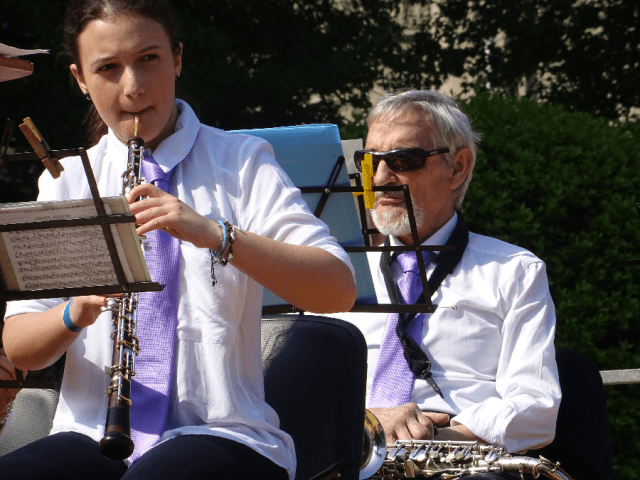
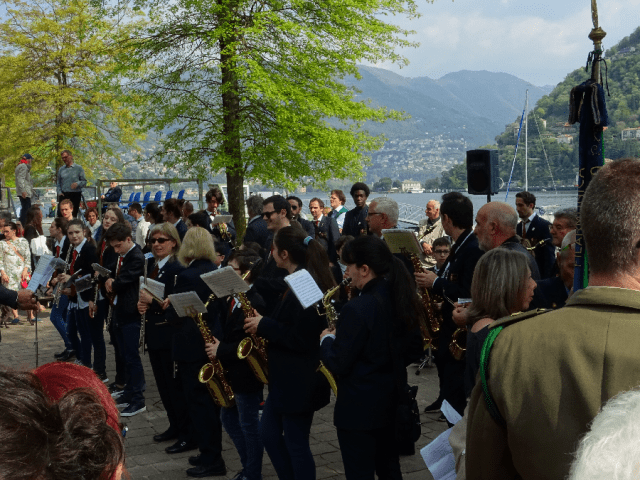
The Banda Filarmonica Monte Olimpino play at the Liberation Day ceremony, Como.
In Milan, on April 25th, Mussolini met with the CLN to discuss surrender terms mediated by Milan’s Cardinal Schuster. He abandoned the talks and fled immediately to Como. The German army representatives had also that very day signed the armistice in Rome. Como strikers were on the streets and civilians were arming themselves to confront the remaining pockets of fascist resistance. The German army was preparing for their final retreat and surrender. On the following day, Mussolini left hidden in the column of German soldiers making their way up the western shores of the lake possibly to cross the Alps via Splugen or possibly to organise a final stand in the Valtellina. His column was stopped by a group of partisans just outside the town of Dongo. The civil and industrial alliance of communist, socialist, royalist and catholic anti-fascists with their relative partisan groups, had brought the illegitimacy of the fascist puppet-state to its inevitable end. The same spirit of collaboration would fortunately last as long as the drafting of the new Italian constitution enacted in December 1947 but as the rest of the twentieth century testified, for not long after.

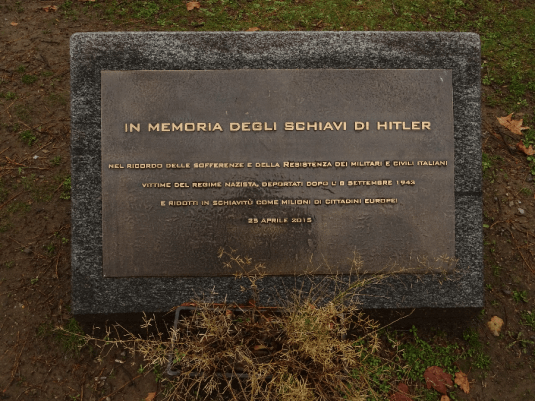
In Memory of Hitler’s Slaves

Mobilita Dolce Initiative – walking the old railway from Como to Varese encouraging its modification into a cycle path
I am not sure how to translate ‘Mobilità dolce’ other than by ‘soft movement’ in which case, we are living through a spring of soft movement – or, to use a possibly better-known phrase, a spring of slow tourism. The AMoDo (Alleanza della Mobilità Dolce) has unilaterally declared that the period from 21st March to 21st June be known in Italy as a season of ‘slow’ initiatives. Como Companion is all for ‘slow’ as in ‘slow food’, ‘slow driving’, and whatever else we can imagine should be taken slow but above all ‘slow tourism’.
Certainly it shares some connotations with the original ‘slow’ movement for food and a common purpose in questioning the pressures of the marketplace and the negative effects of commercialisation. Slow tourism is the antithesis of fast or mass tourism in its bid to get us to spend more time to get to know the areas we visit when on holiday. Slow is more than a delightful adjective, it is an attitude!
‘Slow down, you move too fast
You got to make the morning last
Just kicking down the cobble stones
Looking for fun and feelin’ groovy.’
Simon and Garfunkel, 59th Street Bridge Song
Go slow and you gather moss, you absorb, you reflect, you empathise, you connect. A slow tourist has the means and time to engage with the environment and the community he or she is visiting and so you leave with more than a few photographic records of an exotic location. Slow tourism can give you an appreciation of the economic, social, historical, cultural or environmental elements of where you are – its the form of travel that truly does extend your experience and creates memories that will last for ever.

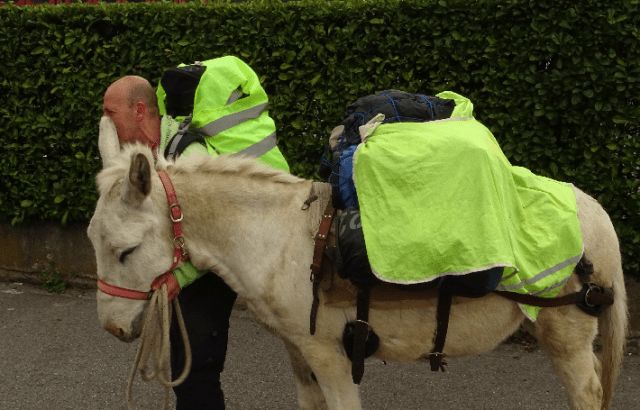
On a recent walk we met an Italo-Swedish couple travelling to and from La Spezia to Sweden with donkeys. An example of super slow travel.
But why the need to proselytise it? Partly to counteract the potential harm of mass tourism, and to get people to think beyond the standard tourist destinations. As fellow-expat blogger, Celia Abernethy has reported in the Huffington Post, Italy is having to deal with ‘overtourism’ with nearly 100 million people arriving by air from between January and July last year.

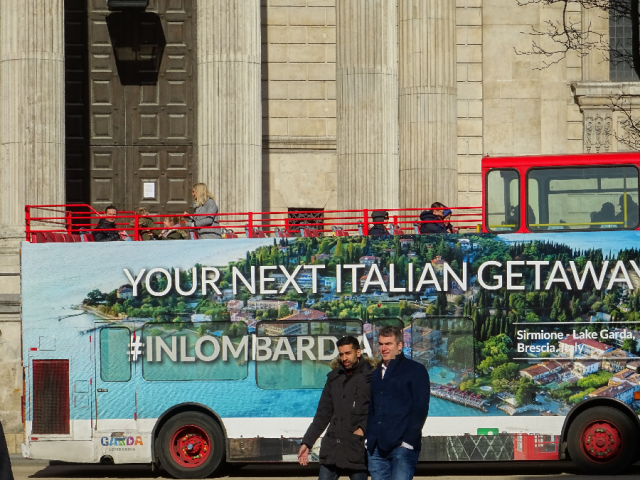
Inlombardia advertising holidays in Lombardy on the sides of a tour bus in front of Saint Paul’s Cathedral, London
If these visitors all keep to the best known sites or towns, (Venice, Rome, Milan etc.) it becomes totally unsustainable. Hence Inlombardia ( the Lombardy Region’s Tourist Agency) are campaigning across Europe to encourage visitors to go beyond Milan to Como, Lecco, Varese, Bergamo, Mantova or Pavia. Also for economic reasons, towns like Como want to see visitors spend more time here and thus spend more money in the shops, hotels and restaurants rather than having half a day in town, the other half in Bellagio with spending limited to a boat ticket and a slice of pizza for lunch.

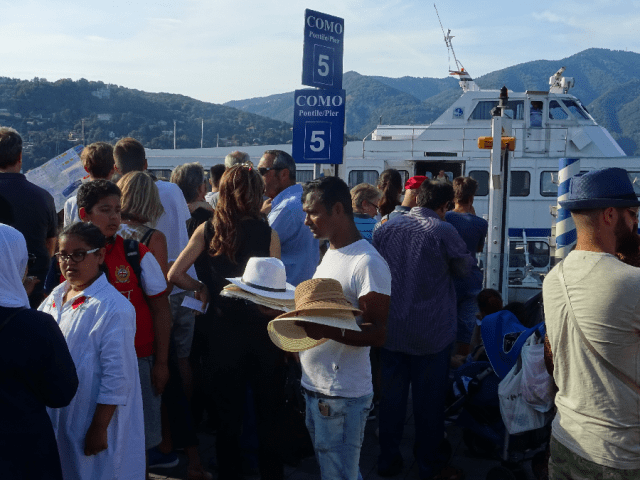
Queue for the fast boat to Bellagio, Ferragosto Public Holiday, August 2017
But slow tourism also seeks to counteract the ‘productising’ tendencies of the mass tourist market. This is the tourism equivalent of the trans-fat horrors of fast food. Fast tourism deals in cliché, stereotype, stock images and easily digested non-memories – it takes these shortcuts because there is no time for true engagement or genuine human contact. And it short changes visitors, sometimes in seemingly small ways such as the restaurant on the lakefront here in Como which cannot be bothered to describe its pasta dishes accurately since ‘the visitors don’t know the difference’! But this thankfully rare disrespectful attitude betrays the sterility of fast tourism since it’s a ‘product’ based on a location whose soul or true essence is of no relevance.

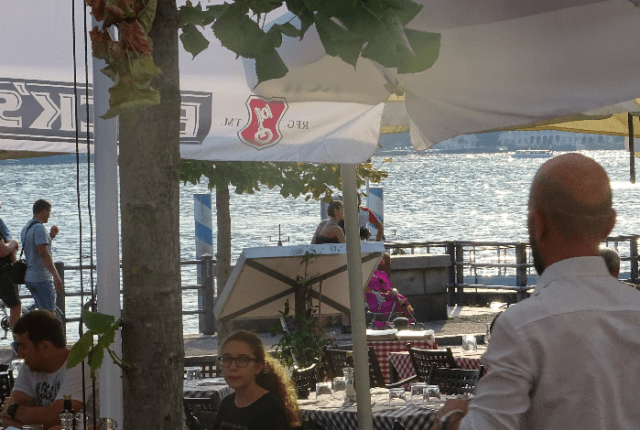
Al fresco dining on the lakefront is massively appealing and the overall quality is more than acceptable but the temptation for the less scrupulously managed establishments is to ignore the need to be genuine or authentic.
Slow tourism instead IS about offering insights into that true essence or the soul of a location – and that is best achieved by going slow – not slow stuck behind a cavalcade of tour buses that get caught up in summer on the narrow lakeside roads around Ossuccio, but slow walking up Ossuccio’s UNESCO-listed Sacro Monte or traversing the lakefront above the blocked roads on the Greenway or the Strada Regina following mule tracks used for centuries by our antecedents.

The UNESCO-listed Sanctuary at Sacro Monte, Ossuccio behind which is a delightful trattoria.
That is why AMODO and the other associations such as Iubilantes campaign so forcefully to extend the network of cycle paths and to reopen the ancient walkways that characterise our territory, particularly since we live on a key north-south axis used since Roman times as one of the principal pan-European routes from Mediolanum (Milan) through the Alps over the Splugen Pass and following the valley of the Rhine.

Moments of peace and reflection
Fortunately it is very easy to go slow on Lake Como. Associations like Iubilantes provide web sites and apps like CamminaCitta outlining and illustrating short city walks and longer excursions. Their site states it is:
A portal in which one seeks to rediscover and celebrate the cultural heritage of our cities combining, as so seldom happens, easy mobility, sustainable tourism and accessibility.
The ultimate goal is to encourage the principle of “good for everyone” and “tourism for all”, in the belief that traveling, especially in the form of slow and sustainable mobility, is a life resource that must be accessible to all, without discrimination, beginning from our territories.
There is even a tour company called Slow Lake Como that incorporates all ‘slow’ principles into the tours they organise. For example, they promote visits to some of the smaller less frequented but genuinely interesting villages on the lake like Brienno with its amazing labyrinth of alleys and fishermen’s houses. This Spring they have also organised a visit to Dongo to explore the sites and stories surrounding the capture of Mussolini as he tried to make his escape up the west side of our lake in April 1945 (see our article on this). They go off the standard tourist routes to explore aspects that give a genuine insight into the area, its history and people.
In their words:
In a world where distances are erased, a true adventure is going deeply into the discovery of the true essence and distinct features of a land, experiencing with all senses extraordinary activities while being accompanied by tour guides who are first place story tellers.
This is Slow Como Lake. The initiative born thanks to the passion and enthusiasm of people united by the fusion of a “slow” way of life and the love for Lake Como and aims at the valorisation of its historical, cultural, gastronomic and environmental heritage.

Looking out on to Lake Como from the portico below the fishermen’s houses in Rezzonico – one of the many delightful locations to discover when you stray from the popular path.
Maybe the best way to engage with a community is through meeting with its inhabitants. This is the principle behind Vincenzo Pandico’s Lake Como Explore – a tour business that allows you to ‘explore Lake Como through people’s experiences – a wonderful journey made by tales and pictures’. Slow Lake Como also organises cookery classes with locals – what better way to get to understand an area than through its cuisine. Specialist tours like Lake Como Food Tours allow small groups to get an intimate insight into the culinary traditions of the lake. Any form of physical activity breaks down barriers and introduces you to the inhabitants of the area – all walkers greet each other up on the mountain paths. Many Italians are keen cyclists and all have respect for anyone prepared to take on any of the challenging hill climbs in the Lario Triangle such as the Muro di Sormano.
Maybe above all else, the ‘slow’ tourist needs information which fortunately the Internet now offers in abundance. Como Companion tries to pass on information of interest to both residents and visitors alike and provide some useful links. Lake Como has the infrastructure to support slow tourism – accommodation options that range from mountain-top huts for hikers, hostels, standard hotels or those specialised for walkers or cyclists, luxury villas etc. Use our site to view the different transport options as well as to kickstart your Internet research.

Time to relax
Slow tourism also aims to be sustainable in the sense that it seeks to support and maintain those factors that attract visitors and delight residents for the pleasure of all both now and in the future. In this respect it’s great to note that Lake Como is now perhaps one of the first overall tourist locations with a network of recharging posts established for electric cars. Awe Magazine in an article from June 2017 describes the initiative thus:
Italy’s breathtaking Lake Como has become the first “electric” destination in Europe thanks to a pioneering new initiative designed to reduce pollution and facilitate the easy use of electric cars, bikes and boats for the first time. Como-The Electric Lake is the brainchild of British business woman Judith Wade.
Launched this summer (2017) by Italy’s largest historic gardens and destinations network, Grandi Giardini Italiani (GGI), the initiative covers 170kms around Lake Como and is the first in Europe to create a widespread infrastructure of 19 charging points for electric cars, boats and bikes in one location. Lake Como is the birthplace of Alessandro Volta, a physicist and nobleman who invented the first electric battery over 200 years ago – making it the ideal location for this eco-enterprise.’
So come to Lake Como where, as you can see, there is no excuse for not going slow!

Taking time to stop and stare
It’s now over one year since my first interview with Ester written shortly after she had moved into her new studio at Via Borgo Vico 82 (Ester Negretti – Como’s Traditional Contemporary Artist). That article has proven to be one of the most popular on the blog and so, on reading about her upcoming exhibition over Easter in Menaggio, I was eager to return to talk once more to her about her recent work.

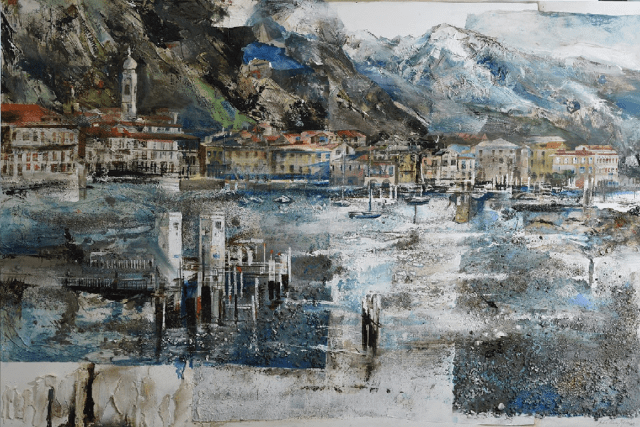
Colours at Menaggio, – Mixed media on canvas, 2017 Ester Negretti
On entering the studio I was comforted by the warmth emanating from a live flame space heater that certainly was not there on my first visit. And that heater seemed to symbolise how this space had settled down into a comprehensive display of the various facets of Ester’s creative interests. The exhibition area is now a true window onto her work whilst the actual studio, with work in progress, lies behind it. In turn the work area leads onto an equally spacious storage area. The studio stands as testimony to the range and energy of her output with the mix of canvases, objects and furnishings revealing facets that can readily be recognised as characteristic of Ester’s style.

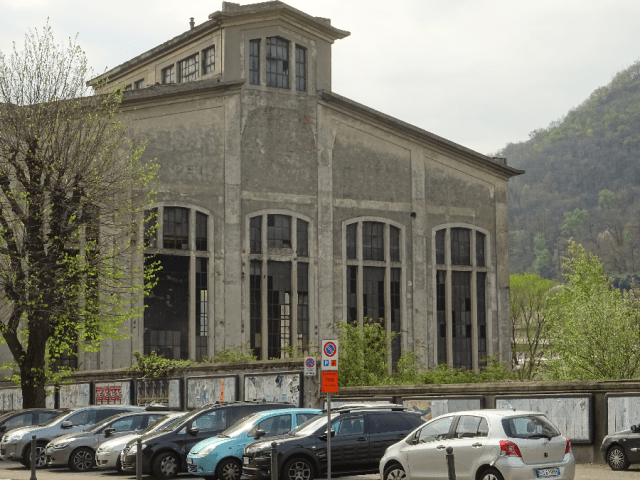
Ester Negretti’s studio at Via Borgo Vico 82
Those stylistic characteristics provide the continuity – an interest in texture, movement, the use of mixed media, broken horizontals, muted shades, an autumnal colour palette that is anything other than Mediterranean – all these aspects are still evident in her work but also there was something new. I looked around trying to identify what actually had changed. Firstly I noted that on the walls her figure paintings were less evident than on my previous visit. Landscapes had assumed a higher priority.

Como, Mixed Media on Canvas – 2017 Ester Negretti
Ester readily admitted that she had perhaps focused more on landscape lately. This was partially in response to public interest but also, more significantly, due to changes in how she herself had been reacting to her environment. Her more recent landscapes, whilst the subject matter of lake, community and surrounding mountains remains constant, do reflect a broader and freer use of colour.

Ester’s Studio Environment
They still reflect her preference for autumnal and winter tones due, as she explained, to the greater variety in light and mood experienced off season, but maybe now through colour she allows the buildings a greater presence. For me, these subtle changes seem to reflect an increased degree of confidence in her treatment of her subjects, still seeking to express the sublimity and inner essence of place but confident enough to allow some externalities to shine through. Whatever the reason, the results are impressive and the exhibition of these new landscapes at Menaggio will be well worth a visit.

Engaged aggressive sails, Mixed media on canvas – Ester Negretti 2017
I had noted in my first interview with Ester a certain ambivalence in her attitude to Como eager not to be considered solely as a Como artist, and holding back from a total enchantment with the beauty of our natural setting. It might be that the recent changes in her landscapes derive if only subconsciously from more acceptance of the role of place in her art, but for Ester the lake does not offer enough drama and movement. If only there was a way to combine the dramatic backdrop of sky and mountain with movement on turbulent water.

Detail of sailing boats to show mixed media technique depicting the mountain backdrop
Her new series of studies of sailing yachts do exactly this – the physicality and layers of the mountains form the backdrop to a water surface chopped up by the graceful lines of boat hull topped by soaring masts and billowing sails. These are not scenes from Lake Como but the Lario mountains are there in the background. In one way, these studies reproduce an idealised landscape combining the Como profile with a marine foreground.
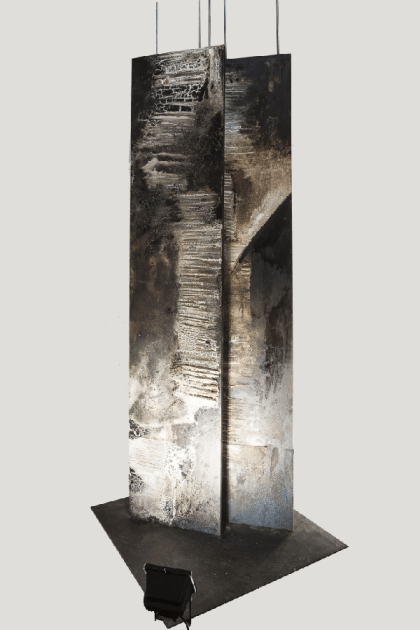
If Ester’s landscapes have become less abstract, her figure studies have become more so – or at least in her series of three-dimensional ‘statues’ that will soon be on display at the Milan Furniture Fair. Ever in search of the inner essence, Ester had previously avoided detailing the external features of the human form. In her statues she may have retained the vertical dimensions but all human contours have been done away with leaving what she refers to as the imprints of personality. She uses her stylistic theme of stratification to create these textural vertical structures which allow for a whole range of personal interpretation.

Essere Senziente 4 (Sentient Being), Ester Negretti 2012
Her output doesn’t stop at that and her studio includes examples of work with furniture, on fabric and with objects such as her series of rusted boxes. All in all, it was fascinating to note how this artist’s work had developed over the last sixteen months, particularly when the changes seem overall to be so positive.
Greater confidence revealed itself in various ways and not least in the broad range in the scale – the actual dimensions – of Ester’s pieces. Some of the statues are tall enough but also some of the sailing boat studies are metres tall. Yet she is also comfortable producing abstracts and landscapes no larger than 20 x 20 cms. I have already noted the freer use of colour but there is the continued bold use of mixed media and texture as well as the heightened drama of subject matter. It all adds up to an energetic output still executed with thoughtfulness and integrity but marked by a growing confidence in the development of her own particular artistic style.

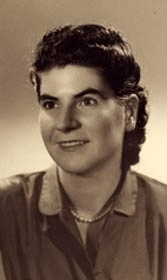
The artist in her studio.
Ester’s personal exhibition at Menaggio entitled ‘Pantone Lake Como‘ can be seen at the Sala Espositiva of the Comune in Piazza Garibaldi. It runs from Wednesday 28th March until Tuesday 3rd April. Her sculptures instead will be on show at the Milan Furniture Fair (Salone del Mobile) which runs from April 17th to 22nd.
If you cannot make it to Menaggio or Milan, the full range of Ester’s output is available to view on her website (esternegretti.com)

Ines Figini
Ines Figini’s testimony of her time served as a slave labourer in the Nazi concentration camps has usually been recalled on Holocaust Memorial Day. This year I used that date to tell the story of the Sormano village priest, Don Carlo Banfi, who aided the escape in 1944 of Jewish migrants from deportation to Germany, by leading them to safety across the Swiss border on Mount Bisbino. With reference to the Holocaust, Ines’s story rewards the retelling as a reminder of how the most unsuspecting Italian citizens could also become victims of the Nazi-Fascist regime. Additionally the qualities of humanity and decency displayed by Ines, alongside her fortitude and her survival instinct that saw her through a set of intolerably stressful situations, are equally worth celebrating on this particular anniversary of International Women’s Day.

Via Grossi, Como looking east as it climbs towards Brunate.
In March 1944 Ines Figini, the 4th of 5 children, was 21 years old and living in the modest family home in Via Tommaso Grossi, Como. She had started work at 16 in the Tintoria Comense after completing elementary education. The Tintoria Comense was one of the largest silk thread and cloth weaving factories in Como. It would later take on dyeing, printing and finishing and combine under the name Ticosa. As the saying went before the war, if you worked at Comense you could guarantee to put bread on your table.

Chimney of the steam room that powered the Ticosa factory – the largest silk factory in Como.
At the start of the war in 1938 there were 318 silk spinning and weaving businesses in the Province of Como employing up to 30,000 people with a further 22 businesses specialised in fabric dyeing and printing who employed a further 6,500. But the war deprived these businesses of their markets in USA, UK and France so that by August 1940 8,000 employees had been dismissed and a further 14,000 had their work suspended (what is known in Italy as Cassa Integrazione). This had risen to 13,000 and 20,000 respectively by the end of 1940. By this time, the Italian industrial economy had, to all intents and purposes, been put to the service of the German wartime one. The first Italian workers had left Como in 1939 to work for Volkswagen and this figure had risen to 5,000 by 1941. These were mostly voluntary labourers but Germany was to rely on up to 20% of its workforce consisting of slave labour with the majority coming from Russia and Poland.

Heart of the old Tintoria Comense (Ticosa) Silk Factory
By 1943, resistance to the Fascist regime was building up – on May Day of that year, a red flag was unfurled provocatively above Como at Brunate and then on 25th July, following the arrest of Mussolini, the fascist authorities left Como and the opposition political parties were able to meet openly for the first time. This euphoric period was however very brief since the Nazis moved to occupy Italy and to establish the illegitimate fascist puppet state known as the RSI.

Paolo Porta
By 14th September Paolo Porta had re-established the Casa del Fascio in Como and by 18th September, martial law had been introduced with a black out and curfew from 8.30pm to 6.00am. The first calls were made for armed partisan resistance.
Conditions of life and work deteriorated markedly over the following period with industrial unrest and resistance growing. The clandestine labour unions tried to organise a general strike for the 1st March 1944 but plans were thwarted by the network of spies and informers set up by the Nazi-Fascist state. Workers were even further taunted when the local fascist boss Paolo Porta was believed to have declared that workers only needed a single slice of bread and an apple a day to live on.
So on the 6th March 1944, as Ines arrived at the gates of the Comense factory at the start of her 8.00 am shift, the word went round to stop work at the blast of a whistle at 10.00 am. When the whistle sounded, Ines and the majority of her co-workers duly stopped work. Police were summoned and when Ines and the others sought to leave the factory at 12.00 for the lunchtime break, they found the gates locked against them. Before the gates were allowed open, the police commissioner read out the names of those who were believed to be the strike organisers and told the crowd that these people would be sent to German labour camps. The gates then opened and the workers filed out for the lunch break but as Ines passed the police commissioner, she instinctively stood up for the arrested strike leaders by declaring their arrest was unfair since they had all obeyed the strike call so they should either all be arrested and sent to Germany or else none of them should be deported. These words would determine Ines’s fate although she was unaware of any immediate repercussions. However there was a knock at the door at her family home that midnight.

Palestra Comunale Mariani on Via Sauro – where Ines was imprisoned alongside other deportees prior to being transferred to Bergamo. The gymnasium is only about 200 metres from Ines’s family home.
That knock on the door in Via Grossi led to Ines being carried off to the local police station where she was put in a cell with two other women workers from Tintoria Comense – Celestina Tagliabue and Ada Borgomainerio. She stayed there for two nights before being transferred to the Palestra Mariani which was being used to group antifascists, Jews and partisans prior to deportation to Germany.
On 14th March, Ines, Ada, Celestina and a further five women from Lecco who had also been imprisoned for striking, were taken to San Giovanni Station at 5.00 am and put on a train for Bergamo where they were housed in army barracks for the next three days. Here Celestina, who suffered from a serious kidney ailment, was returned home since she was deemed unfit to undertake the onward journey to Germany – a consideration not extended to any of the Jewish deportees. Ines, Ada, the strike leaders and the other Jewish and anti-fascist detainees were then marched in a column five wide through the streets of Bergamo to the railway station, with the local population passing food and clothing to them. They were then placed in goods wagons to set out for an unknown destination and an uncertain future in Germany, although Ines was still convinced she would just be employed like all the other voluntary workers who had previously left Como.

Ringed are the three concentration camps where Ines was imprisoned, from south to north Mauthausen, Auschwitz-Birkenau and Ravensbruck.
Little did Ines know that she was not destined to be employed as a regular employee in a German factory but that she would be imprisoned as a slave labourer in some of the most notorious ‘lager’ within the German Reich. She was not to return back home to Como until 25th October 1945 having traveled across the Reich as follows:
When Ines, Ada and the other women from Lecco arrived at Vienna, they were walked through the corridors of a civilian prison and left in a large room with a bowl of thin soup and provided only with some straw on the floor to sleep on. The following day they were loaded onto a lorry smelling strongly of disinfectant to set out for Mauthausen towards the Czech border. On arrival, Ines and the other women were separated from the other male detainees from Como (whom they were never to see again) and were then put through the concentration camp’s registration process. For this they were stripped naked, showered and then walked in single file for a medical inspection, with the onlooking guards passing lewd comments, before dressing again to be marched on to their windowless cells. Ines still managed to hold on to the belief that she would eventually find her workplace and that her conditions would improve. But her next transfer to Auschwitz-Birkenau left her with no doubt that she was a prisoner and that her employee status was as a slave labourer.

Ines’s prisoner number at Auschwitz-Birkenau
Ines and Ada were given a slice of bread and a dollop of margarine for the day-long journey to Auschwitz-Birkenau. They were locked into an actual passenger carriage rather than the goods wagons used to transport the Jewish detainees. The registration process at Auschwitz-Birkenau included the tattooing of her number 76150 on her forearm as just another act in the process of dehumanisation that had started the moment they had arrived in Vienna. Ines was set to work transporting the human waste from the camp to be spread out on the fields as fertilizer. When the winter gave way to spring, the prisoners were set to digging channels in the clay soil to drain the marshland. Ines also became gradually aware of the truly sinister nature of this labour/extermination camp as she came to realise the source of the acrid smoke arising from the camp’s charnel houses. She also worked out the pitiful fate of the young children she saw set to marching five abreast with each clutching a toy given to them by the guards as they were led to their gruesome end. It is only thanks to the testimonies of prisoners like Ines that we can begin to appreciate the extent of the cruelty and inhumanity inflicted on the detainees in the Nazi death camps. But during this period most of Ines’s attention, energy and ingenuity had to be spent in seeking to survive by staying out of trouble.
After eight months Ines was transferred again – this time to the labour and extermination camp at Ravensbruck which lay 90 kilometres north of Berlin. Ines had had to say goodbye to Ada prior to the journey since Ada had taken ill with appendicitis and was still convalescing in the camp hospital. Ines was loaded into the goods wagons for the long ride west. Ravensbruck was a labour camp designated almost exclusively for female prisoners who were overseen by female guards. The camp provided a slave labour force for the nearby Siemens factories. Ines and her fellow female prisoners were marched in columns to work accompanied by armed guards and Doberman guard dogs. She worked the 12 hour stints in two shifts starting either from 6 in the morning or 6 in the evening. In spite of the long hours of work without even the possibility to sit down, the conditions were better than at Auschwitz if just because she was indoors out of the worst of the weather.
From January and February 1945 it became obvious to Ines and the other prisoners that the Reich was on the retreat as news of the Russian advances came through. The retreat soon developed into a flight west away from the encroaching Red Army. For the prisoners life got harder. In April 1945, Ines was transferred out of Ravensbruck to a smaller nearby camp and the normal daily ration of a loaf of black bread was now shared out amongst eight or ten prisoners rather than five as previously. With the Russians advancing ever closer, the prisoners were gathered together, given minimum rations and set to march west accompanied by the Doberman dogs and armed guards. A soldier was delegated to stay at the back of the column to shoot those prisoners who could not keep up with the rest. One morning, after the march had halted for the night in a country farm, the prisoners awoke to find that their German guards had slipped away under cover of darkness. The war was over and Ines realised her survival instincts had seen her through to the end – if she could now just get back to Como.
The end of the war resulted in a new set of challenges to test Ines’s spirit of survival. There were about 11 million displaced persons in Germany at the end of the war, most of whom had been employed as forced or slave labour. Many were as eager as Ines to get home but the lack of food and the damage to the basic infrastructure made for a logistical nightmare. Ines’s strong sense of survival had initially paid off well but drinking untreated milk led to typhoid fever and a prolonged period in a Russian-led hospital. Any attempt to return to Italy had to wait until her life was out of immediate danger and she had sufficient strength to walk and sustain the stresses of the journey.

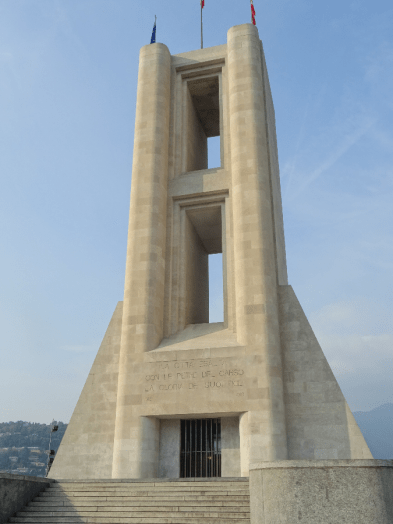
Monumento ai Caduti – War Memorial designed by Giuseppe Terragni and inspired by Antonio Sant’Elia. The two major representatives of the fascist state were executed by firing squad behind the memorial.
Meanwhile back in Como, with the collapse of the Nazi-Fascist state, there were scores to be settled. Paolo Porta, the fascist leader who had gone a long way to provoke the original strikes at the Tintoria Comense back in March 1944, had decided to accompany Mussolini in the column of German troops who had made their way up the western shores of Lake Como possibly attempting to reach the Valtellina (follow link for more detail). He was captured at Dongo by partisans and executed alongside the other fascist leaders on the Dongo lakefront. The Provincial Police Chief (Questore), Lorenzo Pozzoli, officially handed the city over to the partisans following Mussolini’s departure. He and the sadistic Head of the Political Office, Domenico Saletta, were arrested and put on trial. Pozzoli admitted he had been mistaken to put his faith in the fascists. Saletta tried to pass blame for those he had personally assassinated on to Pozzoli. Both were condemned to execution by firing squad which was carried out on the 23rd April 1945 on the lakefront behind the Terragni War Memorial. The managing director of the Comense factory, Umberto Walter – a person whom Ines had always considered respectful and caring towards his employees – was arrested and also faced the possibility of execution or imprisonment for collaboration in spite of having aided the escape of some Jews and anti-fascists.

Viale Geno where Umberto Walter lived. His villa became the Swiss Consulate after the war.
He committed suicide on June 13th 1945. The person who had actually signed the order for Ines’s deportation, the Prefect Francesco Sforzolini, had fled Italy in April 1945 for Venezuela and subsequently returned in 1962. He has never since been required to answer for his wartime actions in a court of law. Ines’s parents were still alive although her father was now suffering from ill health. Ada Borgomainerio, Ines’s colleague from Tintoria Comense whom she had left in the Auschwitz Birkenau Prison Hospital, had been liberated by the Russians from the concentration camp on the 27th January 1945 and had returned to Como. All but one of the men deported alongside of Ines failed to return to Italy – they perished in the Nazi concentration camps with the one survivor dying shortly after his return to Como due to the effects of starvation and poor health.
Ines meanwhile was in the Russian-led hospital in Prenzlau, Northern Germany ever since her rescue by the Red Army on the 5th May and from the moment she had contracted typhoid. The prolonged stay in hospital went on to provoke phlebitis in one leg. It was only four months later in October, when her fever had abated sufficiently, that she had strength enough to join a group of Italian IMIs (Italian Military Internees) being repatriated from labour camps to Bolzano. From Bolzano she was transferred to the refugee centre (Centro di Accoglienza dei Riduci) at Pescantina just outside of Verona. Under the selfless care and generosity of the women who ran the centre, Ines gained enough strength to continue her onward journey to Milan and then onto Como. In spite of her pitiful health, Ines would not have anyone forewarn her parents of her arrival. She wanted to walk up Via Grossi unaided and knock on the door of the home she had been deported from 18 months previously.

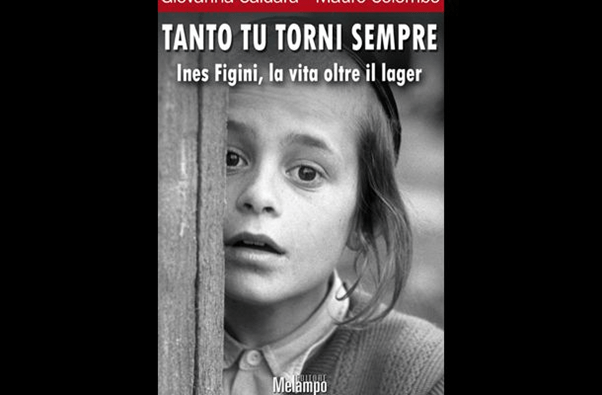
Cover of the book recounting Ines’s story – the title is taken from a phrase often used by Ines’ mother.
Ines had always clung on to the belief that she would make it home and it was maybe a degree of luck but also the strength that came from this belief that saw her through the hellish experience of slave labour. But one cannot go through witnessing and living through all the inhumane horrors perpetrated in the concentration camps without suffering a profound mental impact. Many aspects of life returned to normal; Ines went back to work at the Tintoria Comense (subsequently known as Ticosa) eventually retiring as the firm’s fortunes waned. Yet she still had to come to terms with the mental impact of her hellish experiences. After a few years of work, Ines found that the best way to deal with the mental anguish was to return to Birkenau annually for as many years as possible. She found these visits helped exorcise the damage of her painful memories. She also began to forgive those who had deported and imprisoned her – the various sadistic guards she had encountered or the distant unfeeling officers and politicians who delighted in establishing such an inhumane and cruel regime. She forgave them primarily because she could not bear to carry inside the weight of all her rancour. Forgiveness was essential for her own mental well-being.
She was also persuaded by the historians at Como’s Institute for Contemporary History to recount her experiences to groups of schoolchildren. Whilst initially uncertain about this for fear of either a lack of student interest or of her ability to convey the true horror of life in the Nazi concentration camps, she was soon reassured of both the children’s interest and also of the power of her personal testimony of the atrocities she had experienced and witnessed.

Ines with schoolchildren from Cantu.
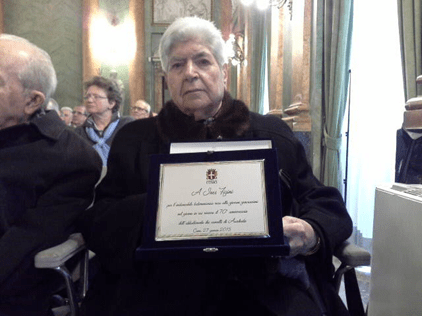
Ines is still with us and still telling her story. The link here is to a video of her recounting her experiences as part of a ceremony held in her honour last year at Como’s town hall. The video is in Italian as is the book written of her experience entitled ‘Tanto Tu Torni Sempre’ written by Giovanna Caldara and Mauro Colombo and published by Editore Melampo. Back in 2004 she was presented with the award of Commendatore by the then President of the Italian Republic, Carlo Azeglio Ciampi, on his visit to Como.
Maybe it was a degree of naivety that got Ines into trouble that fateful morning on 6th March 1944 but if so, it was a naivety that stemmed from an inborn sense of natural justice and humanity – qualities shown also during Ines’s prolonged incarceration as when she took a great personal risk to visit and comfort Ada Borgomainerio as she lay isolated in the Auschwitz-Birkenau Hospital. Ines’s story is not a testimony to courage in confronting an inhumane ideology through political ideals, nor to the altruism of someone driven by a morality arising from religious conviction – it is though a story of personal courage, fortitude, of someone able to retain the optimistic hope of a better future, of a time when the perverted values of war and oppression would finally be replaced by a return to civility and respect for all humanity. Before long we will lose direct contact with those who lived through the Nazi concentration camps so let us take these final opportunities to express gratitude for their willingness to share what they can for the good of all of us.

Ines receives her award from then President of the Republic, Carlo Azeglio Ciampi.

Sasso Gordona by Rifugio Prabello and the Linea Cadorna above Schignano
What can raise folklore festivals beyond the quaint and well-intentioned in modern times? What about days of misrule, disorder, transgression, role reversal and a general set of fooling – as can be experienced through the normally tranquil streets of Schignano at carnival time.

Schignano

The Mascarun parade alongside the Brut in the Schignano Carnival
Maybe it is this town’s setting below the impressive Sasso Gordona and above Argegno and Lake Como that has preserved this town’s tradition of a yearly anarchic rite with its full set of pantomime-like characters in their own set of costumes and masks.
The Schignano Carnival is unique, and whilst well-known in Lombardy, deserves a much wider reputation since this is true interactive street theatre at its pagan best without any hint of commercialism or sanitation.
Whilst the carnival represents a spirit of true anarchy, it does have structure with the yearly re-enactment of a perennial battle between order and disorder, beauty and ugliness, the rich and the poor. The battle has its own cast of characters whose parts and costumes have been interpreted down through the years.

The 2 Sapeur and the Sigurta (explained later) head the Carnival Procession through the streets of Schignano

Brut – the poor, ugly, feckless carnival character in rags and wooden mask
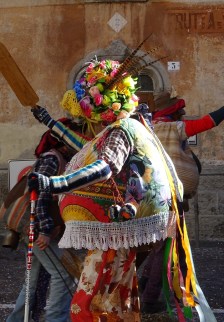
The naughtiest of these characters, and those who seem to have the most fun, are the ‘brut’ (the ugly). They dress in rags and sackcloth with grotesque wooden masks and armed with whatever might be used to aggravate the crowds. Some carried battered suitcases which were opened in parody of travelling salesmen. One character paraded with ‘his’ own torso placed within a picture frame as a living personification of Dadaism. Another tended to lunge at onlookers’ private parts with a pair of coal tongs.
The ‘brut’ had their weaknesses though. They could not sustain their fooling, which after all required lolling about with heavy cow bells slung around the waist, without falling into the occasional catatonic torpor lying down prone on the street. After all, they do not just represent the poor as ugly, irresponsible and feckless but of course, they are also inherently lazy!

A Mascarun – the rich, sophisticated and beautiful players in the Schignano Carnival.
Now enter the Mascarun also known as the ‘Beii’ (the beautiful) to give a disdainful prod at the catatonic brut. Whilst the brut’s gait is a type of lollop, the Mascaroon walk in a parody of style and grace to show off their finery and sophistication, yet all also behind a grotesque mask and with their waists also ringed by cow bells.
The Brut tease and aggravate the Mascarun as well as pinching and lunging at the onlookers. The Mascarun remain aloof as befits their rich status standing proudly sporting their gargantuan girths.
As the general air of expectation increases prior to the start of the procession, the anarchy increases as the traffic police try to keep the traffic flowing. The Brut are no respecters of traffic police or for the potential danger of a moving car. What does a traffic policeman do as his efforts to clear a traffic jam are thwarted when two ‘torporised’ Brut collapse onto the road directly in front of him? What does the driver do as two other Brut open the passenger doors and blast away on the car’s horn and rub the driver’s face with a rag of wet fur? At this stage, the policeman becomes part of the performance going beyond himself by acting a person thwarted by the force of anarchy from performing his essential function.

A Mascarun poses at the junction managed by a stressed traffic policeman.

A brut forces his way into a car with suitcases

A brut falls into torpor in front of a queue of cars
Such disorder cannot go on forever and so, with the start of the procession through the town’s streets, enters the figure of authority – the Sigurtà (see above).

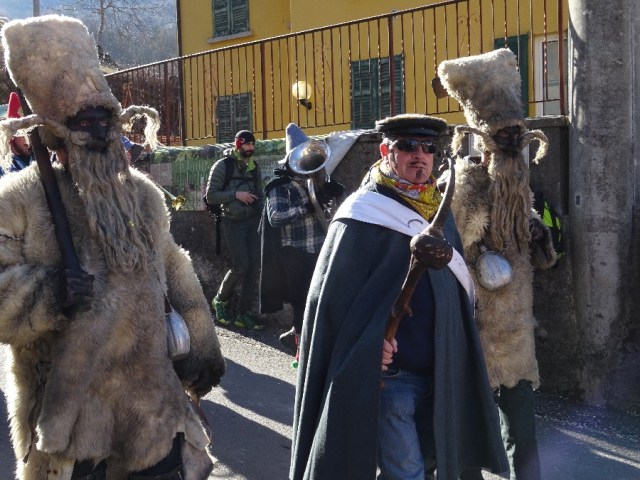
The Sapeur provide an escort for the Sigorta, dressed in sheepskin and wielding a heavy axe.
He is maskless, with a neat moustache and beard wearing a sash denoting his role just like modern day Italian mayors (sindaci). The Sigurtà has his own escort consisting of two massive characters called the ‘sapeur’. They also are without masks but with blackened faces, dressed in sheepskin with splendid sets of sheeps wool whiskers, and armed with heavy axes.
Who has brought about all this misrule? A character (straw man) who remains propped up high on the balcony overlooking the main town square until the end of carnival. This is the Carlisepp who surveys from his vantage point all the chaos below him until he himself will be chased around the town and then burnt on a bonfire at midnight as carnival comes to an end and the forces of disorder are dispelled for another year.

The Carlisepp – the figure responsible for all the misrule who will however be put to flames at the end of Carnival.
Some of this may all be a little scary for the younger children but it’s a whole lot more fun for adults than the anodyne processions of Disney, Spiderman or Toy Story characters who meaninglessly parade through many Italian cities for Carnival. Schignano is noisy, genuine and fun where we all can relish in the freedom offered by a few hours of true anarchy in, of course, the amazing mountain-side setting overlooking magnificent Lake Como.

Lake Como from Schignano with the Sanctuary of Sant’Anna in the mid ground.

Sormano in the Vallassina seen from the Muro di Sormano
The Vallassina lies in the Lario Triangle between Como and Lecco, based on the town of Asso on the upper reaches of the River Lambro. From September to December 1943 this area hosted numerous refugees from the nazi-fascist state thus witnessing the humanity and inhumanity, the heroism and the disaster caused by the Holocaust.
The armistice signed at the start of September between the Italian government (which had dismissed Mussolini from power back in July) and the allies legitimated the allied occupation in Southern Italy but increased the oppression in the north. Here the Nazis immediately occupied the territory and re-established Mussolini as head of a puppet government known as the RSI (‘Socialist’ Republic of Italy). The short-lived elation created by the armistice was followed by a ratcheting up of repression and the loss of any remaining hope of safety for all of the foreign Jews who had mostly been held in internment since 1940. Now there was no barrier to them being deported to the extermination camps in Eastern Europe. And to their numbers were added all Italian Jews in the occupied zone who now also became subject to arrest and deportation following an order published by the RSI on the 1st December 1943. Thus from this date the Italian Nazi-fascist state acted out its inhuman ideology through its direct involvement in the Nazi Holocaust.

Monte San Primo (1600m), the highest of the Pre-Alp peaks in the Lario Triangle
The Vallassina was a natural choice for refugees and those seeking to avoid the attention of the authorities. Firstly it was readily accessible by train from Milan (an advantage that proved short-lived since the ease of access also favoured the Nazi authorities). As a holiday destination in the foothills of the Alps, it offered a variety of accommodation in hotels or in many of the second homes owned by those beginning to form part of the active resistance to occupation. Lastly, it was on a route to the clandestine border crossing points into neutral Switzerland that were well known and frequently used by local smugglers (see Como and Contraband – A Romanticised Legacy? for more on the local smuggling tradition).
Alongside the refugees, some initiatives of spontaneous resistance began to take shape in the area; for example the ex-army officer Colonel Gatta set up a partisan brigade based on the Pian del Tivano right by Sormano.

Pian Del Tivano where some of the first armed partisans in Alta Brianza gathered under the leadership of Major Gatta.

Ada Tommasi and Mario de Micheli were two nationally renowned communists who sought refuge in Sormano and organised ‘viaggi della salvezza’ from there for Jews throughout the Nazi Occupation.
This group in turn connected with the partisans in the Erba/Ponte Lambro area led by Giancarlo Puecher. The CLN (Comitato di Liberazione Nazionale), the organisation responsible for coordinating resistance in the north, set up links through the Vallassina for smuggling out ex-allied prisoners of war. Others such as the communist married couple Ada Tommasi and Mario De Micheli, came to Sormano living there secretly and aiding Jews in making their escape into Switzerland.
The Catholic organisation known as OSCAR was also beginning to co-ordinate the assistance to refugees along the so-called ‘viaggi della salvezza’ offered by priests and parishioners living in the border areas.

Don Carlo Banfi, Priest of Sormano 1943 – 1945.
The young priest of Sormano, Don Carlo Banfi, was one who spontaneously set about offering help to those who had arrived on his doorstep seeking safety. He hid and housed Ada Tommasi and Mario De Micheli in the basement of his vicarage. He joined them in organising escapes into Switzerland for Jews, ex-allied prisoners of war or other enemies of the state. These escapes were led usually by the local smugglers who had detailed knowledge of the clandestine crossing points. These clandestine routes were becoming vital since the Nazi authorities had quickly blocked off the official crossing points in Varese and Como. The Swiss authorities had also closed the border in response to the Nazi occupation.

Sormano and the parish church at the time of Don Carlo Banfi. Taken from a postcard in a private collection produced by Edizioni Prato Bambina, Sormano
However, as summer turned to winter in November 1943, these guides reported that the crossings were becoming dangerous due to the cold. Don Banfi wanted to check this for himself and so he decided to join the next planned evacuation. All went well. The refugees had gained safety across the border but Don Banfi was detained by the Swiss Border guards and warned that he was committing an offence in crossing the border secretly. However they allowed him to return home on this occasion. Back in Sormano, a much larger group of Jewish refugees were awaiting safe passage and they were under time pressure since the Nazi authorities were every day securing control of more of the territory. There were even rumours that they planned to parachute troops into the Pian del Tivano to deal both with the partisans forming there and the clandestine refugee traffic. Don Banfi had no time to make proper preparations for this next journey into Switzerland. Instead he left on November 22nd hurriedly leading a group of 16 Jews which included both some young children and some elderly who would face real difficulty in managing the exhausting two-day journey of mountain climb and descent by foot.

Don Banfi would probably have led his group up this path leading to the infamous Muro di Sormano now renowned as one of the steepest ascents on any road cycling race.
Don Banfi set off on this dangerous journey with 3 accomplices in addition to the group of 16 refugees. Along the way they received help from the country people working in the woods and, when they finally reached the border, from the Italian Customs Police (Guardia di Finanza) who directed them to avoid military patrols and pointed out where best to cross the border fencing. More detail of the heroic role played by the Guardia di Finanza in assisting refugees is reported in our article Como’s ‘Viaggi della Salvezza’ – In Memory of the Holocaust.

Pian del Tivano – the escapees would have got their first glimpse of Switzerland as they entered the Pian del Tivano after descending from the Colma del Piano at 1120m.
The route had taken them from Sormano on to the Pian del Tivano and down to Nesso. They then had crossed the western leg of the lake to get to Torrigia, staying the night at an inn before crossing over to Switzerland along the border by Mount Bisbino – a long and arduous two-day journey which had left most of the group totally exhausted by the time they had crossed over into Switzerland.

Orrido di Nesso, a welcome sight after the long climb and descent to the lake.
Most were unable to walk any further down into the valley. Don Banfi and his accomplices reported to the Swiss border police advising them to bring down the exhausted refugees to safety. He however could not avoid arrest this time but received a lenient sentence partly thanks to the intervention of the Archbishop of Lugano who also passed on to Don Banfi the advice he had received from the Archbishop of Milan, Cardinal Schuster, stating he should not in any way attempt to return into Italy since the Nazi-fascist authorities were seeking harsh retribution. So Don Banfi remained in Switzerland working as a chaplain in internment camps until the war ended.
But back in Sormano, the retribution and repression was mounting. In spite of this, many of Don Banfi’s parishioners and the husband and wife team of Ada and Marco De Micheli continued to assist refugees. They were unable to save all Jews as the authorities increased their control over the territory. A local inhabitant, Liliana Picciotto Fargion, has provided testimony documenting the names of those Jews arrested in Sormano at around this time and subsequently deported to extermination camps. None of those listed below were to survive. Their names have been listed here out of respect for their sacrifice and to illustrate how the disaster of the Holocaust directly impacted Italy under the Nazi-fascist regime of the RSI.
Oliviero Ruggero Barda was arrested in December 1943, sent to Auschwitz, killed on 25th September 1944. Salamone Barda and Renata Hannuna, were arrested together also in December 1943, sent to Auschwitz and subsequently killed on 10th April 1944. Simeone Barda, also arrested in December 1943, sent to Auschwitz, with date of death unknown. The married couple Alessandro Bardavid and Violetta Pontremoli were arrested 13th March 1944, sent to Auschwitz. The date of their death is unknown. Elia Bardavid was arrested along with her parents on the 13th March 1944, also sent to Auschwitz, killed after 22nd January 1945.
The younger daughter of the Bardavid family, Graziella, was saved since she had been entrusted to a married couple living in Asso named Maria Bonaiti and Giuseppe Mazza. Both Maria and Giuseppe were awarded the title ‘Just Among Nations’ in 1998 by the Israeli organisation Yad Vashem.

This medieval bridge at the foot of the Orrido di Nesso as the river enters the lake would have marked the end of the first day’s gruelling ‘viaggio della salvezza’ for Don Banfi’s party of 16 Jewish refugees.
Reward with the title ‘Just Among Nations’ was also conferred on the communist couple, Ada Tommasi and Mario De Micheli as well as on Don Carlo Banfi.
Don Carlo Banfi was also honoured with the Gold Medallion in 1955 by the Union of the Italian Hebrew Community. He returned to Italy after the war and took up the priesthood in Varese until the 1970s. He is an unsung hero whose impact went well beyond his deeds through the example of moral and physical courage he provided to colleagues and parishioners alike. Thanks to his example, other locals were inspired to maintain their humane values and to continue providing assistance to evacuees wherever possible in spite of the threats and acts of state retribution. For me what I find the most inspiring is his willingness to work alongside whoever had a humane spirit irrespective of their political or religious affiliations. This attitude, exemplified by people such as Don Carlo, was apparently briefly but gloriously shared by many during those years of resistance and its spirit dominated the positive collaboration across ideologies in the drafting of the constitution after the war.
The sources of information for this article came from the research undertaken by the Istituto Di Storia Contemporanea ‘Pier Amato Perretta’ based in Como and to the publication issued by the Sormano Comune, the Sormano Alpine Group and the Parish of Saint Ambrogio entitled ‘Don Carlo Banfi: Un Eroe Sconosciuto’.