Fairy Tales, Wanderlust and Landing in Como

Sonja portrait

Sonja Christoph, artist, illustrator and recently arrived new resident in Como.

It must be more than coincidental that so many creative people like Sonja Christoph are drawn to live in Como – the city nominated unanimously back in June by Italy’s UNESCO committee to form part of UNESCO’s ‘Network of Creative Cities’. She herself was unaware of Como’s creative designation, nor necessarily of its astounding recent achievements in art, architecture and both furniture and textile design. But as an art illustrator with a passion for folk tales and fables and as a wife and mother committed to fostering the creativity of all of her family members, it’s as if Como’s spirit and location called her here to join the ever-growing number of local foreign residents involved in the arts.

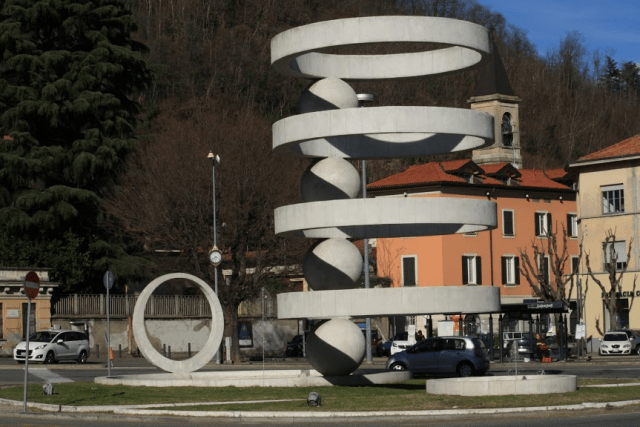
fonte di camerlata

The Ca’Merlata Fountain designed by Rationalist architect Cesare Cattaneo and Abstract artist Mario Radice is a fitting entry from Milan to the creative city of Como.

I initially contacted Sonja, who only arrived in Como back in August, once I became aware of her work as an illustrator, knowing that all us ex-pat immigrants have a story to tell. Her road to Como started as a form of wanderlust overcame her as a ‘teenager’ living with family in Florida.

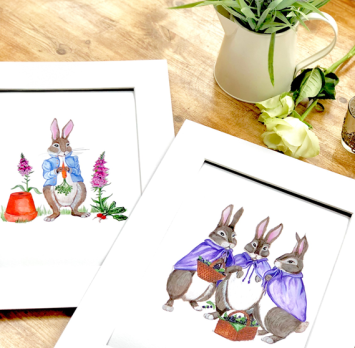
artwork sample

Examples of some of Sonja’s illustrations of children’s stories. © Sonja Christoph

Her family combines links with Norway on her mother’s side and with Germany from her father.  So off to Germany she went to live initially in Heidelberg and subsequently for the next ten years in Munich where she completed a Masters degree in Comparative Literature and met her future husband, Alessandro Vannini, British by birth but Italian by upbringing. They then moved to London where Alessandro took up the prestigious post of Vice Director at the Institute of Cancer Research. It was however the birth of their son, Cristian, that prompted Sonja to develop her artistic career – not primarily for economic reasons but out of a desire to give her son a magical environment in which to enrich and preserve his inherent creativity.

big bad wolf

Little Red Riding Hood. ©Sonja Christoph

As part of her studies into comparative literature, Sonja had been attracted to the theories of child psychologist Bruno Bettelheim concerning the critical role played by fables and fairy tales in children’s emotional and creative development. He postulated how fairy tales and fables, sharing a high degree of thematic universality, seem to provide the means for young children to make sense or manage some of their emotions and reactions to the world around them. She then thought that the best way to maximise these emotional benefits would be to work on illustrating the stories since these would provide a pre-literate child with a stimulus for further reflection and a context for sharing their feelings and reactions.

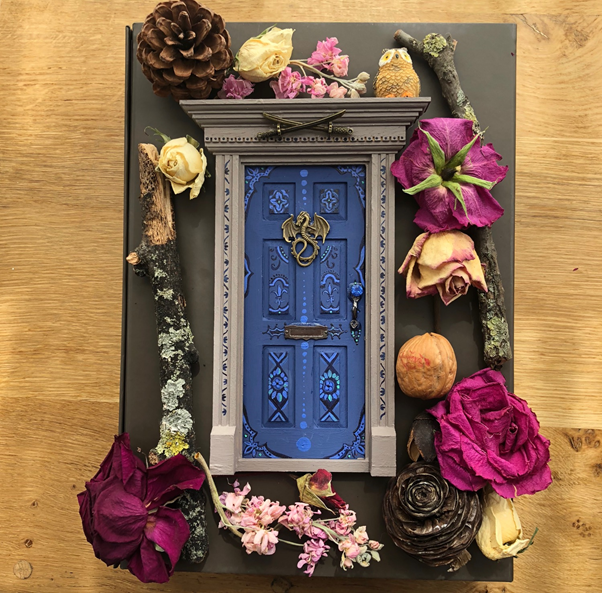
Fairy doors

A ‘fairy door’ personalised art object made to commission.

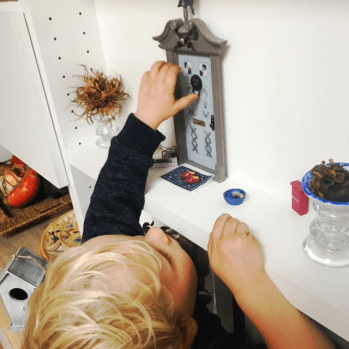
Fairy doors 1This was the starting point for her career as ‘Sonja Illustrates’ which developed from the illustrations on the walls of her son’s room to a series of commissions for other families and the production of a unique child-centred art product known as ‘fairy doors’. The latter combine Sonja’s skills in art and illustration with calligraphy and, applying her literary background, with a series of suggestions for adults on how they might best use the imagery on the doors as gateways into their children’s fears and thoughts


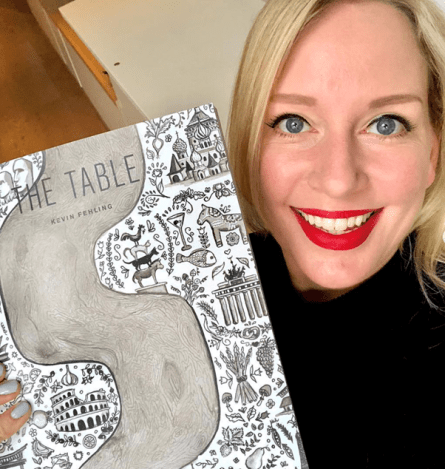
Meanwhile, in the ‘free Hanseatic City’ of Hamburg, Kevin Fehling, the highly successful chef of the city’s 3 star Michelin restaurant ‘The Table’, had commissioned Sonja to provide illustrations in four editions of his in-house magazine.

The Table

Sonja with her cover design to kevin Fehling’s in-house magazine ‘The Table’.

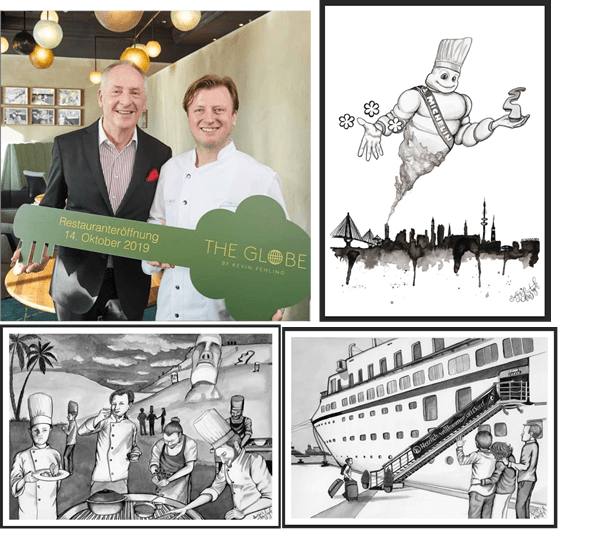
He also turned to her when thinking about the decor for his next project, a restaurant known as ‘The Globe’ aboard the MS Europa, the only cruise liner to achieve a 5 star plus classification. Reading Kevin’s biography one can appreciate why he selected Sonja to design a series of drawings to fill the restaurant’s rear wall. His type of cuisine seeks to exceed any standard expectations of creativity. He must want his customers to both approach and react to his culinary experience with an open-minded almost childlike sense of wonder and amazement. After all, his clientele are for the most part exceedingly wealthy, very demanding, accustomed to luxury and most probably nursing jaded palettes. So what could be more refreshing for them than to be transported back into a sense of innocent discovery combining his cuisine within the packaged ‘wanderlust’ of an ocean cruise.

Kevin Fehling montage

A montage of Sonja’s illustrations for Kevin Fehling’s restaurant ‘The Globe’ on board the MS Europa

Kevin himself has stated how he took on the opportunity of establishing a ‘roaming’ restaurant as a reflection of his own sense of wanderlust which for him he has described as ‘like homesickness but only worse.’ His somewhat oxymoronic comparison seems to capture part of the ex-pat’s dilemma – a love of travel and enlarged experiences but a loosening of roots and fixed coordinates.  Many of us ex-pats including Sonja have upped anchor numerous times. Kevin Fehling’s The Globe restaurant itself upped anchor aboard the MS Europa for the first time this October with Sonja’s illustrations helping to feed Kevin’s clients with a sense of wonder and adventure.

Food, travel and adventure

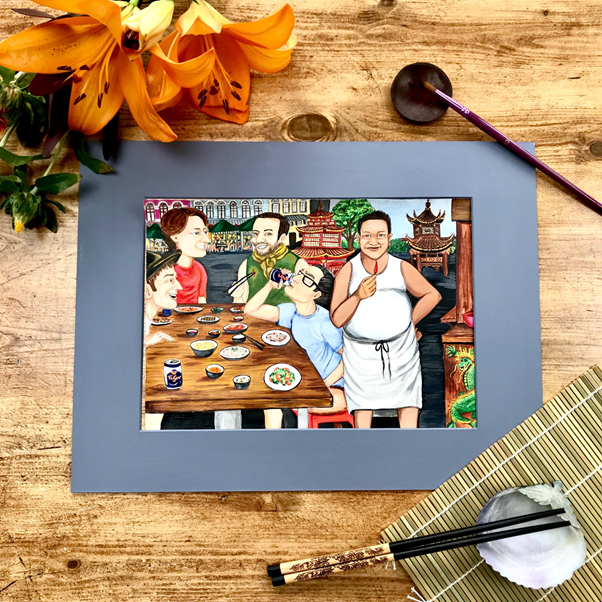
Food, travel and adventure ©Sonja Christoph

So what were Sonja’s first impressions of Como? On the positive side, she was delighted to find herself within a short walk of that great art supply shop on Via Milano so no excuse to getting that key commission from Kevin Fehling out the door. However this major commitment was not helped by an irritatingly long delay in getting Internet installed at home. Italy would not be Italy if there were not at least ‘one or two flies in the ointment’. But, in spite of long exposure to German efficiency moderated to some degree by her spell in London, she is adapting stoically to that uniquely Italian sense of customer service. Notwithstanding Sonja’s fascination in fable and fantasy, she struck me as being a total realist well aware of the need to confront and overcome the intimidating aspect of moving to a country where many of the norms and customs are new to you.

London

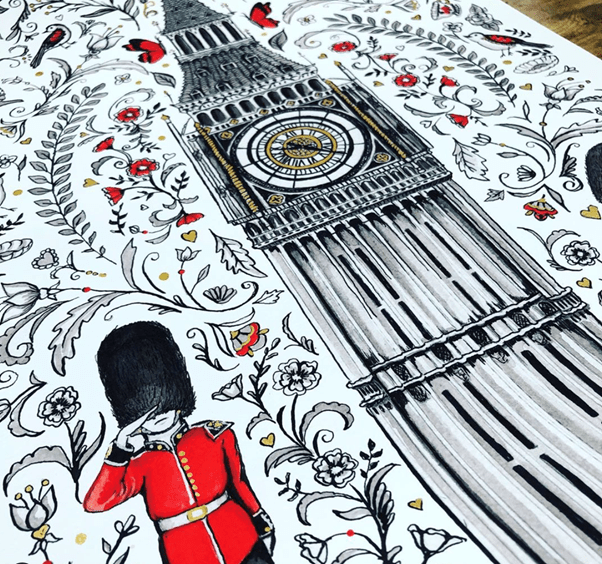
London ©Sonja Christoph. 

The size of cities count. After her years in London where it seemed you remain anonymous no matter how long you live in a neighbourhood, she is happy that both she and her son are now readily recognised and greeted in their local area. Como is still a city of human dimension, but with the additional extraordinary gifts of nature to its north and, if required, the cosmopolitanism of Milan to its south. For now, Sonja has had to return to driving getting Cristian to and from school, to which he has adapted well. Husband Alessandro takes on a highly ambitious and significant role as the Director of Research at the Human Technopole – the state-sponsored project occupying the ex-EXPO site in Rho which aims to re-position Italy as an international leader in life sciences. Sonja continues to foster the creativity of all her family members and, of course, to illustrate.

Fieramilano Rho

Fieramilano at Rho, the site of Expo Milano 2015 and now the headquarters of the Human Technopole

Do visit Sonja’s Internet site to see more examples of her work, for further biographical detail and a very much more accurate and complete understanding of the theoretical basis of her approach.

Her full social media links are:

Internet:  www.sonjaillustrates.com

Facebook: https://www.facebook.com/sonjaillustrates/

Instagram: https://www.instagram.com/sonjaillustrates/

Twitter: https://twitter.com/SonjaChristoph

Also visit  https://www.htechnopole.it/en/home to understand more about what brought Alessandro, Sonja and Cristian to Italy and to appreciate the immensely ambitious scale of this major state-sponsored initiative.

Como Companion has always taken an interest in Como’s artistic tradition, and in both her local and immigrant contemporary artists. The following links may be of interest:

ugly duckling

©Sonja Christoph

Sarah Aller: Como’s New York Artist in Residence

The Como Group of Artists – ‘Astrattisti Comaschi’

Ester Maria Negretti – Como’s ‘Traditional’ Contemporary Artist

Ice Cream and Vespas: Irma Kennaway’s Artistic Odyssey

The Poetry and Joy of Urban Portraiture – Adriano Caversazio

Campo Urbano – Public Art in Como 1969

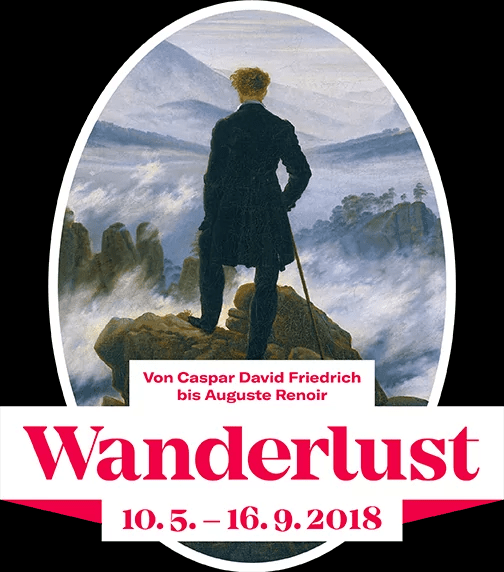
Wanderlust


Posted in Art, Culture, People, Uncategorized | Tagged , , , , , , , , , , , | 1 Comment

Campo Urbano – Public Art in Como 1969

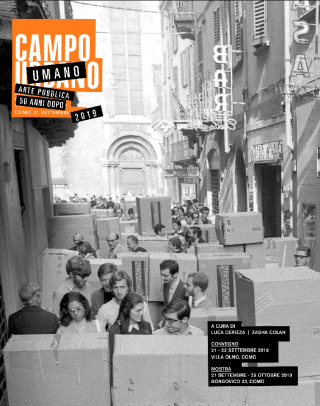
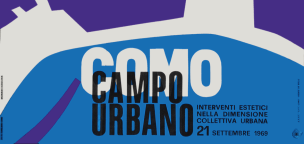
Poster

Poster advertising the recent convention and exhibition commemorating the 50th anniversary of Campo Urbano.

This September 21st was the 50th anniversary of a cultural event known as Campo Urbano – a ‘happening’ held over a single day on the streets of the historic city centre. The anniversary has recently been marked with a conference in Villa Olmo, the dedication of the display space in the town’s art gallery to one of the event’s art installations by Ugo La Pietra and an ongoing exhibition of some of the ephemera associated with the event in the de-consecrated church on Via Borgo Vico 33. This year’s Streetscape exhibition of public art installations running from October to November is also dedicated to the memory of this one day precursor to all subsequent public street art in Como.  Many of the original contributing artists are still with us and some of them, including Ugo La Pietra, were present at a commemorative meeting at the Pinacoteca to review the impact of that single day 50 years ago. 

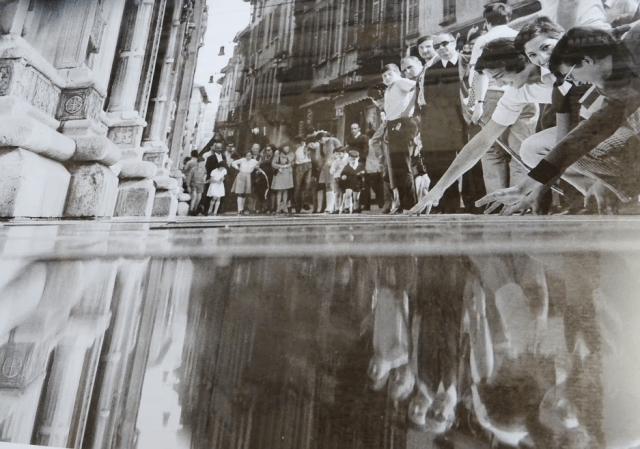
Mirroring the Duomo

Campo Urbano’s subtitle was ‘Aesthetic Interventions within a Collective Urban Context’. This installation was called ‘Riflessioni’ consisting of mirrors at the base of the Duomo

Via Cinque Giornate

Via Cinque Giornate named after the rebellion against Austrian rule in 1848.

All of these events made me gradually aware that Como’s Campo Urbano deserved some closer attention. It was an event still within the living memory of those of my generation in that exhilarating but brief period of youthful political and intellectual idealism which seemed to mark a release from the grey austerity of the post-war years. Como was (and perhaps still is) rather conservative politically and its youth did  not catch the revolutionary fervour until a year after the street demonstrations in Paris, May 1968. This is in spite of the city’s enthusiastic participation alongside Milan and Brescia in 1848 – a fundamentally revolutionary year across Europe. 

Como’s Artistic Tradition

If slow to revolt politically, Como was about to reveal itself again as a national or even international leader in the artistic world since Campo Urbano was pure innovative cultural agitprop. Como had established itself from the 1920s onwards in the vanguard of Italy’s plastic arts with the Futurist theories of Antonio Sant’Elia, the work of rationalist architects such as Giuseppe Terragni  and abstract artists like Mario Radice, Manlio Rho and Carla Badiali. Our previous article on the these so-called ‘Astrattisti Comaschiexplores the extent of their phenomenal success and poses some reasons as to why such international talent came to be concentrated within this provincial city.

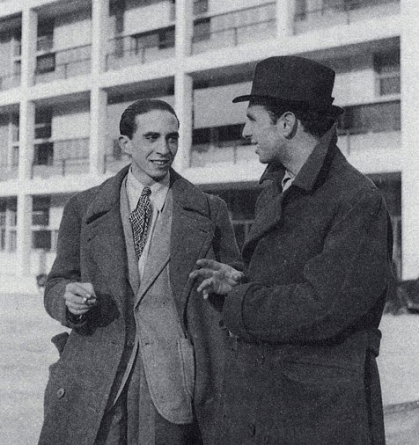
Ico Parisi

A young Ico Parisi (our left) in front of Giuseppe Terragni’s Casa del Fascio.

They had established a cross-fertilisation and integration of ideas uniting the disciplines of fine art, architecture and design. These talents, combined with exposure to international trends through galleries in Milan and links with Paris, put them at the forefront of artistic developments and gained them a massive national reputation. So much so that a next generation of architects, artists and designers decided to make Como their home. These included Ico Parisi who moved from Palermo to come and work in the studio of Giuseppe Terragni. He in turn worked with artists such as Mario Radice and another Como resident sculptor, Francesco Somaini to combine all three disciplines in ground-breaking buildings such as the Casa Bini on Monte Olimpino. Another artist, Giuliano Collina had also moved from Liguria to base himself in Como. Parisi, Somaini and Collina were to become key contributors to Campo Urbano. 

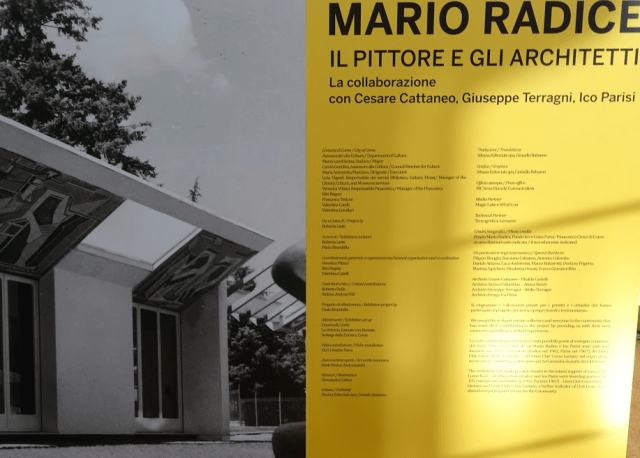
Art and architecture

Poster advertising the exhibition of Mario Radice’s collaboration with architects showing part of his mosaics on the exterior of Casa Bini, designed by Ico Parisi and also including sculpture by another Campo Urbano contributor, Francesco Somaini.

The Demonstration

What interested all of this next generation of artists was the possible impact their disciplines could have on revitalising the living environment in both public and private spaces. However they needed the inspirational leadership of another Como resident, the art and architecture critic Luciano Caramel, to organise Campo Urbano as a living manifesto of their ideals. This is how Fabio Cani, local Como historian and principal editor of Como’s publishing house Nodo Libri, describes the event:

‘Sunday 21st September 1969 some areas of the centre of Como were transformed by an unusual group of artists (mostly from Milan, but with a core of support and inspiration from Como) driven by fantasy and a desire to shatter the complacency of a provincial city. This was ‘Campo Urbano’.

He goes onto describe the uniqueness of the occasion as a mix of artistic activity, protest, exhibition and demonstration. It was essentially one of the most influential acts of public artistic and architectural agitprop, and even though similar events had arisen out of the atmosphere of 1968, Campo Urbano’s significance was in the quality of its organisation and the clarity and force of its message. 

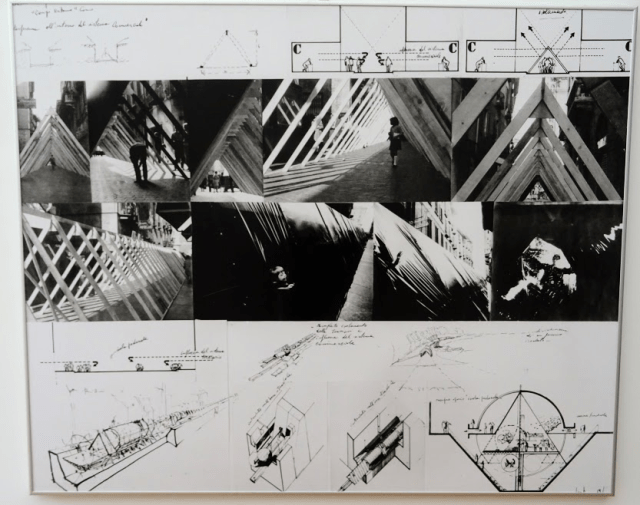
Ugo La Pietra design

Ugo La Pietra’s designs for his installation of an enclosed tunnel along Via Vittorio Emanuele. La Pietra is an artist, architect and designer.

A catalogue of the event entitled Campo Urbano: Aesthetic Interventions in a Collective Urban Dimension, with photographs by Ugo Mulas and illustrations by graphic designer Bruno Munari, was published later giving the event a prolonged afterlife and providing scope for future academics to analyse its social as much as its artistic significance. 

Logo


The main installations of the day are here described by Romy Golan, Professor of Twentieth Century Art at the City University of New York:

‘laundry hung on clotheslines across the Piazza del Duomo by Gianni Pettena, which brought the unsightly qualities of Italy’s impoverished peripheries to the city center; a wooden tunnel covered with black plastic in order to obstruct a main commercial street, by the architect Ugo La Pietra; mirrors lining the foot of the Gothic Duomo, by the architect and conceptual artist duo Mario Di Slavo and Carlo Ferrari, which created myriad reflections that unhinged the city’s most familiar monument; an invitation to the public to release pieces of folded paper from a nearby medieval tower by Munari, as an attempt to ”visualize the air”; and, finally, an artificial storm by the Paduan and Milanese collectives Gruppo T and Gruppo N, who enlisted local firemen and electricians to simulate falling rain and lightning with synchronized loudspeakers and projectors. Nothing could be more “presentist” than this.’

Fabio Cani describes the locals reactions to the event as either ‘shocked or fascinated, prompted to discussion or just disgusted, unable to comprehend and turning their backs on it or getting fully involved.’ 

Interaction at Campo Urbano

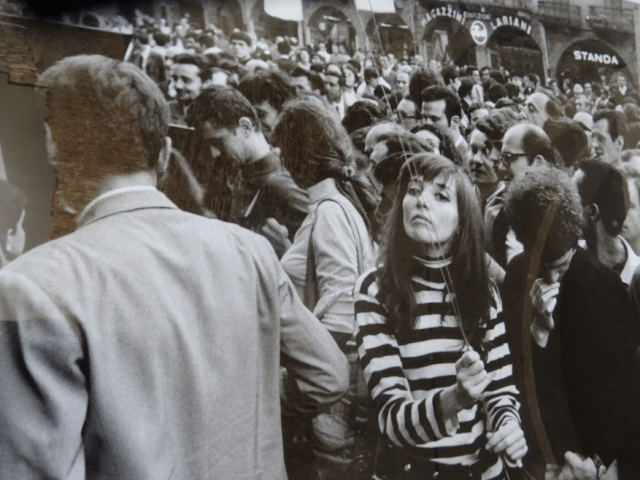
Crowds interact with the installations in Piazza Duomo in September 1969

However much the day’s event has subsequently been discussed, its original purpose was fairly modest, namely to stage exhibitions not in a gallery but in a public urban context alongside people who had not elected purposefully to attend or participate but were just going about their everyday lives. Simple though this now sounds, it was at the time revolutionary, iconoclastic and an idealistic act of civil protest. Like May 68, it was inclusive and egalitarian and about liberation from creative constraint, conformity and social convention.

End of A Dream

Ico Parisi art

Surrealist painting by Ico Parisi in the Pinacoteca di Como.

Campo Urbano was held in the September that  followed on from Como’s first student protests in January 1969 – well after Paris in May 1968. Its importance in the collective memory may well be influenced by this particular timing since in retrospect it seemed to reflect the end of a brief youthful period of idealistic hopes and expectations. Soon after protests on both the extreme left and right were to rapidly degenerate into acts of terror and assassination. The Neo-Fascist atrocity in Milan’s Piazza Fontana took place a mere three months later on 12th December 1969 killing seventeen and wounding eighty eight. So started the period of bitter terror-driven civil war that came to be known as the ‘anni di piombo’ – the years of lead. Alongside the victims in Piazza Fontana lay the innocent idealism of an entire generation nurtured on the humanist and egalitarian principles that had underpinned the work of those architects, artists and designers who had been defining an aesthetic for the post-war world. 

Como’s Artistic Heritage

Giorgio di Chirico

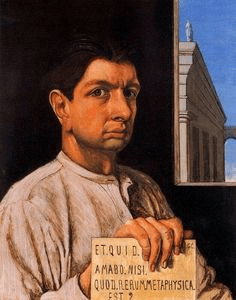
Self portrait of Giorgio de Chirico with a plaque whose inscription in latin reads ‘Et quid amabo nisi quod aenigma est?’. This phrase was placed on a banner spanning the Piazza Duomo by artist Giulio Paolini. The Latin translates roughly as ‘And what will I love if not what is enigmatic?’

For me, the ‘discovery’ of Campo Urbano prompted even further admiration  of how the small city of Como has been able to produce such a rich artistic heritage throughout the twentieth century. It was fascinating to see how a generation following on from Terragni, Badiali, Rho and Radice was able again to take a national lead in the areas of art, architecture and design. Thanks to this, I have begun to appreciate more profoundly the influence and importance of Ico Parisi and his wife Luisa, a furniture designer who trained in the studio of Gio Ponti. 

The 50s and 60s  generation of Como artists differed from their forebears who were for the most part self-taught. Instead they were mostly academically trained with the Brera Academy in Milan taking a leading role. Luciano Caramel even became Vice Director of the Brera Academy later in his career. But the work of that earlier generation had now become mainstream in the art schools and so artists like Atanasio Soldati, a student at the Brera Academy and founder of the Italian form of Concretism, could cite Mario Radice as one of his major influences. 

Campo Urbano’s Legacy

The long term legacy of that single day of artistic agitprop may not be so easy to discern from within our more atomised post-modern art world. It may well have brought about the annual Streetscape exhibitions of street art installations which are commissioned and placed so they refer in one way or another to their urban setting. However I believe Campo Urbano was about much more than that and in any case, even the idea of street art itself seems now to get compromised as installations acquire increasing monetary value. 

Parada Par Tucc

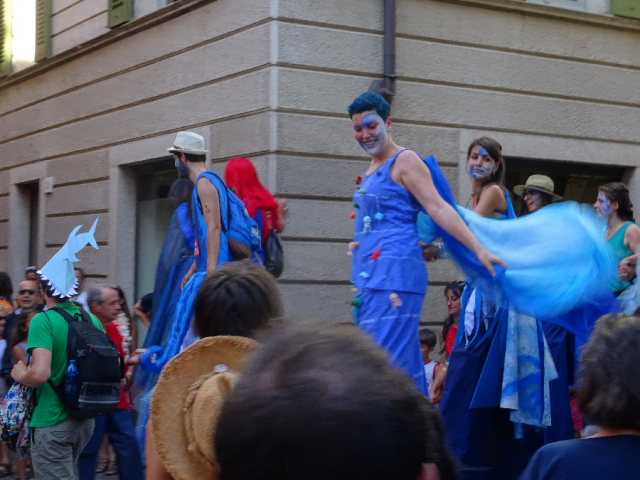
The Parada Par Tucc is an annual event held in June that reflects the spirit of Campo Urbano.

Romy Golan  described Campo Urbano as ‘the reorientation of contemporary art practices toward a dematerialisation of the art object and the extra-mural trespassing of the artifact into its surroundings.’   Her language points me to the danger that the more art objects ‘dematerialise’, the more dependent they become on ‘interpretation’ which in turn relies on textual descriptions that can be very obscure.  That may be one of those ‘unintended consequences’ of Campo Urbano.

Pratiqiamo

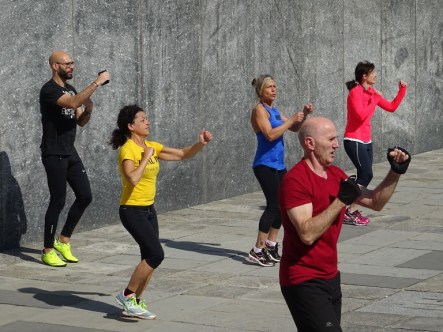
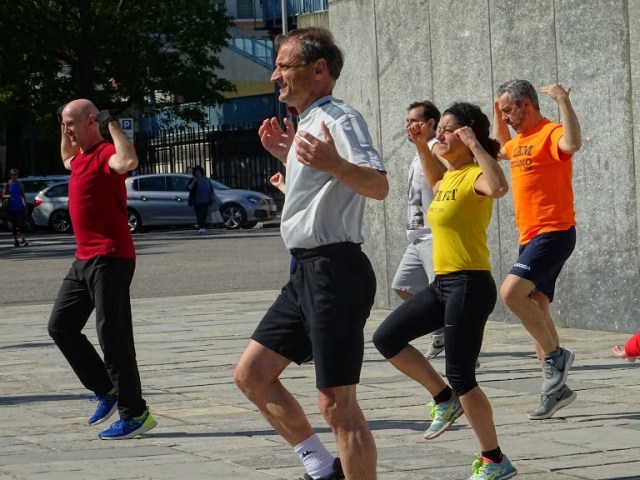
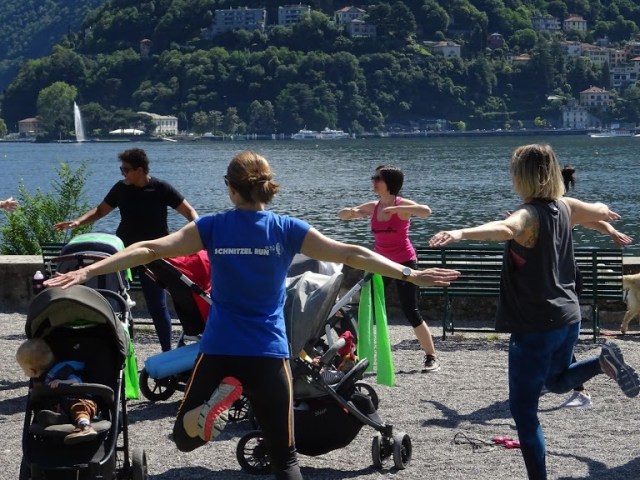
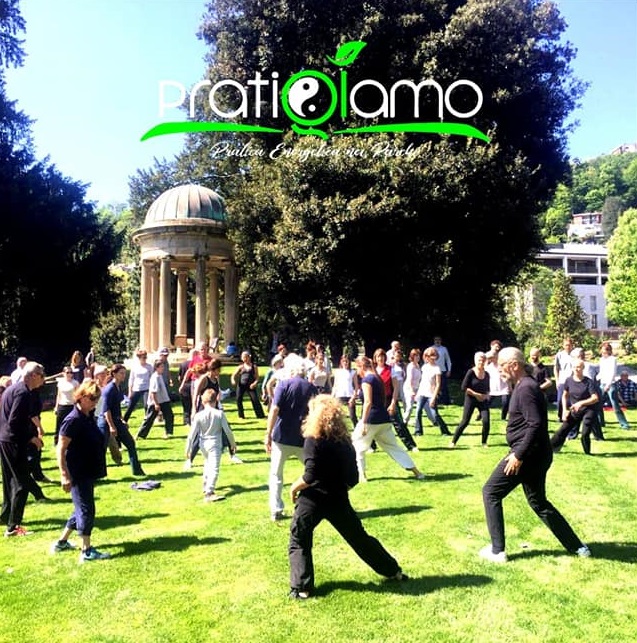
Pratiqiamo have also inherited part of the spirit of Campo Urbano with their social participation and aim of rejuvenating public spaces.

The legacy can also be seen in its social impact.  For example, its spirit is certainly present within the annual Parada Par Tucc.  This may be more street theatre than art but, now into its eleventh year, it is committed to giving visibility to the more marginalised citizens of Como with a strong belief in using art for social participation and inclusion. 

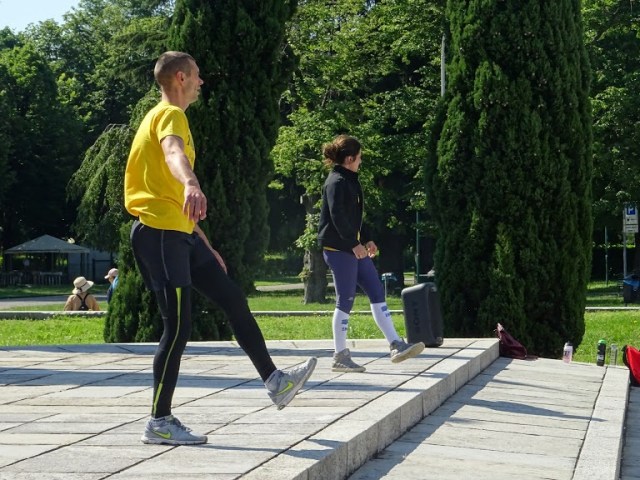
Another initiative in the spirit of Campo Urbano but directed entirely to wellness and physical activity is that organised by Pratiqiamo. They are robustly non-commercial, public spirited and inclusive. They are also dedicated to reclaiming public spaces.  For them, being outdoors and surrounded by nature is of primary importance hence their name Prati-Qi-Amo (translated as Fields-Qi Gong-I love) but also sounding like ‘pratichiamo’ – we practice. They like to locate their activities within Como’s different parks  and public spaces with the intention of reclaiming these as places for communal enjoyment. Some of Como’s parks away from the lakefront can be somewhat neglected and certainly underused. Pratiqiamo aim to assist the reintegration of these overlooked areas back into social urban life.  

Streetscape8

The Bull in Piazza Duomo signals the eighth edition of Streetscape Public Art which runs from mid-October for a month.

These two examples might be thought of as tangential to art and architecture but I believe they, and many other similar low-key events, reflect the social impact of Campo Urbano’s revolutionary act of bringing art out of the galleries. 

Cast of Characters

The Artists

Collina, Giuliano: b. Intra 1938 – . Artist. Studied art at Milan’s Brera Academy. He currently holds a chair in design at Como’s Galli Academy.

La Pietra, Ugo: b. Pescara 1938 – . Artist, architect and designer. Studied architecture at the Milan Polytechnic.

Parisi, Ico (Domenico): b. Palermo 1916 – Como 1996. Artist, architect, designer. Apprenticed to the studio of Giuseppe Terragni.

Mulas, Ugo: b. Brescia 1928 – Milan 1973. Photographer. Self-taught but frequented the Brera Academy and the nearby Bar Jamaica. Photographic chronicler of Campo Urbano.

Munari, Bruno: b. Milan 1907 – Milan 1998. Artist, graphic designer. Self-taught and apprenticed to Milanese studios. One of the original founders of MAC (Movimento Arte Concreta)

Somaini, Francesco: b. Lomazzo 1926 – Como 2005. Sculptor. Studied at Milan’s Brera Academy. Member of the MAC (Movimento Arte Concreta). Collaborated with Parisi and Mario Radice in creating Casa Bini, Como.

Organiser

Caramel, Luciano: b. Como 1935 – . Art and architecture historian and critic. Served as Vice Rector of Milan’s Brera Academy from 1979-1982

Further Reading

Blog describing Ico Parisi’s work as an architect.

Fabio Cani’s article in Italian on Campo Urbano.

Romi Golan’s article in English on Campo Urbano.

Urban Fields Blog – inspired by Campo Urbano with photos of the event and links to other sites of interest.

Movimento Arte Concreta

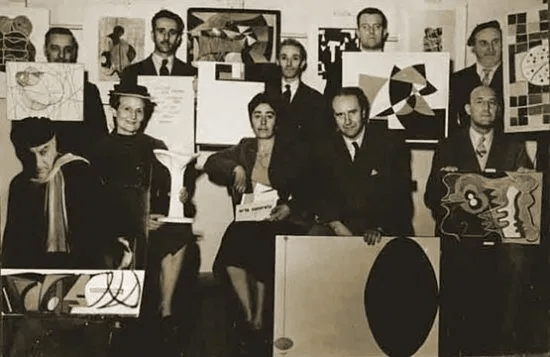
Members of MAC – the Movimento Arte Concreta – a development of abstractism well represented by artists from Como in the tradition of the famous ‘Astrattisti Comaschi’.

Posted in Architecture, Art, Culture, Events, History, People, Uncategorized | Tagged , , , , , , , , , , , , , , , | Leave a comment

Como’s Secret Gardens

Conservatorio

Courtyard and cloister of the ex-hospital Sant’Anna, now the Conservatorio di Como

On the weekend of 21st and 22nd September, those fortunate to be in Como can, for the price of €8, visit a whole series of secret gardens and courtyards within, and sometimes on, the old city walls. This very welcome initiative is called ‘Bellezze Interiori – I Giardini Segreti di Como’. An organisation known as TIKVA is to be thanked for this along with their partners, Como’s  Conservatorio music school and the cultural association Iubilantes.

Off Via Diaz

A courtyard off Via Diaz opposite the Le Soste restaurant – open to anyone with the curiosity to enter.

Anyone walking the streets in Como’s old centre must have peeked into the numerous courtyards or sought a glance through open doors onto the private gardens concealed within wishing they could only just step further into any one of these tranquil spaces so definitively separated from the tumult outside. Now, at least on this one weekend, we can.

The purpose of the Bellezze Interiori initiative is best left to the organisers to describe in their own words on their website but crudely translated by myself since the site is still under development. They say:

Bellezze Interiori is an ambitious project established to give public access to places until now known only to a few.

It is an innovative project already duplicated successfully in other Italian locations intended to spread awareness of local treasures, to promote respect for our urban environment and to rediscover the beauty of our historical and cultural heritage through opening up green spaces.

Their statement of aims gets more hyperbolic at this stage as can often be the case in Italy, this land of harsh realities and impossible romantics. They continue:

This isn’t just the physical opening of the gates but also an internal opening up to others in a genuine real moment of shared urban experience contributing to adding value and access to one of the most beautiful cities in the world.

Chiostrino Artificio

The Chiostrino Artificio, a semi-hidden gem.

Como and its secret courtyards and gardens do however merit the hyperbole and, again thanks to the selfless initiative of some civic-minded individuals and owners, we can all check this out for ourselves.  Locations are all described on their website where you can also purchase the €8 ticket online (€5 for those above 65, free for the disabled and for children under 10). You will in any case need to go to the project headquarters over the weekend in Palazzo Lambertenghi  (Via Lambertenghi 41) to pick up your bracelet that will ensure access to all the locations and events over the two days. You may also buy tickets there on the day.

Palazzo Lambertenghi

Palazzo Lambertenghi, classical exterior, baroque interior

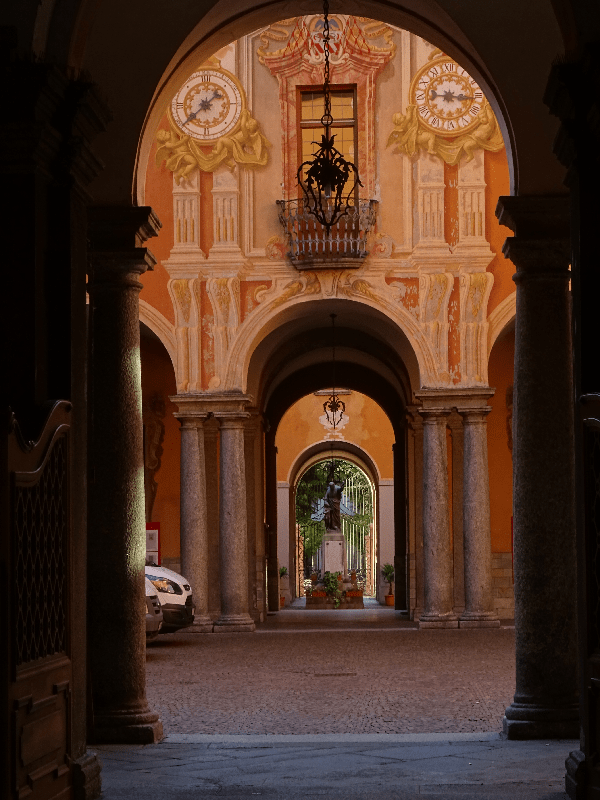
Porticoed courtyards, originating out of monasterial cloisters or the more domestic enclosed yards of medieval dwellings, are bit of a renaissance speciality – and they abound in Como’s urban palaces. Some of these interior treasures are permanently open for all to see and enjoy such as the nymphaeum in the courtyard of the Palazzo Giovio, now the Museo Civico, or the courtyard with terracotta highlighting in Palazzo Rusca. Other treasures like the exterior of the Chiostrino Artificio or the Teatro Sociale’s Sala Bianca can be seen when attending a scheduled event. This does however leave the majority of Como’s architectural delights hidden away from the public, often behind stout ‘portone’ which remain resolutely closed against the outside world.

Museo Archeologico

The Nymphaeum in the courtyard of Palazzo Giovio, the site of Como’s Museo Civico.

There are fortunately some public-spirited owners who have shown themselves prepared and willing to share their good fortune by allowing occasional access on their property to the general public. They appreciate that sites of particular cultural or aesthetic value form part of a shared heritage. The Italian equivalent of the UK’s National Trust, the FAI (Fondo Ambiente Italiano) have done much in organising open days to many of these privately-owned treasures. For example, this year FAI organised visits to the Palazzo Odescalchi in Piazza Roma which is undergoing renovation and conversion into apartments for private purchase.

Collegio Gallo Carlo Carloni

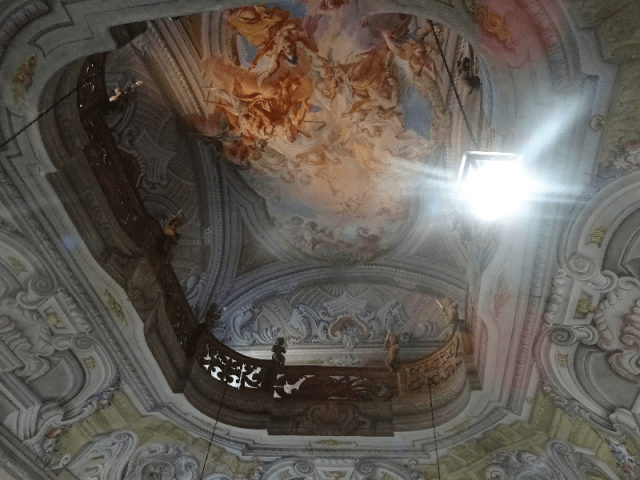
The ceiling of the grand staircase in the Collegio Gallio, frescoes by the Intelvi master, Carlo Carloni.

Here was a chance to see some of the 16th century frescoes by the Recchi brothers before the renovated units get sold off into private hands. They also organised visits to the Collegio Gallio, one of Europe’s oldest teaching institutions where the public were able to see the frescoes by the 17th Century Intelvi master from Scaria, Carlo Carloni, on the ceiling of the grand staircase and decorating the walls of the Aula Magna. Visitors to Bellezze Interiori will also be able to visit the Collegio Gallio.

Martirio di San Marco, Recchi

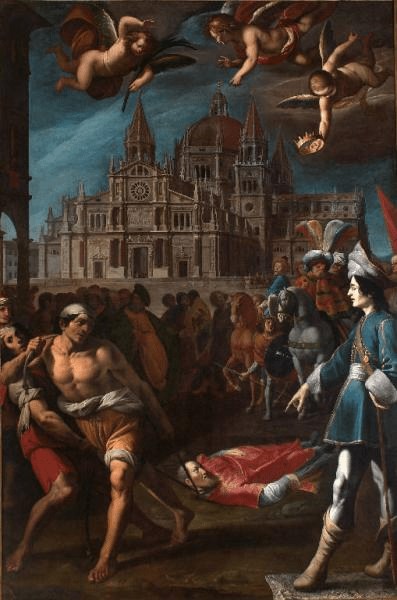
Martirio di san Marco by the Recchi Brothers, taken from the main altar in Chiesa San Giorgio in Via Borgo Vico and now housed in Como’s Pinacoteca on Via Diaz.

When visiting Palazzo Lambertenghi, be sure to note the 16th century frescoes in the Sala Affrescata by Giovanni Battista Recchi and his brother Giovanni Paolo. The room is also referred to as the Sala Recchi. These brothers had a studio in Via Borgo Vico, a street which still hosts the studios of contemporary artists such as Ester Negretti, from where they undertook commissions across Lombardy and Piedmont including decorating their local church of San Giorgio. Their painting above San Giorgio’s main altar, ‘The Martyrdom of Saint Mark’ was removed and is now on view at Como’s Pinacoteca in Via Diaz.

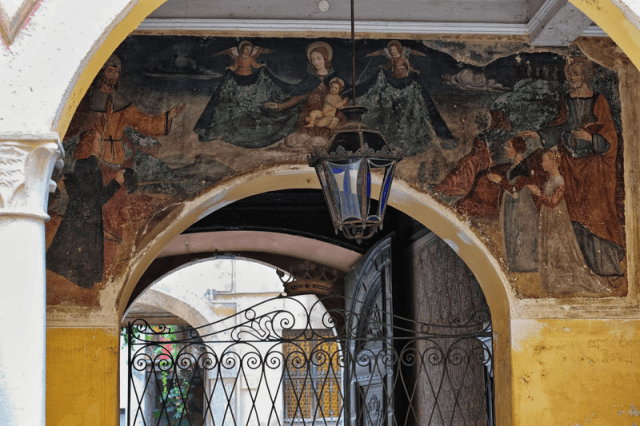
Another of the Bellezze Interiori sites is the Palazzo Albricci Peregrini in Via Rovelli. The main villa here was renovated towards the end of the 15th century and still has a remarkably well preserved fresco from that period on the inside of the main doorway.

Palazzo Albricci Peregrini

15th Century fresco on the inner wall of the main entrance into Palazzo Albricci Peregrini in Via Rovelli.

Behind the villa there is a beautiful garden and alongside that lies a medieval building which has been lovingly restored by the owners of the villa to make one of the most atmospheric Bed and Breakfast locations in the city. It even contains exposed stone walling from Roman times. This is just another, if not entirely secret gem, at least one that deserves a visit and to be better known .

Secret Garden

Not on the list yet of gardens to visit, this is the villa just beside Sant’Agostino outside the city walls on the western side.

Not all the buildings on the list are necessarily old. For example the Palazzo Arturo Stucchi, also known as Palazzo Delle Torre, was entirely rebuilt in 1864 and then extensively renovated by Como’s eclectic-style architect Federico Frigerio for Arturo Stucchi who was a textile magnate. What is of main interest here is the Nymphaeum and the statues representing the Four Seasons in the niches that flank it. This Palazzo is on Via Volta where you will also be able to visit the birthplace of Alessandro Volta. I am not sure if the house itself will be open to the public. Half is now occupied by the Order of Engineers and the other half by a law firm. They have generously given public access to the house in the past. You will certainly be able to visit the gardens of the house and also the gardens down the road at the old silk factory and headquarters of Mantero. Here within the gardens on the corner of the old defensive walls is the tower known as Porta Nuova within which Alessandro Volta undertook some of his early experiments in harnessing electricity. By the way, the whole of the Mantero building, the gardens and the ancient communal salt and tobacco warehouse across the road are for sale.

Sede Mantero

The old Mantero headquarters on Via Volta. The gardens behind also give access to the Porta Nuova tower where Alessandro Volta undertook some of his early experiments seeking to harness electricity.

Both the Volta and Mantero gardens are examples of what are called ‘giardini pensili’ or hanging gardens. These are gardens built on top of other buildings as for example along Via Volta where the gardens have been built on top of the old ramparts and remains of the original Roman wall defences.  From Volta’s house, the gardens are accessed directly from the first floor and then paths lead you up onto the top of the walls overlooking the park and across Viale Varese to the Santuario del Santissimo Crocifisso. Other hanging gardens along Via Volta will also be open to visits.

Via Volta

The ‘Giardino Pensile’ at Alessandro Volta’s home on Via Volta.

No matter how noisy and populated the streets in the old city might be, once the main doors are closed on them the interior courtyards and gardens retain a surprising serenity which, perhaps more than anything else, helps convey the spirit of days past. This upcoming weekend in September  organised by Bellezze Interiori will offer access to the largest number of private dwellings of cultural or aesthetic interest ever available at any one time.  The modest charges go to cover administrative costs and to help plan future events. Not all the details for this year’s weekend have yet been finalised and there may well be more owners signing up to give access to their properties, along with other events. The initiative deserves every success and I certainly hope that it is something that rapidly becomes a reliably regular highlight in Como’s cultural calendar.

Collegio Gallo

The Collegio Gallio will be one of the sites open to the public on 21st and 22nd September,

Posted in Architecture, Art, Culture, Events, Gardens, Itineraries, Places of interest, Uncategorized | Tagged , , , , , , , , , , , | Leave a comment

Argegno to Argegno: Up and Down the Telo Valley

This article has now been moved to Argegno to Argegno: Up and Down the Telo Valley

Posted in Culture, Folklore, Food, Itineraries, Uncategorized, Walks | Tagged , , , , , , , , , , , , , | Leave a comment

Stucco and Scagliola – Two of Como’s Baroque Specialities

Sant Agata Castiglione

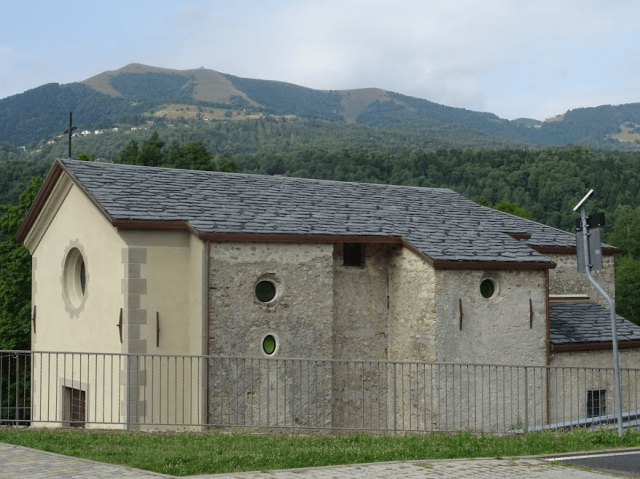
Church of Sant’Agata in Castiglione D’Intelvi with Monte Generoso in the background. The masters of stucco and scagliola originated predominantly from the Intelvi valley which runs from Argegno on Lake Como to Lake Lugano.

Back at the start of the 17th Century, a new technique was developed in Northern Italy to create fake marble marquetry – a much cheaper method of reproducing ‘commesso’ –  the artistic effect of marble mosaic using  ‘pietra dura’ (hard stones) which had its heyday from the 14th to the 17th century.

Commesso Pietra Dura Dubrovnik

An example from Dubrovnik of ‘commesso’ marquetry using ‘pietre dure’ . The technique is expensive and time consuming since each stone inlay must be polished individually since they all differ in density.

This new technique was called ‘scagliola’ (large slither or scale) and it derived from the skills already developed in the use of plaster for internal decoration known as  stucco. A certain Guido Fassi from Carpi, a city between Mantova and Modena, is accredited with the introduction of scagliola in Italy and Carpi rapidly became a centre of excellence for the technique. However, the most successful family of scagliola artisans was forced to move away from Carpi to Milan in the mid 17th century when the father, Battisti Leoni,  committed a murder and fled to avoid imprisonment.

Scagliola Carpigiana

An example of scagliola from Carpi.

He and his three sons set up a new workshop in Milan and before long had completed commissions for decorating the altars of churches across the Po Valley and the table tops for nobility from Genoa to Amsterdam.

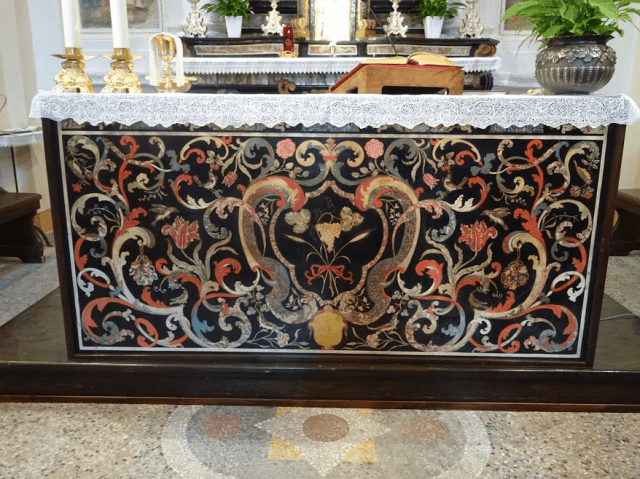
Also by the mid century, the technique had arrived in the Val D’Intelvi  – the valley which links Lake Como with Lake Lugano – where it immediately took root given the pre-existing tradition in stucco, stonework and the other decorative arts as well as architecture.  The first scagliola altar front (known as paliotto) in the Val D’Intelvi  is attributed to the priest artisan Carlo Belleni (1612-1683) and found in Gottro on Lago Ceresio, the name given to the  eastern end of Lake Lugano. The craftsmen of the Val D’Intelvi rapidly developed their skills deploying a distinctive set of design features and undertaking commissions across the Province of Como, and more broadly over the entire Austro-Hungarian Empire.

Castiglione Sant Agata

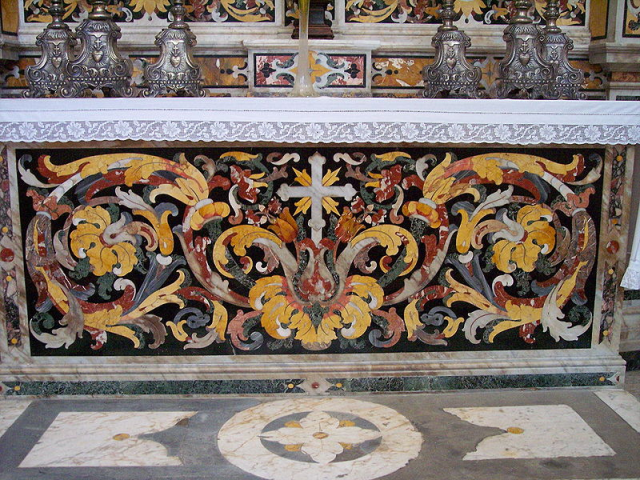
Paliotto decorated with scagliola in the church of Sant’Agata in Castiglione D’Intelvi.

The Val D’Intelvi is a beautiful but relatively remote part of the province of Como straddling the Italian side of the border with the Swiss Federation. For historical reasons, the area had always produced numerous families who perfected craft skills employed in construction. There is good reason to believe that it was the stonemasons from this remote far-northern corner of Italy who led the adoption of the Romanesque style of ecclesiastical architecture across Western Europe.

Sacro Monte Ossuccio 1

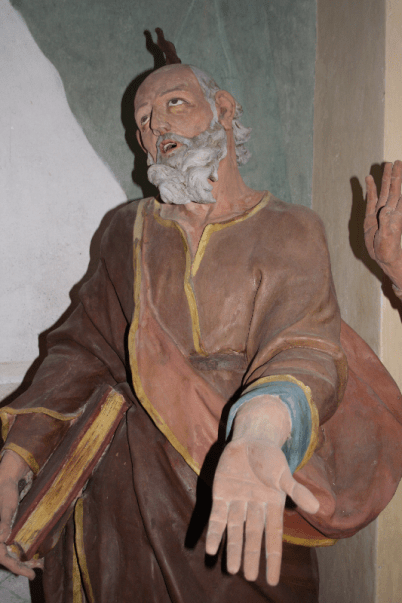
Painted stucco sculpture in the chapels of the Sacro Monte in Ossuccio, now a UNESCO site.

Our previous article Como’s Artistic Tradition – A Pan-European Legacy: Maestri Comacini identified the influence of these itinerant ‘maestri comacini’ in the 13th century and how they established freemasonry as an early  artisan guild set up to protect the secrets of their trade – their ‘mysteries’.  Now in the 17th century, Counter-reformation Europe was gripped by the baroque style of architecture and design. It would be a second wave of itinerant ‘magestri comaschi’ deploying their skills in stucco, scagliola and fresco painting to spread this ornate decorative style across Europe.

Scagliola was born out of stucco, plaster work, which had developed in Rome during the Renaissance as a cheaper option to marble. The techniques were first defined in a tract by Alberti in 1542 but examples had been produced in the workshops of Raphael from the 1520s. Stucco designs could be polished, painted, bronzed or gilded. Or painted sections could be polished to resemble ‘pietra dura’  as developed in Carpi to become what became known as scagliola. Stucco designs were made from a variety of plaster but the preferred final layers for scagliola were made from gypsum rather than lime. This would be mixed with water and animal glue and then coloured. There are numerous examples of impressive stucco work across the Province of Como such as the interior of Santa Cecilia in Como itself decorated  in 1687-88 by an Intelvi artisan, Giovanni  Battista Barbarini from Laino.

Santa Cecilia

Detail of stucco work in the Church of Santa Cecilia, Via Cesare Cantu, Como.

Other fine examples can be seen in the chapels of the UNESCO site,  the Sacro Monte di Ossuccio.  These were produced by Agostino Silva (1628-1706) from Morbio Inferiore, a town just over the Swiss border from Como and Cernobbio.

Intelvi unkmown

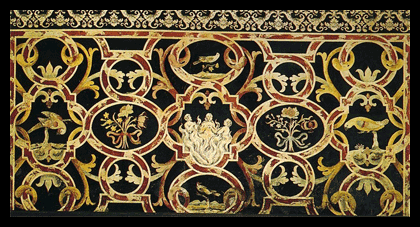
Detail of scagliola work on a paliotto screen from the Val D’Intelvi

Scagliola work was usually reserved for the front panels of the church altars, known as ‘paliotti’ in Italian. Here the idea was to imitate ‘commessi’ mosaic work to the same aesthetic effect but at a fraction of the cost and time to produce. The earlier Carpi paliotti tended to be monochromatic  but the styles developed in the Val D’Intelvi were bright and colourful including a rich variety of patterns and designs. The background colour was normally black. This was produced by colouring the plaster with ‘nerofumo’ also known as lampblack – a pure carbon produced by collecting the soot from burnt oil. The other main colour used to mix and in pure form was white – a lime white known as Bianco San Giovanni  which originated from Florence. The following recipe for its production was written by Cennino Cennini (1346-1427) in his book ‘Il Libro dell’Arte’.

‘…take good white air-slaked lime, put it, in the form of powder, into a pail for the space of eight days, adding clear water every day, and stirring up the lime and water thoroughly, so as to get all the fatness out of it. Then make it up into little cakes; put them up on the roofs in the sun; and the older these cakes are, the better the white will be. If you want to make it quickly and well, when the cakes are dry, work them up with water on your stone; and then make it into little cakes and dry them again; and do this twice and you will see how perfect the white will be. This white is worked up with water and it wants to be ground thoroughly. And it is good for working in fresco, that is, on a wall without any tempera.’

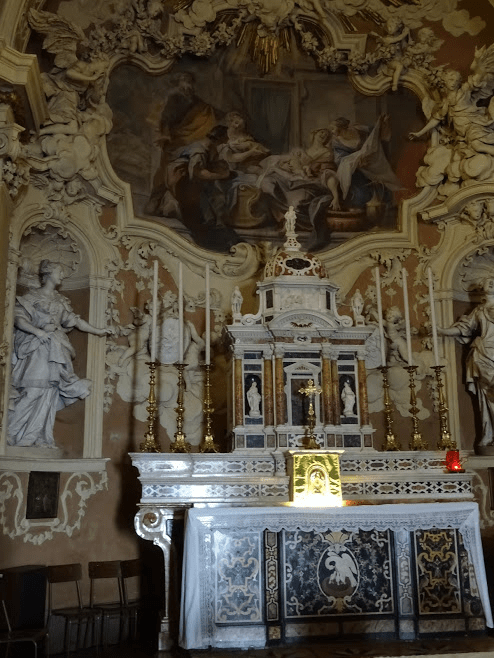
Sant Anna Argegno

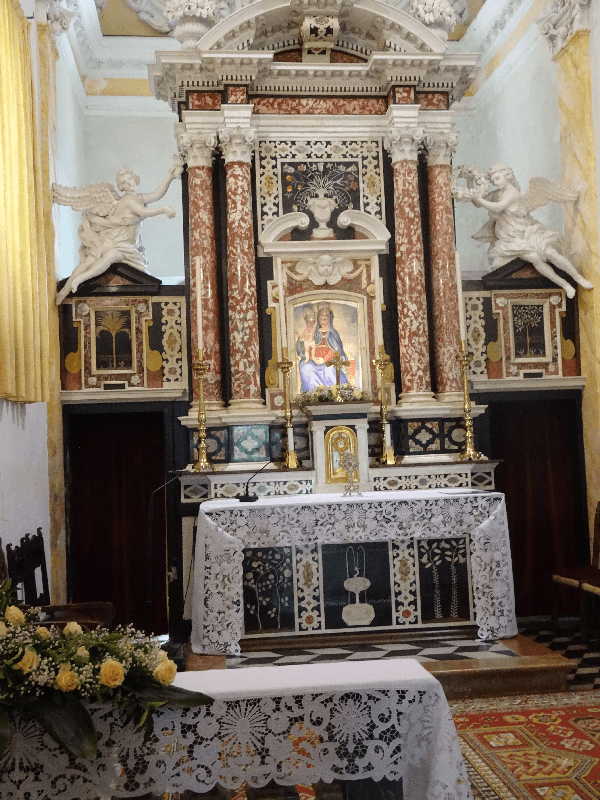
Altar in the Santuario di Sant’Anna, Argegno. with fine examples of stucco, fresco and scagliola work.

The artist’s palette was completed with blue derived from either azurite, indigo or lapis lazuli. Red was obtained from vermilion, cinnabar, hematite for a dark red or crimson. Yellow came from ochre ( a natural clay) or orpiment. The base of the paliotti was made from a plaster mixed with broken up bricks or roof tiles and sand. Quality gypsum for making the plaster for the upper layers  was taken from the local mines at Limonta, just to the east of Bellagio or Nobiallo, to the north of Menaggio.  Marble quarries in nearby Musso (white marble) and Varenna (black marble) and the stone quarries at Moltrasio ensured the craftsman of the Val D’Intelvi had all the raw materials needed for their crafts.

Santo Sisinnio

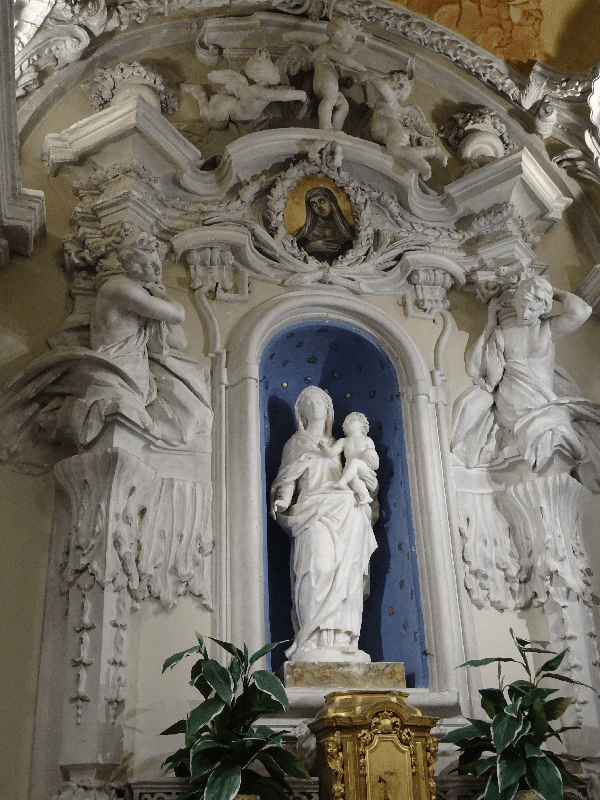
The interior of the Church of Santo Sisinnio in Muronico above Argegno. The statue of the Madonna and Child is in marble with all surrounding decoration in stucco.

While the Val D’Intelvi  had a long tradition of craftsmanship, its prominence in the production of stucco and scagliola maybe would not have developed if Como, being on the border between the catholic world of Italy and the Calvinism of some of the Cantons in the  Swiss Federation, had not been on one of the front lines of the Catholic Counter Reformation. Also Northern Italy had received many catholic refugees fleeing from Protestant Northern Europe during the Thirty Years War and they were intent on securing and declaring their faith by commissioning works in the style that reflected the religious affirmation and exuberance of the Counter Reformation,  namely the Baroque.  The artisans of the Val D’Intelvi, used to long periods of itinerant work and outward emigration, were thus poised to dominate Europe once again.

ludwigsburg

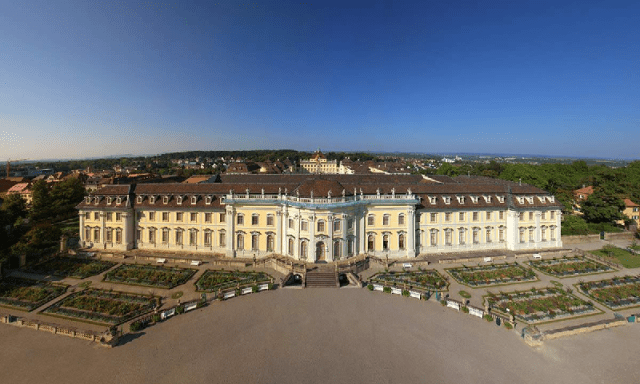
Ludwigsburg Palace, near to Stuttgart.

The predominant position of Val D’Intelvi craftsman is best exemplified by their role in constructing Ludwigsburg Palace, the largest palatial estate in Germany commissioned by Eberhard Louis, Duke of Wurttemberg in 1707.

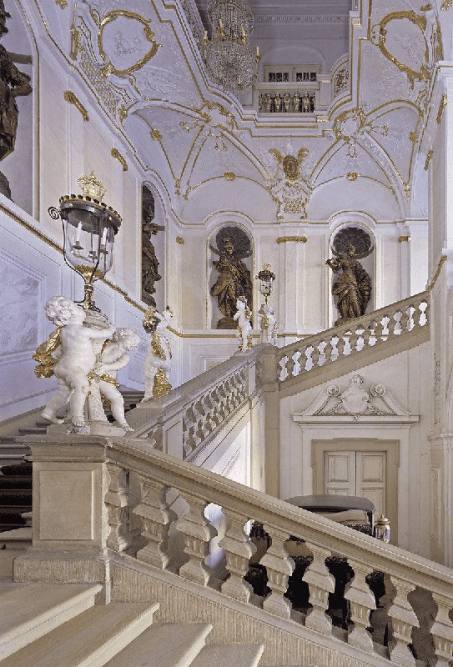
ludwigsburg interior

Interior of Ludwigsburg Palace with stucco work by the maestri comacini led by Donato Frisoni.

When Duke Louis’ architect Johan Nette died in 1714, the sculptor Donato Frisoni, originally from Laino in the Val D’Intelvi, was appointed to take over responsibility for completing the original section of the palace and extending it. Frisoni employed hundreds of his fellow countrymen but the main craftsmen he employed all originated from the Val D’Intelvi, namely Paolo Retti (Frisoni’s nephew), Giambattista Carloni from Scaria,  the Scotti from Laino and the Ferretti from Castiglione. The scale of the works was immense. Paolo Retti was organising  up to six hundred and fifty workers at one stage consisting of stone masons, cutters and labourers.

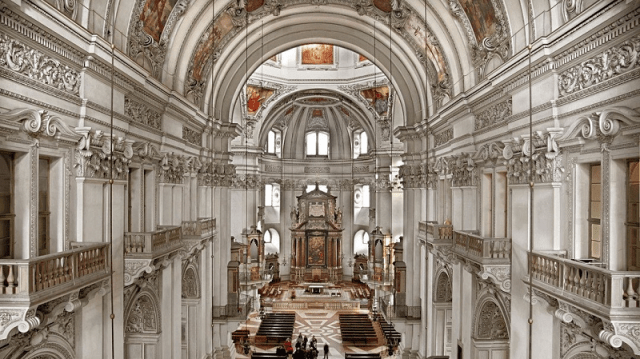
Val D’Intelvi craftsmen were to be found wherever the baroque style was in favour, particularly in cities across Catholic Mid and Eastern Europe such as Prague, Vienna, Passau and Salzburg. Salzburg Cathedral was designed by Santino Solari (1576 – 1646), born in Verna in the Val D’Intelvi. Construction was also done entirely by craftsmen from the Val D’Intelvi.

Salzburg Cathedral

Salzburg Cathedral, entirely constructed by caftsmen from the Val D’Intelvi.

Giambattista Carloni not only worked on the Ludwigsburg Palace but was also responsible for producing ten altars and the stucco decoration in Passau Cathedral. The whole of the interior decoration of the cathedral was project managed by another Intelvi resident, Carlo Lurago from Pellio. These two became the most prominent promoters of baroque decoration across Eastern Bavaria.

Ceiling Passau Cathedral

Ceiling of Passau Cathedral, stucco work by Giambattista Carloni from Scaria in the Val D’Intelvi.

Giambattista Carloni’s two sons, Diego (1674-1750) and Carlo (1687-1775) were also employed at the Ludwigsburg Palace. Diego was a sculptor and master of stucco and scagliola whilst Carlo was an artist. They, like all the other master craftsmen from the valley, worked predominantly abroad returning from time to time to their towns of origin. These two brothers became internationally renowned protagonists of rococo  – the lighter but highly decorative style that developed out of the baroque.  Along with their successful careers in Stuttgart, Vienna, Passau and in Italy, they decided to gift the parish church of Santa Maria in their home town of Scaria with a complete interior and exterior makeover. Carlo also added some delightful frescoes on the wall of the portico added to the side of the nearby Romanesque church of Saints Nazaro and Celso.

Carloni Santa maria Scaria 2

Interior of the Church of Santa Maria, Scaria. Painting by Carlo Carloni and stucco work by his brother Diego.

Carloni Santa maria Scaria 3

Church of Santa Maria at Scaria with stucco and scagliola by Diego Carloni and the fresco above the altar by his brother Carlo.

As with the story of Como’s group of world renowned abstract artists, ‘the astrattisti comaschi’ , one is left wondering what were the circumstances that led to this intense concentration of artistic talent within such a small defined area. I have alluded to some possible geopolitical causes but maybe the most significant influence was family.

Carlo Carloni Scaria

Fresco by Carlo Carloni on the wall of the portico of the Church of Saints Nazaro and Celso in Scaria,, Val D’Intelvi.

For example Paolo Retti, the architect cited as collaborating with Frisoni on the Ludwigsburg Palace was not just Frisoni’s nephew. Paolo’s father Lorenzo was a stucco master as was his brother Donato. His other brother Leonardo was an architect. Craftsmen would marry into other craftsmen families from the valley. Connections to family and place of origin gave these itinerant workers the freedom to travel for years on end knowing there was always a welcome back home.  Travelling for work exposed them to different techniques and ideas while family pride also drove them to perfect their skills and to innovate.

Thus there have been two clear eras over the last nine hundred years when the ‘maestri comaschi’ have had a disproportionate  influence over European art or architecture.  It is difficult to foresee how this success could be replicated again given modern methods of design and production but their legacy has at least ensured, due to the need for restoration, that their old skills remain current.  Students at the School of Artisan Crafts at the Villa Fabris in Verona still learn how to create and restore scagliola!

Students at Villa Fabris

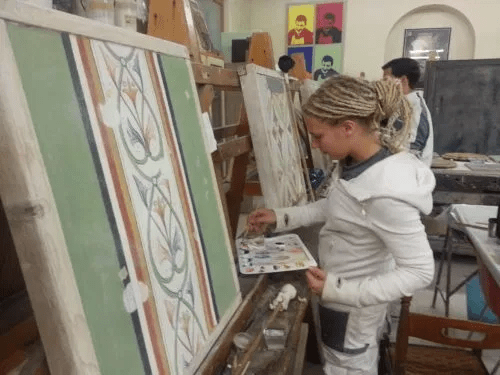
Students at Villa Fabris learn the techniques of stucco, scagliola and other decorative arts so as to recreate or restore the originals.


Posted in Architecture, Art, Culture, History, People, Uncategorized | Tagged , , , , , , , , , , , , , , , | 1 Comment

Tourism on Lake Como – Then and Now

Argegno

Argegno and the start of the Val D’Intelvi

Are more tourists coming to Lake Como these days? Data on this for 2018 has recently been published covering all of Lombardy and its individual provinces including both Como and Lecco for the two legs of our lake.  The data does reveal the increasing importance of tourism to the local economies of both provinces, with a breakdown on the country of origin of visitors and on how long they stay here.  It also reveals the broad differences in the type of tourism on offer in Como or Lecco.  We also see how many people may prefer to visit Lake Iseo or Lake Maggiore. Yet the figures provide no insight into why people choose voluntarily to visit or to live in any of these provinces rather than just stay at home or in their mother country.  The data cannot explain what brought me as a resident or the 1,372,787 visitors in 2018 to pick Como as a location that may possibly be good for the soul.

Now – The Figures
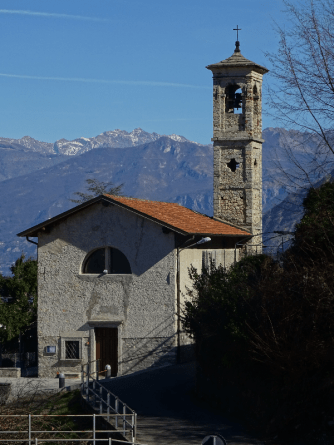
Bell tower

Towards Lezzeno

InLombardia, the Lombardy Region’s tourist board, has in recent years been actively campaigning to encourage more people to visit Milan and the other provinces in the region. The figures for 2018 show their efforts are paying off with a 3.5% increase in numbers since 2017 but 26.4% since 2013. In 2018 , out of a total of nearly 17,200,000 visitors to Lombardy, 7,800,000 went to Milan and 1,370,000 came to Lake Como making us more popular than Lake Maggiore (Province of Varese) or the Valtellina (Province of Sondrio) but less so than Lake Iseo (Province of Brescia). For Como this represents a significant 34.9% rise in numbers since 2013.

On average across Lombardy, around 50% of visitors originate from outside Italy. However for Como the percentage of foreign visitors climbs to 77.5%, ahead of Lake Iseo with 72% or the other leg of the lake in Lecco at 62.6%. Countries of origin are recorded for Lombardy as a whole but not for the individual provinces. The top ten countries in descending order are 1) Germany 2) United Kingdom 3) Netherlands 4) United States of America 5) France 6) Switzerland 7) Japan 8) China 9) Belgium 10) Russia.  The Provinces of Sondrio (the Valtellina), Cremona, Lodi, Monza, Mantova and Pavia all have a majority of Italian tourist visitors.

There has been a radical change in the type of lodging available with a decline in the number of hotel beds across the region except for Como where there has been a steady annual increase of 1.6% over recent years.  The reduction in beds is most marked in the two or three star category. Conversely there has been a massive increase in the number of non-hotel beds. This category includes holiday homes, bed and breakfasts, ‘agriturismo’ and camp sites. Since 2015 this category of accommodation has increased by a massive 302% in Como with a 59% increase recorded in just the one year from 2017 to 2018. Lecco and Sondrio have also seen significant increases since 2015 of around 150% in this category.

There are also marked differences in the length of visitors’ stay. The average for the whole of Lombardy is 3.64 days per visitor with Como just below this at 3.32 days although those from abroad tend to spend less time here, 2.6 days. The challenge is of course to get people to stay longer and Brescia (Lake Iseo) seems to manage this well with an average stay of 5.72 days.

Brescia and Lake Iseo seem to be doing a number of things well and maybe there is something that Como and Lecco could learn from them. The figures also reveal essential differences in the experiences on offer on the Lecco leg rather than Como with Como maintaining or even increasing the number of luxury hotel rooms as well as increasing the non-hotel options. Lecco is managing to increase the number of visitors but less are coming from abroad than to Como and they are also favouring lower cost accommodation options.

Then – The Origins of Tourism

Towards Bellagio

Bellagio from Lezzeno

So we know how many people visit the lake, roughly where they come from and how long they usually stay. Let’s try now to find out why we are all here? The answer is to some extent obvious, in that the lake has its natural beauty. From Roman times Lake Como, known as Lario, was recognised as having a particular appeal with unique qualities. Pliny the Younger was one of the first to describe the attraction of the mild, fertile lakeside contrasting with the dramatic mountain backdrop. He had a villa built for him on its shores, and his enthusiasm for the lake helped give birth to the concept of ‘Il Mito di Lario’ – or the fame of the lake. As time passes, the ‘Mito di Lario’ will form the basis for the growth of an ever expanding and evolving tourism industry. However, tourism as such is a relatively modern phenomenon and the concept of visiting far-away lands for pleasure could only take root once fundamental infrastructure issues were resolved.
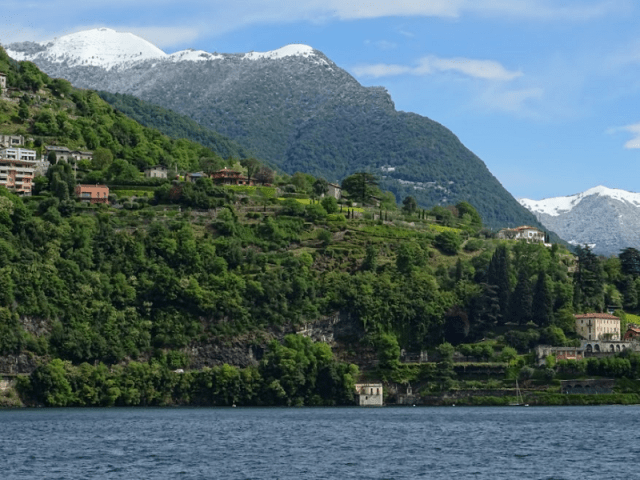
Lakeside and mountain

From lakeside to mountain – Lake Como’s contrasts

We have the diary kept by a manservant of an English nobleman, Sir Edward Unton, who travelled through Italy in 1563 to give us some insight into the concerns and interests of early travellers.  The quote below reveals as much by what it fails to mention and the relative space given to describing Milan compared with the throwaway reference to Como.

‘Milan is a fair great city well-fortified and situated in a fair country having on the one side a very strong castle whereunto all the city is in subjection. This city is very populous and full of artisans of all sorts and much more than other cities I have seen. From thence the 1st October to bed to a city of the same dukedom called Como, not fair standing at the foot of the mountains and the furthest city towards Switzerland. In this part of Lombardy is indifferent good food for travellers, the people notwithstanding are very subtle and crafty given like the rest of Italians to deceive strangers.’

Richard Smith, the diarist, was unimpressed by the lake, the local inhabitants or the cuisine with his focus definitely on urban culture and his preference decidedly for Milan.  His prejudice against Italians in general was matched at the time by the overall contempt of the Milanese towards Como – after all it was only four hundred years previously when the two cities were at war with each other. However, aristocrats, who began to visit the area in increasing numbers from a century later as part of their cultural ‘Grand Tour’ of Europe, were more favourably impressed. Some even settled in the area and established neo-classical villas and gardens on the lake shore adding to the lake’s fascination for successive generations.

Villa D'este

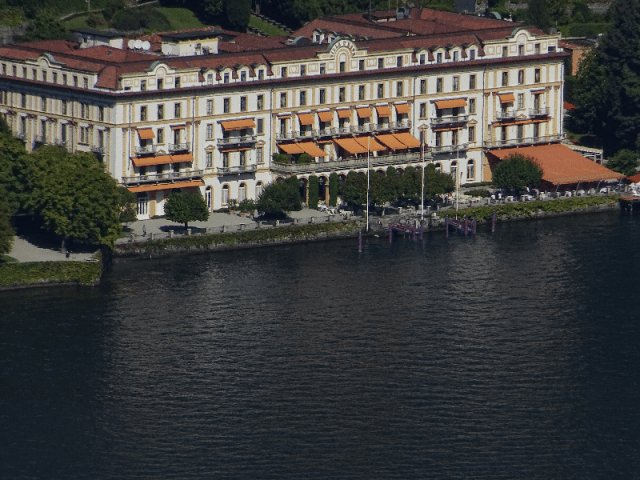
Hotel Villa D’Este in Cernobbio

If Elizabethan aristocrats were not yet interested in the lake, Italians were. In 1568 Cardinal Gallio of Como commissioned the architect Pellegrino Pellegrini to build the Villa D’Este in Cernobbio as his summer home. Villa Monastero in Varenna, originally a monastery as its name suggests, was acquired as a home for the Mornico family in the early 1600s.  Villa Pliniana, originally built in 1573, was bought by a branch of the Milanese noble Borromeo family in 1590.  Villa Dell Grumello on the edge of Como was built in 1570 for Tommaso D’Adda.  It would later pass into the hands of the Odescalchi and then the Giovio family whose ancestor Paolo had built one of the early lakeside villas on the current site of the Villa Gallia in 1543 to house his collection of paintings.
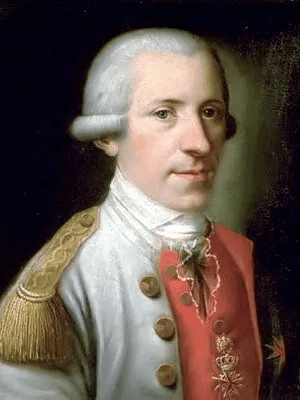
Giambattista Giovio

Giambattista Giovio, author (1748-1815)

The Grand Tour, undertaken as part of the intellectual education of young Northern European aristocrats and focussing initially on the major cultural cities of Europe, did much to develop the concept of ‘tourism’.  It introduced the concept of travelling for its own sake, for the experience and for the opportunity to learn and then to exchange ideas and opinions with other travellers. One such journey was undertaken in 1777 in the company of Alessandro Volta by the author Giambattista Giovio, a member of a long-established Como aristocratic family. Giovio kept a journal of their journey together through Switzerland including their meeting with Voltaire in his home town of Ferney, just over the border from Geneva.

Giovio was perhaps the most influential person in his day to encourage interest in visiting Lake Como. He published ‘Como and Lario’ in 1795 and his further text on travelling around Lake Como was published posthumously in 1817. These books helped to broaden interest in travel beyond visits to sites of antiquity into locations which might inspire through their beauty or dramatic quality.

Then – From Spectacular to Sublime

In 1817 Stendhal visited Lake Como and described it as ‘sublime’.  Sublime is a word that in modern parlance has lost most of its original power and significance similar in a way to ‘awesome’.

Villa Pliniana

Villa Pliniana, Torno – Percy Bysshe Shelley and wife, Mary considered buying this on their visit to Lake Como in 1818

When as a teacher I attempted to introduce students to the Romantic Poets such as Shelley, my personal challenge was trying to get my head round the true meaning and importance to these writers of the sublime – a metaphysical almost mystical belief in the powers of man and nature. So, whatever the sublime might be, for Stendhal and visitors like Shelley and his young runaway bride Mary, Lake Como had it. The Shelleys were so attracted to the lake that they seriously looked into the possibility of purchasing Villa Pliniana, now a luxurious hotel but a dilapidated albeit romantic wreck when they viewed it in the Spring of 1818.

Milano and Sublime

Sublime Lake Como

The Romantic period ushered in a golden age for Lake Como with so many writers, artists and musicians deciding to visit and record their impressions.  Sheer sided mountains reflected in the calm waters, snow-capped peaks above temperate shores, small towns with Romanesque bell towers rising above the surrounding chestnut groves – these were the never changing elements which had enchanted visitors from Pliny’s day.

Torno

The ancient northern Roman gateway into Torno

But for the Romantic sensibility, the beauty and drama of these natural elements conveyed a sense of freedom, awe in its original sense combined with the boundless possibilities of creativity. What could be a better setting for Verdi to complete ‘La Traviata’ or for Rossini to compose ‘Tancredi’ over a three day stay at the Villa Pliniana, or for Bellini to collaborate with Giuditta Pasta, his mezzo-soprano muse, crossing the lake from Moltrasio to her villa in Blevio?

Cardinal Gallio’s summer villa in Cernobbio was acquired in 1815 by Princess Caroline of Brunswick, the estranged wife of the English King, George IV. It was she who renamed it the Villa D’Este having bought it as her home in exile from the London court.  Lake Como had by now consolidated  an international reputation for its charm.

View of Menaggio JMW Turner 1842

View of Menaggio from the sketchbook of JMW Turner, 1842

Now – From Sublime to Serene

As the nineteenth century progressed, the wealthy homes of aristocrats either changed hands with or were accompanied by those built for the financiers and industrialists making their fortunes from Northern Italy’s growing industrialisation.  As we know, the increase in wealth for the few was also matched by a partial mastery and a general deterioration in the quality of the natural environment matched by an increase in the pressures of everyday life.
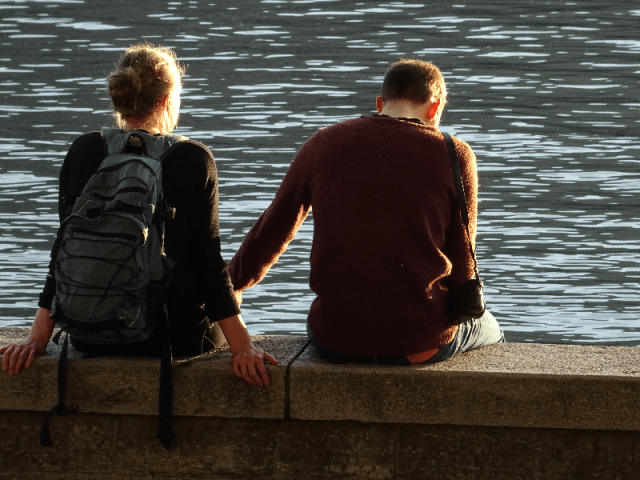
Romance on the lake

From sublime to serene – Lake Como becomes ‘romantic’.

People no longer tended to travel as much for intellectual or spiritual enrichment as they did in search of some peace and tranquillity in a bid to regain equilibrium prior to returning back into the commercial fray. The dawn of the modern world had made the Romantics’ concept of the sublime impenetrable and the search was now more directed to seeking serenity, a concept easier to appreciate even if hard to achieve. Since the quest for serenity was bound to be more in demand than the esoteric search for the sublime, tourism on Lake Como was set for further development. However the lake retained, simplified and then amplified its ‘Romantic’ epithet, becoming to this day a popular location for weddings.
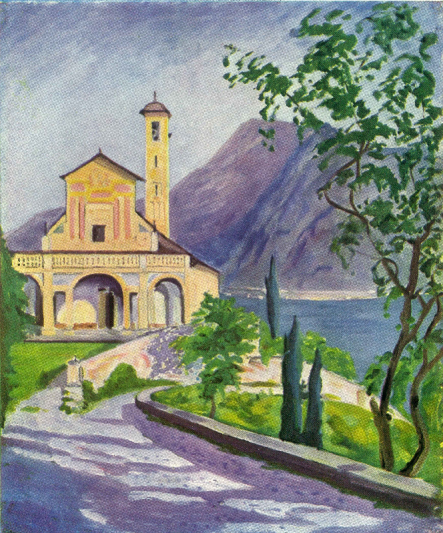
Churchill Val D'Intelvi July 1945

Chiesa di Sant Sisinnio, above Argegno – Winston Churchill, from sketches done in July 1945

Some notable figures in the political world have sought serenity on the lake including Winston Churchill. He visited here immediately after he lost the post war elections in the United Kingdom in July 1945. He started his holiday staying for two weeks in Moltrasio as a guest of an industrialist. He spent much of his time sketching and painting but his stay has also raised speculation that he may also have been trying to track down and dispose of incriminating correspondence between him and Mussolini.

Konrad Adenauer rented a villa in Griante above Cadenebbia for at least two periods a year during his time as the German Chancellor after the last war. Adenauer had one of the most stressful roles in modern politics seeking to drag his country out of the shame and bankruptcy of the Nazi years while also laying the foundations for ongoing future peace in Europe. The Villa la Collina provided the serenity he required. Maybe following Adenauer’s example but years later, the Secretary General of the UN, Kofi Annan, on his retirement in 2006, spent three months staying above Menaggio.

He remained incognito for most of this time but feared his cover may have been blown one day when, while out buying a newspaper, someone seemed to recognise him stating, ‘I know you – you’re Morgan Freeman!’ He was also a regular visitor to the Ambrosetti Forum, the annual meeting of international politicians and industrialists held at Cernobbio’s Villa D’Este. In all he visited Lake Como six times dining on one of the last occasions as guest of George and Amal Clooney in Laglio at their Villa Oleandra.

Rezzonico

Rezzonico in the Comune of San Siro

The Clooneys have done more than any others to publicise the lake in recent years, in spite of the fact that other wealthy industrialists like Richard Branson and various highly anonymous Russian oligarchs also own property here. This summer the Clooneys entertained Barak and Michelle Obama as house guests. No doubt they also  appreciated the soothing restorative benefits of staying on the serene lake.

The Future

The one constant throughout the whole long period in which tourism has grown on the lake is its basic attraction. Lake Como has a unique combination of the lush temperate lakeside fringing the calm water which in turn reflects the dramatic mountainsides with their gullies dividing off the individual mountain communities.
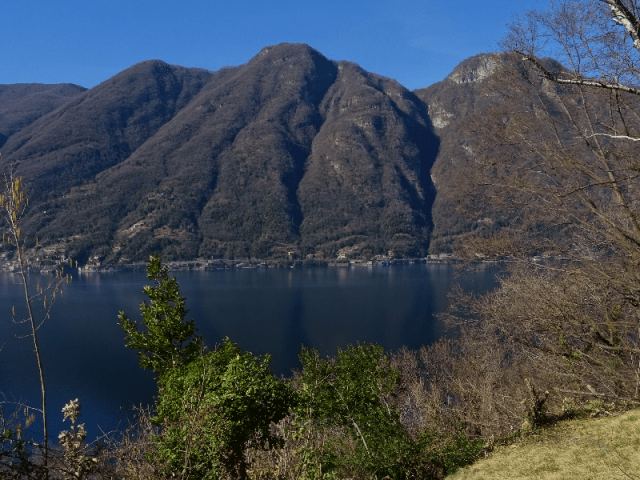
Brienno to Argegno - sheer mountainside

Going north from Laglio from Brienno to Argegno, the mountains fall so steeply down to the lake that not even the mountain paths up to the alpine pastures are readily maintained.

Fortunately these features are largely protected by the local geology, which may also discourage the development of a mass tourism and continue to hinder too much further urbanisation. The current communications infrastructure fails adequately to cope with the number of summer visitors. The father of Lake Como tourism, Giambattista Giovio knew back at the start of the 1800s how important roads were to the area’s wealth and development. Now however we need to develop alternative ecological solutions to enhance the communications network.
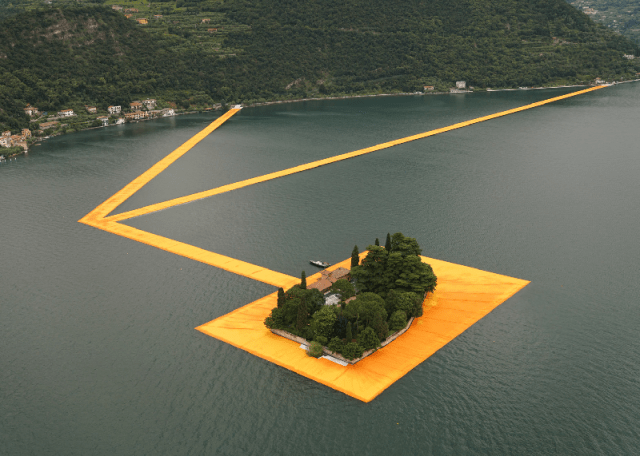
Christo Floating Piers

Bulgarian artist Christo’s Floating Piers on Lake Iseo

Como may also be able to learn a lesson or two from Brescia on how they have achieved their higher than average  length of visitors’ stay in their city or on nearby Lake Iseo.  Their province includes Franciacorta, a wine producing area best known nowadays for sparkling whites (spumante rather than prosecco). The wine quality is generally good but the wine’s success in recent years is due to superlative marketing. The province must have noted this success and applied similar imagination in promoting their lake recognising the part culture can play in attracting attention.
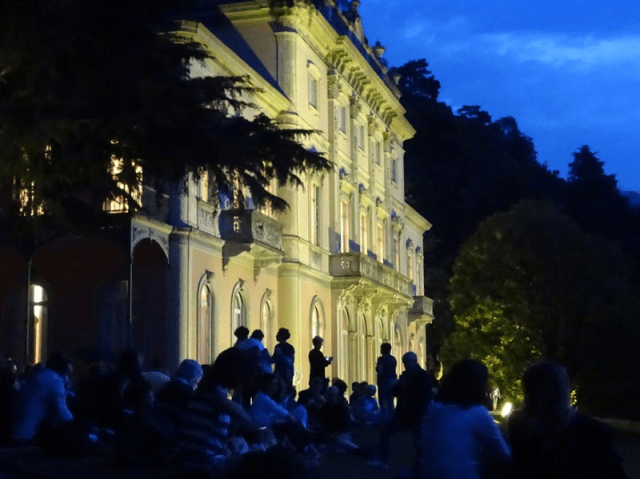
Villa del Grumello

Villa del Grumello between Como and Cernobbio, owned by the Odescalchi and the Giovio families, where Giambattista Giovio entertained his future son-in-law, the poet Ugo Foscolo – Italy’s equivalent to Lord Byron.

Como too is not short of various marketing initiatives including cultural ones such as Grand Tour 2.0 (not to be confused if searching online with a popular TV programme about boys in fast cars). However they lack a certain impact maybe because they are underfunded or don’t receive enough institutional support.

Airbnb

Local advertising for Airbnb, one of the disruptive technologies radically changing the accommodation on offer on Lake Como in particular but also across the whole of Lombardy.

One positive aspect for Como is the increase in the range of accommodation now available providing more options for those on restricted budgets.  Destinations can now include some of the mountain communities as well as those on the lakeside. Those looking for luxury have also seen their options increase in recent years, with an increase in capacity amongst luxury hotels and with the birth of possibly an entirely new category – the super luxury B&B.
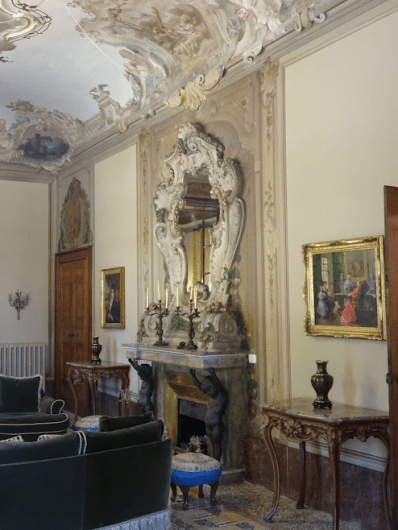
Villa Platamone

Villa Platamone, luxury bed and breakfast accommodation in Como – creating a new category of top end options to rival hotels such as Il Sereno or Villa Pliniana in Torno.

The general view is that Como’s local administrations over recent years have been somewhat complacent in their management of the city. It is not hard to find aspects to criticise ranging from the totally scandalous flood defence project to the lack of any noticeable increase in cycle paths and the generally tired condition of the public spaces. Yet it would feel particularly alien if Como was to become suddenly efficiently and conscientiously managed. The city fortunately has as many charms as faults and the charms of the lake are resilient to administrative indifference since they are deeply loved and appreciated by local residents. As tourism trends change, we can remain confident that the lake will continue to attract visitors from around the world for years to come.

Related Articles:

Read more about Como in the height of the tourist season.

Blevio was the home of Giuditta Pasta, Bellini’s muse and Europe’s most popular diva in the nineteenth century.

Villa D’Este has a long and varied history including this incident that caused a nationwide scandal after the last war.

Visitors need to know if the lake is safe for swimming. This article outlines what is monitored, the data at the start of the 2019 season, and where further updates can be found.

The Odescalchi family, former owners of both Villa del Grumello and Villa Olmo, produced a pope, Pope Innocent XI, and established a noble dynasty across Europe. A summary of their history is included here.

Mention is made above to Winston Churchill possibly seeking to retrieve documents that may have been seized by partisans following Mussolini’s capture and execution on the lake. This article describes the last days of Mussolini and his mistress as they tried to avoid the partisan insurrection in April 1945.

Como Companion recently visited Villa Platamone, on the launch of this super luxurious Bed & Breakfast.


Posted in Architecture, Art, Culture, History, Lake, People, Uncategorized | Tagged , , , , , , , , , , , , , , , , , | 7 Comments
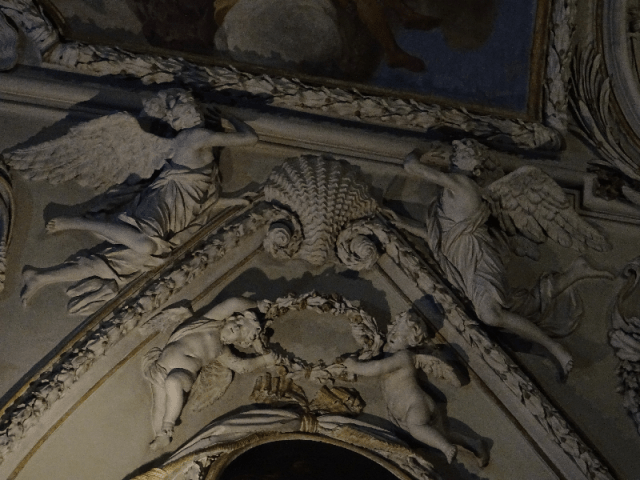
Como’s Pope and other Odescalchi
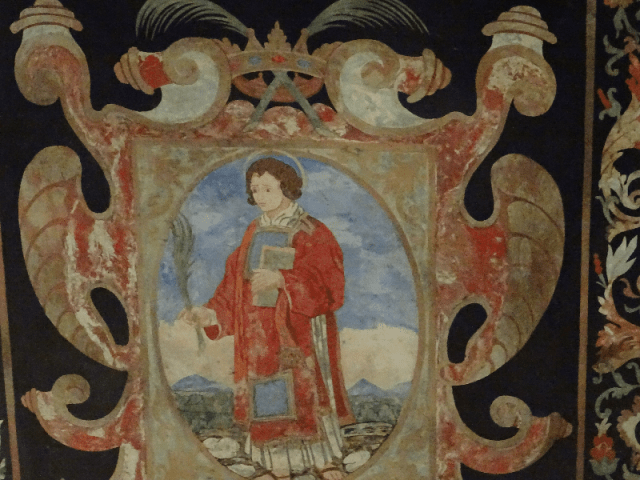
Via Vitani

Via Vitani, one of the streets in Como’s old town which takes its name from a former noble family. Others include Via Rusconi, Via Lambertenghi, Via Giovio, Via Natta etc.

Florence has the Medici, Mantua the Gonzagas,  Milan has the Visconti who merged through marriage with the Sforzas.   Como for its part has the Odescalchi. Many of the streets in Como’s old town are named after some of its former aristocratic families. Amongst these is Via Odescalchi along which, in a piazzetta just beyond the deconsecrated church of San Pietro in Atrio, you will find a sculpture of a very austere looking character, Benedetto Odescalchi, better known as Pope Innocent XI who served as pontiff from 1676 until his death in 1689. So in addition to Via Odescalchi,  Como also has a Viale Innocenzo XI .

Statue Odescalchi

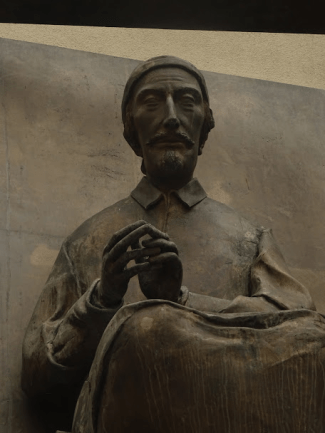
Statue of Benedetto Odescalchi, Pope Innocent XI, in Via Odescalchi, Como.

The first reference to an Odescalchi  (pronounced O-des-cal-key) in Italy can be traced back to 801 when an Odescalchi accompanied the Holy Roman Emperor Charlemagne on one of his Italian campaigns. However it was in 1290 that a certain Giorgio Odescalchi established his family as important residents of Como. He and his successors developed the family’s wealth through finance and mercantile interests.  Como remained the family’s base but branches of their banking interests were established by the sixteenth century in Genoa and Venice. From Venice in particular they established commercial links with Paris, London, Amsterdam and Nuremberg in Bavaria.

Noble families also sought to consolidate their family status through seeking high ecclesiastical office for their offspring other than the primogenitor.  By the sixteenth century a Bernardo Odescalchi had become Bishop of Alessandria and had spread the family influence through missionary work in Poland and Transylvania.

Stemma Odescalchi 2

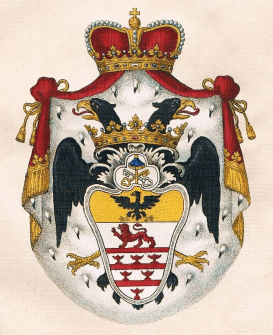
The heraldic shield of the Odescalchi family.

The future Pope, Benedetto Odescalchi,  was born on 16th May 1611 in Como – a plaque can be seen on the side of the villa in Via Volta commemorating the place of his birth.  He gained a positive reputation as a fair and effective civil administrator starting off as a captain in the local militia, then becoming the tax collector for the Marche Region and Governor of the Marche town of Macerata. On the strength of his administrative capabilities as much as his religiosity, he was created a cardinal in March 1645 and appointed to Ferrara. Here he made a good name for his ability to manage the availability of grain and flour thus becoming known as father of the poor. He was elected Pope in September 1676.


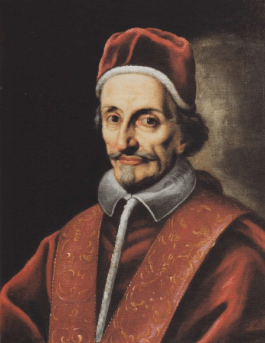
Pope Innocent XI 2

Pope Innocent XI

As his statue in Via Odescalchi  and his portrait convey, Pope Innocenzo XI was an austere character. He was known for his ascetic habits and his attempts to abolish nepotism. However, in spite of this, the Odescalchi family would undoubtedly have profited from his papal position and another strong branch of the family established itself in Rome from that time acquiring substantial property in the capital as well as priceless works of art still in the family’s possession. The Pope did however stick to his high moral principles and set about prohibiting gambling and usury within the Papal States as well as closing all places of public entertainment in Rome itself.  His austerity and frugality certainly was of benefit to the papacy which he left considerably better off on his death due to his supreme financial and administrative capabilities. He was sanctified in 1956 by Pope Pio  (Pius) XII.

Villa Odescalchi

Villa Odescalchi in Alzate Brianza, built as the personal residence of Pope Innocent XI

During his life he remained much attached to Como and had a personal residence built for him just a few kilometres away in the small town of Alzate Brianza. This lovely neo-classical villa has now fallen on hard times and is currently up for sale by auction (current reserve price of €2,717,000) having remained unoccupied (and repeatedly vandalised) since closing its doors as a luxury hotel.  Another relative of the Pope had the Palazzo Odescalchi  built for him facing onto Piazza Roma in Como in the 1670s. Half of this palace has been converted into apartments and the rest of the conversion is still in progress.  Some of its former glory is still evident particularly in the frescoes done by the Recchi brothers and the monumental stucco work around the fireplaces.

The Odescalchi family was also the original owner of Como’s most renowned villa, the Villa Olmo. The land for this villa was initially purchased by the Odescalchi in 1664 who acquired it from the Abbey of Santa Maria di Vico. The current villa was constructed on the site in the eighteenth century and occupied by the family until the Como branch married into the Raimondi in the early nineteenth century. The Raimondis sold the villa on to a branch of the Milan-based Visconti  family, the Duke Visconti di Modrone, in 1883.

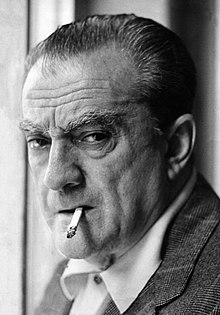
Luchino Visconti di Modrone

Film director, Luchino Visconti di Modrone was a member of a local noble family who bought Villa Olmo from the Odescalchi-Raimondi dynasty. He himself frequented nearby Villa Erba for summer holidays.

It is the famous serpent emblem of the Visconti family which now crowns the entrance to the villa. The neo-realist film director, Luchino Visconti (1906-1976) would spend summer holidays in the nearby Villa Erba in Cernobbio.  Villa Olmo was passed on to the Comune of Como in 1925.

Like most other noble families, the Odescalchi protected their privileged position through securing titles and making tactical marriages with other noble families. Following Benedetto’s death, the family secured a string of noble titles in Hungary and Slovenia from the then Hapsburg Holy Roman Emperor, Leopold I. Benedetto’s sister, Lucrezia married into the Erba dynasty – a family that also had originated in Como.  In the 1820s the Como Odescalchis joined the Raimondi family.  One visible result of all the inter marriages was the way names became longer and longer.  It was the illegitimate but recognised daughter of Marquis Giorgio Raimondi Mantica Odescalchi who, at the age of seventeen, became very briefly the second wife of the fifty-two year old hero of the Risorgimento, Giuseppe Garibaldi . The marriage was annulled almost as soon as completed due to the likely infidelity of the bride. One of the witnesses to the marriage was a Count Giulio Porro Lambertenghi – another name appearing amongst the street names in Como’s centre.

Palazzo Chigi Odescalchi

Palazzo Chigi Odescalchi, in Piazza Santi Apostoli in Rome. Bought in 1745 and still the current home of Prince Odescalchi and family.

Benedetto Odescalchi  (Pope Innocent XI) died without heir but his niece Lucrezia maintained the family line through marriage to the Erba family and a strong Odescalchi dynasty established itself in Rome from then (seventeenth century to today), all in spite of the former pope’s disapproval of nepotism and usury.

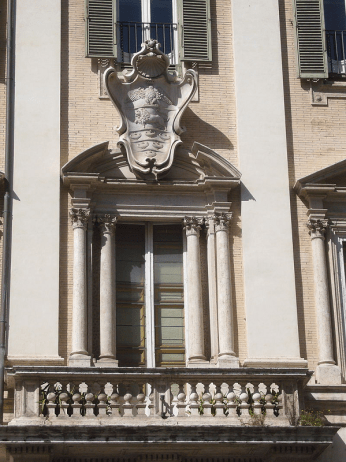
Palazzo Chigi Odescalchi with arms

Detail of the baroque exterior of Palazzo Chigi Odescalchi showing the family crest.

In fact the current Prince Odescalchi lives in the Palazzo Chigi-Odescalchi on Piazza Santi Apostoli in Rome. The exterior of the palace was designed by Gian Lorenzo Bernini in around 1665 and in spite of being restored after extensive fire damage, remains a superlative example of Italian Baroque architecture. The palace was purchased by Prince Baldasssare Odescalchi in 1745. This is just one of the many properties owned by the family in and around Rome. Of note also is the Castello Orsini-Odescalchi in Bracciano. This was inherited as the feudal estate of Bracciano passed from the Orsinis to the Odescalchis towards the end of the seventeenth century. The castle is now open to the public as well as being used for weddings and other events.

Castello Odescalchi a Bracciano

Castello Orsini-Odescalchi at Bracciano with the lake in the background.

The family do however retain an interest in another of their castles – the Castello Odescalchi di Santa Marinella, on the coast near to Civitavecchia. This castle originates from the fifteenth century and was bought by a more recent ‘Baldassare’ in 1888. He acquired it in an auction for very little just as today one could acquire the Villa Odescalchi in Alzate Brianza for relatively little if wishing to participate in the auction on the 15th July.

Castello Odescalchi a Santa Marinella

Castello Odescalchi at Santa Marinella in Civitavecchia

Baldassare Odescalchi went on to be elected to the Italian Senate in 1896. The family developed a beach resort linked to the castle which became a favoured spot for film stars and celebrities in the 1950s with famous guests including Totò, Alberto Sordi, Roberto Rossellini and Ingrid Bergman. It is now also rented out for weddings and retained for the family’s own use as was testified in an interview back in 2014 in Grazia with Sofia Odescalchi, daughter of the current Prince and duly described as an ‘It’ girl!

Sofia, renowned for dining under a Caravaggio in the family’s home on Piazza Santi Apostoli and for spending weekends at the seaside castle in Santa Marinella, was keen to present herself as rather ordinary in her Grazia interview. Here is an excerpt  included just to give an indication of how current aristocrats seek to retain low, understated profiles of banal normality if only publicly.

Grazia: Sofia, must I address you as Princess?

Sofia: Stop pulling my leg! It’s great having an aristocratic name and all the history but all the rest is a disadvantage.

Grazia: How come?

Sofia: Everyone thinks you must be a spoilt brat used to having everything – but it’s not like that.

Grazia: Do you live by yourself?

Sofia: Yes, in a studio flat with a small terrace. I manage it all myself.

Grazia: Is it true you like extreme sports like paragliding and white water rafting?

Sofia: Yes, I find them exhilarating.

Grazia: What’s your dream?

Sofia: To work in the fashion industry.

Grazia: Have you got your own style?

Sofia: Yes, it’s a mix of vintage pieces I pick up in London and items stolen from my mother’s wardrobe. I love soft, capacious handbags like those of Zanellato. I always wear a chain necklace.

Grazia: Do you ever feel like a prisoner in a gilded cage?

Sofia: No – and then I only go to my parents’ castle for a bit of peace – and the sea!

Sofia and Lucia Odescalchi

Sofia with her mother Lucia Odescalchi

If you would like to purchase Villa Odescalchi in Alzate Brianza at auction, there is still time to submit your interest prior to the bidding on https://www.realestatediscount.it/aste-immobili/villa-dei-papi-odescalchi-1162/.

If on the other hand, you wanted to arrange an event at the Castello Odescalchi in Santa Marinella, look at its website for further details.

If you would prefer an Odescalchi connection in Como, enquire into purchasing one of the renovated apartments in the Palazzo Odescalchi at  http://www.palazzo-odescalchicomo.it/eng/

Posted in Architecture, Culture, History, People, Places of interest, Uncategorized | Tagged , , , , , , , , , , , , , , | Leave a comment

Como’s Four Seasons – 4: Summer, Open House

Passeggiata

A reflective moment on the lakefront passeggiata in Como.

Lake Como holds open house over the summer – an invitation extended to all to come, visit and share its beauty. Be aware though that summer on the lake can lend itself too readily to cliché – those perpetuated by the tourist industry itself, those provoked by the expectations of Spring and those that may even emanate from within ourselves as the weather promises a renewed sense of freedom. 

The reality beyond cliché is of course more interesting. Often the freedom promised by the increased warmth turns to restriction as the heat outdoors becomes  unsustainable. Or the pleasures of the evening passeggiata are undermined by a night’s sleep disturbed by an airless ‘affa’ over the city. But these are more the sort of issue faced at this time of year down in the Pianura Padana and Po Valley where atmospheric conditions boosted local tourism in the early 20th century as the new railways allowed so many Milanese to escape onto the lake, or within the neighbouring Triangolo Lariano or the Intelvi Valley. For us, if the heat in Como should get a bit too much, Brunate is a short funicular ride away where it will be at least four degrees cooler. 

Funicular

The funicular to Brunate from Como – a rise of around 500 metres and a 4 degree drop in temperature.

They say that the intermediate seasons of spring and autumn are shortening as winter and summer get longer. It is not so easy though to determine exactly when summer starts. It’s nothing like the summers I was used to in the UK, renowned as they are for massive fluctuations in weather conditions giving an overall sense of unpredictability. That is more typical of a Como spring. Perhaps what differentiates summer here, apart from the increase in temperature, is the on-come of a more stable weather pattern formed by the anticyclones originating from over the Azores. As these become established, they dominate the climate of the entire Mediterranean region. So the biggest change for Como is that one of the most land-locked areas of Italy becomes Mediterranean for a few months.


Lakeside restaurants

Lakeside restaurants entice passersby along Viale Geno, Como

Many of the lakeside restaurants may have already been pretending to be ‘Mediterranean’ throughout the year. Now even the more established places forego the heavy dishes typical of the winter cuisine with its predominance of pork, polenta or rice in favour of fish (either from the lake or the nearby Milanese markets), pasta, fruit and vegetables from the fertile south. Heavy red wines like Inferno from the Valtellina, Barbera from Piedmont or the fizzy Bonarda designed to accompany all the delightful processed pork dishes from the Po Valley give way to aromatic white wines from Friuli, Alto Adige or Campania. The al-fresco lakeside restaurants do their best to seduce or cajole passersby with their promise of food, wine and a view and no doubt most of the time the experience will be positive, but by no means always.  

Hortensias in Villa dell Grumello

Display of ortensia in the gardens of the Villa del Grumello, open throughout the summer at weekends and throughout the week in August.

Lake Como’s, or to be more precise the Lombardy Region’s drive to increase tourism and direct it to destinations beyond Milan seems to be working well. Hotel occupancy increases each year. New luxury and budget accommodation is coming on stream constantly. One visible result is the number of people in the city – and the queues that form outside the Navigazione Laghi’s ticket office or for the funicular up to Brunate. Queuing for boat tickets is no longer necessary since the Navigazione Laghi adapted its website to allow for online sales. The Funicular railway, managed by ATM – the Milanese public transport company, have yet to follow the example of the Navigazione Laghi so queuing at their ticket office is often unavoidable.

Ferragosto 2

In August, queues for the funicular railway or the lake boats are inevitable but at least tickets for the boats can be bought online.

The Como end of the lake is characterised by small towns or villages nestled into valleys within the steep-sided mountains rising from the lakeside. This is what makes our area so beautiful and also restricts much further development. While this helps safeguard the tranquillity of the individual communities, it does make travelling between them somewhat difficult on the narrow twisting roads. All it takes is for two good-sized tour buses to meet in one of the more constricted sections of the lakeside road to create lengthy traffic jams. So, take the boat rather than the bus, and if forced to travel by car, allow plenty of time for any journeys that take you through notable pinch points such as Sala Comacina or Ossuccio. 

Inviting waters Careno

The inviting water at Careno – a tranquil spot even in the height of August.

A significant part of the summer’s liberating feeling is the extension to a life outdoors – the same sense that inspires the hopeful organisers of so many village fetes across the UK. Here, even though events often have alternative arrangements in place in case of bad weather, they rarely need to be invoked allowing us all to enjoy the many varied festivals, ‘sagras’, and open air events that run throughout the summer months.

Canadian Choir

There are a full variety of festivals and other musical events on Lake Como throughout the summer.

corpo musicale

Como’s Teatro Sociale hosts a season of summer concerts in its open-air venue known as the Arena under the banner of the Como Città della Musica Festival. They always include a major opera production (this year it is Verdi’s La Traviata) involving a large number of local residents within the production’s chorus. In fact the whole summer on the lake is characterised by musical events and festivals of all kinds. Check out our section on Musical Events and our calendar for more information on what is taking place, as well as glancing at the official Como newsletter.

Villa D'este

The Hotel Villa D’Este in Cernobbio, one of Lake Como’s luxury hotels.

Tourism on the lake is still very seasonal even if the season seems to be lengthening. The luxury hotel Villa D’Este in Cernobbio marks this by providing local residents and visitors with spectacular fireworks from time to time as part of some hotel-based celebration such as a wedding or for their traditional celebration of the United States’ Independence Day on 4th July. 

Isola Comacina

The spectacular annual firework display at Isola Comacina re-enacting the sacking of the island by the Como fleet in 1169.

Nothing though can equal the most extravagant firework display held every year on the Saturday closest to St. John’s Day – usually the last or penultimate of the month. This celebration of the ‘Sagra di San Giovanni’ is in effect a re-enactment of the sacking of Isola Comacina by the Como fleet back in 1169 as an act of revenge for the island’s previous alliance with Milan during Como’s 10 years war with the cities of the Northern League. During the display it seems as if the whole of Isola Comacina is consumed by flames – a true pyrotechnical wonder. No doubt the Clooneys will have accompanied their newly arrived guests, the Obamas, travelling by boat from Laglio to Sala Comacina to witness the spectacle. Arriving and departing by boat is the best option.  As dusk falls a whole flotilla of small boats gather in the channel that divides the island from the mainland to await the start of the action. Given the narrow roads and the numbers attracted to the event, it is best to travel to and from the event courtesy of the Navigazione Laghi who lay on special cruises.

Lake

No stay on the lake in summer would be complete without at least one swim in its dark, clear waters. On the evening of July 22nd, 600 people will participate in a mass crossing of the lake from the delightful town of Torno to the equally delightful Moltrasio. This represents a one kilometre swim in waters which should have warmed up to above 20 degrees Celsius by then. This event has become so popular locally that all 600 places were signed up for within two hours of opening for applications. For those of us looking for a less challenging swim, read our two articles on water cleanliness and beach selections, or use the Italian government’s site to check on the water quality wherever you may be staying. 

Orion

Orion, one of the largest of the Navigazione Laghi’s boats.

The tourist season peaks during the week including the national holiday of Ferragosto on August 15th. In the past most factories would have closed for the entire month of August. That is no longer the case but the vast majority in Italy will at least be on holiday during Ferragosto week.

Duomo

The interior of Como’s Cathedral

For Como, Ferragosto is particularly significant since this is at heart a day of religious celebration to mark the assumption – the ascension to heaven –  of Mary, and Como’s cathedral is dedicated to Santa Maria Assunta. In lead up to this event, the cathedral leaves its massive western doors open in the evening so passers by can look in on the richly decorated dome and roof illuminated to great effect. 

The storms caused by clashes of cold and warm air tend to multiply as summer progresses and provide the first intimations of us losing our Mediterranean identity as autumn beckons. However, if it was hard to identify the start of summer, it is even more difficult to define its end. Maybe the best guide are the dates of the scholastic year which ended on the 8th June this year and will start again on 15th September.

Storm clouds Baradello

Storm clouds gather by the Baradello Tower

Certainly by then the intense heat will be over and the days are noticeably shorter but… nothing else will necessarily change until the weather systems above the Azores weaken and allow Como’s climate to revert to its major influences arriving from across Continental Europe or the Atlantic. The Villa D’Este has traditionally turned its back on tourists by then and welcomed instead the politicians and industrialists who come for Italy’s version of the Davos World Economic Forum – the European House organised by the Ambrosetti Club. With the tourist season extending, they may well prefer if it were possible to postpone this prestigious event until mid October but rather worryingly, traditions evolve more slowly than the climate these days. 

Lakeside passeggiata

The lakeside park in Como

Como’s nature changes markedly thoughout the seasons and we have tried to capture some of these different features in this mini series of blogs. We started off in Autumn as if we were following the academic year, on to winter where Como puts on an extravagant show for the holiday period followed by a deep hibernation which in turn gives way to the rebirth of Spring.

Marching Bands

Marching bands form part of the summer’s musical entertainment

Posted in Events, Gardens, Lake, Uncategorized | Tagged , , , , , , , , , , , | Leave a comment

Palanzo on Show: A Pilgrimage to Serenity

Palanzo

View of Palanzo from above Molina, courtesy of the Amici del Torchio di Palanzo

Within the comune of Fagetto Lario, on the road from Como to Bellagio and suspended about 300 metres above lake level, are three small medieval towns – each as beautiful as the other. From the lake you see them nestled in the mountainside in a string above Faggeto starting with Molina to the south, Lemna in between with Palanzo at the end.

Palanzo 5

Ancient portico in the heart of Palanzo

Palanzo has decided this year to show off its very particular appeal to a broader audience than usual by holding an exhibition and various events over the three weekends between 15th and 29th June. It’s an artistic event designed to celebrate the town’s unique virtues. And quite rightly so since all three of these towns possess a singular quality of peace and serenity, with Palanzo perhaps exceeding its siblings through a touch more beauty in its architecture and in the advantages of its natural setting.

Il Torchio

The medieval wine press (il torchio) lies at the physical and spiritual heart of the town. Courtesy of the Amici del Torchio di Palanzo

The exhibition is staged in various parts of the small town and curated by Roberto Borghi and Stefano Ceresa. They have produced a fascinating guide to the exhibition which can be downloaded in PDF format. I was particularly impressed by the written introduction to the guide by both curators. Stefano Ceresa cites the importance of the old wine press at the centre of the town (which dates from 1572 and is a national monument) as almost representing the original soul of the community. He mentions how the town is surrounded on all sides by impressive dry stone walled terracing used in the past for the production of grain and fruit and for the extensive cultivation of black grapes. Many of these walled terraces remain although agricultural production has ceased to be important and wine production a distant memory. But the wine press (il torchio), and the soul of the town, lives on.

Terracing

An example of the extensive dry stone wall terracing to be found surrounding Palanzo. This example is on the stretch of Strada Regia to the north of Palanzo in the direction of Pognana Lario.

terracing 2

Palanzo when all the terraces were intensively cultivated. The decline in agriculture has transformed the hillsides around the lake since the 1940s.

I have often mused to myself as to what is the best elevation for viewing the lake. Is it on the lakefront itself, or half way up the surrounding hillsides or viewed from way above when walking on the crest of the mountains? I have come to believe that Palanzo and its sisters share the ideal, more or less at two hundred fifty metres above the lake level. At this height the lake is not so far down to not be in constant sight, yet it is away from the more intense commercial activity or the numbers of people to be found at lakeside, particularly in the summer months. It and they are also very much welded into the mountainside with Monte Palanzone rising to over one thousand metres behind them.

Cascata Palanzo

Waterfall on the walk towards Pognana.

Roberto Borghi’s introduction in the ‘Palanzo in Mostra’ catalogue identifies how Palanzo’s reality is defined by the three physical factors of sky, lake and mountain with rock and water forming the vital elements. Buildings and terraces are made from locally quarried stone. Water is present in the abundance of the lake and also in the streams, springs and waterfalls that surround the town. He goes on to introduce the exhibition in the form of a metaphor where the artworks on display form a type of glossary to Palanzo, the story. And if Palanzo is a story, the routes to follow from one set of exhibits to another form the narrative lines. Water for Borghi is the main protagonist in this metaphorical story of Palanzo with an implicit, actual and symbolic presence.

Palanzo 3

Maybe I have now been living in Italy long enough to become accustomed to the type of  metaphysical hyperbole in Borghi’s description of the town, but I believe Palanzo warrants it. Palanzo (and her sisters) deserve both the hyperbole and strangely enough, the meta-physicality. Borghi describes the work of one set of exhibitors, the Como-based visual installation co-operative ‘OLO Creative Farm’ as representing a pilgrimage to the town. It’s true to say that when you enter Palanzo you leave one world behind and enter a different reality, one that Borghi sees as being mysterious, silent, thoughtful inspiring contemplation, as shared with the pace and reflection of pilgrimages in the past. He admits that all this serenity may not be to everyone’s taste, and certainly it may not be so easy to live in such a community if unaccustomed to the silence of its indolent rhythm. And who knows, maybe that serenity starts to fade as new arrivals become more accustomed to the place and aware of the various forms of intrigue commonly found in most societies. But he totally captures the spirit of the town to those of us visitors willing to be impressed.

Palanzo 1The exhibition itself consists of six different sets of works displayed across the small town. All of the works are relevant to Palanzo in one way or another – as Borghi says, providing a glossary or a set of footnotes to the town. The catalogue suggests an ‘itinerario espositivo’ that starts off with the sculpture by Como-born Carmen Molteni on two sides of the large doors to No. 3 Via Stretta. Moving on to a courtyard by the town’s wine press you see the large canvases depicting Palanzo’s view down onto the lake. These are the work of Milan-born Alberto Colombo who now has his studio in nearby Torno.


The Bar Dolores is the only bar in Palanzo and so it is not hard to imagine how central it must be in the social life of the town, particularly for those whose working life is over and who have the time to meet and talk. Borghi describes it as ‘Simenon-esque’ Photographer Jeanette Muller, Swiss-born and resident in Como Province, has taken a series of images of some of the bar’s former and current habitues and these are on display here.

Sentieri Palanzo

Palanzo lies on the Strada Regia with paths also up to the summit of Monte Palanzone and the Rifugia Riello

Palanzo does boast a very small but well maintained library and this now houses the exhibition of photos taken by the members of the OLO Creative Farm collective when on their ‘pilgrimage’ from their base in Como to Palanzo.

lavatoio

The ‘lavatoio’ – Palanzo’s communal laundry facility used in the days before domestic washing machines.

So many towns and cities in Italy retain the communal laundry facilities known as ‘lavatoio’. These are no longer used but they seem to be preserved, if not intentionally, to provide a collective reminder of a not-so-distant past where everyday life was materially much poorer but socially richer. Palanzo boasts a particularly fine and extensive example of a lavatoio, and it has been used to display the sculptures by Milan-born Ornella Piluso, better known as Topylabrys in the art world. The final installation is the sculpture by Roberto Biondi in the portico of Chiesa della Madonna del Soldo. His suspended empty frames look down onto a view of the lake which is itself framed by the arches of the church’s portico – a work which exploits the unique qualities of Palanzo’s natural setting.

Madonna del Soldo

The Chiesa della Madonna del Sordo, on the southern edge of the town with a view over the lake.

Palanzo 6

To accompany the exhibition, a series of events have been organised for each weekend starting on the 15th June and ending on the 29th. Visit the site of the organisers, the Associazione Amici del Torchio di Palanzo, for more information on these events, about the Torchio itself or on the other events they organise throughout the year.

Palanzo can be reached from Como on Bus C31 but note that no buses operate there on Sundays. Alternatively, if you have time to enjoy a walk taking in all three of these medieval towns, read our article on the stretch of the Strada Regia starting from Torno and ending at Pognana.

Posted in Architecture, Art, Culture, Events, Itineraries, Lake, Places of interest, Uncategorized | Tagged , , , , , , , | Leave a comment

Exercising Outdoors – Some Options

Total Fit 3

Total Fit’s instructors lead a group through their exercise programme beside Como’s Monumento ai Caduti.

Most of us recognise that physical activity is good for us – but exercising indoors can be unappealing particularly when the weather improves as at this time of year. So here are three main and some supplementary options for exercising outdoors under guidance and in the company of others.

Total Fit

Total Fit 1If you pass by the Monumento ai Caduti (the War Memorial) along the lakefront you may well see an animated group, ranging from between ten to twenty people, being led through a work out to the accompaniment of a reggaeton soundtrack. These classes are run by Total Fit. Their website introduces themselves as follows:
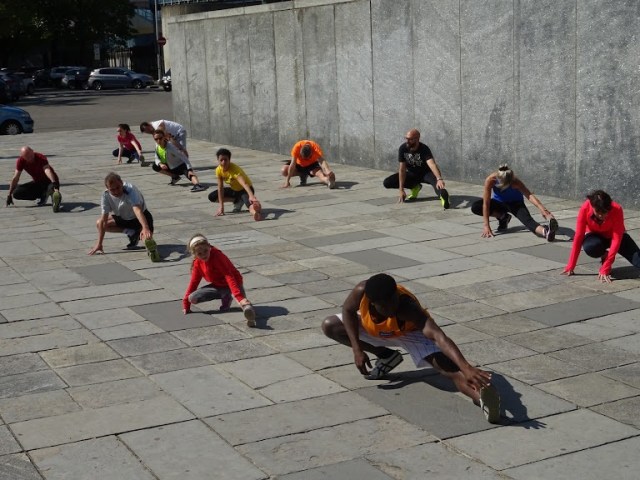
‘We aim to appeal to those who do not want or are unable to subscribe to a classical fitness centre where you are left on your own during your training without options for stimulus or support. With us instead you will find a welcoming and enjoyable environment.’

The website (in Italian) also includes this illustrative video which captures some of the excitement and energy I witnessed when passing by the other day.

Total Fit 4

Total Fit have a three point approach to wellness, namely through exercise, nutrition and what they refer to as integration. Their holistic philosophy is something participants can take on, explore as profoundly as they wish or alternately, ignore in its entirety. Theirs is a well-established organisation that has been running for the last three years in which time they have built up a following of over sixty clients.  They are associated with Herbal Life, the nutrition and dietary supplement company. They do state that those who sign up with them are entirely free to pursue any recommended lifestyle goals as far as they wish. Nor are they obliged to purchase supplements from Herbal Life if they prefer not to.

Total Fit 5You can just drop in at the Monumento dei Caduti on one of their outdoor sessions held, weather permitting, from 09.00 to 10.00 on Mondays, Wednesdays or Fridays and from 10.00 to 11.00 on Saturdays. There are also two evening sessions held in the same location from 20.00 to 21.30 on Tuesdays and Wednesdays. One session will cost you €10. When weather does not permit, sessions (at the same times) are held in the gym of the Scuola Media ‘Ugo Foscolo’ on Via Borgo Vico. All ages, abilities and aptitudes are welcome with courses designed for three levels of participation – base, intermediate and advanced. Each level has its own focus for achievement with base level directed at posture and breathing, intermediate at strength and resistance while advanced incorporates cardio and muscular definition. Scroll down to the end of the article for their contact information.

MammaFit logoMammaFit

Total Fit aim to hold their exercise sessions outdoors as far as possible for both the physical and mental benefits of direct contact with nature. The same commitment to exercising in a natural environment is shared by our next group – MammaFit.  If you were to continue your walk from the Monumento ai Caduti, along the lakefront walkway to the gardens of Villa Olmo, you may well see a group of young women, with their babies in buggies, being led through an exercise programme designed specifically for postpartum mothers.

Mammfit 1MammaFit is an Italian organisation set up to offer vital support to mothers looking to get back into shape after giving birth. But its much more than a standard exercise class. Its an opportunity to get together away from the home, to undertake exercises designed specifically for the needs of a new mother and of course, to share thoughts, ideas and information amongst a peer group facing the same sort of emotions, concerns and challenges.
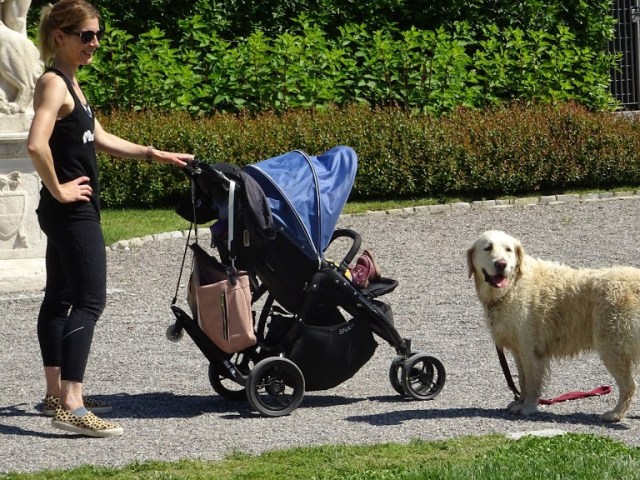
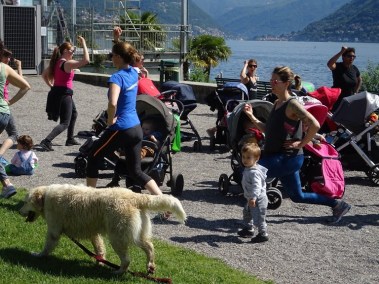
Mammfit 7

Katy Rose, leader of the Como group of MammaFit with baby and dog.

The Como group meet in front of Villa Olmo, on the lakefront close to the Lido bar on Tuesdays and  Fridays at 10.30, weather permitting. They are led by qualified personal trainer and osteopath Katy Rose who is originally from the UK. Her group is truly international consisting of both Italian and foreign mothers. As with Total Fit, the instruction is given in Italian but language really is no barrier and of course, Katy can always clarify in English if necessary.

Mammfit 3Recent mothers are recommended to join the programme approximately forty days after the baby’s birth and maintain it for about twelve months or as long as the babies are happy to stay sat watching in their buggies. In fact, the babies all seem totally intrigued as they watch the circle of mothers pass by their push chairs. The activity has a calming effect on everyone, including Katy’s beautiful dog!
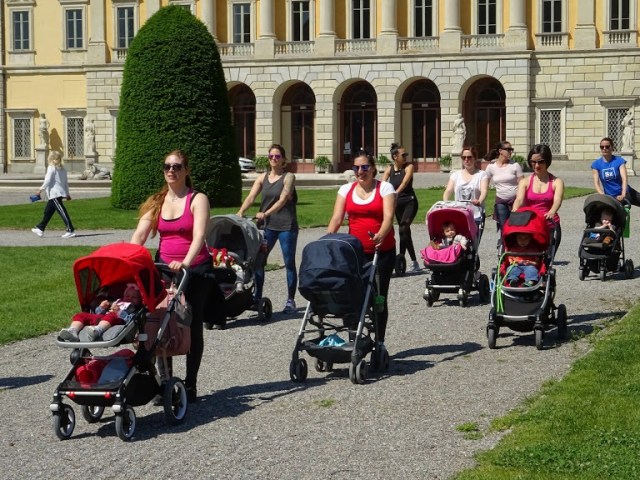
Katy’s personal journey from Guildford in Surrey to Como is fascinating and she shares some of the similar qualities I discovered when recently interviewing Sarah Aller, Como’s New York artist – a determination to make a success of living as an ex-pat by embracing Italian life for its positives and of course, managing the negatives! Sarah happens also to be one of Katy’s MammaFit participants.

Mammfit 4Katy started leading the Como group back in 2016 having completed her training with MammaFit in 2015. She was looking for an activity that allowed her to continue her interest in physical activity while caring for her new-born child. Now into her fourth year, she is again accompanied by her second child but also thinking of the needs of mothers with toddlers. For them, she has devised her own programme held indoors called ‘Back in Shape‘. Contact information for MammaFit and Katy is at the end of the article.
Pratiqiamo logoPratiqiamo

June in Como is the ideal month for outside physical activity – the heavy rains of spring have stopped, the sun is shining but the temperatures have not yet risen too high. It is just the right time to participate in the totally free ‘pop-up’ activities organised by Pratiqiamo which start on Monday June 17th.  All the groups mentioned here pay attention beyond the physical to embrace the mental and social advantages of participating in outdoor activities. For Pratiqiamo these aspects, alongside the ethical, are fundamental to their philosophy based as it is on the principles of the Chinese art of Qi Gong from which are derived Tai Chi and other martial arts. As was explained to me by Francesca Cervellino, Pratiqiamo’s activity coordinator,  Qi Gong is basically about listening to your body and learning how to use our internal energy.

pratiqiamo 1Pratiqiamo is a loose grouping of like-minded professionals who volunteer their time to offer a month long programme of physical activity in the open, for free.  They range in age from 30 to 70 and come from a variety of different disciplines including dance and sport as well as the martial arts. They eschew publicity as much as they reject formal organisational structures, marketing or any other aspect of commercialism. However, by following their Facebook page and getting your details into their WhatsApp group via Francesca, you will receive all the practical details as to where and when they are meeting.
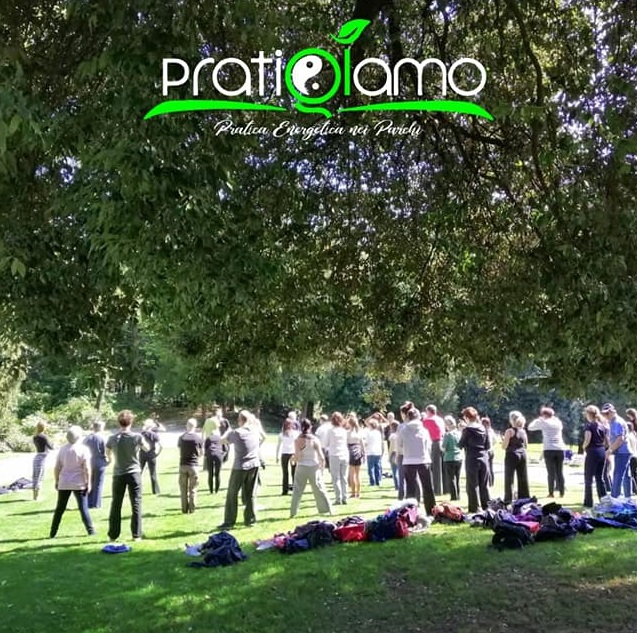
pratiqiamo 2For them, being outdoors and surrounded by nature is of primary importance hence their name Prati-Qi-Amo (translated as Fields-Qi Gong-I love) but also sounding like ‘pratichiamo’ – we practice. They like to locate their activities within Como’s different parks  and public spaces with the intention of reclaiming these as places for communal enjoyment. Some of Como’s parks away from the lakefront can be somewhat neglected and certainly underused. Pratiqiamo aim to assist the reintegration of these overlooked areas back into social urban life.
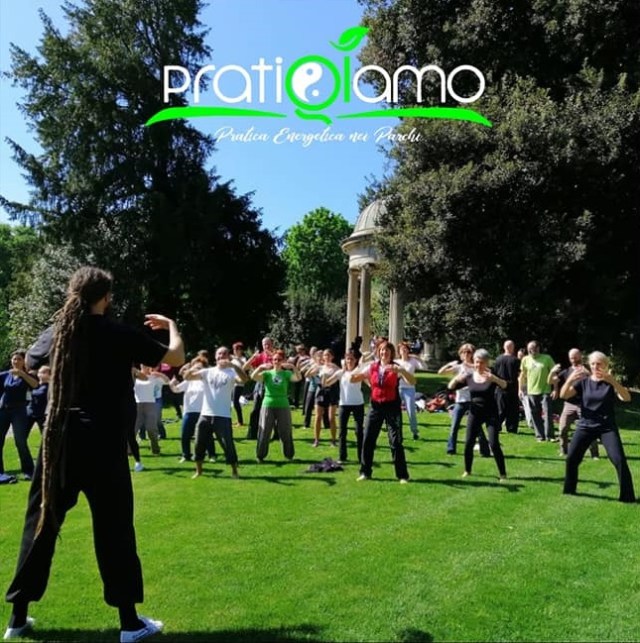
pratiqiamo3Their group activities are not highly structured. Each session is normally ‘guided’ (not taught) by three or four leaders. They seek to assist all participants, no matter what age, level of experience or capacity, to find their individual source of energy. Language is not a barrier. Francesca speaks English but, as with the other physical activities described here, communication is as much about being led by example as through verbal explanation.
Pratiqiamo’s programme (if it can be called as such) runs for just about a month starting on Monday June 17th. They may also hold one or two additional events at other times of the year. Follow their Facebook page to get information on the start of their activities or you may also contact Francesca directly. If you have time free in June or are visiting Como during this month, get your name and details into their WhatsApp group so you know where to be and when. Contact details can be found at the end of the article.

Row-In-Fit

Gerosa Twins Provincia di Como

The Gerosa twins, instructors for the evening classes in rowing for adults known as Row-In-Fit. Photo courtesy of the Provincia di Como.

Right alongside the Monumento Ai Caduti is the club house of Canottieri Lario, Como’s very successful rowing club. They too offer classes for adults aged typically from twenty five to sixty and above. These are not strictly outdoor courses since they run in the evenings from autumn through winter until spring.

vascavoga

The Vasca Voga at Canottieri Lario

They make use of the club’s gym and the ‘vasca voga’ – one of the unique features of the club which allows teams to practice rowing indoors.  They do also go out on the lake on occasion if weather permits. These evening classes have been running for the last seven years and they offer a great way for participants to test out if rowing could be an enjoyable physical activity for them. In many cases, this proves the case since usually about half of the courses’ participants go on to join the club.  Instructors such as the Gerosa twins, are both qualified and experienced rowers.

Summer Activities for the Young

June sees the start of the long summer holidays which bring the annual challenge for parents to find activities to keep their children occupied and happy.

Horse Riding

Red House Horses

One of Red House Horse Riding Club’s ponies being introduced to an adoring public.

The Red House Riding Club, based in Senna Comasco on the road out of Como towards Cantu, organise two weeks of summer camp with a daily programme running from 09.00 to 17.00. If days horse riding and helping out in the stables with an international group of children might be of interest, contact long-time English ex-pat resident Roz on +39 338 3405 954 for more information.

Football School

The soccer school run by the famous Portugese team, Benfica, hold soccer training camps for children and young people in Olgiate Comasco from 10th to 14th June, in Giubiasco from the 17th to 21st June and a residential course in the Valtellina from 30th June to 5th July.

Contact Jorge Pinto (Portugese also speaking Italian, Spanish and English) on +39 349 385 0344 for more information. You can also visit their website.

Varied Sports

rugbycomoGo to our Sport page for details of a number of other organisations offering courses for adults and children. Check out the Como Rugby Club who will be facing a touring team from Ireland later this month and are also holding an open day for children born between 2008 and 2015 this Saturday (8th June) from 15.30-17.00 at the Centro Sportivo Belvedere on Via Longoni.

Contact Details

Total Fit

Website: http://totalfit.it/ 

Facebook: @totalfit.it

Contact name and number: Marta Garlaschelli +39 333 241 7952

MammaFit

Website: http://www.mammaf.it/

Facebook: @MammaFit

Contact name and number: Katy Rose +39 392 533 7036

Pratiqiamo

Website: https://www.facebook.com/pratiqiamo/

Facebook: @pratiqiamo

Contact name: Francesca Cervellino, message her via Pratiqiamo’s Facebook page and send your telephone number to her to get included in the WhatsApp group.

The first week’s schedule of Pratiqiamo’s activities are also listed on our calendar and future dates will also be included when known.

Row-In-Fit

Website: http://www.canottierilario.it/

Facebook: @canottierilario

Contact name and number: Call +39  031.574720 Mondays to Fridays 09.00 to 12.30 and 14.00 – 18.00


Posted in Events, Gardens, People, Sport, Uncategorized, Wellness | Tagged , , , , , , , , , , , , , | Leave a comment