Fables, Legends and Folklore: The Festa della Giubiana


Giubiana

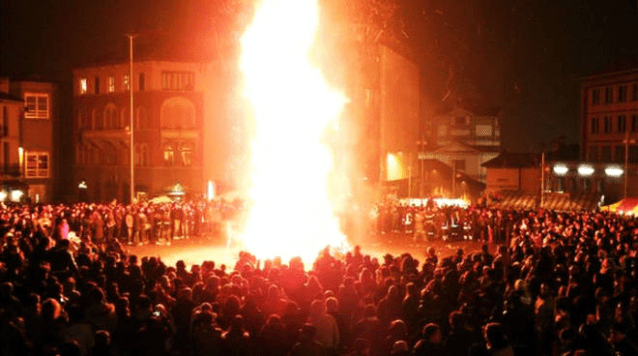
The effigy of the Giubiana put to flames

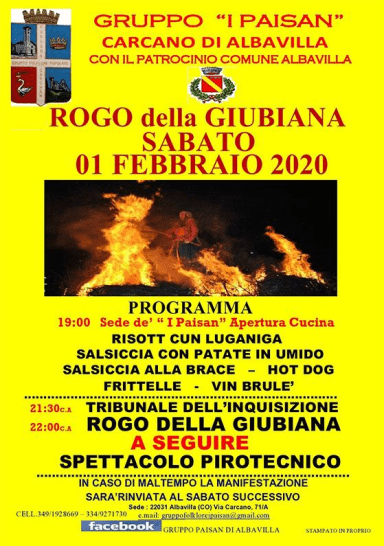
Up to sixty years ago, the predominant culture in the Como countryside, as in much of Italy,  was that of the ‘contadino’ – the peasant farmer – engaged with family in a struggle for survival ever open to the vicissitudes of fortune. The contadino’s year was dominated by the agricultural cycle punctuated with periods of plenty or paucity, activity or sloth, with family life providing moments of joy or sorrow. This culture was enriched over time by fables, legends and folklore encapsulating aspects of the contadino’s wisdom gained from acute environmental awareness and sustained through an ignorance attributable to their necessarily restricted focus on survival.  Nowadays, that culture is dead but it has bequeathed a rich legacy of customs, rituals, local cuisine and artisan crafts. Its folklore and rituals provide even the most urbane of us with a link to our distant past, to mystical times when fundamental issues determining man’s fate could only be resolved through magic and fantasy. So it is that our ancestors, when perceiving the first signs of nature reawakening as the sun seemed to regain some power, celebrated the season by the symbolic burning of all the ills and misfortune of the old year in the hope that this cleared the way for better luck in the year to come. This is the festival of the Giubiana – and it is celebrated today in many towns across Como and Brianza on the last Thursday of January (although some towns celebrate it on the following Saturday to accommodate the modern rhythms of our industrial society).


Risotto

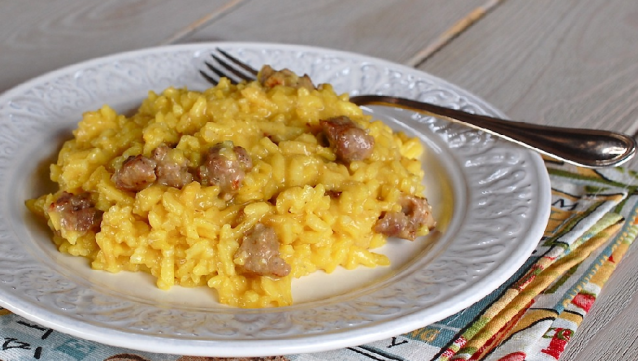
Risotto alla Milanese with Luganega sausage – the dish traditionally eaten during the Festa della Giubiana

This Thursday the Festa della Giubiana will be celebrated by burning an over-sized human effigy on a massive bonfire after conducting a symbolic trial and sentencing. Participants will then set to feasting with a specific local dish made of Milanese risotto (risotto flavoured with saffron) and a particular sausage called ‘luganega’.  On Lake Como, the Giubiana will be ceremonially tried, sentenced and burnt in Varenna at 20.30 and in Bellagio on Saturday at 20.00. The most spectacular celebration takes place in Canzo on Thursday with another sizeable celebration also on Thursday in Cantu. Albavilla also has a long tradition of celebrating the Giubiana but on Saturday joined also by celebrations in Barni and Civenna. Most celebrations start from around 20.00. 

Cantu

The bonfire in the centre of Piazza Garibaldi, in the heart of Cantu. Cantu burns a different effigy to all other towns in the area for reasons described below.

Uomo selvatico

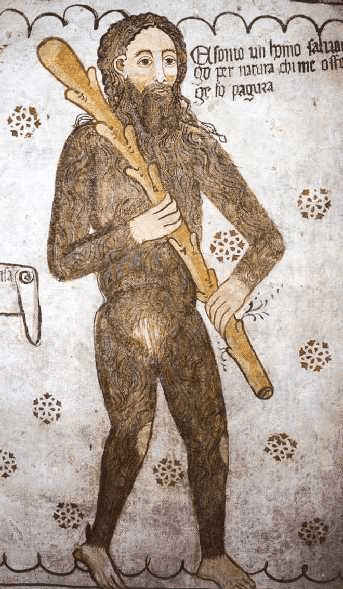
The Wild Man – a character from Alpine mythology who features in the Festa della Giubiana in Canzo.

The origins of the festival seem to date from when the Celts from Gaul had taken over from the Iron Age Golasecca culture from the 3rd to 2nd century BCE. There are various versions of the legend behind the celebration but the most common recounts how a mother outwitted an old witch. The witch, driven by hunger at the time of year when stores are depleted and nothing grows, had been forced to roam at night looking to capture and eat young children. The mother decided to lay a trap for the witch by cooking up a massive pot of risotto including the local sausage – luganega. She left the pot on her window sill. The delicious smells tempted the witch who settled down to eat her fill. The risotto was so delicious that the witch was still eating as the sun rose. Unfortunately the witch was as sensitive to sun as Dracula and so perished due to her greed. The mother had liberated the whole community from the fear of the witch and the sacrifice of their young children to her hunger. With the witch destroyed, the ills of the old year died with her and all could hope for better fortune through the year to come. 

Canzo Giubiana

Canzo’s poster for this year’s Festa della Giubiana

The most elaborate Festa della Giubiana is held in Canzo with a long list of characters playing their part in the four  act drama – the trial, sentencing, execution and celebration. The cast list in local dialect represents a rich variety of mythical sources and gives a good indication of the bizarre not to say surrealistic character of the event. It includes:

  • Giubiana – an elderly figure representing all that was bad in the past year
  • Anguana – an aquatic fairy from the district of Canzo known as the Ceppo dell’Angua
  • Ul Cervun (Il Cervo) – A giant stag in the figure of the Nordic/Celtic god of the forest, Cernunnos.
  • L’Omm Selvadech (L’uomo selvatico) – The wild man, a figure from Alpine mythology.
  • L’Urzu (L’Orso) – A bear representing the instinctive forces of nature that must be tamed.
  • Ul Casciadur (Il Cacciatore) – The hunter who captures and tames the bear and teaches it to dance.

    Cernunnos

    The Cernunnos from Celtic and Nordic myth

  • I Diaul (I Diavoli) – The devils who serenade the Giubiana
  • Il Boja (Il Boia) – The executioner who represents the condemnation of the bad.
  • I Cilostar – characters who carry candelabra on their heads symbolising the good that will conquer the bad.
  • I Strij picitt – Witches who scare the children and try to save their companion, Giubiana.
  • I Bun e I Gramm (I buoni e cattivi) – The good and the bad symbolised by children wearing either white or black.
  • Barbanegra – The town’s wizard.
  • Ul Pastur (Il pastore) – Masked representation of the shepherd’s craft.
  • Ul Buschiroo (Il Boscaiolo) – As with Ul Pastur but for woodsmen.
  • L’Aucatt di caus pers – The Milanese lawyer sent to defend lost causes i.e. the Giubiana.
  • La Cumar da la Cumtrada – The friend of Giubiana who reads out her testimony in court.
  • I Pumpier (I Pompieri) – The fireman dressed in historic costume on bicycles with fire fighting equipment from the 1800s.
  • Gli Scarenej – Representatives from the nearby allied comune of Scarenna.
Cantu 2

The young traitoress who caused the sacking of Cantu by Como in the 12th century is burnt in effigy rather than an elderly witch.

In Cantu their Giubiana is not an elderly witch but a decidedly beautiful young woman. This marked divergence in tradition apparently stems from the city’s betrayal by a young woman during the conflict between Como and Milan from 1118 to 1127 – a war in which Cantu had allied with Milan. One night during the war a young woman was heard knocking at the gates of the town begging entry and seeking asylum from the marauding Comaschi. She was granted asylum and entrusted with a set of keys to the town gates. She treacherously handed these keys over to the Comaschi who entered and burnt Cantu to the ground. However when the fortunes of war turned in Milan’s favour, the woman was captured, put to trial and executed by being burnt alive. 

Gruppo i paisan Albavilla

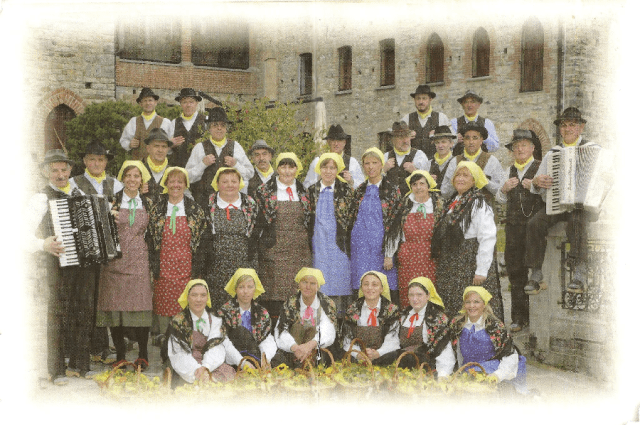
The group ‘I Paisan’ (contadini or peasants) from Albavilla. This group organises the Festa della Giubiana and undertake other initiatives to celebrate local folklore and culture.

Another of the notable celebrations locally is that in Albavilla, a small town just about 6 kilometres to the east of Como on the route to Lecco. Their celebrations are organised by an active group intent on maintaining awareness of local folk culture. This year they will introduce a detail that updates the idea of ridding the old year of its pains. Participants will be invited to make a brief note of any personal negative issues from the past year. These notes will be thrown into a communal bin which will then be put on the bonfire along with the Giubiana. Following fireworks all will celebrate with a plateful of risotto with non-vegetarians adding luganega.  Albavilla’s festival is on Saturday evening.

Gruppo i paisan

The Festa della Giubiana may well herald the first signs of the start of the natural cycle, but in spite of the sun showing signs that it will regain its strength, the winter is far from over. In fact, we are now coming up to what is known as the three days of the blackbird (the merlo) which traditionally are the coldest in the year – and there is another story from local folklore at the heart of why people to this day refer to the days of the blackbird. Click here to find out more!

If however, the bizarre sound of the Canzo festival attracts you, do not miss out on the truly anarchic, surrealistic street theatre which is the Carnival in Schignano. I cannot recommend this festival enough for its effortless invocation of misrule in a beautiful mountain setting. The organisers of all these festivals are to be complimented for their efforts in keeping alive local traditions, and in the case of Schignano, associated local crafts such as mask making. 

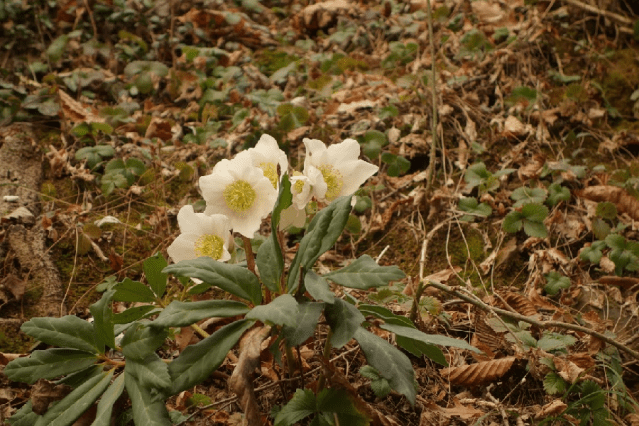
Helliborus

Helleborus, a winter flowering Alpine plant that grows wild in the woods around Lake Como.


Posted in Culture, Events, Folklore, Uncategorized | Tagged , , , , , , , , , , , | Leave a comment

Como Remembers the Holocaust

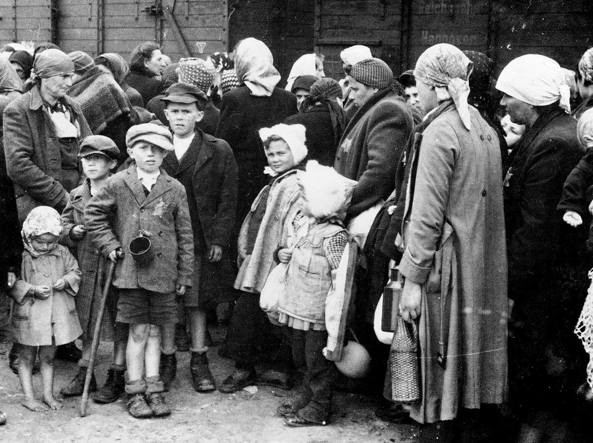
Jews deported from Alto Adige to Germany

Italian and foreign Jews resident in the Alto Adige facing deportation to Nazi-run concentration camps. Many German and Austrian Jews had previously migrated to the Alto Adige (Sudtirol) to avoid racial persecution only to find a gradual increase in discrimination codified in the Racial Laws of 1938 and progressing to active deportation from 1943 under Mussolini’s nazifascist regime known as the Republic of Salo.

27th January is International Holocaust Remembrance Day to commemorate the six million European Jews massacred by the Nazis in Germany as part of that regime’s belief in the need to maintain the purity of the Aryan race. The Nazis also massacred similar numbers of Russians and Poles as well as other groups seen as a threat to Aryan racial purity. This latter category ranged from those with physical or mental disabilities, gypsies, homosexuals alongside others classified as social deviants and even religious groups like the Jehovah Witnesses. Included in this horrific carnage were the Italian and foreign Jews who had previously sought safety in Italy from Nazi Germany and Vichy France. Their  transportation to the extermination camps in Eastern Europe from the northern half of Italy occupied by the Nazis started after the signing of the Italian Armistice in September 1943. Thus also Mussolini’s Nazifascist puppet state, known as the Republic of Salo, played its part in the mass extermination of European Jewry as a logical consequence and progression from the racial laws introduced by the Italian fascists in 1938.

Don Carlo

Don Carlo Banfi, a young priest who led groups of Jews to safety across the mountains into Switzerland.

With Como bordering neutral Switzerland, many of its citizens took a part directly or indirectly in helping Jews, anti-fascists, allied ex-prisoners of wars and other enemies of the state to avoid capture by following the smuggling trails over the mountains to safety. We have tried to honour the memory of some of those involved in aiding refugees on previous anniversaries. This year I wish to recall the exploits of Giorgio Perlasca, born in Como on January 31st 1910, who has been attributed with saving the lives of over 5000 Jews living in Hungary. He has sometimes been referred to as the Italian Schindler after Oskar Schindler who saved 1200 Jews in Poland. He was a contemporary and worked alongside another better known humanitarian, Raoul Wallenberg who also saved around 5000 Hungarian Jews. There are memorials to Giorgio Perlasca locally in both Como and Cernobbio showing the amount of pride there exists locally for a Como-born hero granted the status ‘Righteous Among Nations’ in 1989 by the Israeli State organisation, Yad Vashem.

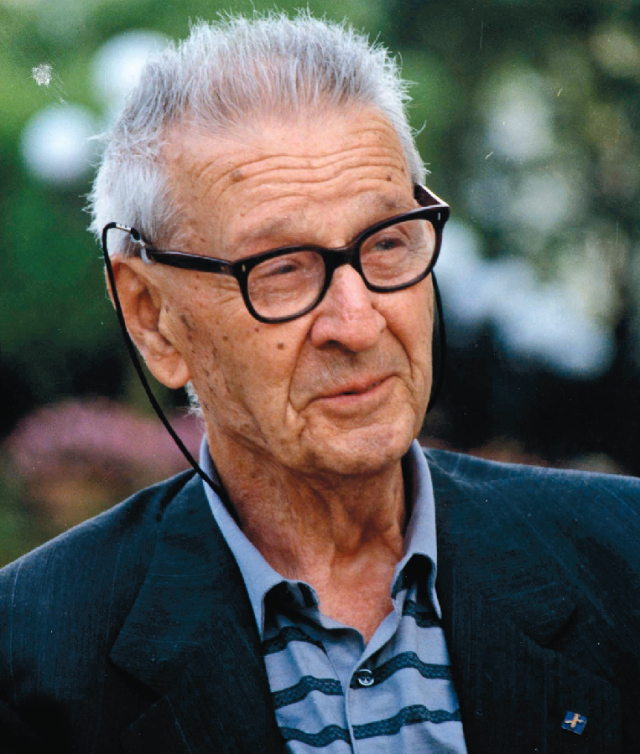
Giorgio Perlasca

Giorgio Perlasca

In many ways Giorgio Perlasca was an unlikely hero starting out as a fully committed fascist volunteering to fight in the war against Ethiopia and, significantly for his future, in Spain during its brutal civil war on behalf of Franco’s Nationalists. He must have contributed significantly to the Spanish fascist cause because he earned sufficient gratitude from General Franco to be granted a letter of introduction from the Spanish Head of State requesting all Spanish embassies to grant him whatever assistance he might require on demand. 

Cernobbio

The memorial to Giorgio Perlasca in Cernobbio cites his original commitment to a fascism inspired by Gabriele D’Annunzio which was strained when Mussolini allied with Hitler and passed the Racial Laws in 1938. He then went on to impersonate a Spanish diplomat in Hungary issuing a number of letters of protection to Jewish families placing them in safe houses until Budapest was liberated.

On his return to Italy from Spain, he apparently lost some of his faith in fascism maybe disagreeing with Mussolini’s overtly racist turn in 1938 when he introduced anti-Semitic legislation whilst also seeking closer allegiance with Hitler. Perlasca took on a role in Hungary with diplomatic status organising the supply of meat from Trentino to the Italian troops stationed in Eastern Europe. When Italy signed the armistice with the allies in September 1943, Perlasca preferred to retain his allegiance to the Italian king and not to Mussolini’s puppet state known as the Republic of Salo. He thus overnight became an enemy of Germany and Hungary. It was at this point that he played his joker by presenting his letter of introduction to the Spanish Embassy in Budapest. He was immediately granted a Spanish passport with the single modification of his first name from Giorgio to Jorge. Jorge presented himself from then onward as a Spanish diplomat.

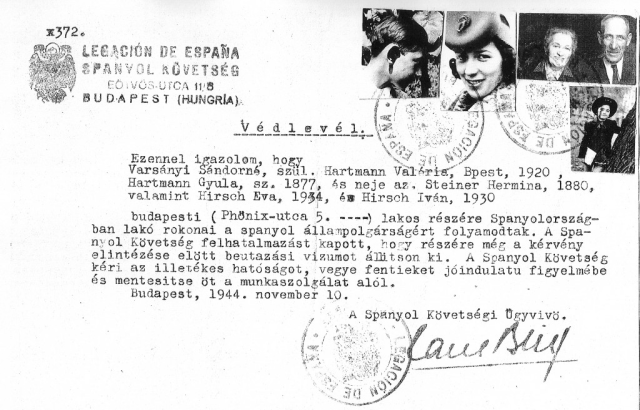
Letter of protection

A letter of protection issued to the Harsanyi family by Giorgio Perlasca posing as a Spanish diplomat.

The Spanish Embassy was doing what ever it could to save Jews from deportation. They and other diplomatic missions were aware of the extermination camps where the Nazis were developing the means to implement the industrial scale of mass murder planned for the infamous ‘final solution’ phase of their ethnic cleansing policies. The embassies of Portugal, Sweden, Switzerland and the Vatican State were also assisting Jews by granting letters of protection. Spain was granting these certificates on the basis of a Spanish law passed in 1924 granting the rights of Spanish citizenship to those Jews descended from the Sephardic population expelled from Spain in the 15th century. The embassy had acquired up to eight buildings deemed part of the Spanish delegation to house those offered protection. Giorgio Perlasca assisted the embassy in granting the letters of protection and in running the safe houses. He later took on the entire responsibility for these people once the remainder of the Spanish diplomatic mission had been withdrawn to Switzerland for safety following the Nazi overthrow of the Hungarian regime in 1944. At this stage, Giorgio Perlasca falsified documents so as to present himself to the Hungarian authorities as the legitimate Spanish Ambassador. He successfully maintained this bluff and was thus able to continue providing protection to the Jews under his care in spite of constant and very real danger of exposure. He was even brought to the attention of Adolf Eichmann, the Nazi official tasked with implementing the holocaust in Hungary. 

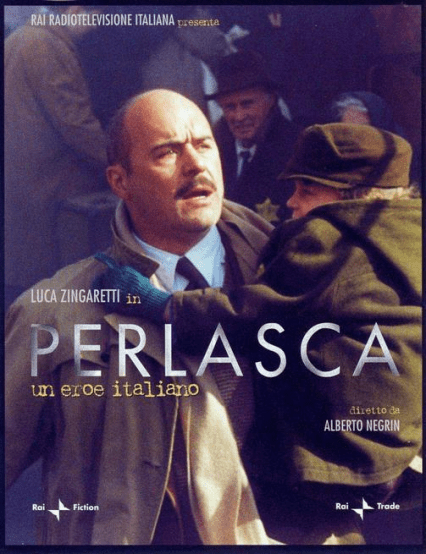
Zingaretti

Luca Zingaretti (better known in UK for portraying Inspector Montalbano) portrayed Giorgio Perlasca in a film of his exploits produced by the RAI.

Through his bluff he was able to save over 5000 Jews who remained under Spanish protection in their safe houses until the Red Army liberated Budapest in April 1945. He has also claimed that by continuing his impersonation of the Spanish Ambassador he was able to prevent the demolition of the Budapest ghetto containing 60,000 Jews. The German SS and the extreme Hungarian fascist corps, Arrow Cross, had planned an assault on the ghetto but Perlasca threatened the Hungarian government that, if they permitted this, he would personally ensure that all Hungarians resident in Spain would in turn be arrested and interned. 


The actions of Giorgio Perlasca and others such as the Swede Raoul Wallenberg and in particular the Swiss Carl Lutz, managed to save many lives but there were still 568,000 Hungarian Jews murdered by the time the Red Army liberated the country. The German official responsible for the Hungarian extermination programme, Adolf Eichmann, evaded capture until finally traced, tried and then executed in Jerusalem in 1962. Eichmann never denied the holocaust but sought to avoid responsibility by claiming he was simply following orders. This incredulous defense and his nondescript appearance prompted Hannah Arendt, the author of the definitive book describing his trial, to coin the phrase ‘The Banality of Evil’ for its subtitle. 

The Banality of Evil

When Giorgio Perlasca returned to Italy, he made no mention of his role in saving lives until a group of Hungarian Jews, wishing to meet and thank the person who had given them so much help, managed to track him down to Padova in the 1980s. He was subsequently presented with the awards from Yad Veshem and the Italian and Hungarian governments. His biography by Enrico Deaglio, in contrast to that of Eichmann, is entitled ‘The Banality of Goodness’ to reflect the matter of fact way in which Perlasca assumed the responsibility for helping those he could. He did not see it as so much a conscious choice but more as following a natural reaction to witnessing inhumanity,  

The Spanish Civil War was characterised by appalling atrocities committed by all sides but arguably to a greater degree by the Nationalists, and it is hard to believe that Perlasca would not have witnessed this during his time in Spain. Yet over time he came to recognise the moral bankruptcy and illegitimacy of fascist racist ideology. His decision to act followed witnessing a German soldier in Budapest execute a 10 year old Jewish boy in the street.  He felt compelled from that moment on to do what he could to resist the forces of oppression. 

The Banality of Goodness

We owe it to those six million Jews –  to the equal number of Slavs also murdered by Nazis, to the Muslim men and boys murdered in Srebrenica, to the deaths in Rwanda and Myanmar  and to all other victims of attempts at ethnic cleansing across the world – that we never forget their sacrifice and do whatever is humanly possible to prevent further instances of genocide in the future. A memorial ceremony will be held outside the Biblioteca on Monday morning at 10.00 on this the 75th anniversary of the day Auschwitz was liberated.


Monument to European Resistance 1

The memorial to European Resistance and to Hitler’s Slaves on the Lungo Lago Mafalda di Savoia, Como.

Posted in crime, Events, History, People, Politics, Uncategorized | Tagged , , , , , , , , | Leave a comment

Como’s Microplastic Pollution Challenge

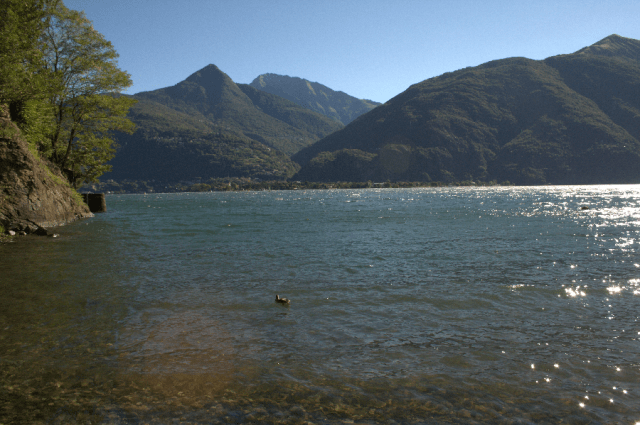
Rezzonico

The beautiful clear waters off Rezzonico bear the highest density of micro-plastics on Lake Como

In recent years, and particularly after David Attenborough’s screening of his series Blue Planet 2, there has been growing concern over the amount of plastic in seas and inland waters. In addition to the unsightly and highly visible plastic detritus that circulates the oceans, there is now greater awareness of the presence and dangers of so-called micro-plastics. Micro-plastics are defined as particles of plastic less than 5 mm in length or diameter. These small particles may have broken down from larger items such as plastic bottles but they also derive in original form inserted in cosmetics or from fibres shed from man-made fabrics when being laundered. This latter group are known as primary micro-plastics and they mostly get into rivers, lakes and the seas having first passed through sewage and water purification plants. Some of these particles are microscopic and thus readily digested by fish as well as by those animals including humans exposed to natural untreated water. 

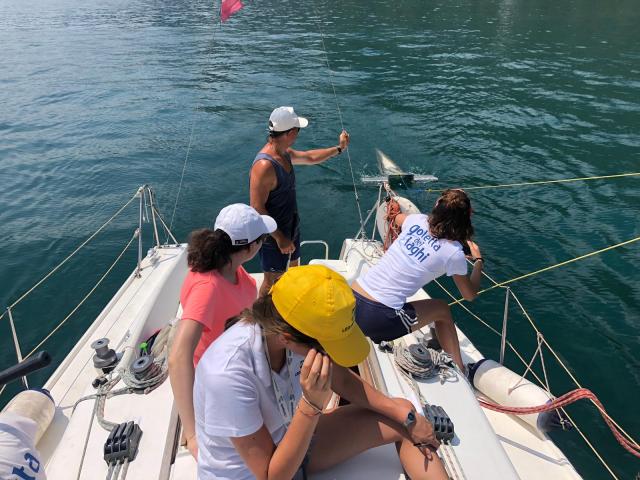
monitoraggio_microplastiche_3

Micro-plastic densities are measured each year now to a depth of 50 metres by Goletta Dei Laghi – part of Legambiente.

No studies yet suggest that ingested micro-plastics are sufficiently small to cross over the stomach lining of either fish or animals to endanger other organs. However research has shown how the micro elements develop a form of natural coating which then provides a host for bacteria including those such as e-coli. In other words, all plastics including micro-plastics are a threat to the environment in general but some may also present a direct threat to health. 

Positive Result: Microbiology

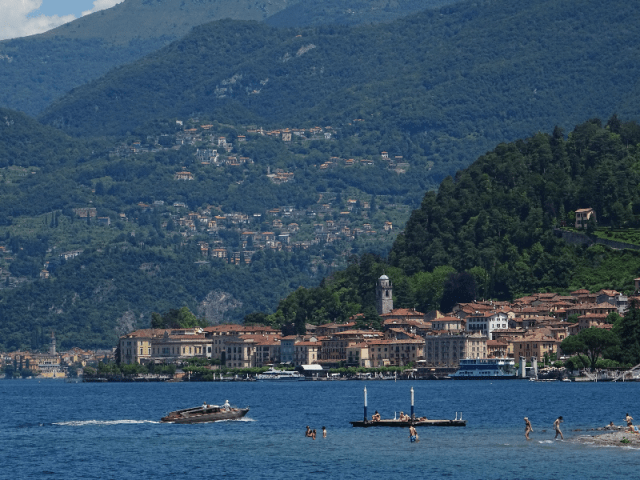
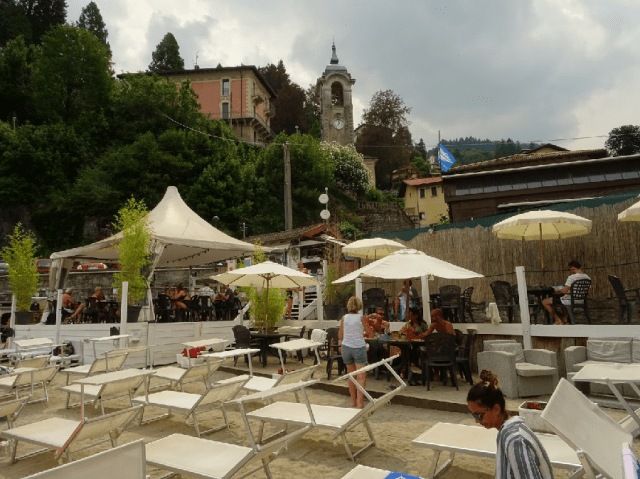
Bellagio

Bellagio’s Beach – one of the cleanest on Lake Como

The ongoing good news is that Goletta dei Laghi confirmed that all sites analysed  during this year’s survey on the Como side of the lake were well within safety limits for bacteria. The same is not the case for micro-plastics. All Northern Italian lakes, unfortunately including Lake Como, have an issue with the amount of plastic pollution. Monitoring for plastics has only started relatively recently thanks to the work of the Goletta dei Laghi, driven by the Italian independent environmental organisation Legambiente. Goletta dei Laghi undertake an annual control of the major Italian lakes checking for both microbiological and micro-plastic levels. Biological readings from the lake are also undertaken monthly from April to October and published on the Internet. As we have reported over the last two years (2018 and 2019), Lake Como’s beaches are mostly well within safety levels particularly those within our own area of interest – the southern part of the lake’s Como leg. Legambiente’s last report in July 2019 confirmed the government’s figures giving a clean bill of microbiological health for all sites checked on Lake Como except for Perlasca, a beach to the north of Varenna. This is particularly reassuring since Legambiente undertake their water sampling at the most critical points where rivers such as the Cosia in Como or the Breggia in Cernobbio enter the lake. Both these rivers have purification plants metres upstream from the lake. 

Negative Result: Microplastics 

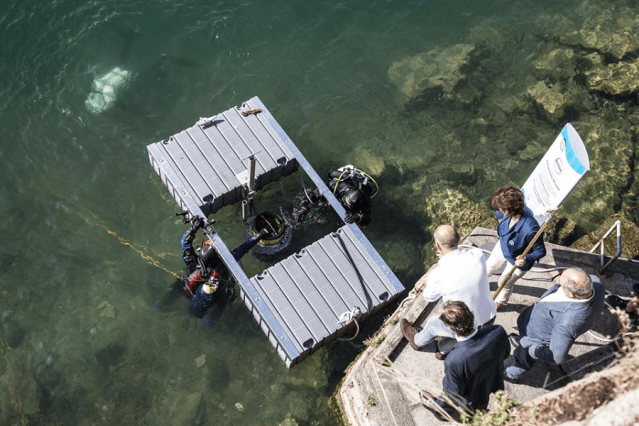
Seabin Como

A ‘Seabin’ designed to filter out plastic from the lake being installed at Proteus Lab’s HQ at the Darsena di Villa Geno in Como.

The data for micro-plastics leave no space for complacency. Checks on their levels show quantities doubling once water courses have passed through the local purification plants. This means that these plants are not currently equipped with the filters necessary for taking out the particles from domestic or industrial water waste. There are additional problems towards the north of our lake where water flows in from the Rivers Adda and Mera. Figures for micro-plastics are quoted based on a particle count per cubic kilometre. Data for 2018 had Lake Maggiore at the top of the list with 100,000 particles per kilometre followed by Lake Orta with 63,000. Lake Garda followed with 36,000 with Lake Como following with 28,500. The cleanest lake was Iseo with 11,500. However distribution of plastic is very variable and the average figures for Lake Como do not reveal that the limited area between Dervio on the Lecco side and San Siro on the Como side has recorded a maximum count of up to 500,000 particles per cubic kilometre presumably arising from the inadequacies in local filtration and the volumes of water entering from the river systems towards the north of the lake. This does not mean that the area is unsafe for bathing. Yet the high presence of micro-plastics and their capacity to allow for the culture  of harmful bacteria, putting yet another challenge in the way of the regeneration of the lake’s fish stock, does require immediate attention.

Legislation

Beach_litter_2

Plastic drinking straws gathered up by Goletta dei Laghi during this year’s survey of Lake Como

Pasta as drinking straws

Bio-degradable pasta drinking straws now replace plastic in many of Lake Como’s bars including the lido at Faggeto Lario.

Fortunately some key initiatives to reduce levels of all forms of plastic have been launched on both a national and local level.  Starting nationally, the Italian government banned the use of plastic in ear buds this time last year and followed it further this year with a ban on the use of micro-plastics in any form of cosmetics, e.g. body scrubs and toothpaste. Legislation though can only be part of the answer. The treatment of waste water and sewage needs greater investment to ensure filters prevent the onward spread of particles from human and industrial waste. Equally we all need to reduce the amount of plastic ending up in domestic water waste. Some of this waste, such as the fibres from man-made textiles, are difficult to capture domestically and the ideal of preventing the shedding of micro-plastics from laundry can only be achieved totally if we give up wearing man-made textiles.  

Plastic Free Challenge

Batz

The ‘Spazzino’ clears debris from the lake in Como but is not designed to capture micro-plastics.

The Italian Ministry of the Environment in 2018 launched an initiative called the Plastic Free Challenge to raise awareness of the issues and to seek to change both domestic and business behaviours. Some businesses are adapting their habits in order to improve matters. 

Faggeto Lario

The plastic free lido at Faggeto Lario

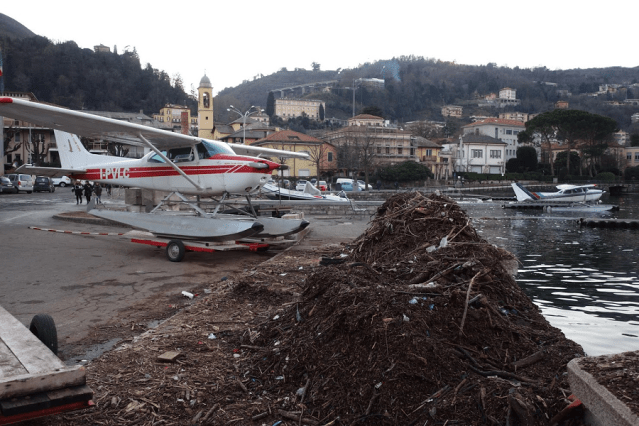
For example the lido in Faggeto Lario and its bar have declared themselves totally free from single-use plastics. They are the first commercial exercise on the lake to do this. They initially introduced metal reusable drinking straws to accompany their cocktails, as have many other bars in Como, but so many were being lost as customers took them home as a novelty souvenir. They are now using bio-degradable pasta straws. Environmental campaigners Lifegate secured sponsorship from Volvo Italy to install   ‘Seabin’ on the lake at the Darsena di Villa Geno – the headquarters of Proteus Lab. These seabins filter out micro-particles larger than 2 millimetres. Seabins are being installed internationally but the one in Como is the first in Italy to be installed on a freshwater lake. The Spazzino boats who keep Como’s port area free from water-born detritus are fine for ensuring the seaplanes can take off and land safely on the lake without risk but aren’t designed to reduce the quantity of micro-plastics. 

Aeroclub

Heavy rainfall brings down a lot of detritus from the mountainsides which must be cleared away to allow for safe landings and take offs for Como’s Aeroclub fleet of seaplanes.

Let’s hope though that the ban on micro-plastics in commercial products combined with the public’s greater awareness of the dangers posed by single-use plastics will quickly lead to reductions in our seas and inland waterways, and in Lake Como. We can be assured that Legambiente, with their annual checks by the Goletta dei Laghi on both biological and plastic waste, will hold national and local administrative entities to account and so provide the necessary third party assurance that our lake is safe for swimmers.  The ongoing improvements year by year in microbiological water quality, undoubtedly due to investments in local drainage and purification systems, cannot allow for any complacency. Our water purification plants now need further enhancement to filter out those micro-plastics originating from domestic or business waste. These particles are too small to offend us visually but they represent another real challenge, on top of climate change, to the ecological health of the lake.

River Adda Sondrio

River Adda upstream from Sondrio descends the Valtellina to enter Lake Como in the north and then exits the lake at Lecco to later join the River Po at Lodi.

Posted in Lake, Politics, Sustainability, Uncategorized | Tagged , , , , , , , , , , , , | Leave a comment

Lake Como and Climate Change

Forest Fire Varese

Forest Fire on October 30th on Campo Dei Fiori, Varese

Man’s impact on our natural environment through climate change is becoming frighteningly dramatic in many instances. The recent flooding in Indonesia and the devastation of the forest fires in South Eastern Australia are clearly a concern to all except for the more sociopathic of the world’s leaders. Yet the impacts of climate change are not just visible on the grand scale. Even on Lake Como there is reason to be concerned that recent patterns of weather are having a negative impact on the lake’s ecosystem. 

water level

Water marks on the lake walls show the variety in water levels.

Back in June 2018 the combined Como and Lecco Chambers of Commerce held a conference to kick off a project raising awareness of what climate change is doing to our lake.  They asked what we should be doing to ensure a sustainable future for all those who live or visit the area and gain either social or economic benefits from the lake’s natural environment. Proteus, a local environmental association, was entrusted with the responsibility of raising awareness amongst the young. In turn they set up a group called ‘Resilario’ whose slogan is to re-appropriate our lake. Locals can often be heard talking proudly of OUR lake and Resilario have been astute in selecting the use of that pronoun to elicit local pride and a sense of ownership in the hope that this inspires a communal sense of responsibility.

Como Futuribile

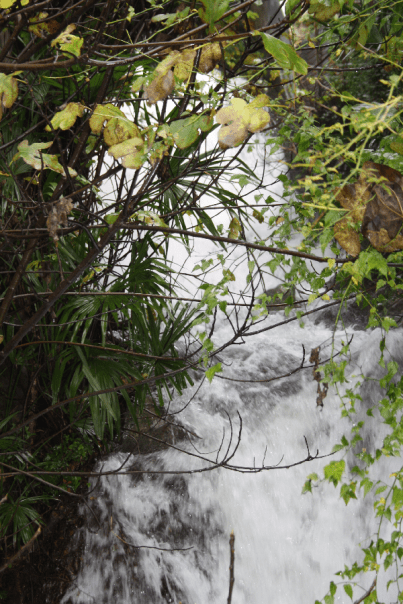
Waterfall Moltrasio

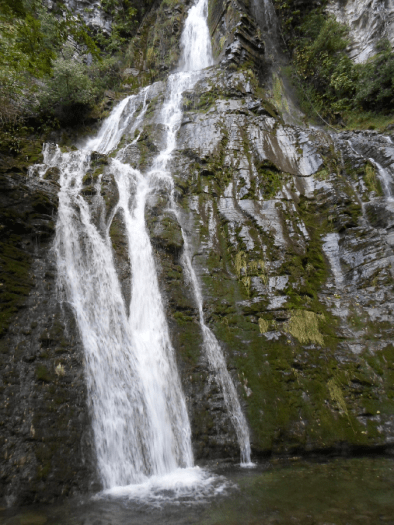
Waterfall above Moltrasio – the mountain streams become raging torrents at times of high rainfall

Resilario and their initiative now called ‘Como Futuribile’ are still in the consciousness-raising phase of the project. As part of this, local geologist Filippo Camerlenghi recently addressed a meeting at the Universita Popolare to outline exactly how climate change is impacting the lake. And the very first thing he mentioned was the change in the distribution of annual rainfall. This last November saw 25% of total annual rain fall in the one month. Apparently our annual rainfall totals have remained constant but there is now a marked variation between wet and dry periods with a concentration of rain in the Spring and Autumn. There are a number of issues that arise from this since the level of the lake can now vary considerably during the year and we are not prepared for the impact of a distribution of this sort.

Water levels

faggeto water level

Low water levels in Faggeto lario

The lake is renowned for its many villas with their gardens descending down to walled lakeside terraces. These walls were constructed with the expectation of constant pressure from the lake’s waters corresponding to the contrasting pressure outwards from the terraced land. That balance does not exist when the water level is low and so the whole aesthetic fabric of the lakeside is under threat due to the changing need to deploy structures more designed for tidal seafronts. The weakening of these traditional lakeside walls has created crevices to appear in them at low water which then allow water to enter and permeate the shore line at high water. This water, isolated from the main mass of the lake, then freezes in the winter causing further damage to lakeside structures such as roads and pavements. This causes the sort of damage experienced recently on the Como lakefront when a massive hole opened up on the road to Villa Geno. Further evidence of accelerated erosion can be seen on the any of the walks on Como’s lakefront where the pavements suffer from subsidence and distortion.

Street damage

Lakeside erosion in Como

Agone, Laverello and Other Lake Fish

missoltin

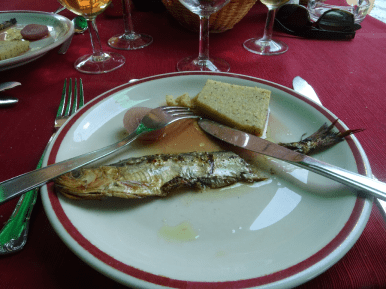
Missoltino, a local ‘delicacy’

The increased variation in water levels is also responsible for risking the recovery of the lake’s fish population, in particular the ‘agone’ – the small fish also known as fresh water sardines – which when dried and pickled are known as ‘missoltini’. If the water level drops after the agone have lain their eggs in the shallow lakeside waters, these eggs are then exposed as water levels drop and so fail to spawn. 

Torrent

Mountain stream in full flow above Cernobbio

Camerlenghi was keen to point out that we need to consider the health of the lake as part of an ecosystem that includes the surrounding mountainsides. Excess rain before the cold temperatures of winter reduces the amount of precipitation stored as snow on the mountains and increases the runoff containing sand and silt carried by the two rivers that feed the lake, the Adda flowing down the Valtellina and the Nera from the  Val Chiavenna. This sand residue does not directly pollute the lake but it does coat the bottom in its upper reaches with additional quantities of silt reducing the ability of the fish to feed. The resulting local reduction in the fish population there may be one of the causes for the increase in alghi in the summer months. Alghi may also flourish due to the growing numbers of the non-native fresh water mussels which have the effect of clearing the water in shallow areas. This may appear to be a positive sign of clean and attractive water for swimming but it allows for increased penetration of sunlight and heat which again can encourage the growth of more alghi. These are just a few examples of how the lake’s ecosystem, like all ecosystems, is so delicate and thus at risk from the effects of climate change. 

Economic Impact

Fisherman

Summer time swimmers may well be encouraged by the clear waters filtered by the increase in fresh-water mussels. Neither do they have need to fear bacteria levels since these are all well within safety limits around the lake. These attacks on the ecosystem do not result in any increase in pollution. But the economic interests of the seventy licensed fishermen and the number of restaurants offering produce from the lake are at risk if spawning and feeding grounds for the fish population continue to be threatened. Even the Navigazione Laghi who manage the ferries across the lake have suffered some economic disadvantage. At low water they can no longer deploy the larger ferry boats transporting vehicles from and to Bellagio and Menaggio. The smaller vessels maintain the service but at a higher cost.

Lake and mountain

In normal years, precipitation during the winter is held as snow on the mountains as here on Monte San Primo.

On the 23rd August 2017 a massive landslide on the borders of Switzerland and the Val Chiavenna to the north of Lake Como claimed the lives of eight people and made over one hundred inhabitants homeless. (Dramatic video of the landslide). This event followed a torrential summer storm. The land acts like a massive sponge seeking to absorb the precipitation that falls on it. There comes a point though when the mountainsides can no longer support the weight of the additional water they have absorbed. The result is a landslide. This November saw a relatively small landslide on the hills above Cernobbio close to one of George Clooney’s favourite restaurants, the Gatto Nero in Rovenna. Fortunately there were no fatalities as in the Val Bregaglia but the only road up to Rovenna was cut off. If we continue to see excessive rainfall in months like November, there will be a need to review the whole of the communications infrastructure in the lake’s surrounding mountain communities. The danger to life is real and the potential costs of revising the infrastructure are enormous.

Is Flooding a Problem?

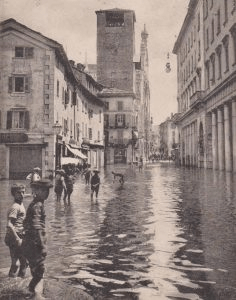
1917bFlood

Como floods in 1917

Como has had its own scandal running for years on a smaller scale but similar in aspect to Venice’s attempts to construct flood defences across its lagoon. Como’s scandal resulted from the contract to build flood defences along its lake frontage. The contract was awarded to the same constructors building the Venice defences. One may want to question why flood defences were ever needed since the levels of the lake are controlled at the end of the Lecco leg as the lake runs out into the continuation of the River Adda which eventually flows into the River Po near to Lodi. Those responsible for managing the dam in Lecco are constrained by law to only take two factors into consideration when deciding how much water to release out of the lake into the lower reaches of the Adda.

water level 4

Sign in Via Diaz showing where the flood of 1673 arrived.

These factors are firstly the needs for irrigating agricultural land in the Lombardy plain and secondly maintaining sufficient flow to operate the hydro electric power plants on the river past Brivio. They are prevented by law from taking any other factor into consideration including the possible risk of flooding in Como or anywhere else on the lake. Having said that, even the record-breaking rainfall this November only caused the lake to break its banks to trickle slightly over onto Piazza Cavour – nothing like the flood levels recorded in the past. 

However the plans for Como’s flood defence became ever more extensive and costly and, clearly with the prospect of rich pickings to be made, were finally deemed illegal. The council and contractors had decided to take a chunk out of the lake without permission hoping to increase land on the lakefront which would then be highly attractive commercially and bound to sell at a high price. Some of those responsible for this speculation now face jail terms and Como still has an incomplete, useless and probably unnecessary flood defence system. Como does not need to spend massive amounts on managing high water levels but it does need to spend to counter the effects of massive water level variation. This is in effect a much more complex and less visible issue. One can only hope that our local politicians are up to facing such a challenge.

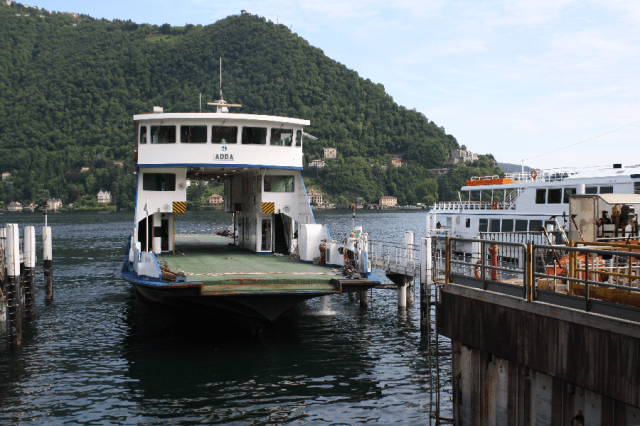
Small car ferry

One of the smaller car ferries the Navigazione Laghi are constrained to deploy when water levels are low

The Future

The Lecco and Como Chambers of Commerce are to be complimented on kicking off this initiative to raise awareness and foster the knowledge and determination to confront the issues of climate change on the lake. The Como Futuribile project will see ongoing efforts to increase local awareness and knowledge of the lake’s ecosystem and promote all forms of sustainable development. In March they and Proteus plan a live broadcast filming underwater just to let us all see what exactly is going on below the water’s surface. In one sense the concentration of rainfall in months like November, one of the quietest months for tourism, might be seen as a positive. Certainly I would advise visitors to plan on visiting the lake at any other time of year. However the impact of such heavy rainfall on the mountainsides with the associated risks of more landslides and accelerated erosion will be very costly to manage. As will be the need to secure the lakefront structures from the erosion arising from increased variations in water levels.  These impacts may all be relatively small scale but they affect the whole region and so could become a heavy financial burden. Similarly the economic impact on the lake’s seventy fishermen might be dismissed as hardly significant but those seventy are supplying the much larger catering sector who provide residents and visitors alike with an authentic lakeside culinary experience. Although personally I am no fan of missoltini, just consider how poorer the region would be if this small pickled fish disappeared from local menus. 

water level 3

This spit of land formed from the silt and sand brought down by the River Cosia only appears at very low water levels.

Finally we might be grateful that we have not experienced any of the more dramatic impacts caused by climate change such as the forest fires currently raging in Australia. However, our woods and forests do get very dry over the summer months and a repeat of the Varese fires in 2017 is always a possibility. We cannot afford any degree of complacency.

Posted in Food, Lake, Politics, Sustainability, Uncategorized | Tagged , , , , , , , , , , , , , , , | 3 Comments

Poets’ Way: Como to Brunate


path

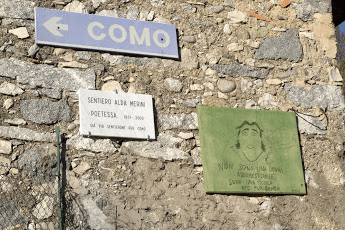
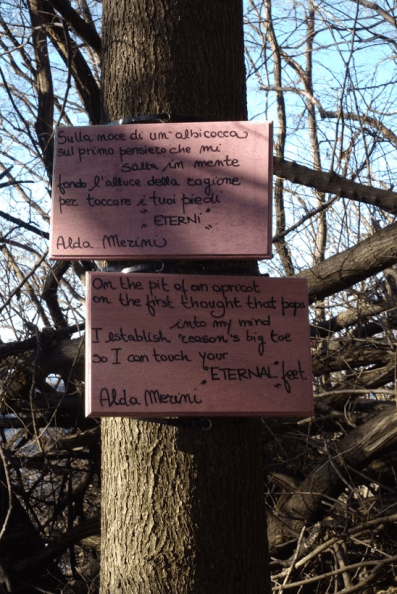
The walk up to Brunate on the recently named ‘Sentiero Alda Merini’

Within minutes on foot you can leave the centre of Como and be walking up through tranquil woods to either Brunate to the east or within the Parco Spina Verde to the west. The city’s particular topology provides this sudden transition from town to country. With little effort, you can come across the most timid of wildlife including boar, ibex and deer living within hearing distance of the city. These very special characteristics were what attracted the Milanese poet Alda Merini to spend so much time revisiting Como and her paternal grandparents’ home in Brunate. Now, to honour Alda and to give greater expression to the inspirational qualities of the area, the footpath that leads up from Como, past the Sanctuary of San Donato and on to Brunate, has been renamed ‘Sentiero Alda Merini’.


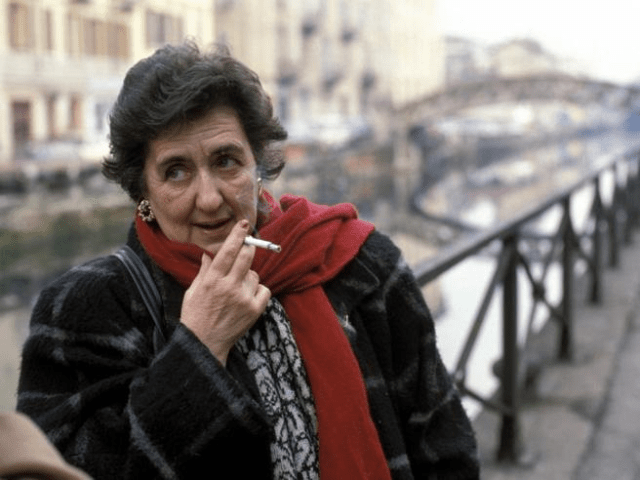
Alda Merini

Alda Merini, 1931-2009 photographed in Milan near her home in the Navigli district

Alda Merini seems to be kept in very fond regard in Italy and in particular in her home town of Milan where she was born in March 1931 and died in November 2009. She had a modest background with a father who worked for an insurance company and a mother who cared for the family. Her father encouraged her interest in language but discouraged her from writing poetry for economic reasons. Her mother did not want her to consider any other future other than as a housewife.  Yet in spite of this and also in spite of suffering the first symptoms of bipolar disorder at 16, she went on to write her first verses at 15, to publish these at 19 and to continue publishing poetry and prose until 2007. She attained numerous prizes and great acclaim for her poems and aphorisms. 

Sentiero

Alda writes in direct, relatively simple language with an honesty conveying a total lack of social or artistic pretension – rare qualities which may in part be due to her ancestry on her father’s side. Her paternal grandfather, Giovanni Merini, was initially a count from an aristocratic Como family. He however fell in love with Maddalena Baserga, a peasant girl from Brunate. He was disinherited  the moment he married his peasant bride. Alda’s father did not as a result inherit much money but he was well educated and passed on his love of culture to Alda gifting her a dictionary at the tender age of five.

view

The view from Brunate – the balcony on the Alps.

Thus Alda Merini, who spent most of her life in her beloved Milan, had a very special link with Brunate and to that footpath which for centuries has linked that village known as the balcony over the Alps with Como. That path facilitated the love match between the young Count and his peasant bride. It may also have encouraged Alda’s  love of nature which even took on a mystical aspect in later life. 

The renamed footpath was first described here as one of those quick escapes out of the city. Now it has been given a definite name and been adorned by some of Alda’a aphorisms and excerpts from her and other poets. The novelty is that these are all accompanied by an English translation for which I for one am very grateful. Poetry is not so easy to internationalise but an American poet, Susan Stewart, has produced  translated versions of Alda’s poetry and aphorisms which are available on Amazon. I have included Alda’s poem ‘Night, if it is not swift’ translated by Susan Stewart to give a sense of her style:

Big toe

Alda Merini 

Night, if it is not swift

Night, if it is not swift,
has no time to cover the dream.
My eyes are lanterns and you
the breath that clouds them.
You sleep on everyone’s heart
oh little asphodel
and as soon as the fingernails
have scraped the winter cold
you will return, a blossoming arunculus,
to make me happy.

Eager your ivory cups
eager your testicles of desire
and the fingers filled with plums
blossom into vast perfumes.

I have always had a tricky relationship with poems – so many seem to require too much effort to understand their intention, or perhaps even more fundamentally, there simply don’t seem to be the right moments or opportunities for taking the time out to read and consider them. Yet, when an opportunity does present itself, I love at least some of them. So thanks to the local organisation ‘Sentiero dei Sogni’ for campaigning to rename the Brunate footpath and for providing the inspirational excerpts on the wooden boards. They have certainly added a further element of enjoyment to my walks up the hill. For example, I never knew that Alessandro Volta, Como’s famous scientific inventor of the battery, also wrote poetry if only for his own pleasure.


Wordsworth

William Wordsworth who walked around Lake Como in 1790

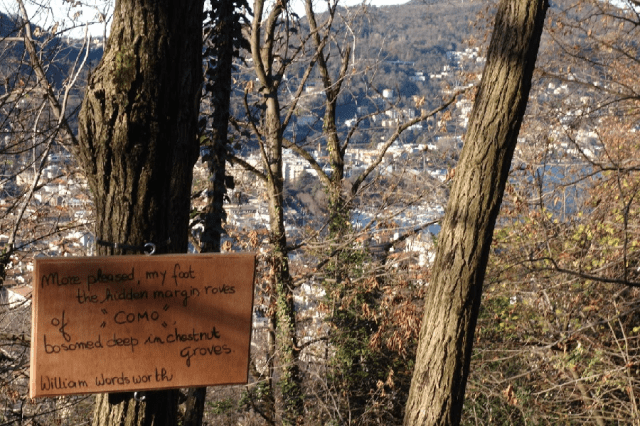
And, not only do the boards carry an English translation, one of them even has a quote from William Wordsworth, whom it appears did once wander ‘cloudlike’ along the lake’s paths, although not precisely here in Brunate.


Villa Pliniana

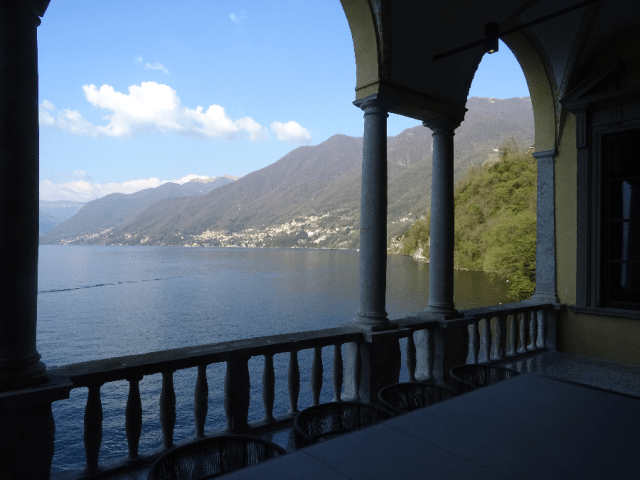
The view over the lake from the loggia of the Villa Pliniana where Mary and Percy Bysshe Shelley resided for a time.

Wordsworth was travelling in 1790 with a friend from University, Robert Jones. Having passed through Paris, Lyon, Geneva and Chamonix, he then crossed the Simplon Pass to reach Locarno and on to Porlezza on Lake Lugano to arrive in Menaggio on Lake Como. He then headed north along the lake to Sorico before continuing up the Val Chiavenna to Splugen. He later recorded his journey in verse published as ‘Descriptive Sketches’  – one of his earliest publications. Here are some excerpts relating to Lake Como:

From ‘Descriptive Sketches’

More pleased, my foot the hidden margin roves
Of Como, bosomed deep in chestnut groves.
No meadows thrown between, the giddy steeps
Tower, bare or sylvan, from the narrow deeps.
 — To towns, whose shades of no rude noise complain,
From ringing team apart and grating wain —
To flat-roofed towns, that touch the water’s bound,
Or lurk in woody sunless glens profound,
Or, from the bending rocks, obtrusive cling,
And o’er the whitened wave their shadows fling —
The pathway leads, as round the steeps it twines;
And Silence loves its purple roof of vines.

bucolic scenes

A typical rural scene on the Antica Strada Regina which would have impressed William Wordsworth and even inspired Mary Shelley

The vineyards around the lake have diminished greatly since his time yet he may have had Domaso in mind where wine production has successfully returned in recent years.

He goes on to express a certain young man’s desire and frustration on seeing so many beautiful maidens labouring on the terraced slopes until he recovers his equilibrium sufficiently to portray what was to become a repeated romantic trope:

From ‘Descriptive Sketches

Yet are thy softer arts with power indued
To soothe and cheer the poor man’s solitude.
By silent cottage-doors, the peasant’s home
Left vacant for the day, I loved to roam.
But once I pierced the mazes of the wood
In which a cabin undeserted stood;
There an old man an olden measure scanned
On a rude viol touched with withered hand.
As lambs or fawns in April clustering lie
Under a hoary oak’s thin canopy,
Stretched at his feet, with stedfast upward eye,
His children’s children listened to the sound;
– A Hermit with his family around! 

This passage reminds me of the quite long episode in Mary Shelley’s Frankenstein when in the Creature’s Narrative, he describes living alongside but hidden from the peasant family living in the woods. Mary Shelley herself spent time on Lake Como renting out the Villa Pliniana with her husband, Percy Bysshe Shelley, when it was in a poor state and certainly not as luxurious as in its current incarnation as a super luxury hotel. Clearly the Romantic Movement found and shared inspiration from the natural beauty of Lake Como!

Balcony on the Alps

Brunate – view over to Monte Rosa


Unable to freely appreciate the Italian verse of Alda Merini, I was drawn to how many similarities there seem to be between her and England’s so-called peasant poet, John Clare – a Romantic poet and contemporary of Byron and Shelley but a self-taught son of a farm labourer. John Clare shares the same simplicity and honesty of language and feeling with Alda and incidentally, also suffered from long bouts of mental illness. I have reproduced his poem ‘I am’  to show some of the similarities with Alda and as a contrast and antidote to the flowery language of the early Wordsworth quoted above:  

I Am

I am—yet what I am none cares or knows;
My friends forsake me like a memory lost:
I am the self-consumer of my woes—
They rise and vanish in oblivious host,
Like shadows in love’s frenzied stifled throes
And yet I am, and live—like vapours tossed
Into the nothingness of scorn and noise,
Into the living sea of waking dreams,
Where there is neither sense of life or joys,
But the vast shipwreck of my life’s esteems;
Even the dearest that I loved the best
Are strange—nay, rather, stranger than the rest.
I long for scenes where man hath never trod
A place where woman never smiled or wept
There to abide with my Creator, God,
And sleep as I in childhood sweetly slept,
Untroubling and untroubled where I lie
The grass below—above the vaulted sky.

The Sentiero Alda Merini forms only part of what the association ‘Sentiero dei Sogni’ hopes will one day be a complete ‘Lake Como Poetry Way’ highlighting the literary tradition of the area. The project is ongoing and foresees a walk starting off from Cernobbio, passing by the Villa del Grumello, through Como and then following the section already dedicated to Alda Merini to finish up in Brunate. This idea was born out of the ‘Passeggiate Creative’ initiative of local poet and journalist Pietro Berra. More information on the project is available from the association’s website.

Villa del Grumello

The gardens of the Villa del Grumello with the bust of the poet Ugo Foscolo

Posted in Culture, History, Itineraries, Lake, People, Uncategorized, Walks | Tagged , , , , , , , , , | Leave a comment

Noir in Festival – Como 2019

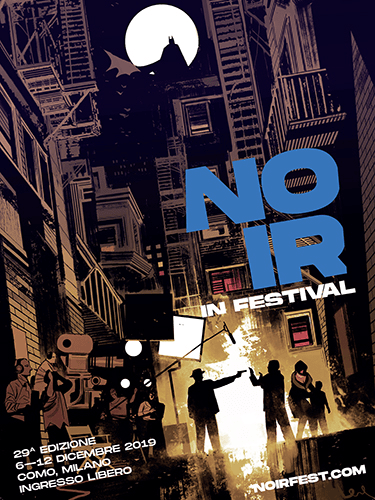
Poster

Noir in Festival this year takes Batman as one of it main themes.

This Friday, 6th December, sees the start of the Como-based section of ‘Noir in Festival’ – an annual feast of crime film and fiction. This celebration of the ‘noir’ genre is into its 29th edition and its the fourth year that Como has co-hosted this festival alongside Milan. Two awards for literature are made or presented during the course of the festival and two for film. Additionally there are interviews with authors and screenings of films in original language as well as opportunities for media-folk to get together. The Como-based events, all of which are free, are held on Friday and Saturday in Villa Olmo. Events continue from Sunday onwards in Milan. The Como events in English are posted on CC’s Calendar but the full programme is available from the festival’s website.

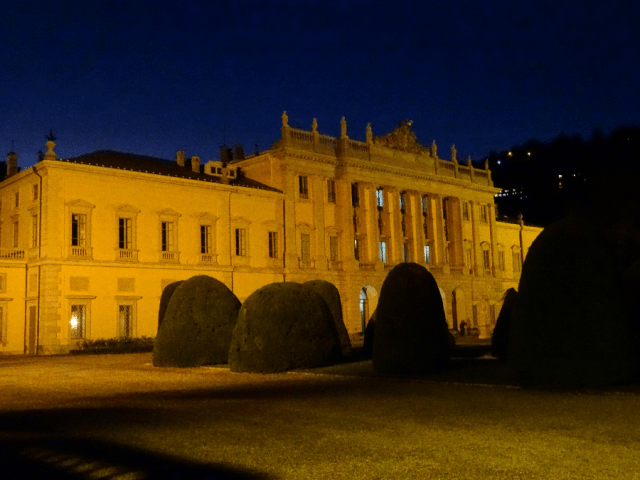
Villa Olmo

The Como-based events for this year’s festival are held over Friday and Saturday 6th/7th December in Villa Olmo. Entrance is free.

Glorious Prizes

Jonathan Lethem

Jonathan Lethem

For literature the winner of the internationally renowned Raymond Chandler Award this year is the American writer Jonathan Lethem. Last year’s winner was Jo Nesbo and in 2017, Margaret Atwood. Jonathan Lethem will be presented with the award on Saturday evening at 21.00 in Villa Olmo.  There is also a prize for Italian novelists named after the ‘father’ of Italian noir, Giorgio Scerbanenco.  

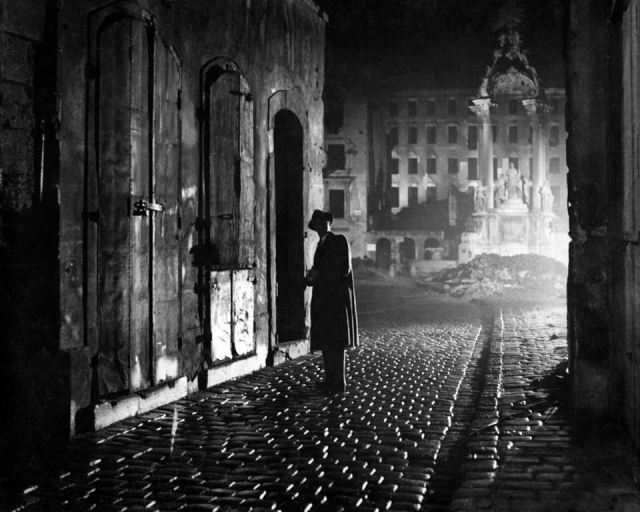
For film an award is made for the best  international film selected out of the six entered for the competition and screened during the festival. This year there are films entered from South America, China, Sweden and USA. The ‘Premio Caligari’  is a prize awarded during the festival to nationally-made ‘noir’. This prize is promoted by IULM (The Free University of Language and Communication at Milan) and so most of these films are screened on their site during the Milan-based part of the festival. However, the mood of the festival is set by a showing on Friday evening at 16.00 in Villa Olmo of Carol Reed’s atmospheric spy story ‘The Third Man’ starring Joseph Cotten and Orson Welles.

Third Man

A still from Carol Reed’s ‘The Third Man’ set in bomb damaged Vienna

The whole mix of special events, film screenings and conversations with authors goes to form an intriguing dive into this most atmospheric of literary and visual genres. Margaret Atwood’s acceptance speech on receiving the Raymond Chandler Award here in Como two years ago, is worth quoting in part for its insight into why the genre remains so appealing:

Margaret Atwood

Margaret Atwood, Raymond Chandler Prize, 2017

 ‘….I am not a crime writer as such – just a writer about human behavior, which includes crimes among all of its other manifestations. Why are we fascinated by such acts? Because we would never do them ourselves, or because we fear we might? In our dreams and nightmares we find ourselves engaged in the most bizarre activities – perhaps that is what crime writing is for us – an exploration of our nightmares. And what lies between us and this nightmare world? Only the thinnest of barriers.’


The Noir genre may have originated with Raymond Chandler and Dashiell Hammett in the USA alongside Hollywood but it seems now to be a truly international genre.  Yet there seem to be some geographical hot spots where ‘noir’ is at its densest. One of these hot spots has to be Italy with strong representation in both film, TV and literature created by a host of writers.  Events in Italy’s recent history have almost made ‘noir’ an involuntary response within a society that has suffered so many moral and emotional traumas through the ‘anni di piombo’ when from 1969 to 1980 there were over 4,200 terrorist incidents. Whilst Italy did face open civil war from 1943 to 1945, these ‘years of lead’ in the 70s and 80s have also been described as a form of creeping civil war with atrocities born out of the shadows and formed out of duplicity, deceit and ambiguity – actions performed by a ‘dark’ state intent on spreading fear, tension and anxiety, a true ‘nightmare world’ to recall Margaret Atwood.. What could be more designed for ‘noir’ than a parallel state apparatus incorporating parts of the army and secret services set upon exploiting political extremists in creating a so-called ‘strategy of tension’? Remarkable but true – this was Italy at the height of the Cold War.

A Series of Anniversaries

Piazza Fontana

12 December will be the 50th anniversary of the terrorist attack in Piazza Fontana, Milan.

70 years ago, Carol Reed’s ‘The Third Man’ was awarded the Grand Prix at Cannes on its release in 1949. The brilliance of that film, with its atmosphere of menace and secrecy located on the front line of a Cold War first emerging from the bomb-damaged cities of eastern Europe, shares inspirational space with Batman at this year’s Noir Festival. Also 70 years ago, NATO was established to coordinate western power responses to the perceived internal or external threats of communism. Fifty years ago on 12 December 1969, a bomb exploded in Piazza Fontana in Milan killing 18 people and injuring a further 84. That outrage, along with a number of bomb explosions in Rome on the same day, saw the opening salvo in Italy’s parallel state’s Strategy of Tension – known as ‘stragismo’. In response to the growing popularity of the Communist party in Italy and the wave of radicalism across Western Europe, ‘rogue’ elements of the right-wing establishment sought to discredit the left and provoke a reactionary response to terrorist atrocities they themselves committed. There is speculation that the Italian secret services, whose direct involvement in terrorism has been established in the courts, kept both NATO and the CIA informed of their actions.  

The ‘Nightmare World’ of Cold War Italy

Judge Salvini

Judge Salvini has spent a good part of his judicial career in trying to establish the facts behind the ‘Strategy of Tension’. 

It took from 1969 to 2005 for the Italian judiciary to finally close its process on the bombing of the Banca Nazionale dell’Agricoltura in Milan’s Piazza Fontana.  By that time, although guilt had been established, no further sentencing was possible due to the passing of time under the statute of limitations. The fault for this does not lie with the judiciary, but rather is down to the success of the ‘occult’ powers committed to frustrating the work of the magistrates and courts through a process known as ‘depistaggio’ – misleading and derailing investigations through witness interference often resulting in verdicts of ‘not proven’ which, as in Scottish law, is not the same as ‘not guilty’ 

The Strategy of Tension

The strategy of tension ran like this. Commit acts of terrorism which appear to be perpetrated by the extreme left. Find an ostensible culprit amongst the left and pressure the magistrates to arrest them. Use neo-fascist extremist gangs to undertake the acts of terror. Use the ‘parallel state’ consisting of parts of the army and the carabinieri along with the secret services to obfuscate justice if right wingers are accused. Exploit the rising levels of alarm in the general public to get increased popularity for an authoritarian anti-communist government or foster acceptance of a right-wing coup d’etat. Extraordinary though this may seem, this is exactly how the Cold War was conducted in Italy backed up by the numerous establishment members of the illegal and fiercely anti-communist P2 masonic lodge. 

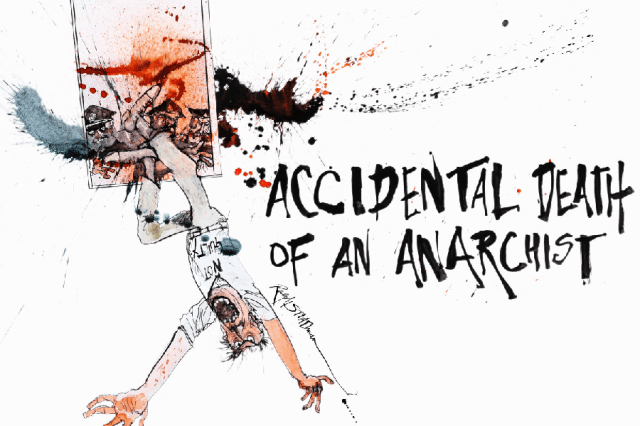
Accidental death

Dario Fo wrote the play ‘The Accidental Death of an Anarchist’ following the alleged suicide of one of the two anarchists initially arrested for the bombing in Piazza Fontana. The anarchist,  Giuseppe Pinelli, died falling out of a top floor window at Milan’s police hesadquarters.

The players in this strategy divided into either operational or directional groups. The operational groups were those extra-parliamentary groups of neo-fascists such as Ordine Nuovo strong in Northern Italy and Avanguardia Nazionale with its support more focussed in the south. They undertook the assassinations and bombings. The directional groups were responsible for the overall policy and for providing protection to the operational elements by delaying and misleading the judicial enquiries through a variety of means. The directional groups consisted of SID (the name of the secret service at the time), elements of the army and some elements of the Carabinieri. It is debatable to what extent the directional groups managed to control their operational partners. It is also unclear to what extent the parallel state structure of the directional groups operated with the knowledge of the established state given that both ‘states’ shared membership in the illegal conspiratorial P2 masonic lodge.  

Massimo Carlotto

Massimo Carlotto

If all this sounds fanciful, consider the direct experience of  ‘noir’ writer Massimo Carlotto, author of ‘Death’s Dark Abyss’ (2004). Massimo Carlotto was a student member of one of the left wing extra-parliamentary groups ‘Lotta Continua’ (Continual Fight). He was accused when 19 of murdering a 24 year old female student in Padova. Condemned to a 16 year prison sentence and on the advice of his lawyers, he fled to France to take shelter under President Mitterrand’s refusal at the time to extradite left-wing political prisoners back to Italy. He subsequently moved on to Mexico but was then later expelled and faced re-imprisonment on his return to Milan. There then followed a 17 year fight for his liberty making his one of the longest campaigns in recent history leading eventually to his release granted through  a presidential pardon from Oscar Luigi Scalfaro in 1993. However it was not until 2004 that he finally regained all his civil rights with the courts granting full exoneration of any responsibility for the original crime. With his direct experience as a victim of ‘stragismo’ it is hardly surprising that Carlotto is perhaps one of the bleakest of the current generation of Italian noir authors. Massimo Carlotto had inadvertently breached that thinnest of barriers separating us from nightmare.

Fact Stranger than Fiction

The machinations of Italy’s ‘dark state’ with its cynical readiness at the time to sacrifice its own citizens in order to deliberately raise tension and anxiety within the population at large defies credibility. It also challenges writers of ‘noir’ since fact (doggedly achieved by the heroic dedication of many of the Italian judiciary) has so often exceeded what might form credible fiction.

Giancarlo de Cataldo

Giancarlo de Cataldo

The novels of Giancarlo De Cataldo represent one response to this. In his ‘Romanzo Criminale’ De Cataldo uses his in-depth knowledge as a magistrate in Rome to depict the lives of the common criminals who formed the notorious Banda della Magliana in the late 70’s. These partially cover the procedural aspects of judicial enquiries but Margaret Atwood would appreciate that the main focus is on the characterisation of this group of petty criminals. This novel shares similarities with Marlon James’sA Brief History of Seven Killings’ which also explores the lives of petty criminals caught up as foot soldiers in an orchestrated attempt at political and social destabilisation at the same period but within another bitter theatre of the Cold War – Central America, the Caribbean and Michael Manley’s Jamaica in particular.  Giancarlo De Cataldo’s follow up to ‘Romanzo Criminale’ was ‘Nelle Mani Giusti’ which covers the period of the assassinations of the Palermo magistrates Falcone and Borsellino and the end of the First Republic resulting from the political corruption trials in Milan known as ‘Mani Pulite’. He will be at the festival at 19.00 on Saturday 7th to discuss his latest crime novel ‘Quasi per Caso’ which is set in the mid nineteenth century in Piedmont at the time of the struggle for independence from the Austrian Empire.

Quasi per caso

ITALY COMES IN FROM THE COLD?

Following on from the collapse of the Berlin Wall in 1989, the ‘Mani Pulite’ trials in Milan in the 1990s caused the collapse of the so-called First Republic and marked the end of the Cold War in Italy. Historians have still to disentangle the full scope and impact of the Cold War here but, due to the deep and long-lasting political divisions in the country, some historians have characterised the period as representing a sustained form of creeping civil war running on uninterrupted through the ‘anni di piombo’  and following on from the open civil war fermented by the Nazi Occupation after the Armistice in September 1943. Some suggest that such deep divisions along such polarised political lines require a form of ‘Truth and Reconciliation’ process similar to that conducted in South Africa after the collapse of Apartheid. No doubt the country and its political structures would be strengthened by this but cupboards are still so jammed full of skeletons for this to prove unlikely to happen. And so, Italian ‘noir’ will thrive for the foreseeable future, and we here in Como will at least be able to continue to take pleasure in ‘Noir in Festival’ which must be the only positive but bitter-sweet by-product of such tempestuous times.

Further Reading

The following form the nucleus of the current group of Italian noir authors:

Giancarlo de Cataldo

Gianrico Carofiglio,

Maurizio De Giovanni

Donato Carrisi,

Maurizio Carlotto.

English editions are available for some of the books by all of the above authors.

To understand more about Italy’s ‘anni di piombo’, I would recommend:

Leonardo Sciascia: ‘The Moro Affair

Anna Cento Bull  (University of Bath): ‘Italian Neofascism – The Strategy of Tension and the Politics of Nonreconciliation.’

 Como Companion has previously written about ‘Noir in Festival’ and Italian crime writing in Noir 2018: Moral Ambiguity and Death

Posted in crime, Culture, Events, History, People, Politics | Tagged , , , , , , , , , , | Leave a comment

Como and Cernobbio Say Goodbye to Nonna Pupa


nonna pupa.png

Ida Frati, better known as Nonna Pupa, the creator of Cernobbio’s Giardino della Valle


Most of the well-maintained public spaces in and around Como are dependent on the goodwill of volunteers. In some cases they owe their very existence, let alone their upkeep, to public-spirited private citizens – as in the case of  Cernobbio’s Giardino della Valle (Valley Garden). This singularly beautiful oasis of calm, straddling the banks of a mountain stream as it descends to the lake alongside the Hotel Villa D’Este, exists thanks entirely to the vision and tenacity of Ida Lonati Frati, better known to all as Nonna Pupa. Nonna Pupa died on Wednesday November 20th.

Garden 4

She was born in August 1924 in Varese and moved to Como with her husband after the last war. When she became widowed in 1972, she moved to Cernobbio to live in a cottage at the end of Via Plinio, part of the Antica Strada Regina which runs up the west side of the lake. Every time she walked into town she would pass the unofficial rubbish tip which filled the course of the valley running down towards the lake. This eyesore was an affront to her sensibilities and of course a source of unregulated pollution flowing directly into the lake. She saw how this abandoned piece of waste ground could instead become a green corner of peace and beauty, and so set her mind to achieving just that.


Taking on Italian officialdom is a daunting task since its attempts to balance the views of the various self-interested parties tend to favour retaining the status quo. To overcome this inertia and achieve a personal vision like Nonna Pupa’s requires determination, tenacity, and patience.  Those individuals who, without the advantages of considerable wealth or political connections, manage to navigate through the murky waters of state bureaucracy need more than mere conviction to sustain their campaign. Nonna Pupa had those necessary qualities and by the 1980s, the Cernobbio municipality had granted Nonna Pupa rights to transform the waste ground into ‘Il Giardino della Valle’.

Music event 2

The principal cellist from the Teatro alla Scala’s Orchestra, Sandro Laffranchini, gives a recital dedicated to Bach in July 2019

Through her hard work developing the site and setting up an association of volunteers to extend and maintain her vision, Nonna Pupa created a garden that became more than just a pleasant park. It also became a favoured spot for cultural and educational events, a location for informing the young about plants and the environment, an ideal spot for a summer concert or poetry recital or just a calm corner to enjoy moments of tranquillity. It’s fame spread beyond the boundaries of Cernobbio as much because it seemed also to symbolise what personal initiative can achieve despite the discouragements of disinterested officialdom. She created a park that did provide peace and encourage reflection, welcoming all visitors with her openness and generosity of spirit. 

Irma

Local artist Irma Kennaway recorded one of the garden’s recent musical events on her Ipad. 

In 2009 the municipality of Cernobbio presented Nonna Pupa with a civic award for ‘having transformed an open rubbish tip into a green oasis, for her love of the environment and for having known how to add another marvellous attraction to the beauty of our territory.’  In a statement following the news of her death, Cernobbio’s Deputy Mayor, Maria Angela Ferradini said ‘In the name of the whole of Cernobbio we can only say thank you to Nonna Pupa for all she has done. She created something unique. She was a special woman who will remain in all of our hearts.’ As the Garden’s website states, she achieved all this through ‘passionate, persistent and dedicated determination’. La Provincia’s tribute cites how she was ‘always smiling, friendly to all, cultured and with an enormous spirit of ‘volonta’’. 

Funeral

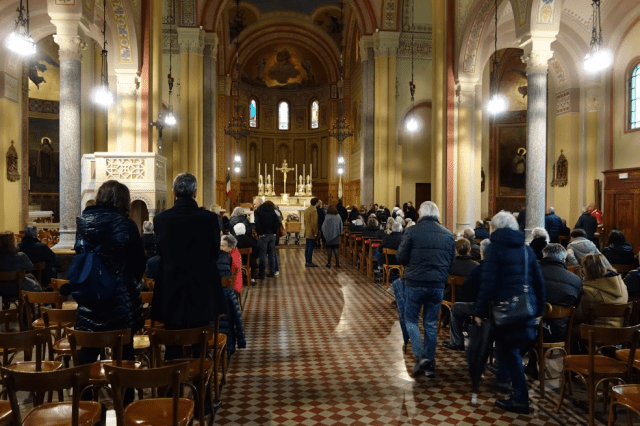
Nonna Pupa’s funeral was held in Cernobbio’s Chiesa del Redentore on Saturday 23rd November.

Nonna Pupa herself expressed her own hopes for the future in this statement made in December 2018 when being presented with the book ‘The Garden of Nonna Pupa’ by Manuela Moretti. She stated:

‘I truly wish that this garden can continue to live and to provide its visitors with moments of contentment and inner peace. From this point on, my obligation is to ensure the garden does not end when my life ends but that it goes on, so as to make sense of all the work done on it over so many years. I wish more than anything else that my efforts do not pass in vain.’

Book covers 2

The covers to Manuela Moretti’s book on the garden published locally by Carlo Pozzoni Editore in 2018. 

Nonna Pupa’s funeral was held on Saturday November 23rd in Cernobbio’s Chiesa del Redentore. She leaves a son, a daughter and seven grandchildren. The service was well attended in spite of the heavy rainfall which had in turn fuelled the torrent flowing through Nonna Pupa’s garden and caused a landslide above Nonna Pupa’s house during the very night of her death.

Garden 3

nonna pupa

Nonna Pupa 29th August 1924, Varese to 20th November 2019, Cernobbio


Posted in Art, Culture, Gardens, People, Places of interest, Uncategorized | Tagged , , , , , , , , , , , , | 1 Comment

Lake Como’s Moltrasio Trunk Murder

Moltrasio 4

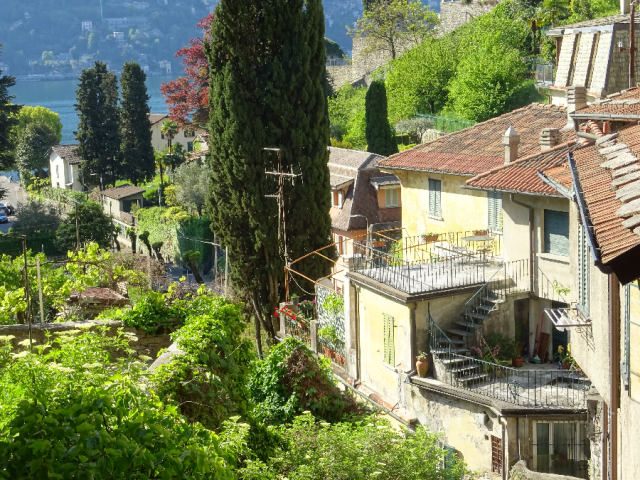
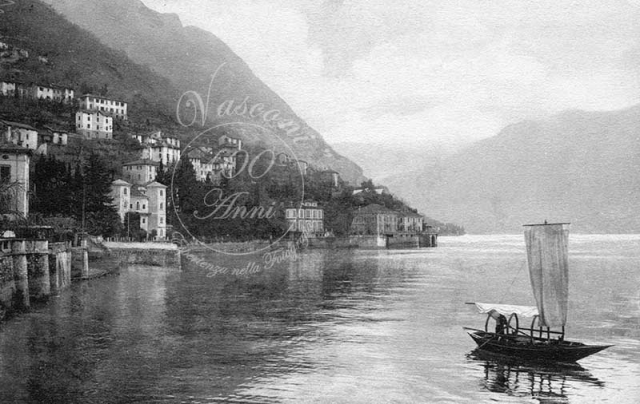
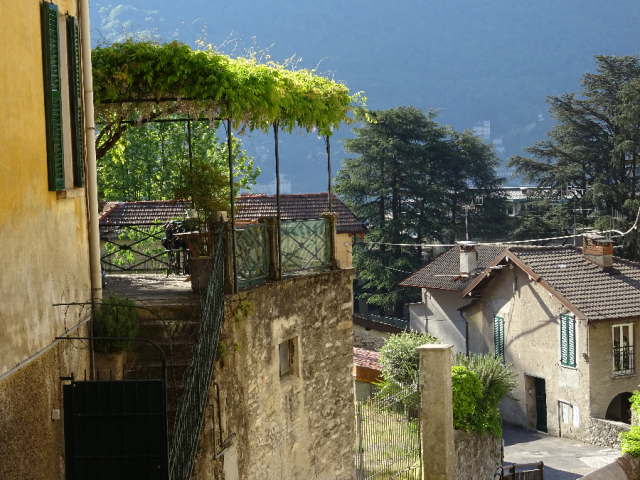
Via Durini, Moltrasio, 5 km north of Como. A peaceful little town unused to violent crime but..

Lake Como is a peaceful place but, when crimes are committed, they tend to truly hit the headlines. No doubt this is due to media coverage delighting in the lake’s exotic natural landscape and that Como has seemed to specialise in crimes of passion. We have previously reported on how Cernobbio and its luxury hotel, Villa D’Este, saw the shooting of wealthy industrialist Carlo Sacchi by his ex-lover, Countess Pia Bellentani, in September 1948 and how this tragedy hit the national headlines at the time. Fifty eight years prior and just up the road in the neighbouring village of Moltrasio, another murder – also later to be judged a crime of passion – saw the conviction of a young American for bludgeoning his wife during their honeymoon, placing her stunned body in her travelling trunk where she died of asphyxiation and seeking to conceal the body by jettisoning the trunk in the lake. This incident also gained massive newspaper attention on both sides of the Atlantic not just for its self-evident drama but also because it raised a whole series of legal issues at the time surrounding the extradition of an American citizen to Italy.

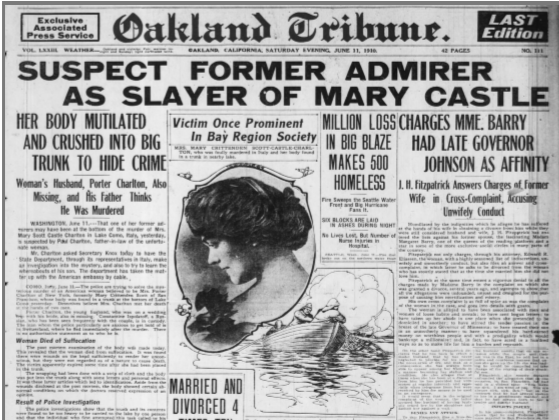
Headline

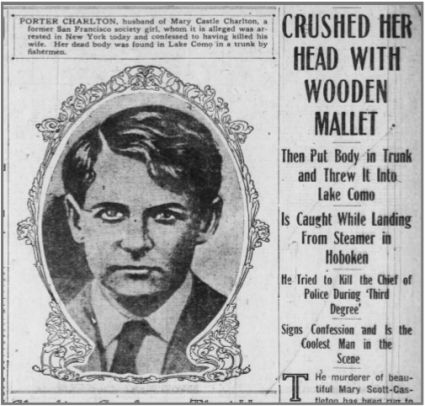
A Bay Area newspaper reports the murder of Mary Scott Castle before husband, Porter Charlton, was suspected.

The Fated Newly-Weds

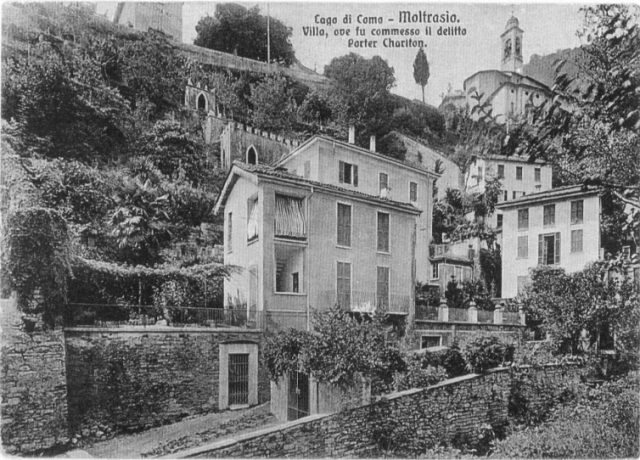
Villa Legnazzi

Villa Legnazzi on Via Durini, Moltrasio – the house rented by the newly-weds where Mary Scott was murdered.

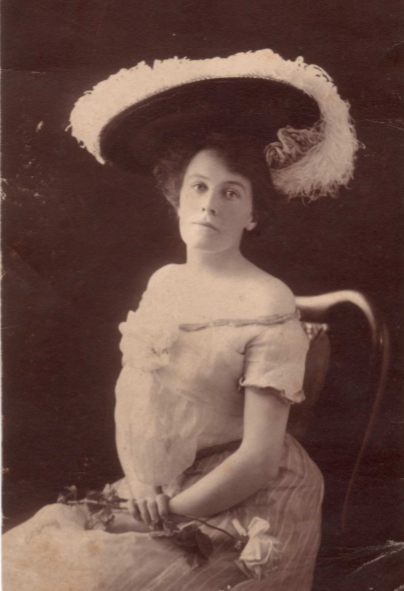
The murder took place on June 6th 1910 within the ‘dependance’ of the Villa Legnazzi in Moltrasio. The victim was the 40 year-old ex-actress, ex-San Franciscan socialite divorcee Mary Scott Castle and the accused was Porter Charlton,  the 21 year-old bank clerk and son of Puerto Rican judge Paul Charlton.

Mary Scott

Mary Scott Castle

The couple had recently married on March 12th of that year in Wilmington, Delaware where she had claimed to be 27 years old and he 25. Mary had just been granted a divorce from her husband Neville Castle who had been a prominent San Franciscan attorney but, having lost a fortune, had moved up to Alaska to pursue fresh enterprises. Porter’s parents were unaware of their son’s marriage until after the event and were not impressed by the bride. Her acting career had stalled after some initial success but she still retained a reputation for her great beauty. She had been characterised as ‘imperious of will and with a consciousness of power’. Porter suffered from ill-health. He was tubercular and his father once described him as ‘weak of will and feeble of body’. The newly-wed couple did however share a similar character trait, a tendency to lose their patience and get into furious tempers. This trait may well have led Mary Scott Castle to the attempted murder of a former lover William D. Craig.  She shot him at close range, but with an under-powered revolver, in a corridor of the Waldorf Astoria Hotel in New York in 1909. This event is remarkably similar to the shooting of Carlo Sacchi in the Hotel Villa D’Este in 1948 except that Craig was fortunate to survive unharmed. In Mary’s case, the bullet intended for her ex-lover was deflected by a fountain pen and he was only lightly injured. When the case against Mary finally came to court, the victim decided not to press charges. 

Moltrasio 1907

Moltrasio Lakefront in 1907 

The Road to Tragedy

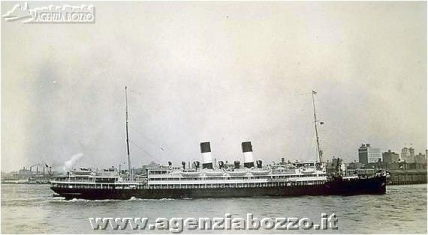
Piroscafo Duca D'Aosta

Steamship Duca D’Aosta

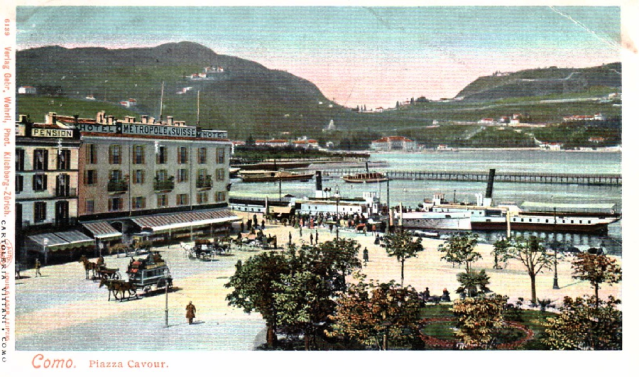
The couple set off on their extended honeymoon in Italy from New York on April 16th 1910 on the Italian steamboat Duca D’Aosta. They arrived in Genoa on April 28th and overnighted the day after at the Pensione Rigatti. They then made their way north and checked in to the Hotel Barchetta on Piazza Cavour in Como on May 3rd, staying for two nights before moving over to the nearby Hotel Metropole Suisse.

Piazza Cavour 1900s with Metropole Suisse

Piazza Cavour and the Hotel Metropole Suisse at the turn of the twentieth century before the hotel’s front was redesigned by Giuseppe Terragni.

They were impressed by Como and made it known on May 7th that they wished to spend at least a month on the lake if they could find somewhere to rent. Not long after, they took up residence at the Villa Legnazzi in Moltrasio. There was nothing to suggest at this stage that the couple were anything other than happy in each other’s company.

Moltrasio 1

Moltrasio

Yet, on having moved into the Villa Legnazzi, which was a relatively modest ‘villetta’, the locals could hardly fail to hear the occasional heated argument sounding over the tranquil village. When returning to dine and stay overnight at the Metropole Suisse on May 17th, they were ejected from their room by the hotel manager at two in the morning due to their failure to stop disturbing the other guests with their animated rows. Porter even followed this up by refusing to pay the full fare demanded by the boatman prepared to row them back to Moltrasio at that early hour. Relationships between the couple and local residents deteriorated even further once they were befriended by a retired Russian resident called Konstantin Ispolatov, known locally as ‘Costantino il Russo’. Costantino was well read and spoke a number of languages thus making  himself useful to the couple as their translator. Porter spoke only English whilst Mary also spoke some French. Added to the locals’ distrust of Costantino and the sound of violent argument emanating from the villa, gossip also began to circulate that the couple and Costantino held wild orgiastic parties.

In A Fit of Temper

Capture of Porter Charlton

Article in the Oakland Tribune June 1910

As the honeymoon began to go severely sour, the couple began to consider that they had both made a mistake by marrying in such a hurry. Money was clearly a problem. Local suppliers were having to wait for payment. Porter could only call upon a modest allowance from his father. Mary had more of a fortune but was soon forced into selling jewellery to finance their stay on the lake. The realities of life were catching up with them and neither liked the prospect. On the night of June 6th all these tensions rose to the fore as the couple again started an intense row. Porter was later to claim that he was so provoked by his wife that he lost his temper and, picking up a mallet he had been using earlier in the day to mend some furniture, struck her a number of times to the head. Mary collapsed unconscious in a pool of blood. Porter immediately assumed she was dead and so, possibly after waiting one day, he emptied her trunk except for some letters and jammed his wife’s body in it forcing her head between her knees. He then also threw in the mallet, closed up the trunk and carried it down to the nearby jetty on the lake. Here he added a boulder to the trunk to give it added weight and heaved it into the water. The next morning he pocketed the rest of his wife’s jewellery and set out for Genoa to avoid capture intending to return to the United States as soon as possible.

Moltrasio 2

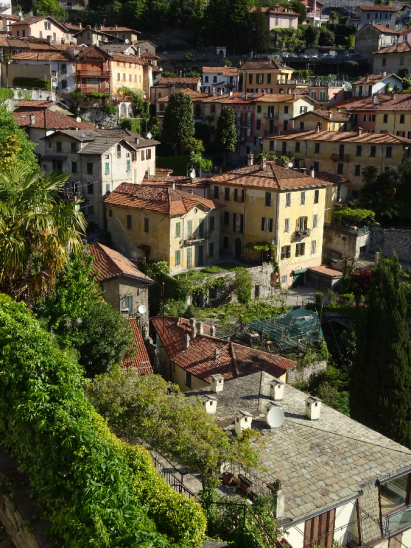
Looking down on Via Durini, Moltrasio

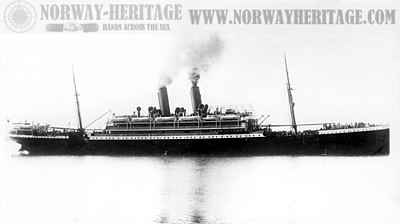
The trunk was discovered two days later on June 9th when a couple of fishermen caught their lines on it. They retrieved it thinking its weight suggested it might contain something of value but found instead the body of Mary. She was quickly identified by the letters that had remained in the trunk. An autopsy followed which revealed that she had not died as a result of her head wounds but due to asphyxiation – she had been alive when placed in the trunk.  At first, investigators considered that maybe Porter had also been killed since there was no sign of him. The bottom of the lake was dragged in search of a similar trunk containing the husband. Meanwhile, ‘Costantino il Russo’ was arrested as the main suspect to a double murder. Porter had sent off a couple of letters on the morning of his rapid departure and, once those had been retrieved, suspicion turned on him. A false lead led investigators to believe Porter may have taken the train north to Zurich which implied he may well be heading for Hamburg where he could take a steamer for New York. Instead he had boarded the steam boat Prinzess Irene which from Genoa, having stopped also at Naples and Palermo, docked on the  morning of June 23rd at Hoboken, New Jersey. 

01prinzessirene-ndl

The Prinzess Irene, a German ship was interned in New York in 1914 and renamed the USS Pocahontas and used as a troop ship. It was given back to German owners in 1923 and renamed the Bremen and then finally renamed the Karslruhe in 1928. 

Mary Scott’s brother, Captain Scott, had been convinced from the moment Mary’s body had been recovered that she had been murdered by Porter. He was at the dock in Hoboken on the morning of June 23rd following his hunch that Porter might be arriving there on a steamship from Hamburg. By chance, the Prinzess Irene had also docked that morning in the same port and Captain Scott was able to identify Porter as he waited to take charge of his luggage. Porter claimed to be called Jack Coleman when questioned but his true identity was soon revealed after his luggage was searched. He made a rapid and complete confession once his true identity had been revealed. He was then arrested and detained in New Jersey. 

Porter arrested

The arrest of Porter Charlton (in bowler hat) at Hoboken, New Jersey on June 23rd 1910.

Extradition to Italy

Public interest at this point on both sides of the Atlantic switched from the details around the actual murder to the course of the legal debate on whether Porter should be extradited. An extradition treaty did exist between Italy and the United States. It had however been broken a number of times with Italy preferring to bring its nationals to trial in Italy wherever possible even if their crime may have been committed in the United States. Under US law, a United States citizen could not be tried for a crime committed outside of US jurisdiction. So, unless Italy requested extradition, Porter would have to be released immediately. On June 29th 1910, the Italian Minister of Foreign Affairs duly requested Porter’s extradition. While Porter remained in detention, his family set about contesting extradition on the basis that the existing treaty had been abused so many times that it was no longer valid and, in any case, Porter was insane and could not be held responsible for his actions.

Tremezzo 1900s

Another vintage photograph from the turn of the century from the Vasconi archive shows a posed group of boatmen on a break on the waterfront at Tremezzina. The boat in the foreground is an ‘Inglesina’ and the cargo vessel behind it is a ‘Comballo’.

The legal issues were disputed from June 1910 until June 1913 when a definitive order was given for extradition. Porter finally returns to Como in November and is given a trial date of May 1914. He would however only face a charge of ‘unpremeditated’ murder – a formula similar to a crime of passion – and he underwent further examination by psychiatrists (known at the time as ‘alienists’) to establish the extent of any apparent insanity.

San Donnino Prison, Como

The old San Donnino prison in Via Giovio, Como. This was was directly behind the courthouse in Palazzo Volpi, now the city’s art museum.

In spite of the date set as May 1914, the trial did not actually begin until October 1915 by when Italy was at war. A final verdict of guilty but with diminished responsibility was passed on October 26th with a sentence of six years eight months. Porter only had to serve a further 29 days in Como’s San Donnino prison since time spent in detention since 1910 was taken into consideration as well as a one year ‘discount’ awarded to all those convicted during the war for crimes committed before the war started. Thus it was that Porter left Italy for the United States for the last time on January 12th 1916 taking the SS America from Naples to New York. 

SS America launch

Launch of the SS America built for Navigazione Generale Italiana at the La Spezia shipyard in 1908.  It’s route took it from Genoa via Naples and New York to Philadelphia – a round trip undertaken 34 times until 24th December 1916 when it changed to the South American routes.

Porter Charlton then faded into obscurity to die aged 45 in November 1933. 

Sources

Thanks are due to the research undertaken by Fabio Cani and Gerardo Monizza (both local historians and editors at Como’s publishing house, Nodo Libri). Their research was based on the material deposited with the Como Palazzo di Giustizia and later transferred to Como’s Archivio di Stato.

Other sources include the United States newspapers of the time with many articles in the newspapers from the San Francisco Bay area where Mary’s family were mainly based and from New York where Porter had previously been working. 

Moltrasio 3

Moltrasio

Posted in crime, History, People, Uncategorized | Tagged , , , , , , , , , , | 1 Comment

Dining Out in and Around Como: Genuine Food

Honest food

‘Honest’ food? Not visually stimulating but truly delicious. Fried polenta and funghi porcini. To revitalise yesterday’s polenta, it has been lightly fried in butter, as served in the Trattoria behind the Santuario Della Madonna Del Soccorso in Ossuccio.

I have only recently felt sufficiently qualified to pass on some recommendations for dining out here. Why has it taken over five years to arrive at this point? Primarily because I am from England and so lack experience of local culinary traditions – I was essentially blind to those links between food and local culture. Secondly, my ability to offer a reasoned commentary of restaurant food cannot begin to match the well informed and exacting criticisms of Italian friends.  Just as my Italian will always be cadenced with a strong foreign accent, I also feel that my culinary judgements can never aspire to the native level of sophistication. Thirdly, in spite of these significant disadvantages, I persist in listening to an inner voice prompting me in the search and appreciation of a cuisine I can only describe as ‘genuine’ – a quality so nebulous that I have only recently been able to appreciate what I myself might mean by it. And finally I have hesitated to step into this area since we dine out for a variety of different reasons or to meet different needs – and as such, a set of recommendations do really need to match specific motivations. 

To address the latter issue first, I have decided to write a series of articles under the general title of ‘Dining Out in and Around Como’ with each one addressing a different category of need. This first one will take on what I might mean by a ‘genuine’ cuisine and where it can be found. 

What is Genuine?

Describing a wine as ‘honest’ either means it’s not that great but at least doesn’t cost too much or else it’s just pretentious twaddle. Describing a meal  as ‘genuine’ runs a similar risk. Further explanation is required and that, unfortunately, is far from straight forward.
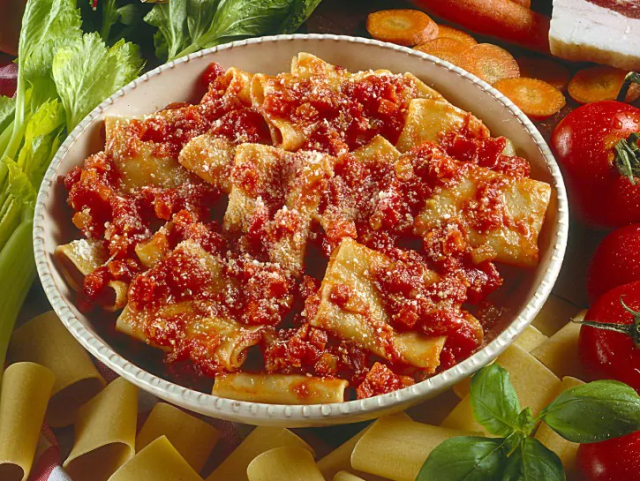
Paccheri alla napoletana

Paccheri alla Napoletana – the form of pasta NOT served up as promised on the menu at Antica Riva  on Como’s lakeside.

It may be easier to start by identifying  restaurants which are not genuine. From my own experience once when eating at the Antica Riva on Como’s lakefront, my wife ordered a pasta dish based on a distinctive type of pasta called paccheri but was served an entirely different pasta without comment or explanation. When challenged as to why they had not served what had been ordered, the waiter offered the excuse that most of their clients would not have known the difference between it and any other pasta in any case. Restaurants of this type that display such a deplorable attitude deserve to be singled out and avoided at all costs. These are the antithesis of ‘genuine’. Unfortunately cities with high levels of tourism do allow such forms of dishonesty to go unpunished in the marketplace. Fortunately, Como has other options available but you seem more likely to find them as you move away from the lakefront.
Er Piu

First recommendation Ristorante Er Piu, well away from the lake near to the ex-army barracks in an area now abandoned by local industry but retaining this excellent restaurant.

Recommendation: Er Piu, Via Pastrengo 3, Como

Editor’s note March 2023: This restaurant is no longer run by the same family and I have not been back to try it since the change of ownership.

Closed Tuesdays. Speciality fish and Lombardy Cuisine. Established for 30 years. Tel: 031 272154. Email: ristorante@erpiucomo.it. Link to website.

Notes: Located near to the military barracks in an ex-industrial area where the previous textile factories have now left.  In addition to the quality of the food, it is a joy to observe how the head waiter maintains a constant control on how service is progressing across the dining room. A popular location for weekend family meals but they also offer a daily weekday lunch menu at reduced prices. Other restaurants of quality on Como’s periphery left high and dry by the repositioning of industry include Ristorante S. Anna and Ristorante Navedano.

Recommendation: Tira, Mola e Meseda
tira mola meseda

Tira, Mola e Meseda Restaurant. Typical Como and Brianzola cuisine

Tira, Mola e Mesada is just down the road from Er Piu, in other words nowhere near the centre of town but this is perhaps the best restaurant for sampling local cuisine alongside Osteria del Gallo in Via Vitani. Being another family run establishment it meets one of the primary requirements of a genuine cuisine, consistency. A trip out to the edge of town will be well rewarded at this restaurant.

The address is Via Gabriele Castellini, 17. Contact them by phone on 031 275 9735. They are open for lunch only from Sunday to Tuesday and for lunch and dinner for the rest of the week. Booking is well advised particularly at weekends when the restaurant quickly fills up with locals.

In London, most middle-of-the-road restaurants identify themselves by alignment with a particular national or regional cuisine. Often you hear people selecting where to eat by running down a list of nations – Chinese, Indian, Italian etc. In London, on Islington’s Upper Street, there are two ‘Peruvian’ restaurants within 50 metres of each other for whom the majority of clients can only have the most remote idea of what represents good Peruvian cooking. I would argue  that it is fundamentally impossible for an Upper Street restaurant to recreate a Peruvian cuisine matching anything like the quality you might expect back in Lima. To do so would require spending  a fortune on flying in their raw materials as well as acquiring and retaining qualified Peruvian staff. Even in France, which we know has as proud a culinary tradition as Italy and not so prone as in England to fall for novelty,  the food served up in most so-called Parisian Italian restaurants  is awful and dishonestly priced. 

Risultati immagini per valverde como

Ristorante Pizzeria ValVerde, Cernobbio. A ‘regional’ restaurant specialising in sea food that has acquired a great reputation amongst both local and Swiss customers.

Recommendation: ValVerde, Viale Matteotti 29,  Cernobbio

Open every day. Speciality fish and Sicilian Cuisine. Established for over 30 years. Tel: 031 511150.  Link to website.

Notes: Located on the road out of Cernobbio towards Maslianico. This is a family run business started by the elder brother who moved up to Cernobbio from Palermo a long time ago. The restaurant prides itself on the quality of the fish bought in from the Milanese market. It profits from its proximity to the Swiss border and the fact that the Swiss often prefer to eat early from about 18.00 meaning tables are freed up for Italian clients who tend to dine from 20,00 onwards. Organisation in the kitchen is their weak point and sometimes service can suffer as a result but this is the sort of establishment that can be forgiven such shortcomings due to its commitment to quality in all other respects. They also remain stubbornly closed over both the August and Christmas periods when both brothers return to Palermo for the holidays.

It may be stating the obvious that there are no ‘Italian’ restaurants in Italy nor are there ‘French’ restaurants in France but revealingly one can find a handful of  restaurants in London identified as ‘English’.  Here however there are an increasing number of restaurants identifying themselves as regional, e.g. Sicilian, Pugliese, Tuscan or Umbrian to name some of the more common.  Regional restaurants have been around for some time but crucially the original ones rarely identified themselves as regional. They were set up by migrants who, not being that far from their places of origin, could source the real raw materials and initially offer some culinary novelty to their clients in their adopted locations. They then worked over the years to establish a reputation for the quality of their cuisine.  The more recent wave of regionalism is instead a reflection of marketing trends aimed at commercial exploitation and more likely originating from a partnership including a Milanese financier rather than owned by a displaced family applying their traditional skills whilst seeking their fortune in a wealthier part of the country. This new wave will have to wait the test of time and the judgement of the marketplace before they can gain the accolade as ‘genuine’.
Casa 28

‘New Wave’ Pugliese regional restaurant ‘Casa 28’ on the corner of Via Vitani and Via 5 Giornate, Como. Slick interior, kitchen on view and even a slogan ‘Your satisfaction is our best prize’ on the exterior blackboard. Time will tell if this establishment can be classified as ‘genuine’ but it has gained some initial popularity.

I contend that very few people in Italy consciously decide to go and eat out in a regional restaurant. The national or regional ‘identity’ is not what primarily attracts people. Even if a restaurant does identify itself as Tuscan or Sicilian, it is more likely to be selected on the basis of its reputation and not by any geographical identifier. And their reputation depends on offering dishes that stand out and which they do best. Regional identification is in my opinion a marketing error since it is appealing to novelty, and novelty has a limited shelf life. 

La Barchetta

La Barchetta, Argegno. The interior of this restaurant has not changed in any respect since when this photo was taken in 2012. ‘Genuine’ restaurants tend not to remodel their interiors very often.

Recommendation: La Barchetta, Piazza Roma 2, Argegno

Closed Mondays. Speciality lake fish, Porcini mushrooms and truffles, Alpine Cuisine. Established in 1908 and run by the Dotti family since 1989. Tel: 031 821105. Link to website.

Notes: Located on the lakefront in Argegno at the start of the Valle Intelvi. Renowned for the quality of traditional local dishes such as Risotto al Pesce Persico or Risotto ai Funghi Porcini  as well as Ossobuco with Risotto Milanese. They also get in white truffles from the Alba area of Piedmont when in season.  This restaurant is included in the Rassegna Valle Intelvi along with other quality restaurants in the Intelvi Valley such as Ristorante Castiglione.  Another recommendation in the area is the Locanda Sant Anna.

Reputation depends on a number of factors, not least being the passage of time and the ability to sustain consistency. Reputation is gained by keeping faith with your clientele and seeking to maintain what is good and improve wherever possible. This in itself requires experience, a true desire to impart pleasure and a high degree of honesty to yourself as the proprietor and to your customers. Put all this together and we arrive at that ‘genuine’ cuisine. 
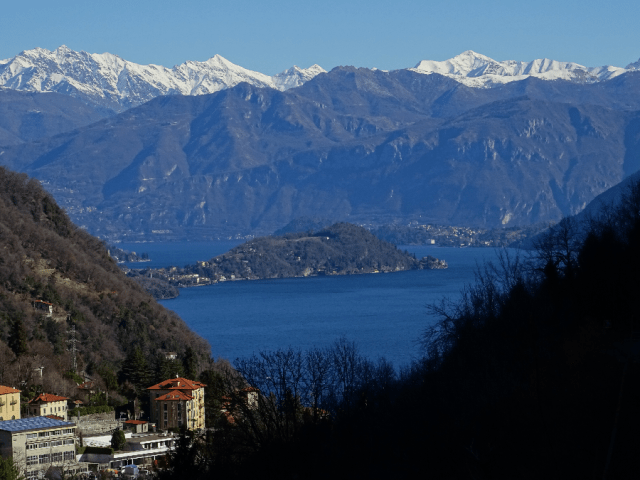
View from Locanda Sant Anna

View of the lake and the Villa Balbianello Peninsular  from the Locanda Sant’Anna above Argegno on the road to Schignano.

Thus ‘genuine’ cuisine is a notion at odds with novelty although innovation is not disallowed. It is at peace with tradition and comfortable with the notion of seeking to recreate what has been done well over many years. It is aided by consistency and continuity and by strong links to culinary habits laid down through previous generations. Given all that, a ‘genuine’ establishment goes beyond the menu to provide a relaxing atmosphere born out of its own effortless self-confidence in its quality and its capacity to impart pleasure. It is a quality that seems to hang in the air providing an oasis of certainty in an insecure world and which can only be extinguished by an excess of luxury. 
osteria gallo

Osteria del Gallo on Via Vitani, Como’s oldest street.  Traditional food in a traditional almost timeless setting. 

This definition seems to preclude new establishments, and admittedly it is harder but not impossible for them to qualify as ‘genuine’. What they need to offer before they acquire the necessary patina of experience is their enthusiasm, a clearly visible commitment to quality, the warmth of their welcome and the sincerity of their desire to please. As time passes, these restaurants are permitted to become more individualistic in their approach and style always assuming they remain ‘genuine’.
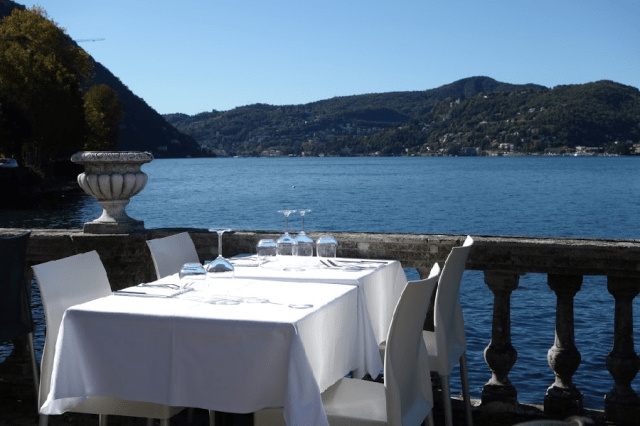
Momi restaurant

Momi’s Restaurant on the lakefront at Blevio. This must be one of the most romantic and soothing locations when not over busy, matched by the quality of the cooking, commitment to local and seasonal products and a warm welcome. 

Recommendation: Momi, Riva Stendhal, Blevio

Closed Mondays. Speciality lake fish, local and seasonal dishes using quality ingredients.  Established in 2010 by Chef Momi  who tries to give a personal greeting to all customers. Tel: 334 1202327. Link to website.

Notes: Located with a terrace directly on the lake in the tranquil small village of Blevio, Momi’s restaurant is individual and their commitment to quality is best made obvious when the season quietens down and they are not under time pressure.  They offer a very reasonable Menu del Giorno during weekday lunchtimes. Staff at the restaurant also manage the neighbouring imbarcadero so they will not let you miss your boat departure.  Other establishments with direct lake access and a reputation for quality include La Tirlindana in Sala Comacina.
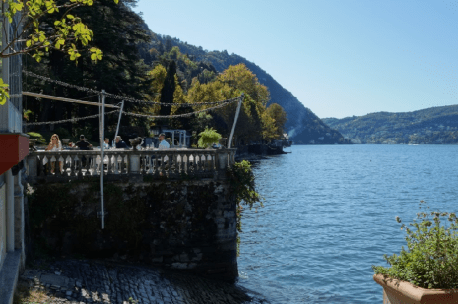
Momi restaurant 2

Momi’s from the Imbarcadero which is operated by staff from the restaurant.

The average lifespan of a London restaurant is measured in months not years and that is because most are ‘identity’ based and so are appealing to novelty, fashion, aspects of  life style, or god knows what else other than the quality of their cuisine. They are created around marketing briefs and business plans which fail to go beyond a superficial understanding of quality , or lack a fundamental interest in delivering culinary authenticity. Their ongoing replacement with new establishments with the same mentality, and destined for a similar short-lived existence, marks the triumph of hope over experience, but at least goes to guarantee a future for those establishments that conversely do commit to quality.
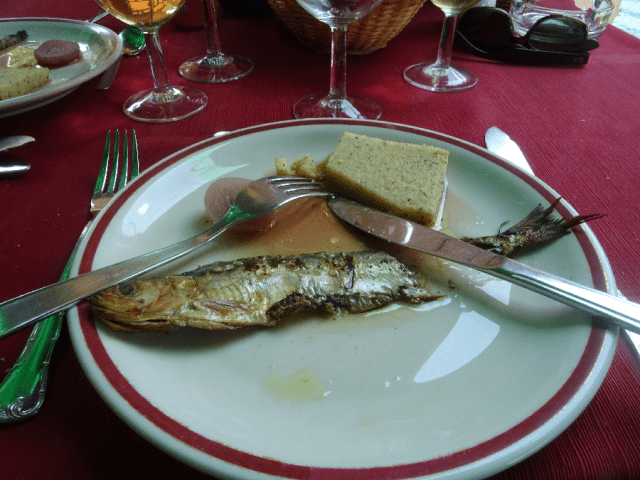
Missoltin

Some local dishes such as missoltini can be an acquired taste. Missoltini are the small lake fish (called Agone on Lake Como) which have been salted, pickled and pressed. They have a strong and distinctive flavour. They are typically served with the ubiquitous polenta.

While I am more than prepared to admit regional restaurants into the band of genuine establishments, for example ValVerde in Cernobbio, it has to be admitted that those offering local cuisine are usually better placed. That is because they call upon the tradition of local expertise with locally-sourced products. Many are also family enterprises and these seem well able to provide the continuity necessary to establish long-lasting reputations for quality. Nothing disqualifies a restaurant faster than an ever-changing chef. 
Antica Trattoria

L’Antica Trattoria, Via Cadorna, Como. This long established restaurant specialises in grilled meat but the full range of its menu is of excellent quality.

Recommendation: L’Antica Trattoria, Via Cadorna 26, Como

Closed Sundays. Speciality barbecued meat, local and seasonal dishes using quality ingredients.  Established many years ago and family run. Tel: 031 242777. Link to website.

Notes: Located well away from Como’s lakefront, L’Antica has built its reputation on commitment to quality and use of seasonal products. In particular they specialise in ‘carne alla brace’ and in guaranteeing totally gluten-free cooking for those suffering from this intolerance.

Rassegna Gastronomica

La Fagurida menu

Rassegna Gastronomica Special Menu for La Fagurida in Tremezzo

The local cuisine comes into its own at this time of the year – a period of plenty based on the harvest of corn for polenta, wild mushrooms from the woods and chestnuts. To reflect this abundance, there are now so-called ‘Rassegna Gastronomica’ (Gastronomic Collections) established in Como, Valle Intelvi and Tremezzina. These are all seasonal initiatives promoting local cuisine in participating restaurants. I had somewhat cynically assumed that these were primarily intended as marketing ploys to fill a slack period after the end of the summer season and prior to Christmas. However I now know better and would redefine them as nothing less than a perennial reassertion of local culinary culture.

The Rassegna Gastronomica Valle Intelvi is in its second year. It runs from 18th October to 18th November involving sixteen different establishments. More details are available from their Facebook page.

GastrolarioThe GastroLario is also into its second year. It is on a larger scale than the others involving fifty restaurants promoting the local cuisine found around Lake Como and within the province. It runs from 4th October to 24th November. Details are available in English from their website. This year’s competition is to identify the best ‘polenta uncia’ in the area. 

Polenta in Mendrisio

Mendrisio’s Fire Brigade offer hospitality and a plateful of polenta to diners at the town’s annual Wine Festival

The Rassegna Gastronomica Tremezzina is into its fourth year. It runs from 18th October until 30th November and, as in the Valle Intelvi, involves sixteen establishments. The link here is to download the organiser’s brochure.

Over the border in Switzerland the Rassegna Gastronomica di Mendrisiotto e Bassa Ceresio is just coming to an end as it runs from the 1st October to 3rd November. This year was its 56th edition celebrating as always the local cuisine and the winemaking of the region. More information is on its website

If you too might be in search of a cuisine that might loosely be described as genuine, try out some of the establishments within these initiatives, or any of those recommended here. It’s also a good idea to seek recommendations locally and the best in my experience come from those who have lived here for a long time. They can identify which restaurants have moved beyond novelty to withstand the test of time.

Slow FoodI would also like to mention the Slow Food movement which campaigns to retain and strengthen the same principles about food that I have attempted to describe here as genuine. There is a local chapter of the Slow Food movement here in Como and their website explains their philosophy and notice of the various events and initiatives in which they are involved. 
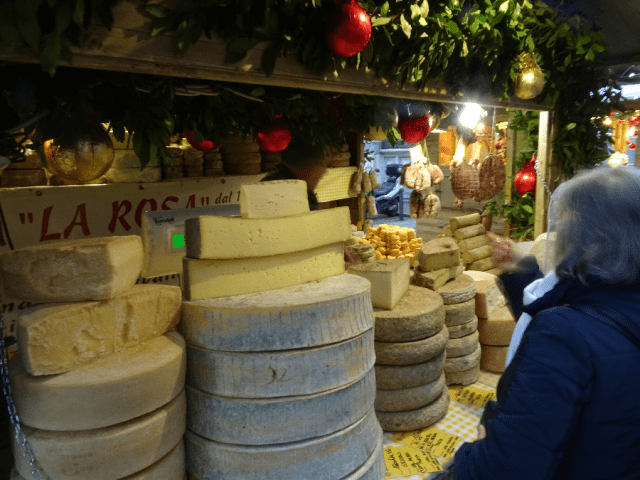
Just a morsel of cheese

Local cheeses (from goat, sheep or cow) form a key part of the area’s alpine diet and are readily available within the covered market or, as photographed here, in the Christmas market.

And Beyond…

A follow up article will seek to expand on the alpine roots of the local cuisine and the habit of Como city dwellers to dine out at weekends in one of the mountain refuges or ‘baita’. Additionally, in spite of my argument that there is no such thing as a national Italian cuisine, one has to recognise the ubiquity of pizza and ice cream and so we need to identify the best pizzerias and gelaterias. Finally, and probably not before next Spring, we will try to address the complex and varied needs of tourists to Como to offer our advice to the savvy visitor. 
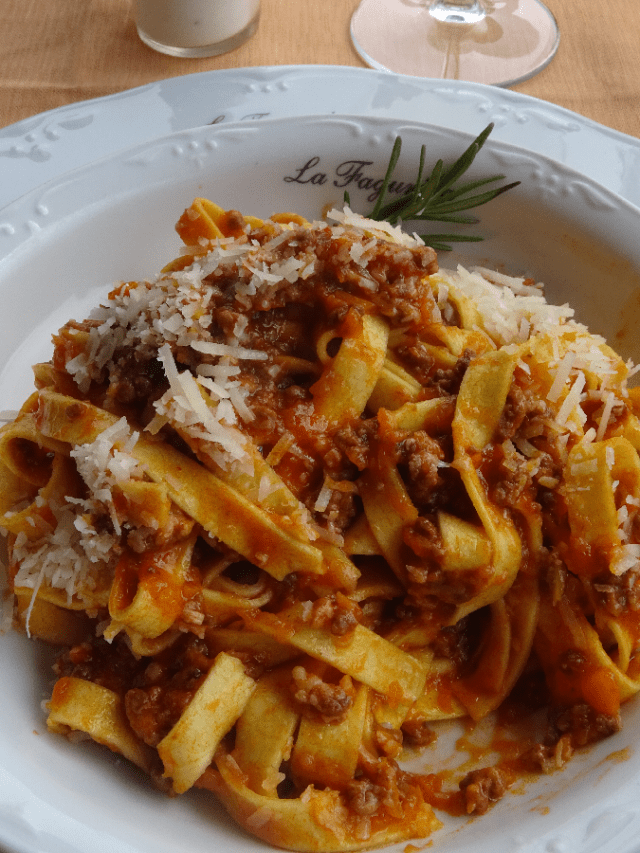
La Fagurida.png

Tagliatelle at La Fagurida, Tremezzo

Posted in Culture, Food, Restaurants, Uncategorized | Tagged , , , , , , , , , , , , , , , , , , , | 2 Comments

Strada Regia: From Nesso to Lezzeno
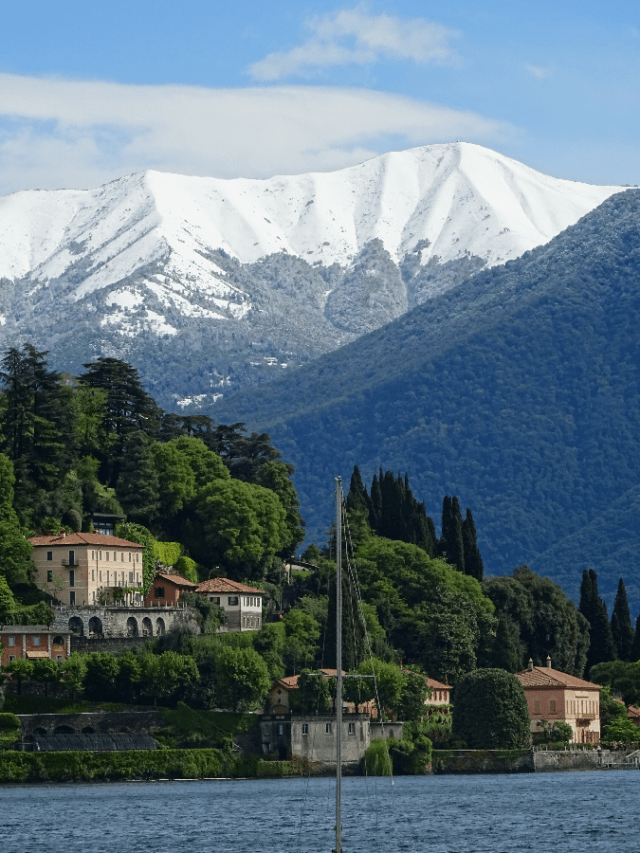
This article has now been moved to Strada Regia: From Nesso to Lezzeno


Posted in Itineraries, Lake, Places of interest, Uncategorized, Walks | Tagged , , , , , , , , , , | 1 Comment