Moltrasio’s stone and its ‘Ecomuseo’

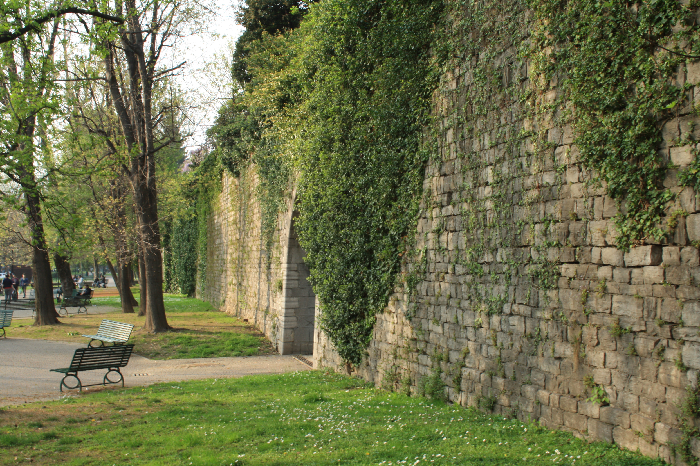
Moltrasio stone was used to construct the Roman walls and the currently standing Barbarossa walls built in the 1200s

Moltrasio stone was the dominant building material used in and around Como from Roman days until the turn of the twentieth century. It is found at the heart of most buildings even if some may have then be adorned with a veneer of render or a dressing of Musso and Varenna marble.

Doorway to the villa opposite the Prefettura on Via Volta showing the use of black and white keystones around the entrance way, rendering on the walls and Moltrasio stone underneath.

Nothing more characterises the appearance of a town than the type of building materials used in their construction. Think of UK cities like the granite of Edinburgh or those Cotswold villages with their warm shades of sandstone. Or contrast the ancient russet brickwork in the centre of cities like Parma or Mantova in the Val Padana with the grey stone of the villages along the shores of Lake Como. And this local characteristic extends beyond the village centres through the lengths of dry stone walls supporting ancient terracing.  

What Is Moltrasio Stone

Strata of Moltrasio stone over the border in the Parco delle Gole della Breggia

Moltrasio stone is a sedimentary rock formed over many years from deposits on the ancient sea bed. These strata of limestone, some containing fossils of ammonites or other sea creatures, are ideal for quarrying since they can be relatively easily cut into blocks for construction. Scientifically known as the Moltrasio Formation, the rocks were mostly developed in the Lower or Middle Sinemurian stage of the Lower Jurassic, as a result of tectonic changes impacting shallow water deposits on the south western edge of the Alps. The formation extends into the Canton Ticino in Switzerland and up to the area of Lake Lugano.

Sentee di Sort – Ex-limestone quarries above Moltrasio.

Moltrasio stone is therefore not only found in Moltrasio. It was quarried on both sides of the Como leg of the lake up to Argegno on the western side and Lezzeno on the east, but the area where the rock is best formed for use in construction is around Moltrasio and Carate on the west and between Torno and Nesso on the east. The quarries around Moltrasio and Carate are no longer exploited with the only remaining excavation taking place at Careno by the company called Gandola Srl

In the Villages

Palanzo, village of stone

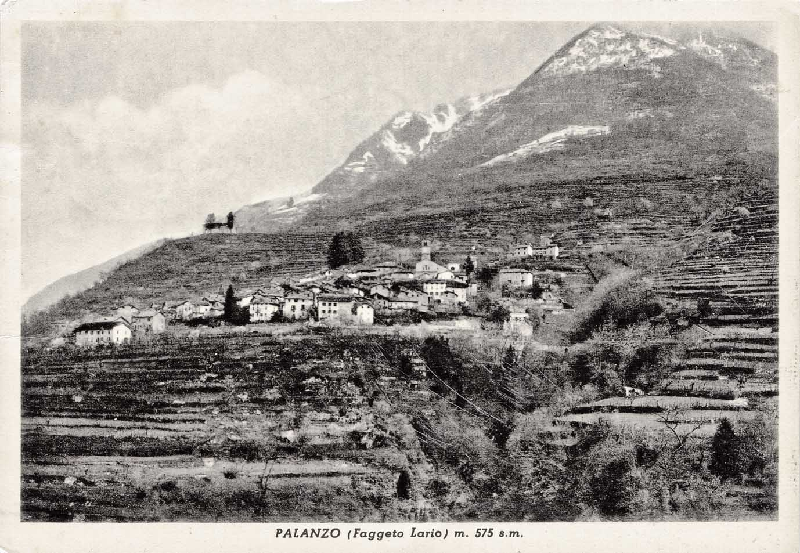
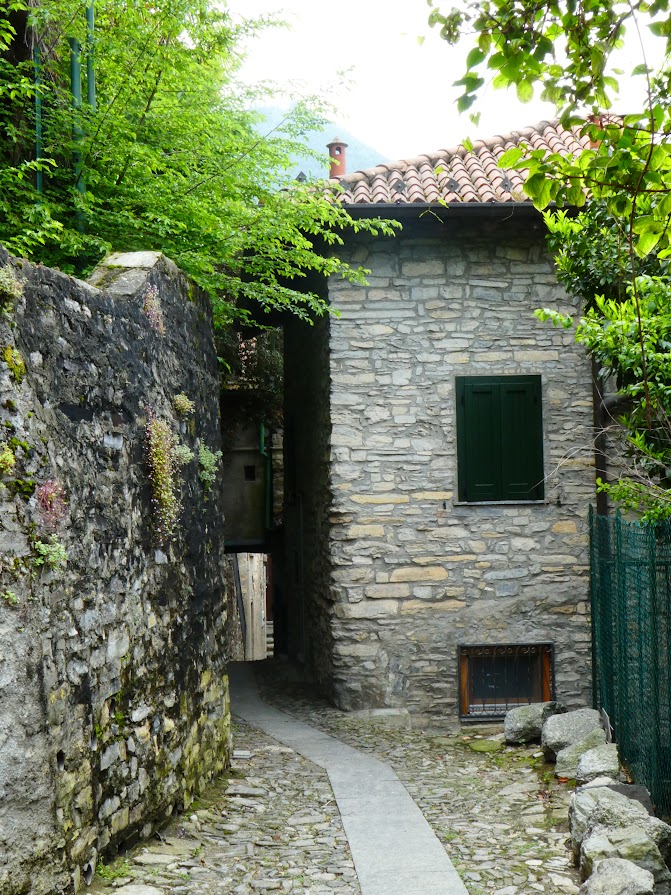
If visiting a village such as Palanzo above the lake shore in Faggetto Lario, you will be hard pressed to find more than a handful of buildings built or faced with any other material. The same goes for the medieval centres of most other villages sitting just behind the shoreline along the length of the lake. Alongside the preservation of ancient street patterns and paths, the use of Moltrasio stone ensures a remarkable uniformity in the form and feel of these ancient communities. However these are locations where the majority of visitors are less likely to venture being attracted for the most part to the shores of the lake itself where the bourgeoisie and aristocrats had built their stylishly designed sumptuous villas rigorously rendered in painted stucco. Take a town like Blevio for example, with its row of wealthy ‘stuccoed’ residences overlooking the lake and its series of bare stone districts strung out above. 

In Como 

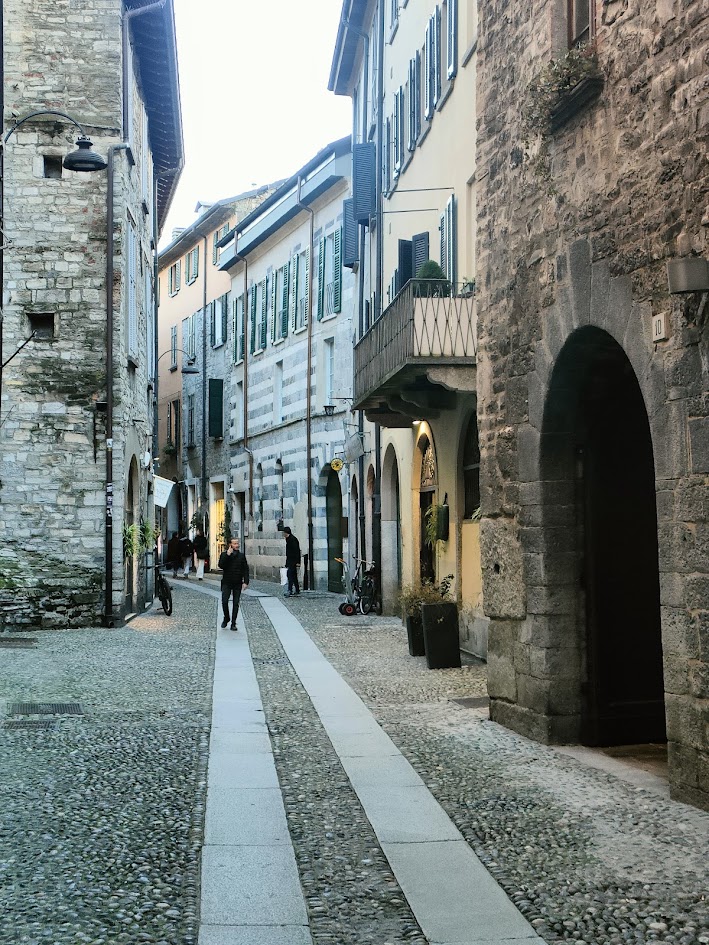
Via Vitani, the only remaining part of the medieval quarter known as Cortisella with villas in Moltrasio stone and one dressed in corresponding shades of Musso and Varenna marble.

The most obvious and visible Moltrasio stone structures in Como are the city walls and their defensive towers. Less visible below street level are the Roman baths built with Moltrasio stone. A walk down Via Vitani (the oldest street in Como) will give you an idea of how ubiquitous Moltrasio stone would have been in medieval Como. But more prestigious materials were required for structures like the Duomo with its mosaic of coloured marbles.  As also on the Broletto and surrounding the entrance ways into the aristocratic villas where the contrasting colours of Musso (white/light grey) and Varenna (black/dark grey) marble give a banding or chequered effect. While most of the city’s aristocratic villas were faced with a layer of stucco, the more prosaic Moltrasio stone remains at the heart of their construction.  

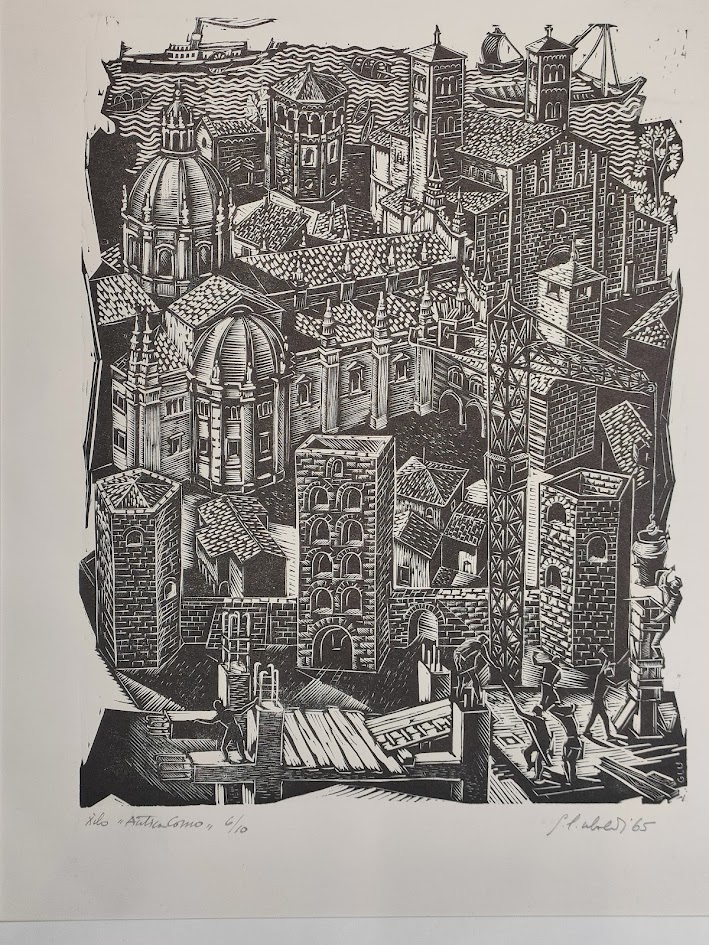
Print by Gian Luigi Uboldi featuring the city’s main structures of architectural interest.

Only in relatively recent times has stone been replaced by reinforced concrete, first introduced in Como by local architect Federico Frigerio in the construction of the Politeama in 1920. 

In the country

Palanzo when all the terraces were intensively cultivated. The decline in agriculture has transformed the hillsides around the lake since the 1940s.

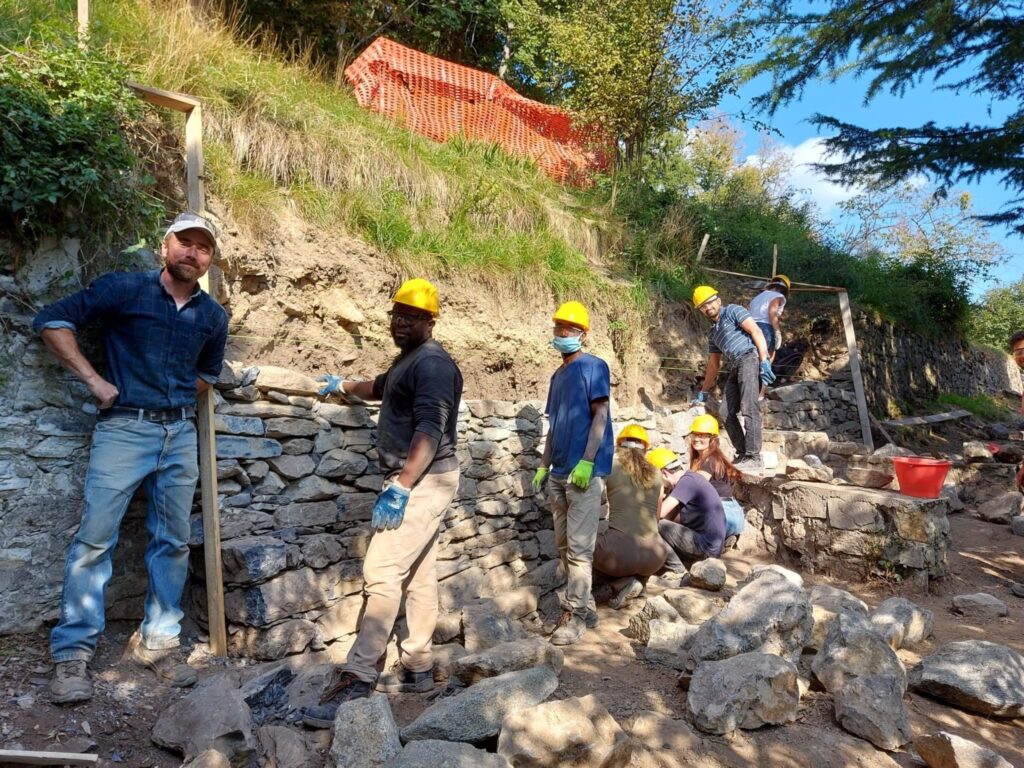
The hillsides surrounding the lake would have looked very differently a mere eighty years ago before the major migration from the land to the towns after the last world war. Then the miles of terracing were constructed and maintained to maximise the acreage of productive agricultural  land. And those terraces were (and are still) held in place by dry stone walls made from Moltrasio stone. Although some of these terrace walls are no longer clearly visible from a distance, they remain in place as a characteristic feature of our landscape. Their maintenance is not only vital for ensuring ongoing access to  hillside walks and paths but also for preserving a key element of the local heritage. There is always the risk that the knowledge and skills required for dry stone walling get lost over time, and so we should praise the work of voluntary associations such as Miledù, based in Civiglio, who are committed to passing on the necessary skills to future generations and to playing their part in maintaining the countryside. 

Volunteers from Miledù working on dry stone walls.

Sentee di Sort

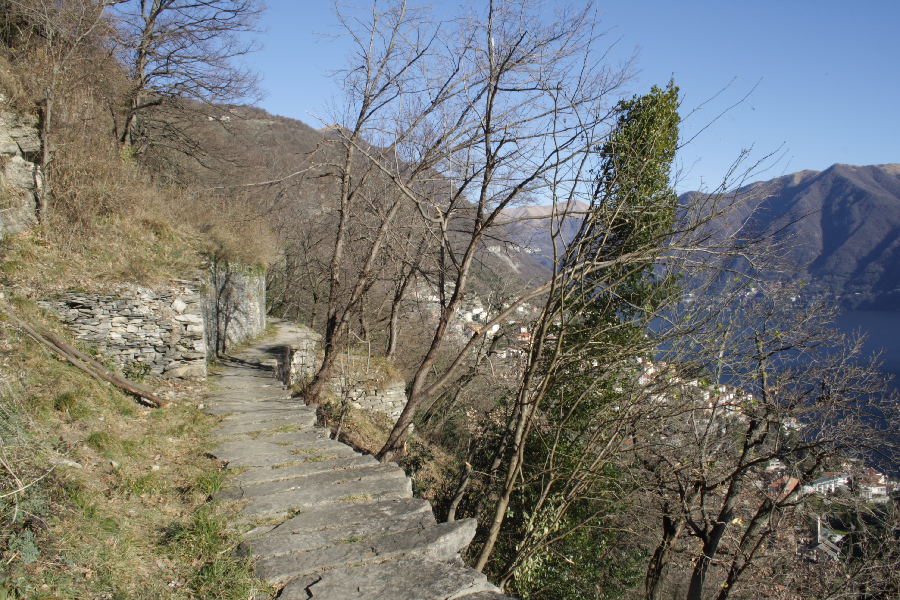
This pathway linking Rovenna above Cernobbio to Moltrasio passes one of the largest of the old Moltrasio quarries. Sentee di Sort translates roughly from Como dialect into ‘path of the terraces’.  Apart from offering delightful views over the lake, it also lets you see the extent of the old workings and the paths, obviously made of Moltrasio stone, laid down to transport the rock down to the town for onward shipment on the lake. 

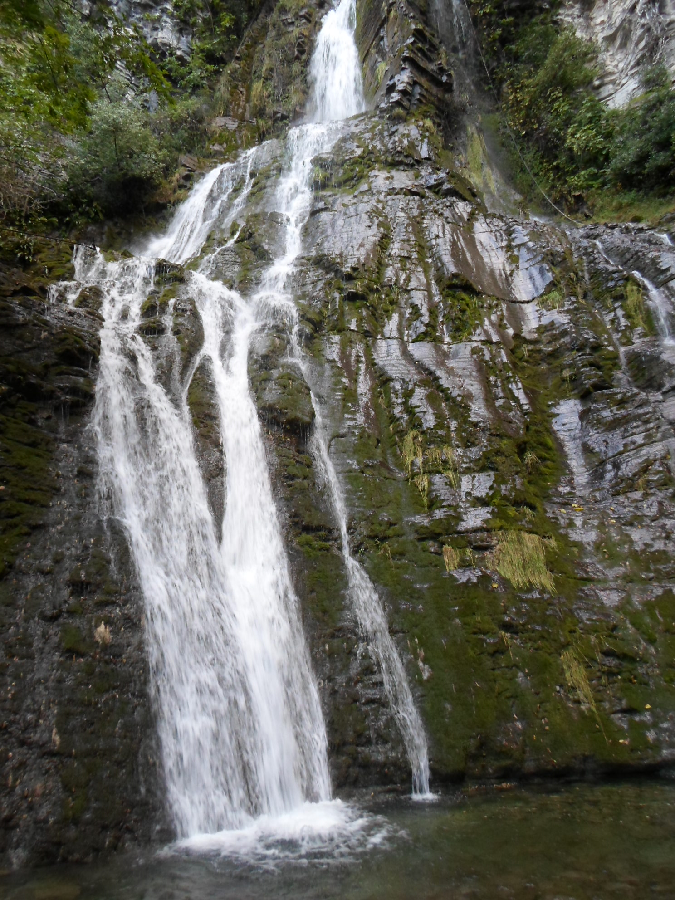
Motrasio – Cascata di Cam

Moltrasio represents itself as a town of water and stone and you will appreciate both these aspects by following the Sentee di Sort by turning off to the left on your arrival in Moltrasio to take in the waterfall known as the Cascata di Cam. 

Moltrasio’s Stone Ecological Museum (Ecomuseo del Sasso)

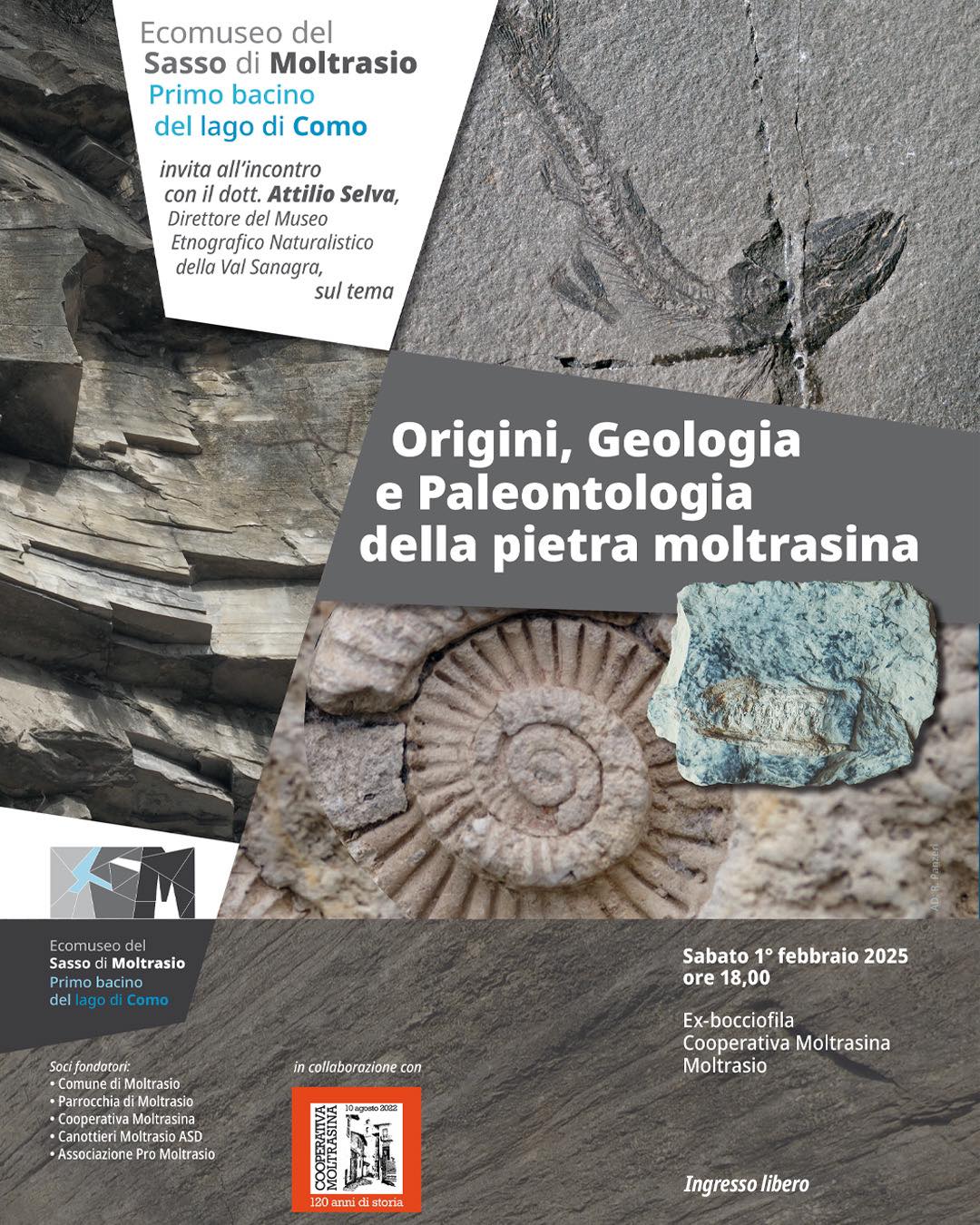
Poster advertising one of the presentations organised by the Ecomuseo di Sasso di Moltrasio

We have already noted in a previous article how active Moltrasio’s local residents are in their  ‘Pro-loco’ association in promoting the attractions of their delightful small town. They have now gone one step further in seeking to preserve knowledge and awareness of their local culture by forming the so-called ‘Ecomuseo del Sasso di Moltrasio’. An ‘Ecomuseo’ is not a traditional museum enclosed within four walls. Instead its a virtual reality animated by a voluntary association which aims to study, conserve, present and spread knowledge of their local artistic, social and cultural patrimony. Look out for notices on their Facebook page advertising their meetings and tours to this end. Without a physical heart, it is primarily the enthusiasm and commitment of its local volunteers that makes an Ecomuseo a reality.  And Moltrasio’s residents are particularly active in promoting the attractions of their town. 

Members of Pro Moltrasio demonstrating the traditional techniques for quarrying Moltrasio stone at the old quarry in Cavirolo during a FAI Open Day

Moltrasio is a fine example of a town where the full range of tourist facilities and attractions are available. At the top end of the market, the Villa Passalacqua is perhaps the most luxurious hotel on the lake with the Hotel Imperiale also seeking to cater to the lake’s image of an exclusive playground for the rich. But there still remain more affordable and accessible  family hotels such as the Posta, of the type of establishment traditionally available to visitors over the past years. However those visitors  who are prepared to make the climb up the steep set of stairs away from the shore will discover so much more within this medieval town of stone and water.

The flower beds at the side of the Broletto in Como are lined with Moltrasio stone quarried in Careno by Gandola Srl. They use modern techniques of extraction and finish to meet a variety of needs.

Further Information

More information on current quarrying can be found at Gandola’s website.

Follow this link for the Ecumuseo del Sasso di Moltrasio’s Facebook page.

Miledù is a social cooperative engaged in a number of activities in support of sustainable tourism and preservation of local rural culture. Visit their site for more information.

Good food at acceptable prices can be found at the Cooperativa Moltrasina

Further Reading

We have featured Moltrasio in the following articles:

Moltrasio: The Power of Civic Pride 

Moltrasio: The Power of Civic Pride

The Sentee di Sort is described in greater detail in Sentee di Sort (From Rovenna to Moltrasio).

We have also described two other walks that start or finish at Moltrasio: 

Carate Urio to Moltrasio via Rifugio Bugone.

From Laglio to Moltrasio

Moltrasio dream


Posted in Architecture, Culture, History, Lake, Places of interest, Sustainability, Walks | Tagged , , , , , , , , , , | 1 Comment

Lake Pusiano, Cypresses and Wallabies

pusiano and resegone

Lake Pusiano with the village of Pusiano on its northern shore and Mount Resegone in the background.

At the foot of majestic Lake Como a string of much smaller lakes stretches out between Como itself and Lecco – each possessing their own charm.  In order from west to east they are Lake Montorfano, Alserio, Pusiano, Segrino, Annone and Garlate. They were all formed as retreating glaciers left morainic deposits that dammed up the streams and rivers descending from the Alps. Such is the case of Lake Pusiano formed by the River Lambro.

Lake Pusiano

passeggiata pusiano

The park along the banks of the lake in Bosisio Parini is a popular spot for a weekend passeggiata

fishingNormally the surface of Lake Pusiano is particularly still perhaps due in part to its maximum depth of 27 metres – compared with the 425 metre maximum depth of Lake Como. This gives a perfect surface for the various rowing clubs in the area, including our own Canottieri Lario, to use it as their main base for training and competitive racing. The sense of tranquillity evoked by its calm waters is further emphasised by its contrast with the dramatic backdrop of Mount Resegone behind Lecco. All go to make Lake Pusiano, known as the Pearl of Brianza, a popular location locally for a relaxing weekend passeggiata or for a picnic along its shores.

Isola dei Cipressi

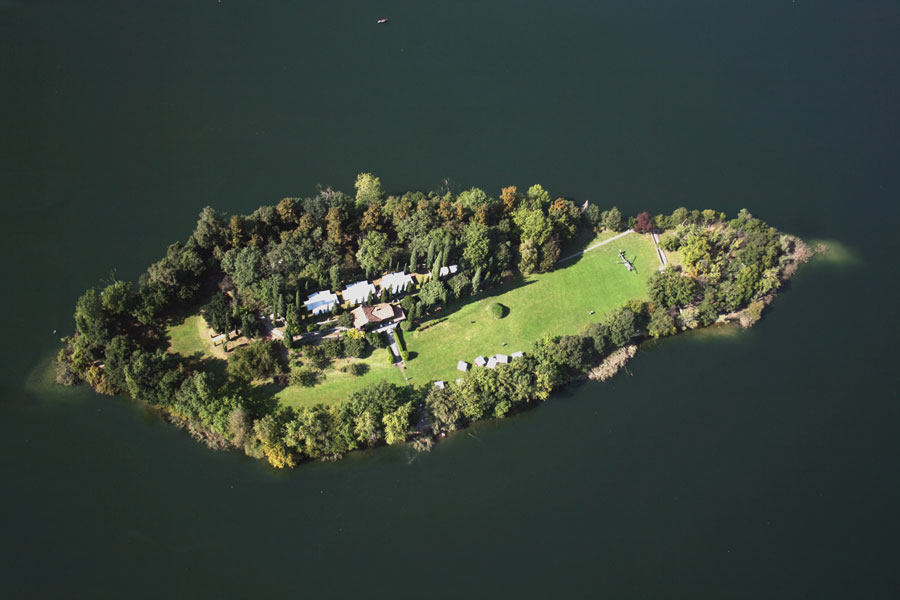
Adding further to the lake’s charm is the small oval-shaped island off its northern shores known as Isola dei Cipressi, so named after the one hundred and thirty monumental cypress trees growing there. Its literal ‘isolation,’ whilst remaining within shouting distance of the mainland, makes the island in some ways comparable to Isola Comacina, at least in terms of its atmosphere if not its scale. Gerolamo Gavazzi, the current owner of the island, identifies precisely what this magical quality is in the opening sentence of the preface to his book dedicated to his island. He states, “Islands have always held a strong fascination. The surrounding water creates a sense of protection for those within their shores, and a sense of adventure for those who view them from afar.”

Isola-dei-Cipressi

The oval shaped Isola dei Cipressi with its 130 cypress trees and abundant wildlife.

Unlike Isola Comacina, Lake Pusiano’s island was never the site of full time occupation after the demise of the original Neolithic residents who lived there around twelve thousand years ago. Its changes of ownership from the Middle Ages to today reflect the various changes in the dominant power of the time.

pusiano mirror

Lake Pusiano, the Pearl of Brianza

From the 14th to the 17th century it was owned by one branch or other of the church. The aristocratic Carpani family, who came to own large tracts of land around Erba, took ownership of the lake and island from 1483 and also set about building the splendid Palazzo Carpani in Pusiano. From the late eighteenth century, the lake, island and palace passed on to the Molo and D’Adda families who owned it until the early 19th century when it was passed on to a series of viceroys representing either the Austrian or French domination of Lombardy. It became the property of the local municipality of Bosisio in 1869 but was sold five years later to the ancestors of the current tenants, Antonio and Egidio Gavazzi – wealthy silk industrialists from the nearby Valmadrera. The state took ownership, as with all internal waters, in the 1920s allowing former owners rights of tenancy as in the case of the Gavazzi family who still retain tenancy of the island to this day.

The main commercial interest of the different owners over the years was in the granting of fishing rights and the obligation by law to guarantee a certain level of supplies of fish to Milan. 

Palazzo-Carpani-Beauharnais-Pusiano

Palazzo Carpani in Pusiano – originally built in 1688 by Bartolomeo Carpani and once the summer home of Prince Beauharnais.

The island of course was also a glorious summer retreat but it never offered any truly comfortable overnight accommodation until relatively recently. Perhaps its best known historical occasional resident was Prince Eugene of Beauharnais, the stepson of Napoleon, who served as the French viceroy to Lombardy from 1805 until 1814. He was a young, handsome and heroic military commander renowned for his numerous amorous adventures. He spent much time in the Palazzo Carpani in Pusiano as well as on the island where he had a small one room structure built there for his ‘convenience’. 

EugeneBeau

Prince Eugene of Beauharnais, Duke Leuchtenbergh and Prince of Eichstadt, Napoleon’s stepson and Viceroy of Italy from 1805 to 1814.

Beauharnais’s one room shelter was later extended, and an ice house built within the ground. In 1831 a fish canal was built running the width of the island’s eastern end. This served as a place to deposit caught fish, preserving them alive until required. 1831 also saw a change in fortune for the grand Palazzo Carpani which was then converted into a silk spinning and weaving factory. A general decline began to set in symbolised by the felling of the island’s original set of cypresses that had been planted in the 1770s by the Marquis Giuseppe Antonio Molo. 

Looking at the lake and visiting the island today you would not believe that both had reached a sad state of neglect and decline by the 1970s and 80s. The River Lambro and the lake had been allowed to become heavily polluted with domestic and industrial effluent. No-one seemed to care about enforcing the local by-laws governing local planning, fishing or general maintenance of the area. The island had become a dumping ground for waste. All started to improve from 1991 when local laws started to be enforced, controls were placed on abusive building and strict fines imposed on any household or business allowing untreated waste into the waters. The Gavazzi family undertook a massive programme for clearing the island, replanting the trees and returning the environment to its former status as a favoured spot for migrating birds. 

isola

Isola dei Cipressi

Fish stocks in the lake have also returned to former levels in terms of overall quantities but the numbers of the favoured quality varieties such as trout and perch have not yet fully recovered.  

A Gulp of Cormorants, a Creep of Tortoises and a Troupe of Wallabies

crane

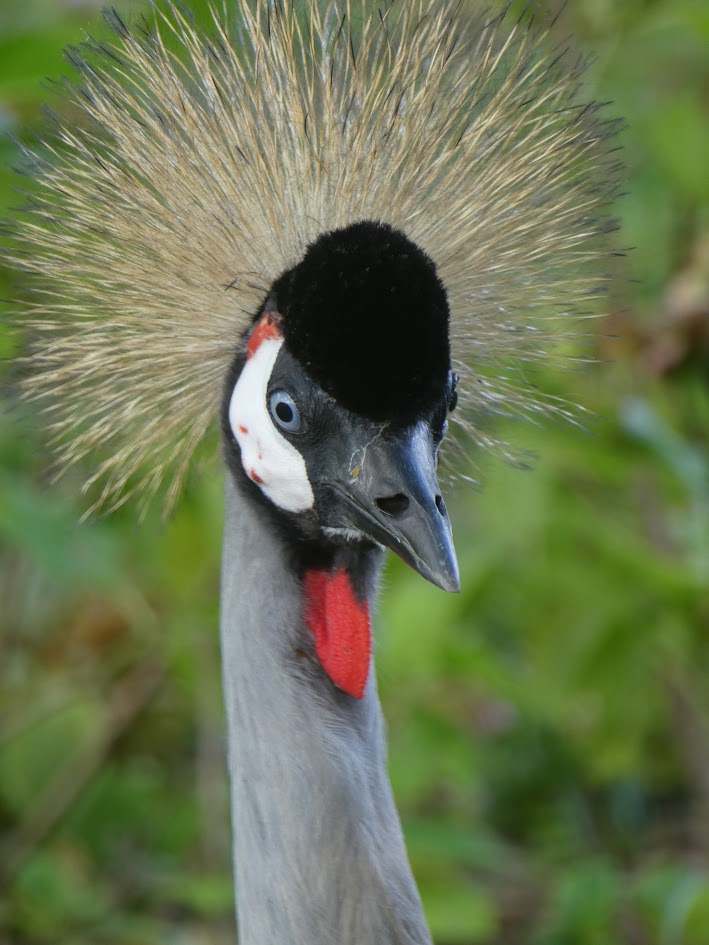
A pair of African Crowned Cranes patrol the island

Isola dei Cipressi is now the permanent home for a pair of African Crowned Cranes who majestically stroll the grounds with their heads held high. They share company with a pair of peacocks and a considerable number  (a ‘creep’ to use the appropriate collective noun) of tortoises, some of which are quite sizeable. They are joined by a large flock (a ‘gulp’) of cormorants who nest over the winter months and, as result, lay down a carpet of guano that reinvigorates the gardens. And until relatively recently they were all joined by a ‘troupe’ of wallabies – the diminutive cousins of kangaroos. This troupe was 13 members strong but unfortunately the Italian state had them classified alongside their relatives as dangerous and so they were removed. 

In 1991 the zoo in Milan closed and Gerolamo Gavazzi agreed to rehouse their two wallabies on his Isola dei Cipressi. There they flourished so well that numbers grew to thirteen until 30 years later a court order demanded their ‘exile’ to a reservation in the Province of Grosseto in Tuscany.

WALLABY

Wallabies are related to kangaroos but are much smaller and less aggressive.

The order was forcefully contested at every stage but the final decision of the Appeal Court in Rome (the Corte di Cassazione) upheld their eviction. The fate of the wallabies reached the attention of the national media and, with the support of the local newspaper, a petition called upon the Minister of Health to put a stay of execution on their removal. All to no avail since the underlying official concern was the closeness of the troupe to the island’s visitors with the risk they could act as agents in transmitting viruses from wild animals to humans. Essentially the wallabies were victims of the paranoia over virus transmission resulting from Covid and its devastating impact on Italy and worldwide. 

Further Information

The days of degradation of the lake, its island and the Palazzo Carpani are long past. One section of the lake covered in reeds is now marked off as a nature reserve, its waters are clean and full of fish. The Palazzo Carpani has received massive investments in recent years from charitable funds to restore it to its glory days during the time of Prince Eugene of Beauharnais. It now houses the municipality, local library and other local institutions. Ville Aperte Brianza open it to the public twice a year. Visitors are also welcome to the Isola dei Cipressi by contacting the Pro Loco Bosisio Parini who organise transport and catering if needed. The rowing clubs still take advantage of its still waters to train their athletes and hold competitions whilst the cormorants thrive by feeding on the lake’s abundant stock of fish. 

tree house

Gerolamo Gavazzi had this tree house built overlooking the lake for the pleasure of his family

Websites: Bosisio Parini Pro Loco, Isola dei Cipressi, Palazzo Carpani.

Bosisio Pro Loco can be contacted via prolocobosisio@gmail.com

Link here to the other Brianzolan lake featured in Como Companion  –  Lake Montorfano, which we describe as a glorious spot for wild swimming.

segantini

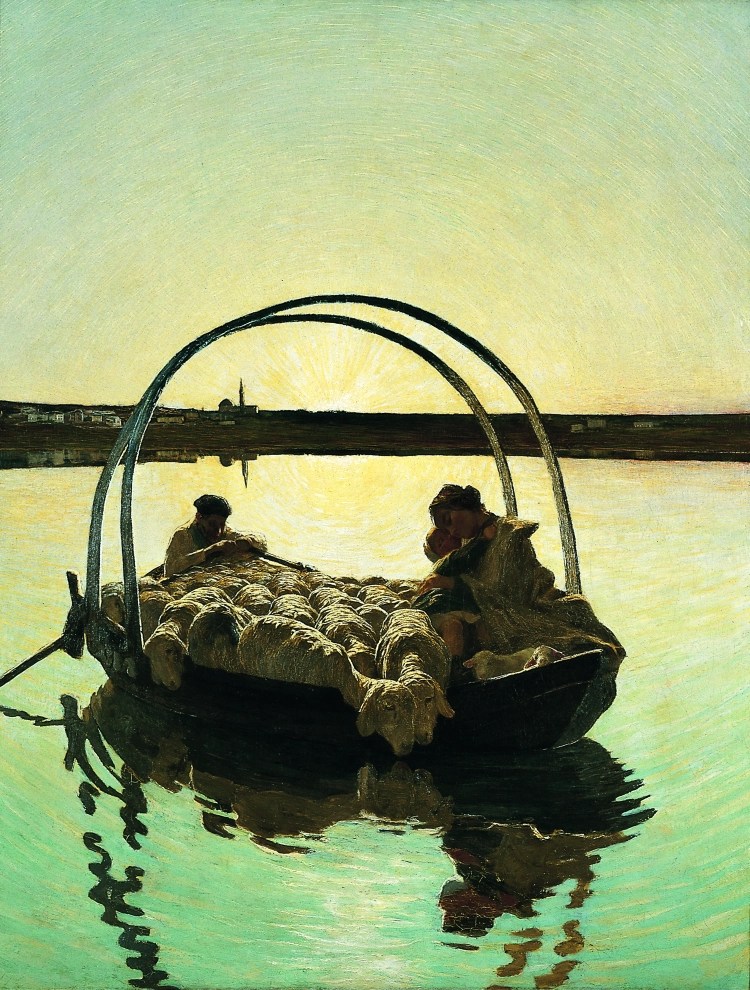
‘Ave Maria a trasbordo’, Giovanni Segantini 1886. Segantini moved from Milan to Pusiano in 1881. One of his best known pictures is this depiction of a lucia loaded with sheep on Lake Pusiano with the village of Bosisio Parini in the background. The painting now hangs in the Segantini Museum, Saint Moritz.

Posted in Gardens, History, Lake, Places of interest, rowing, wildlife | Tagged , , , , , , , , , , , , | Leave a comment

Como Tourism Post Covid

lake charms

The charm and beauty of Lake Como

Covid dealt a blow to tourism throughout 2020 and 2021, only allowing for a reduced season from June in 2022. The restrictions on travel over this prolonged period created a pent up demand that saw record numbers of tourists visiting the lake in 2023. Expectations are high this year of achieving similar results but last year’s success has brought its own challenges. What is more, the traumatic restrictions on liberty over Covid lockdown seem to have had an impact on what visitors now look for from a holiday. Lake Como’s natural charms are secure but does Como possess the necessary infrastructure, professionalism and will to meet the challenges of success, to safeguard and publicise the qualities of the ‘brand’ and  to satisfy the evolving demand for ‘experiential’ tourism?

The Impact of Covid

Lombardy was the worst affected region in Italy to be impacted by the Covid pandemic. Within the region, the province of Bergamo suffered the greatest number of fatalities. The mortality rate in the province of Como was less but tourism here was hit badly since it receives a high percentage of foreign visitors and their travel was more restricted than domestic visitors during the brief periods when lockdown measures were eased. 

Overnight stays in Lombardy

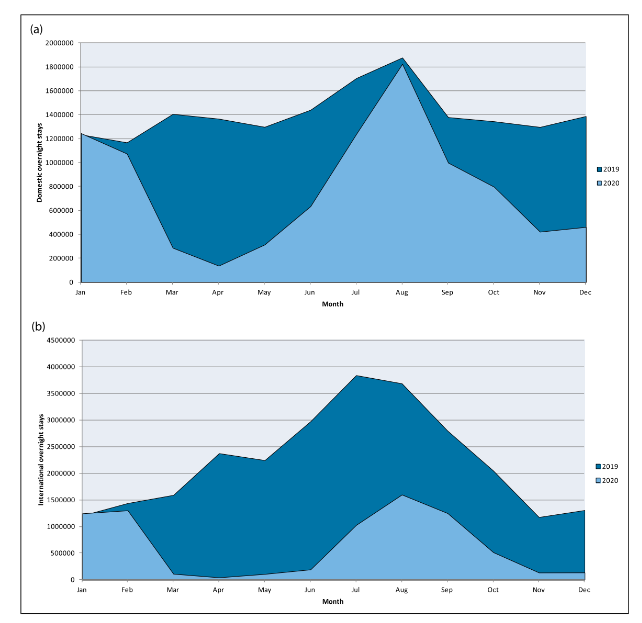
Table A (top) shows numbers of domestic visitors to Lombardy in 2019 (dark blue) and 2020 (light blue). Table B shows numbers for foreign visitors.

Table A above shows the figures for domestic visitors to Lombardy in pre-Covid 2019 (dark blue) compared with 2020 (light blue). Table B makes the same comparison but for foreign visitors. Domestic visitors even managed to achieve similar numbers in August 2020 to the same period in 2019 but this was far from the case for foreign visitors. Eight out of ten visitors to the province of Como come from abroad.

The Recovery

Last year, 2023, saw a massive recovery in visitor numbers across Lombardy with a 25% increase compared with pre-Covd 2019. Lombardy had 51 million visits of which 44 million stayed overnight. Of the overnighters, Milan was the most popular destination with 18.8 million total nights followed by Brescia with 13.1 million. The province of Como came third with 4.6 million closely followed by Sondrio with 4.4. million. Whilst foreign visitors to Milan represented 66% of the total, the figure for Como was 85%.The average length of stay in Como falls below the regional average at 2.7 days (2022 data) which shows little improvement over the 2.5 days registered back in 2014. 

oplus_34

The lake retains its charms over the usually dry and sunny days of mid winter.

Day visits to Como – either by foreigners staying elsewhere or by those residing in the Milanese conurbation – doubled from 2014 to 2022 to arrive at a total of 3.9 million. 

Como’s restaurateurs, hotels and holiday home owners were very pleased to see a record-breaking recovery in visitor numbers last year but the persistent difficulty in increasing the average length of stay and the high proportion of day visitors suggest there are some challenges ahead, in addition to  protecting ‘the brand’.

The Brand

Why do an increasing number of people want to visit Lake Como? What in marketing terms is its brand, and to whom does it appeal? 

Villa Balbiano (1)

Villa Balbiano originally built for the Giovio family but past on to Cardinal Tolomeo Gallio in the late 16th century.

There are a surprising number of Russian oligarch residents on Lake Como who tend usually to keep a low profile.  But Mikhail Kusnirovich, 57 year old entrepreneur and owner of the GUM shopping mall on Moscow’s Red Square, recently afforded a rare interview to the local newspaper ‘La Provincia’. He has owned a second home in Tremezzo adjacent to the Villa Balbiano since 2005. He and his family fell in love with the lake for its ‘tranquillity, convenience, good climate and the unique colours of its lake and sky’. This may be a fair description of the Lake Como ‘brand’ if we also include an element of exclusivity (literally meaning ‘to exclude’). This brand definition may apply less to the northern end of the lake (Alto Lago) where the topography allows for more camping sites and beach facilities but is entirely accurate for the high end tourism focussed on the area between Menaggio, Varenna, Bellagio and Tremezzina whose facilities are primarily accessed via the city of Como itself. 

oplus_34

Breakfast ‘alla americana’ in Como’s Piazza Cavour.

The natural beauty appeals to all visitors no matter how short their stay but the tranquillity and exclusivity appeal primarily to visitors from abroad (8 out of 10 visitors) with the highest numbers coming from Europe (Germany, France, Netherlands and United Kingdom). In recent years there has also been a big increase in visitors from America and particularly from Asia and the assumption is that these two will see the biggest growth in the future. 

But Mikhail Kusnirovich foresees some problems with growth.  In expressing his concern for the number of parties held over the season in the neighbouring Villa Balbiano he commented, “Two parties per season represents exclusivity. Two parties per day transforms a ‘Ferrari’ into a utility vehicle, “ resulting in the “loss of peace and tranquillity”. He went on to say “Lake Como must stay as a dream location, leaving those who visit with the wish to return. If it turns into a Miami Beach, this changes the rules of engagement…Don’t ruin its enchantment.” 

lake lunatics

Calm and tranquillity at risk from displays of excessive exuberance!

No doubt famous seasonal residents like George Clooney have given a massive hand in marketing the Como ‘brand’ but an unmanaged increase in visitor numbers may well kill off this particular golden egg-laying goose. Back in October 2023 rumours circulated that the Clooneys were putting their Villa Oleandra in Laglio up for sale based on Amal Clooney’s apparent preference for France. Their solid denial came as a massive relief to local businesses but the mere threat illustrated the fragility of the brand image.

The Challenges to Lake Tourism

The geography of the lake does not lend itself to mass tourism. The number of visitors in 2023 saw previously unknown pressures put on the area’s transport infrastructure via land and lake. There are 45 licensed taxis able to operate in Como and available to take visitors from the railway stations to their various destinations within and beyond the city. These were not enough.  Many hotels and holiday home owners had to make their own arrangements for getting their guests to and from the 240 hotels and 6,000 holiday homes on the lake. 

Concordia

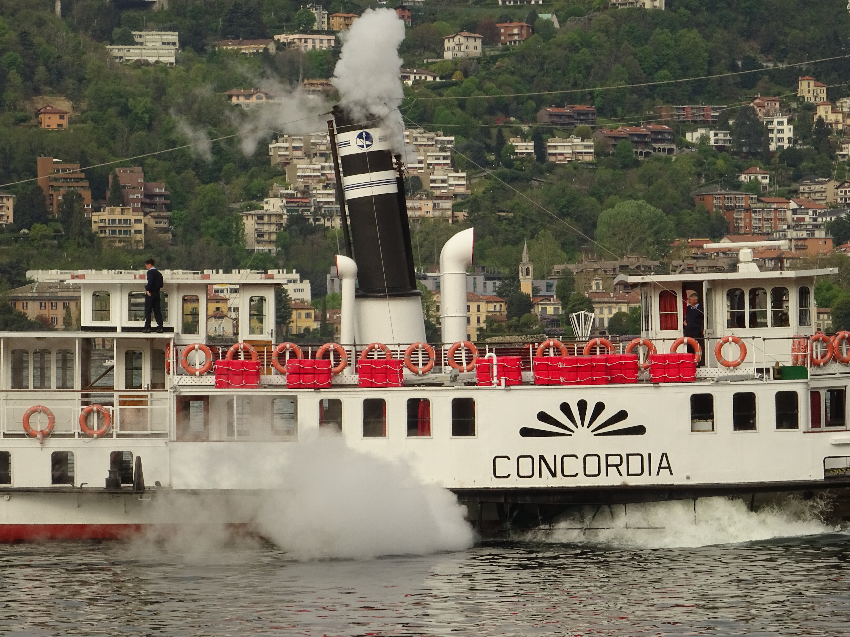
Pride of the Navigazione’s fleet, the restored steamboat Concordia

In 2023 up to 5,800,000 people were transported on the lake in the boats of the Navigazione Laghi  – more than those travelling on either Lakes Garda or Maggiore. Unfortunately the Navigazione suffered technical issues with at least two of their high speed boats intended to transfer visitors quickly to Bellagio, Tremezzina or Menaggio. Long queues developed in front of the Como ticket office in spite of the possibility of purchasing tickets online (a service not sufficiently publicised). 

oplus_34

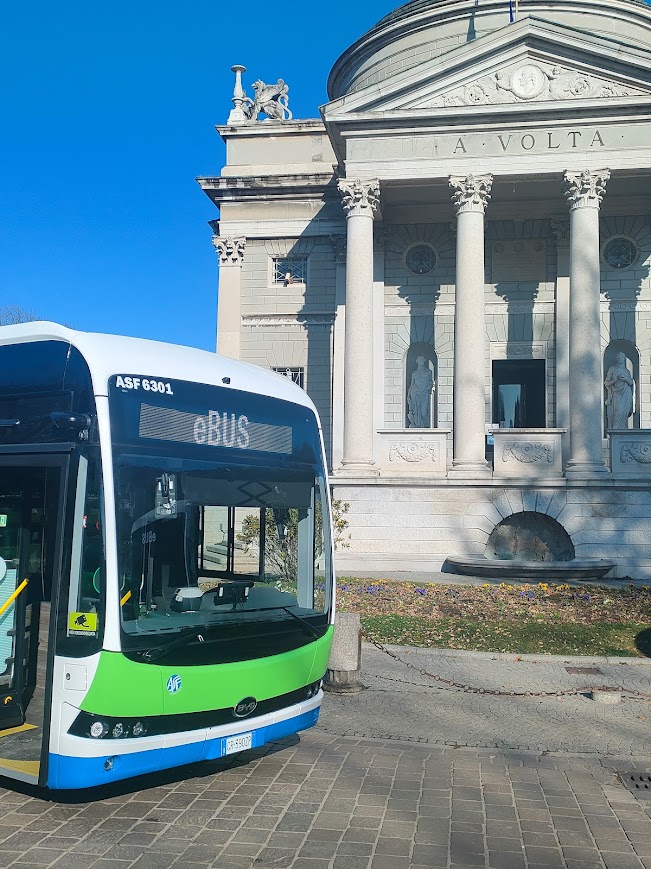
The bus fleet may well boast latest full electric members presented in front of the Tempio Voltiano (the father of electricity) but the narrow roads present an insurmountable challenge to increasing passenger volumes.

The bus routes (C10 for the west side of the Como leg of the lake and C30 for the east to Bellagio) were overwhelmed.  Although there may be the possibility of increasing the number of journeys if staffing levels permit, there is no option to increase the size of the buses given the nature of the roads. Travel was further impacted by the traffic jams caused by large vehicles trying to negotiate the narrow roads on the sections of the Via Regina from Colonno to Lenno. 

The numerous transport issues caused frustration to visitors and residents alike and certainly threatened the sense of ‘calm and tranquillity’. 

The Como municipality recently approved the issuing of an additional 23 taxi licences to bring the total number up to 68 but these may not all be granted in time for the current season. This is the first change in the number of taxi licences granted since the 1970’s – such is the pace of change on Lake Como.  The Navigazione Laghi have brought two more high speed boats into operation this year and they hope to avoid further technical issues. Little though can be done to improve bus services other than some tinkering to improve integration with other transport services. 

High end tourism requires well qualified staff to meet the levels of knowledge and service demanded by discerning visitors. Staffing across most industrial sectors, but particularly in the tourism and hospitality industry, has been a problem post Covid. Back in pre-Covid 2019, 30% of appointments in the tourism sector on Lake Como had been difficult to fill. That has now risen to 51% whilst the average across all sectors has risen to 45%. 10% of the workforce in the province  – a total of 31,300 people – are employed in the tourism industry working within 7,636 different establishments – a total that has increased by a mere 1.2% over 2022. Many new establishments are hoping to open their doors in the near future but the challenge will be to find the numbers of appropriately qualified staff to work in them. 

Current Tourism Objectives

oplus_34

Climate change is encouraging the lake’s cormorants to stay on over the winter months but will ‘deseasonalising’ also work for foreign visitors?

Other than managing the issues raised above, the local tourist industry has set itself two main objectives. The Italian term for the main one is ‘destagionalizzazione’ a clumsy term equally clumsily translated as ‘deseasonalising’ or in other words, seeking to extend the season beyond its historic span from April to October. Some of the larger hotels have managed to stay open recently throughout the year or with an additional opening over the Christmas period but the majority do not. 

oplus_34

Christmas in Como is atmospheric. The days are ususually dry but the climate is not so favourable in early spring and late autumn.

Opening from late autumn to early spring means equipping your hotel sufficiently to keep your guests comfortable and entertained. The investment needed can be considerable and the modifications may also require prolonged closure. The vast majority of hotels on the lake are family-run businesses less able than the national or international chains to cushion these costs. Possible result? A decline in family run establishments in favour of chains. The chains are more able to manage the investments needed either to ‘deseasonalize’ or to set up any of the high end luxury units that the market now favours. But any attempt to increase the length of the season beyond the long balmy days of a prolonged summer runs into the realities of the climate. November in particular is usually a particularly wet month with the risk of incessant rain falling for four or five days at a time. So much for the ‘good climate’ espoused by Kusnirovich as part of the lake’s enchantment. The same risk of rain applies to spring as experienced this year over the Easter break. 

IlSerenoHotel_PatriciaUrquiola_cPatricia-Parinejad_2979_LOW-1024x682

Staircase of the hotel Il Sereno in Torno whose interior and exterior were designed by Patricia Urquiola – an example of one of the latest high end luxury hotels.

The Italian term for the other main objective is ‘delocalizzazione’ offering an equally clumsy translation as delocalising. What this represents is the aim of spreading the distribution of visitors beyond a focus on the  Menaggio-Varenna-Bellagio-Tremezzina  area and out of the city of Como itself. Apart from the recent and planned openings of some luxury hotels in and around Como (for example in Torno, Moltrasio and Brunate) this may mean seeking to develop new forms of tourism pointing to some possible future trends.

The Future

sentiero-viandante

The multi day walk on the Via del Viandante on the Lecco leg of the lake

We can assume that high end tourism is set to increase in the near future with a greater presence of international hotel chains opening relatively small luxury units more adapted to providing comfort all year round. 

One trend that might favour delocalisation is the post Covid move to what is called ‘experiential tourism’, namely holiday breaks designed around specific activities such as cycling, walking, cultural studies and food and wine tours. Lake Como is well qualified to provide for all these forms of holiday activity. Two long multi day walks flank either leg of the lake  – the Via del Viandante on the Lecco side and the Via Francigena Renana  running down from Coira (Chur), through Chiavenna to and beyond Como. And there are of course other scenic one or two day options for walking in the neighbouring mountains. Much more could be made of the cultural and historic heritage of the region but the potential is there. If we think of Lake Como as the gateway to the Valtellina then we can also boast a fine tradition of viticulture with a local cuisine to match. The large increase in holiday home rentals over hotels means there are many more visitors looking to eat out and in search of local traditional food. 

Pizzocheri

Nothing can beat the simple pleasure of a well made plate of pizzocheri and a glass of everyday wine on a hillside hike.

The current estimates for the numbers of people engaging in one form or other of experiential tourism in Europe are as follows: 4.8 million in France, 5.6 million on Germany and 7.1 million in the United Kingdom – with Italy favoured as a destination. The potential is there. A growth in experiential tourism would support delocalisation and could potentially bring revenue to the string of small communities based in the mountains up from the lakeside. It would definitely increase the average length of stay and It would also democratise local tourism and counter the trend towards Como becoming a millionaires’ playground. 

Posted in Culture, Food, Itineraries, Lake, Sustainability, Transport | Tagged , , , , , , , | 2 Comments

Wartime Occupation of Cernobbio

como cernobbio

Como in the foreground and Cernobbio on the left hand side of the lake

On the 19th July 1944, Cernobbio’s  Commisario Prefettizio, Angelo Martinelli, wrote the following letter to the Prefect of the Province of Como, Renato Celio: 

The geographical position of Cernobbio – precisely due to its proximity to Milan -, the fame it has acquired over many years and, last but not least, its well-known tourist organization for supplies, well-stocked shops, health services, etc., etc. ., have put the town, in relation to the displacement situation, in a particularly difficult situation.The Italian and German commands have drawn heavily on hotels, villas and private homes; commercial organizations, semi-public or otherwise, have created offices; large Milanese companies, especially after the bombings of August 1943, have transformed hotels and villas into offices and company canteens, so that a frantic and sometimes ruthless hunt for apartments and rooms has developed. The current situation does not allow us to have even one space left available and it would be really appropriate for Cernobbio to be forgotten for the moment. It must be kept in mind that the water, gas and electricity systems are based on a presence of 5/6000 people, while currently the inhabitants are almost double that figure. For these reasons Cernobbio cannot logically increase the already overwhelming number of its residents, nor can its houses be further congested. It is hoped that by taking the above into due consideration, we will desist from any new requisitions and requests in the town of CERNOBBIO.

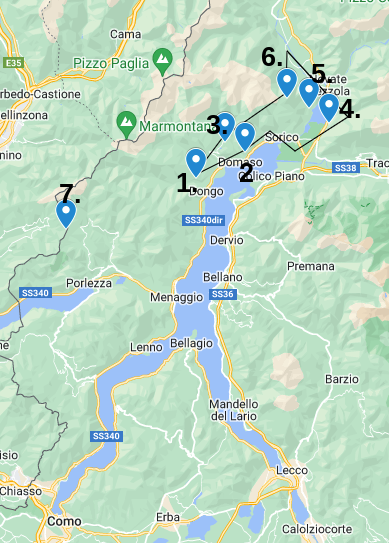
From the start of the allied bombing campaign over Milan that reached a crescendo in August 1943, Cernobbio had housed individuals, families, businesses and state organisations seeking a degree of safety from constant bombardment. Martinelli’s letter identifies the reasons why Cernobbio was particularly selected as a refuge, due to the number of holiday homes, the tourism infrastructure and, not least,  its pleasant location on the lake. Its location close to the Swiss border offered some degree of assurance against allied bombing with the allies keen to avoid the risk of shells falling inadvertently within neutral Swiss territory. For others as well, the town offered the reassuring possibility to make escape over the border if necessity required it.

But the principal demand for accommodation in Cernobbio came from abroad – from the moment of the Nazi occupation of Northern Italy that immediately followed the Badoglio government’s armistice with the allies announced on September 8th 1943. 

In ever increasing numbers arriving at their zenith in September 1944, the Nazis either sequestered or requisitioned rooms, apartments, hotels and entire villas across the town. There were three Nazi organisations primarily heading this occupation. The Luftwaffe requisitioned the Hotel Villa D’Este as a military hospital. Sections of Heinrich Himmler’s SS and SD sequestered Villa Fargion (now known as Villa Carminati) as their base for the Frontier SS controlling border activities. The RUK (Albert Speer’s department of the Reich government  responsible for war provisions and armament production) took over Villa Erba. Both the SS/SD and the RUK extended their occupation of the town from September 1943 to April 1945.

Villa Carminati

Villa Carminati (formerly Villa Fargion)

Villa Carminati became the barracks and prison for the Frontier SS known as Como West – Grenzbefehlsstelle. This division of the SS was responsible for managing the frontier with Switzerland from the Val Ossola to the far corner of the Valtellina. Its location in Cernobbio reflected the importance of the official crossing of the border by road and train at Chiasso. The Como West group controlled all access to and from Switzerland. The rail link from Como to Chiasso in Switzerland, managed from Cernobbio, was critical for the transport of food and war materials produced in Italy for distribution in Germany. The other formal and clandestine routes into Switzerland  became increasingly important to the Germans as the war progressed proving eventually absolutely critical in the final days of ‘Operation Sunrise’ – the surrender negotiations between Karl Wolff, the Head of the SS in Italy,  and the allied delegations in Berne. Como West became used as the bridge in the passage of secret agents organised by the SD and reporting officially to the head of Grenzbefehlsstelle, SS Hauptsturmführer Joseph Voetterl.

One of the protagonists representing the SS in ‘Operation Sunrise’, Baron Parrilli, had a very low opinion of Joseph Voetterl as shown in this quote from ‘La Resa degli  Ottocentomila’ – the account of Baron Parrilli’s wartime exploits written by Feruccio Lanfranchi. These  comments by Parrilli followed on from being denied return access to Switzerland via the border at Chiasso:

“In reality, the “higher orders” did not come from Garda, but from the nearer Lake Como: the ban on allowing Baron Luigi Parrilli to enter Switzerland had been given by the commander of the border SS, Captain Giuseppe Voetterl, who had created a sort of fortified citadel in Cernobbio, requisitioning some villas and establishing his residence in the most beautiful and spacious Villa Geltrude Locatelli; another building, Villa Levi, had been reserved for guests. Captain Voetterl left nothing to be desired! I went to Villa Locatelli to ask him the reason for the ban. He greeted me with cold haughtiness, stating that the pass I had was valid for a trip or two at most. My back and forth with Switzerland didn’t convince him and he decided to stop it: that’s all. The officer’s tone especially irritated me. I replied, dryly: “Well, if you have any doubts, call Fasano, Rosenfels private switchboard: you will receive precise orders from General Wolff himself.”

The German occupation of Como had commenced on 12th September 1943 with their primary objective to stop the massive flow of fugitives crossing over the border into Switzerland via Ponte Chiasso. Joseph Voetterl was in command of the Frontier SS charged with controlling the border. He immediately took over the Villa Carminati sequestered from its owner, Eugenio Fargion. 

Cernobbio-Villa Locatelli

The lakefront at Cernobbio with Villa Belinzaghi (occupied by the RUK) to the right and Villa Belinzaghi Locatelli (occupied by the Frontier SS) closer to the San Vincenzo church.

A month later on 15th October 1943, he took possession of the entire Villa Belinzaghi Locatelli on the lakefront having requisitioned it from its owner, the Countess Nora Belinzaghi. Villa Locatelli became the preferred location for receiving and hosting the numerous high Nazi officials and agents on their way to or from Switzerland. 

votterl letter

A letter from Joseph Voetterl to the Prefect of the Province of Como confirming the latter’s right to proceed with the sequester of property and goods belonging to Giuseppe and Guglielmo Levi following their arrest and imprisonment in Milan for the crime of being Jewish

Many of those seeking refuge across the Swiss border were both foreign and Italian Jews who, following the Nazi occupation, faced the serious risk of deportation to one of the Nazi-run extermination camps in Eastern Europe. The Frontier SS worked in collaboration with local bands of fascists such as the Monte Rosa Legion who readily took responsibility for capturing Jews and others defined as ‘enemies of the state’.  The captured Jews would then be brought to Villa Locatelli/Carminati and handed over to Joseph Voetterl who was responsible for approving their imprisonment (usually in Milan’s San Vittore prison) and onward deportation to extermination camps. He would then relay his decision by letter to the Como Prefecture giving the fascist state confirmation of its right to sequester all of the prisoners’ goods and property. 

The persecution of Jews provided a source of funds for the fascist state evidenced by the law passed in February 1939 that put limits on how much property and industrial activity Italian citizens of Jewish origin could own. All goods above the set legal limit could be sequestered and proceeds from sale granted to the state. An organisation known under the acronym of EGELI was set up to manage and dispose of all goods and property sequestered under this law. 

In selecting facilities for the Frontier SS, Joseph Voetterl took advantage of those properties in Cernobbio belonging to Jews that had or could be sequestered under the fascist law. The largest one of these was the Villa Carminati. It had been owned as a second home on the lake by Eugenio Fargion, but had been sequestered by EGELI  around September 1943. Eugenio Fargion himself had managed to reach safety in Switzerland over the summer of 1943. His sister Elisa and her husband Gastone Levi had themselves also spent that summer in the villa but had not managed to follow Eugenio over the border. They were later arrested on their return home to Ferrara. They were then deported to Auschwitz and faced execution on the very day of their arrival there on the 26th February 1944.

Cernobbio-Villa Carminati

The location of Villa Carminati on Via Della Libertà

The fascist state later sought to take possession of Villa Carminati from Voetterl’s Frontier SS. A decree was passed by the Milanese Prefecture on 10th February 1945 confirming the right of the RSI (Mussolini’s puppet Socialist Republic of Italy)  to  take possession of the villa. A judicial delegation arrived at the villa on 3rd March to enforce the state’s right of ownership. However Voetterl’s division refused their entry and also refused any suggestion to move out. EGELI continued to make claim to the property as belonging to the state with the Nazis having no right to possession. Voetterl continued to ignore the RSI’s claim. The Frontier SS continued to use Villa Carminati as an administrative base and centre of detention until abandoned as part of the general Nazi retreat in late April 1945. It was immediately occupied by allied troops.

Baron Parrilli was right in claiming that Voetterl was building up a citadel in Cernobbio with mention of the Villa Levi being occupied for guests of the Frontier SS. This villa, at No.3 Via Cavour, had been sequestered from its Jewish owner, Vittorio Levy. The Nazis occupied it from October 1943 until April 1945. Vittorio’s son, Dr. Aldo Levy, wrote a letter to the Cernobbio Municipality on 12th July 1945 seeking compensation for rent not paid during that period. 

EGELI records list two additional properties sequestered from Vittorio Levy and occupied by the German command, namely Via Cinque Giornate, 150  and Via Bernasconi 7C. The latter villa was later redefined as requisitioned rather than sequestered in a note from the Cernobbio Municipality dated 25th August 1944.

Another large sequestered property occupied by the Nazis was the holiday home of Mary Sforni just across the border of Cernobbio with Como at Tavernola. The EGELI records show that the entire villa, its gardens, outhouses, boathouse and landing stage were occupied by the SS – Joseph Voetterl’s division. Mary Sforni herself had moved to Florence with her husband, the scientist Tullio Terni, and her children in 1941. She survived the war hiding out in the Tuscan countryside at Tutignano.

The German command occupied many other properties in Cernobbio but these were for the most part requisitioned through orders to the local municipality, through its Commissariato Alloggi. Owners of requisitioned properties were due compensation not paid by the Nazi occupiers but by the municipality itself. Compensation was based on a rental value based on predefined tariffs. As an illustration, when Aldo Levy after the end of the war claimed for non-payment of rent due to sequestration of his father’s property on Via Cavour, he sought compensation from the municipality based on rents charged for similar sized properties at 9,900 lira per month. Rates were fixed at the beginning of the period of Nazi occupation in September 1943 and did not vary up until liberation in April 1945 – a period that saw considerable inflation and devaluation of the Italian lira.

The German command passed all the invoices they received for rent to the municipality which, under the terms of the occupation, was obliged to pay for the accommodation and for all other services rendered to the Nazi occupiers. The Cernobbio Municipality would then in turn seek funding to cover these costs of occupation from the Como Prefecture. A note passed from Cernobbio’s Commissario Prefettizio dated 25th January 1945 to Renato Celio, the Prefect of the Province of Como who succeeded Franco Scassellati, specified that the annual expenditure for maintaining the German occupation during the previous year amounted to 2,304,907.55 lira and that this had been covered by funding from the Province of Como of 2,305,000 lira. The note also asked for an immediate advance of 700,000 lira to meet demands already received in January for 407,625 lira with more invoices in the pipeline. The Municipality were even charged for the cost of feeding prisoners of the Frontier SS retained in the Villa Carminati.  

Villa D’Este

Villa D'Este

Villa D’Este, requisitioned to serve as a military hospital for the Luftwaffe.

The largest of Cernobbio’s requisitioned properties was the Hotel Villa D’Este acquired initially for Joseph Voetterl but then passed to the German Luftwaffe for use as a military hospital known by the Nazis as the Luftwaffen Lazarett.

Initially the Nazis in the name of the SS requisitioned the use of fifty rooms in the hotel from the 16th September 1943 – almost immediately following their occupation of Northern Italy.  They then requisitioned the hairdressing saloon within the hotel owned by Signora Cervieri from 1st November 1943.  The following month they requisitioned the entire hotel at an annual cost of 115,000 lira with an order from Hauptmann, PlatzKommandator Como for the hotel and its dependance to be left empty by 1st February 1944. By then, the SS and Joseph Voetterl had clearly agreed to allow the German Army (the Wehrmacht) rather than the SS to make use of the site. 

bisbino

Monte Bisbino with Villa D’Este on the lakefront. The path up to Monte Bisbino was one of the most common routes for making a clandestine crossing over the border into Switzerland.

Prior to the Nazi possession of the entire site, the Director of the Villa D’Este, Augusto Besana, sent a letter on the 28th December 1943 addressed to the then Prefect of the Province of Como, Franco Scassellati, in which he complained how the Germans had already transported furniture from the hotel to furnish private residences and offices in and around Como. In spite of the hotel being denuded of its furniture, the Cernobbio Municipality received various requests from residents demanding reimbursement for furniture requisitioned by the Nazis for the Luftwaffen Lazarett.

In later months the hotel’s garages and the apartments above them were requisitioned for Nazi use at a cost per month of 22,000 lira for the garages and 3,400 lira for the apartments. The apartments were used as accommodation for the hospital’s doctors. Other rooms in the town were requisitioned for use by the German nursing staff. 

Joseph Voetterl, in giving up the use of the Villa D’Este for the Frontier SS, set his eyes on the Villa Belinzaghi Locatelli on the lakefront but closer to the town centre. This villa was requisitioned from 15th October 1943 at an annual cost to the municipality of 150,000 lira. This became the main headquarters of the Frontier SS where they would receive high ranking Nazi and fascist officials. Baron Parilli stated that Voetterl himself lived there although other sources state he retained his residence in Como’s Hotel Barchetta.

In between the Villa Belinzaghi Locatelli and the Villa D’Este was the similarly named Villa Belinzaghi, also formally owned by the Countess Nora Belinzaghi. This was occupied by a group belonging to the Reich Ministry of Armaments and War Production (the RUK) headed by General Hans Leyers in Italy. The RUK group who occupied Villa Belinzaghi focussed on managing aircraft production. They  moved into forty rooms of the villa at a cost to the municipality of 14,500 lira a month. 

Villa Erba

villa erba

Villa Erba, requisitioned with its extensive park and gardens by the Armament Office of the Wehrmacht

The impressive holiday home and park of the Visconti di Modrone family, Villa Erba, immediately attracted the attention of the German and RSI military authorities. Initially it was occupied by the Republican National Guard (GNR) which had been established in December 1943 by Mussolini. However they would be ousted by a requisition order from the Nazis that resulted in the Cernobbio Commissariato Alloggi sending out a notification on the 16th August 1944 commanding the GNR to vacate the villa by the 27th of the month. The entire villa, its park and the Villa Vecchia (Villa Gastel) had been requisitioned on the orders of the Director of the Italian Army Weapons Office, General Ritter Von Horstig. The administrators for Edoardo Visconti di Modrone and his sister Ida wrote a letter to the municipality on 13th October 1944 seeking to secure agreement over the rent they should receive in compensation for giving up the complete property with the exception of two rooms in Villa Gastel used to store the furniture of Ida’s husband. They pointed out that the Nazis had also constructed six wooden barracks in the park.

Von Horstig had identified the strategic advantage of Cernobbio in close proximity to the all-important rail link with Germany via Chiasso as an ideal location for the warehousing of arms either for or from the Reich. Not only was the Villa Erba’s park used as a fuel repository but most of the buildings running alongside the River Breggia towards Maslianico were used for military warehousing.

The Frontier SS, the RUK and the Military Hospital had been quick to establish their presence in Cernobbio shortly after the Nazi occupation in September 1943.  In the ensuing months, the demands for accommodation continued to grow particularly after the fall of Rome in June 1944 which caused the relocation of many Nazi offices to the north. Although the Nazis favoured Lake Garda and Verona to locate their administrative offices, the attraction of setting up on Lake Como close to the Swiss border increased as their imminent defeat became more obvious to them and the fascist hierarchy.  
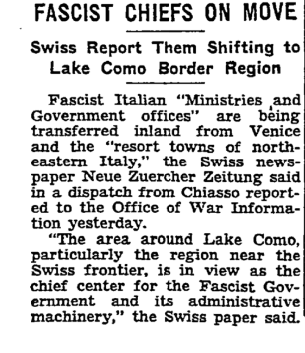
NYT Aug 22 1944

New York Times report dated 22nd August 1944 on the RSI decision to move many of its administrative offices to the area around Como and Cernobbio.

A conference held by the SS in April 1944 at the Villa D’Este outlined plans for extending the foreign secret service branch of the SD (Amt VI) in Milan and Cernobbio with the purpose of sending agents into Switzerland and into the allied occupied half of Italy. Joseph Voetterl hosted the AMT VI administration in the Villa Locatelli and set out to requisition further lodgings for the increase in staff.

The number of large hotels in Cernobbio provided an obvious solution for housing temporary visitors and a provisional base until accommodation was requisitioned for those staying on permanently. The Prefect of Como Province, Franco Scassellati, had established the charging regime for hotel accommodation back in January 1944 as follows:

  • Where less than half the total number of rooms were rented, the cost was per room
  • Where over half the rooms were rented, the cost was as fixed by the Ministry of Popular Culture
  • Where all the rooms were occupied, the cost was fixed by the ‘Commando Presidio Germanico’ in agreement with the podestà.

Invoices for German occupation were passed on to the Como Prefecture from the Albergo Asnigo, Miralago, Centrale,  Regina Olga and the Terzo Grotto. This latter hotel was requisitioned by the Nazis in its entirety from September 1944.  The apartment belonging to the former Director of the Hotel Villa D’Este, Augusto Besana, in the Villa Besana Ciani was requisitioned for Germans previously housed in the Albergo Miralago. 

A number of individual rooms and apartments were also requisitioned across Cernobbio. In August 1944 two rooms and a bathroom in Via Carlo Porta 5, and belonging to the Suore di San Giuseppe, were rented out to six German nursing nuns working at the Villa D’Este. A further six rooms at this address were requisitioned in October. Back in August an empty apartment of five rooms belonging to Pastore De Micheli on the second floor of Via Regina 55 was requisitioned. Three rooms and a sitting room in a property owned by the Tessitura Seriche Bernasconi were rented out to the Nazis in September 1944. 

There are instances where the Nazis requisitioned property for possession by Italians. For example, tin September 1944 the Nazis ordered the requisition of an apartment in Via 24 Maggio 21 to be occupied by the Rizioli family. In the same month an apartment of five rooms at Via Perlasca 1, belonging to Giuseppe Vismara was rented out to the Dotti family on orders of the German command and presumably at the expense of the Province. This may have been to compensate for the fact that the Nazis had requisitioned in turn the entire seven-roomed villetta belonging to Alfredo Dotti at Via Cavour 5. Alfredo Dotti was later rehoused after the German surrender by virtue of a requisition by the allied command of a property in Via Privata Lupi belonging to Carlo Cavalleri, the proprietor of the Albergo Centrale. 

sept 6 1944 news erport

New York Times report dated September 6th 1944 based on intelligence provided by Italian partisans of a meeting held bt senior Nazi commanders at Villa Carminati.

By September 1944, the eventual defeat of the Nazis was evident to all, but this seemed to provoke even further expansion of the Nazi occupation of Cernobbio with a fresh blitz on requisitioning entire houses. In that month they acquired a ten room villa at Via 24 Maggio 6A and the nearby villa of 14 rooms down the road at Number 2. In the same month they requisitioned the entire house at No. 1, Via Cavour as well as the Dotti home mentioned above at Number 5 and a seventeen room villa at No. 2, Via Porta. The month previously they had moved in to Villas Noseda and Bindi. In October they took over the house of the Fromenini sisters at Via Regina 57.  

By January 1945, with Nazi leaders in Italy putting out ever more committed peace feelers towards the allied intelligence agencies in Switzerland, their requisition of Cernobbio properties finally came to an end. The German Wehrmacht Platzkommander Von Mulber had put in an order to requisition the Villa Tarsis belonging to Count Giacomo Tarsis di Castel D’Agogna on the 16th January. This property consisted of fourteen rooms plus outhouses at No. 10, Via 20 Settembre. However four days later Von Mulber had changed his mind and withdrawn the requisition order. 

Zona Franca
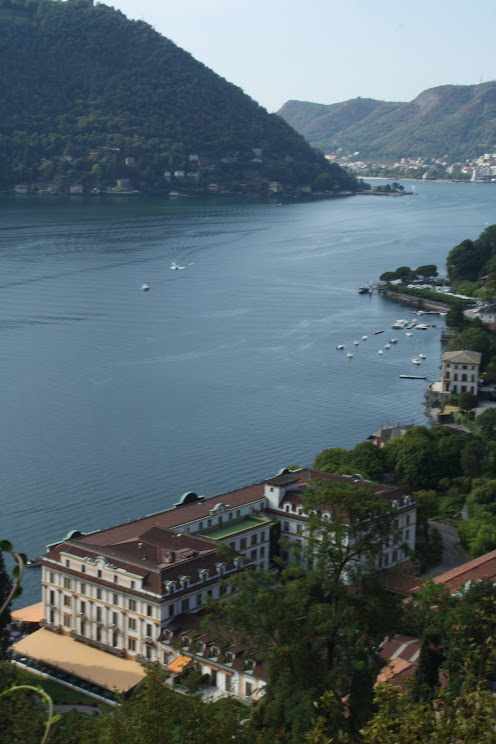
above villa deste

A look down on the Villa D’Este in the foreground and the Villa Belinzaghi to the right with Como in the distance.

With such a high concentration of Nazi offices and personnel in Cernobbio, it was not surprising that Voetterl tried to define the entire Como/Cernobbio area as a so-called ‘zona franca’ outside of the normal areas of conflict between the nazis, allies and partisans. Renato Celio, the Prefect for the Province of Como, had the same ambition given the increasing number of leading fascists making a home for themselves, their families and close friends around the lake. Both Nazis and partisans had a shared interest in maintaining the passage between Milan and Lugano free for the movement of couriers transporting intelligence, funding and even contraband to and from Switzerland, whether via the clandestine route over Monte Bisbino or across the official border crossing at Chiasso. The one significant exception to this informal agreement was the RSI and in particular, the Como Federale Paolo Porta who, as head of the local Brigata Nera ‘Cesare Rodini’, continued to seek to round up and eliminate the local partisan groups. Voetterl and Celio had attempted to get Porta replaced but their plan had been thwarted with Porta being supported by the more hardline SS Commander Willy Tensfeld based in Monza. There are even suggestions that Joseph Voetterl was acting selectively as a double agent on behalf of the American OSS (Office of Strategic Services).

The end of the war came to Cernobbio when Villa Locatelli was occupied by Lugano-based American Army Officer Emilio Daddario on April 27th. Joseph Voetterl was allowed to vacate the building with the 200 officers and soldiers at his command to journey up the Valtellina finally to reach the Alto Adige. He then made his escape to Argentina. Once the Nazis had vacated Villa Carminati, it was occupied by allied troops until they left on 17th September 1945. Villa D’Este was taken over by the American Army for a time to serve as a centre for their troops’ rest and recuperation. 

The end of the war was followed by months of confusion caused by the displacement of so many people across Continental Europe. Only gradually and slowly could Cernobbio return to normal such that the demand for accommodation was still a grave problem as expressed in a letter from the Mayor of Cernobbio to the Prefect of Province of Como, dated 2nd January 1947:

Due to the absolute lack of housing in the territory of this Municipality, which has been subject to continuous requisitions first by the German Armed Forces – then by the Allied Forces, as well as for civilian refugees and victims of other Provinces, please include this Municipality itself in the list from which the Legislative Decree of the provisional Head of State 18 October 1946, n. 290. Sentences or orders issued monthly by the Magistrate No. zero. Housing destroyed by war. No. zero. Accommodation requisitioned currently No. 54

sindaco letter Jan 46

A letter from the Mayor of Cernobbio to the Prefect of the Province of Como outlining the continual number of requisitioned properties even by January 1947

Sources

Archivio Storico di Cernobbio, Class 8 – Carteggio 146, Fascicolo 8; Class 8.4, Fascicolo 9

EGELI Archive, Intesa San Paolo, N. 998, Carteggio 158, Fascicolo 3

Fossati Daviddi, I. R. (2003). Cernobbio 1943-45 Dalla Memoria alla Storia. Istituto Storia Contemporanea.

Posted in crime, History | Tagged , , , , , , , , , , , , , | 5 Comments

An Expatriate’s Life on Lake Como

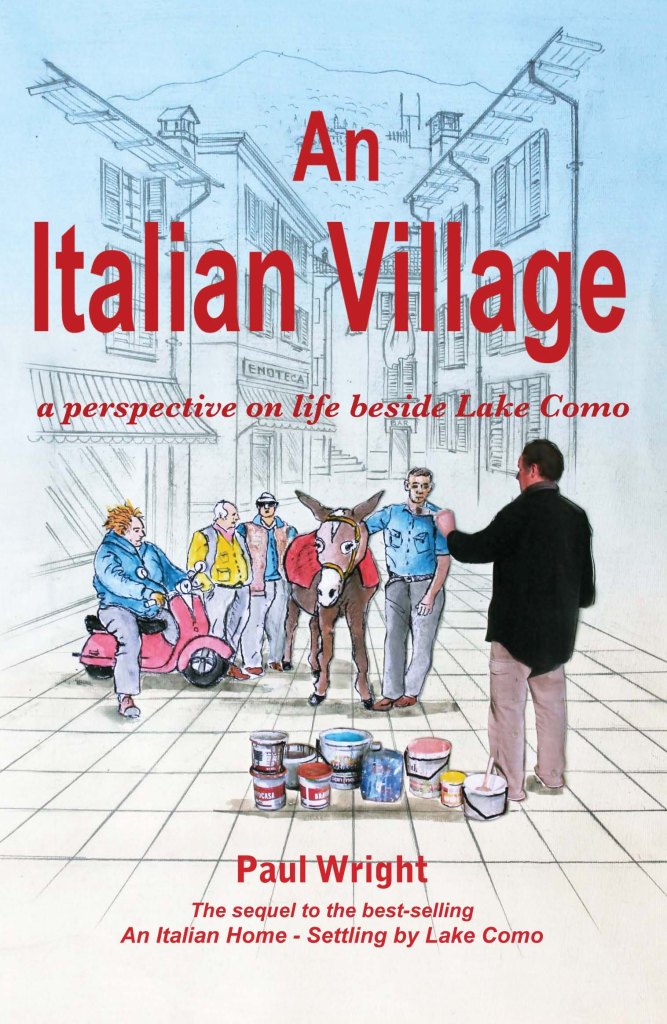
Paul’s first book in his autobiographical trilogy describing life of an expatriate settling in Moltrasio on Lake Como. The cover design by Paul met with the initial disapproval of his neighbour for including her underwear on the clothes line.

Paul Wright and his wife Nicola moved from England to Lake Como over thirty years ago. They have faced various challenges and tribulations over this time but have never regretted making that move. Initially they tested the waters by house sitting a friend’s home in Moltrasio and, once they found their venture to be economically viable, went for full expatriate immersion by selling up their home in Surrey in favour of a villa in Argegno. Paul  recorded the couple’s experiences as expatriates in a trilogy of books available on Amazon.

I read the first two titles in the trilogy fascinated to learn how he and his wife responded to the challenge of moving to a different country and what it was about Italy that they found so appealing, and at times, exasperating. I could not help contrasting his views and experiences with those of my own since my wife and I also moved to Italy at around the same time. 

The Expatriate Genre

My wife and I first moved to Italy in 1988 while Paul and Nicola moved to Moltrasio from Surrey in 1991. Increasing numbers of people at that time were exploring the possibilities of living abroad within the European Union, a right that was not actually established in law until the signing of the Treaty of Maastricht in 1992. A genre of biographical nonfiction developed on the back of this interest in which the authors recounted their experiences of setting out to establish themselves in a foreign land. The most successful of these was Peter Mayle’s ‘A Year in Provence’(1991). It set in chain this fashion for accounts of foreigners (usually from the cold and wet North) settling in envious sunny rustic environments. I hated Peter Mayle’s book with an almost irrational vehemence. The major irritant for me was the author’s air of self-satisfied smugness that lay behind the rose-tinted cliche-ridden depiction of what had to be a pseudo-reality. It was a journalist’s time-limited project whose principal aim from the start was the production of a best seller. Unfortunately its immense success influenced the tone and voice of many of the others that followed in the same genre. So it was a great relief to me to find that neither of the two books in Paul’s trilogy shared this fault. The first ‘An Italian Home’ describes the challenges and excitement of moving, getting established and becoming acquainted with your new adopted country, home, and neighbours – a dramatic and often traumatic process even if just moving to the next street let alone to a country where you have yet to learn the language. The second, ‘An Italian Village’,  focuses on when the couple were already well established in Italy but needed to move, primarily for economic reasons, from their much beloved Moltrasio to nearby Argegno. Both books have an authentic feel with a sense of honesty and integrity incorporating some amusing incidents and engaging character sketches along the way.  

Watercolour, Moltrasio Centre by Paul Wright

The Expatriate Experience

Expatriates voluntarily expose themselves to a series of challenges of which the most significant must be the ability to communicate. Paul’s wife could speak Italian but he could not. He was not an employee of some large multinational with a workplace in which speaking Italian may have been desirable but not essential. He was and remains a self-employed artist needing to both understand a client’s commission and explain his response to it. They had also moved to Moltrasio, a small village on the west bank of the Como leg of the lake where the locals were more likely to have the local dialect as their alternative language rather than English. And he wanted and needed to become fully integrated within his new social setting. Achieving a degree of functional literacy must be the first hurdle for any immigrant and Paul does not shirk in describing how much a challenge that was – with its detrimental impact on his self-confidence. 

Morning Mist Over the Lake, Paul Wright

Pre-Maastricht, an English expatriate went through exactly the same bureaucratic hurdles in obtaining residency rights as immigrants from any other part of the world. Paul and Nicola had a tough time obtaining the right to stay. Italian bureaucracy has not got the best of reputations.  I had hoped that the UK’s ongoing membership within the European Union would mean never needing to queue up again at the Questura with multiple copies of the correct documents and a ‘marca da bollo’ of the right value. But no, following Brexit, Paul, Nicola and myself now need to return there again to obtain a ‘carta di soggiorno’ which is similar in name and intent to the original ‘permesso di soggiorno’ that they bravely queued up for so many years ago. 

River Telo, watercolour by Paul Wright.

The issue of bureaucracy is though a mental trap for the expatriate since, back in the UK, a British subject has no need to obtain a ‘permesso’ for anything. But a foreign visitor does and their experiences in attempting to gain residency, let alone nationality, have been for years difficult and are only getting worse.  And to make a slow underfunded bureaucracy even worse, the UK government deliberately set about making the immigrant’s experience more unpleasant by instituting the so-called ‘hostile environment’, a phrase that  ex-Prime Minister Theresa May has belatedly come to regret using. As an expatriate/immigrant you are on the powerless side of the bureaucratic battle in whichever country you aim to settle. Until you have secured your rights, the ongoing sense of powerless is yet another blow to your well-being and self-confidence.

Libero Professionista

The River Telo as in the painting by Paul Wright above with Argegno’s famous Roman bridge

Apart from being an author, Paul’s main activity is as an artist specialising in murals as well as using trompe l’oeil effects to decorate furniture. One of his original reasons for leaving leafy Surrey was because UK fell into recession in the early 1990’s causing a major drop in the number of clients. He very quickly gained some commissions on settling in Moltrasio thanks primarily to the contacts Nicola had made years earlier when acting as an au-pair. Paul had immediately learnt the importance of personal introductions in allowing him to market his skills. Back in the UK he had been accustomed to present his portfolio to private galleries as the primary way of gaining commissions. He was told and quickly learnt that this was not a sufficient marketing technique here. In Italy one needs some form of personal contact, an established person who can recommend you to others. I have heard the same point made by other expatriate artists working around Como. Fortunately Paul’s wife’s contacts could provide Paul with the necessary entry amongst interior design architects. 

He worked initially for a Como architect who gained him a number of rich but demanding clients but sadly also introduced him to a less scrupulous variety of business ethics. While cheats and scammers can unfortunately be found everywhere, they seem to stand out to a greater extent in Italy since they exist in direct contrast to the much larger number of selfless, generous people who dedicate time and energy volunteering for all manner of associations and social causes. Paul was being introduced to the Italian world of ‘bravi e stronzi’ or heroes and villains.

Heroes and Villains

Heroes and villains stand in contrast to each other. Villains are essentially sociopathic with the capacity to defraud or cheat without moral qualms. By acting almost entirely selfishly, they debase their human value. Heroes act on behalf of others to increase their quality of life through their organisational or inspirational abilities or simply through selfless acts towards others. Their human value goes beyond price. 

If the defects in Italy’s judicial system provide scope for villains, then the existence of so many voluntary associations also provides scope for heroes. Paul’s villain was the Como architect. His hero was the leading light in the Moltrasio Pro-Loco association. 

Many small Italian towns and villages have what is called a Pro-loco association whose aims are to enhance community life through organising social events or additional services to those provided by the local council. Moltrasio clearly had an inspirational figure behind organising carnival celebrations, Christmas crib competitions as well as coaching the local football team. Involvement with the Pro-loco association certainly helped Paul and his wife to integrate within their adopted community and in exchange Paul came to recognise the exceptional nature of their inspirational leader with his tireless energy.  

Continuity and Change

Paul did not just leave UK due to the recession in the early 1990s but because he felt that UK society had lost an element of ‘continuity’. If I have understood him correctly I believe he refers to a continuity of custom and values, aspects of everyday life that pass from one generation to another made explicit through social events and ceremony. These are definitely aspects that are more identifiable in a small town or village, and Paul certainly seemed to relish living and integrating within a relatively traditional society. However change is a continuous given, and as we get older, the rate of change appears to get ever faster. For expatriates perhaps the most significant positive change since the 1990s has been the Internet and the rise of social media. Phone calls back to family no longer cost an arm or a leg as in the days of metered tariffs. Events in family groups can be shared in real time as with news and current affairs.  Technology has even ameliorated some aspects of the local bureaucracy but by no means all!

The fountain in Argegno’s main piazza became a significant meeting point for Paul as he became acquainted with the band of pensioners who would gather there and in the adjacent bar most days of the week.

Paul and Nicola themselves had to undertake a significant change once they had decided to buy a house on the lake. They found they could not afford what they wanted in Moltrasio but did find what they wanted fifteen kilometres north in Argegno. Their experience of moving and living in Argegno is the subject of Paul’s second book in his trilogy ‘An Italian Village’. 

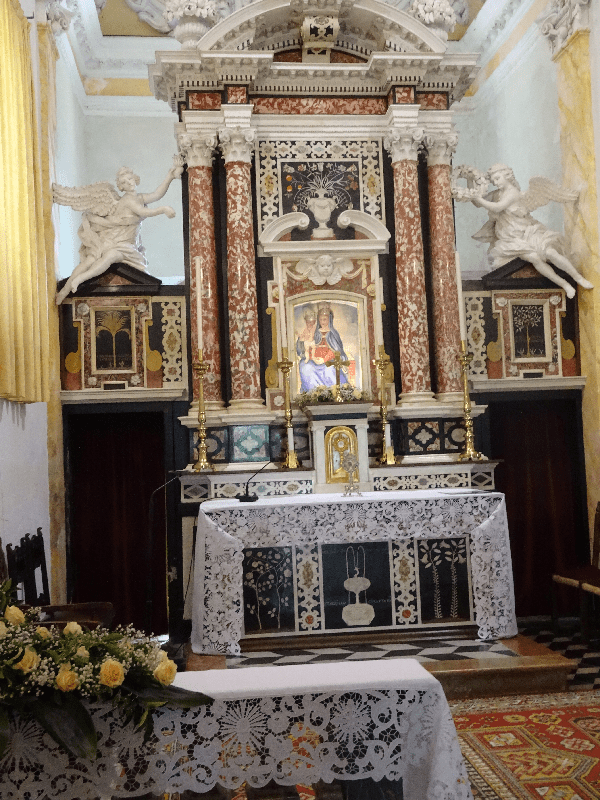
Altar in the Santuario di Sant’Anna, Argegno. with fine examples of stucco, fresco and scagliola work by local artists and craftsmen.

Argegno sits on the lakefront at the start of the Val D’Intelvi which runs horizontally from Lake Como towards Lake Lugano. The Val D’Intelvi has a long tradition in providing artists and craftsmen whose skills have gone to embellish churches all over Eastern Europe and Southern Italy. The first wave of craftsmen, known as the maestri comaschi, constructed churches in the Romanesque style throughout the middle ages. The second wave worked on the redecoration of church interiors during the Baroque period. Val D’Intelvi artists and artisans were used to paint frescoes and design plaster statuary. Paul learnt about the technique perfected by the artisans of Val D’Intelvi called ‘scagliola’ used to give the appearance of marble marquetry on altars.

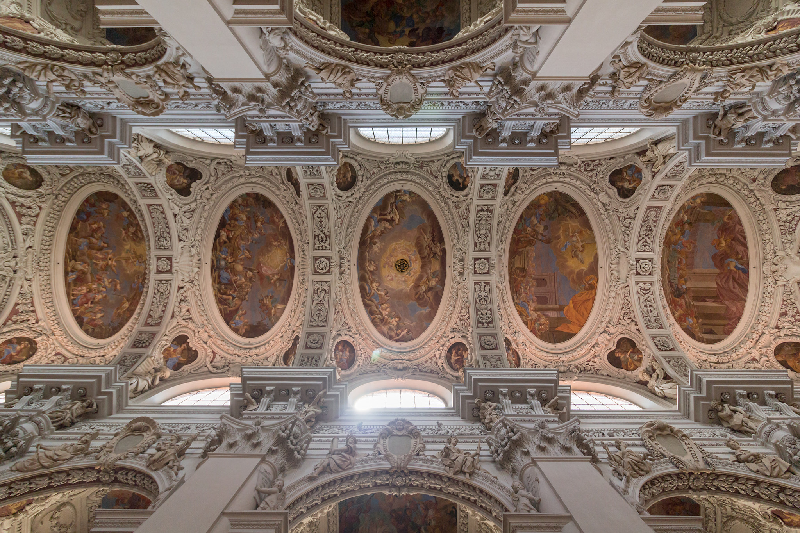
Ceiling of Passau Cathedral, stucco work and frescoes by Val D’Intelvi craftsmen

Paul’s own skills in painting trompe l’oeil murals fitted into the tradition of Val D’Intelvi craftsmanship as did the resulting need to work away from home for prolonged periods. Val D’Intelvi craftsman might work away from home from Spring to Autumn in decorating a cathedral such as that in Passau (Passavia) in Germany. Paul’s Passavia was down on the Ligurian coast where he worked away throughout the summer heat in the company of two builders from Bergamo. Little was he to know that he would be participating in a traditional pattern of seasonal migration established in the area he had chosen as home as far back as the tenth or eleventh century. 

Too Much Continuity

Screenshot from Google Maps showing an inveterate band of pensioners passing the time outside the Bar Milanese in Argegno. Most bars in Argegno do now seem to discourage this less profitable type of customer in favour of the ever increasing number of tourists.

Paul was as keen to integrate as fully in Argegno society as he was in Moltrasio. But rather than involvement in the local pro-loco, Paul’s target here was to become a member of the inveterate band of pensioners that gathered daily around the main piazza’s fountain to gossip and put the world to rights. Most Italian small towns, villages or city districts have at least one location, usually a bar, where retired men gather to while away the hours until called home to eat at midday. Paul’s group in Argegno seemed to consist of retirees from the hospitality industry – from the many bars, restaurants or hotels that for years have met the needs of visiting tourists. As a result many had retained an enhanced interest in eating or drinking or both. They also shared in the migratory instinct of the Val D’Intelvi having spent time at some stages in their careers in working abroad, particularly in the United Kingdom.  

Membership of this select band of societal ruminants required a heavy obligation to maintain a regular appearance around the piazza’s fountain and to accept the unchanging daily pattern of discourse. The repetitive continuity of the ritual discussions and the necessary regular commitment to them became even too much for Paul after a while. Apart from other demands on his time, he found the company was limiting its own horizons, becoming far too focused in time and place. This was just one further level in local immersion and continuity he could not sustain. 

A Lakeside Village, watercolour by Paul Wright

Conclusion

The second book in the trilogy describes life in Argegno where he and his wife finally settle.

Now over thirty years have passed since Paul described his arrival in Moltrasio in ‘An Italian Home’. As a result his account has become slightly historical but perhaps all the more interesting as a result. As mentioned  previously, he writes with honesty and humour avoiding all the standard pitfalls of an expatriate’s viewpoint, such as generalisation and cliché. All the traumas and excitements of the couple’s initial move to Italy were behind them when he describes their move to Argegno in his second book ‘An Italian Village’. It is here where he actually establishes his own home and, no longer over concerned in gaining local acceptance and without further challenges to his self-confidence, he can settle to the idyllic existence he must have had in mind when moving out from Surrey so many years ago. 

For my part, his books engendered a whole series of personal thoughts on the expatriate/immigrant experience simply due to their authenticity – a response in marked contrast to that provoked by ‘A Year in Provence’. I am very grateful to him for that.

Further Information

All of Paul Wright’s nonfiction is available on Amazon and in Kindle editions. He is currently working on a novel set on Lake Como so look out for its publication early next year.

Further Reading

I have previously noted the positive results that can be achieved by small communities with an active pro-loco association, in particular Moltrasio. Please read Moltrasio: The Power of Civic Pride to see why it is well worth visiting this enchanting village.

The Maestri Comaschi and the work of the Val D’Intelvi artists and artisans feature in two previous articles which are Como’s Artistic Tradition – A Pan-European Legacy: Maestri Comacini and Stucco and Scagliola – Two of Como’s Baroque Specialities.

For walks around Moltrasio see Carate Urio to Moltrasio via Rifugio Bugone and for Argegno see Argegno to Argegno: Up and Down the Telo Valley

Moltrasio is characterised as a village of stone and water
Posted in Art, Culture, Lake, People, Places of interest | Tagged , , , , , , , , , | 1 Comment

Isola Comacina – A Serene Location with a Tragic Past

isola
Looking back over the lagoon separating Isola Comacina from the mainland villages of Sala, Ossuccio and Campo

Isola Comacina is the only island on Lake Como. Its past glory and tragic destiny results from its strategic position close to the narrow channel in the lake between the promontory housing the Villa del Balbianello and the town of Lezzeno on the eastern shore. Whoever occupied Isola Comacina could control navigation on the lake southwards to Como itself and on to Milan or northwards towards the Val Chiavenna and the Valtellina with their access over the Alps to the river systems of the Rhine and Danube. Isola Comacina was to pay a heavy price for its valued location.

Looking out from the eastern tip of the island to the promontory of the Villa Balbianello.

Nowadays Isola Comacina is a beautifully serene spot totally uninhabited for reasons we will uncover, but well maintained for those visiting its ancient ruins or the three houses for artists designed by Pietro Lingeri. These three houses were built in 1939 for the Milanese Brera Academy of Art to whom the island had been entrusted by the Italian state. The island is only 600 metres long by 200 metres wide and so is very easy to explore. It is a mere 250 metres from the mainland with the point of embarkation at Ossuccio’s Antiquarium (a mediaeval hospital). The Antiquarium forms part of the complex around the Chiesa di Santa Maria Maddalena whose bell tower is one of Lake Como’s iconic structures. A visit to the island is highly recommended not just for the archaeological and architectural aspects but also because it’s a calming tranquil spot isolated from the sometimes frenetic mainland with glorious views up, down and across the lake. 

Map of Isola Comacina

Isola Comacina’s distant history is still visible amongst its ancient ruins, as with the mosaic of a fish dating back to the 5th century within the Baptistry alongside the Church of John the Baptist. The frescoes within this same structure date from within the 8th and 9th centuries. The ruins of the Basilica di Sant’Eufemia date back to their origin in the 7th century. The basilica would later be remodelled in the Romanesque style in the 11th century before it and all the other religious buildings and walled defences were destroyed in February 1169.

Isola Comacina in the Early Mediaeval Era

The Baptistry was first built in the 5th century with later additions in the 8th and 9th.

Walking around the tranquil island today, it is hard to imagine it as the vibrant religious, political, and military base it was back in the 11th century. Its role might be compared with Baghdad’s  ‘Green Zone’  in that it provided a secure environment for the military, religious and cultural elite and also a safe area for the residents of its hinterland on the shore, namely Colonno, Sala, Ossuccio and Campo, to retreat into in times of danger. Its monastery, castle and numerous churches were all enclosed within defensive walls with a naval fleet on hand to patrol and protect access from the lake.

5th century mosaic within the Baptistry

Its defences, none of which survive today, were originally built by the Romans and later enlarged under Byzantine rule in the 6th century to strengthen what was known as the ‘Linea Greca’ whose primary purpose was to protect Como. In addition to the island itself, the other two elements of defence were Como’s city walls and the Torre Baradello standing sentinel over the Pianura Padana. In the 520’s Isola Comacina was commanded by the Byzantine Captain Francilione who held out against the Lombard invasion from Germany for twenty years. Francilione controlled considerable territory on the lake until gradually he was forced back into his stronghold on the island. The Lombards were unable to mount an invasion across the mere 250 metres of lake but did maintain a siege of the island for six months before coming to an agreement with Francilione granting him free passage to the Byzantine capital in Ravenna. 

Ruins of the Basilica di Sant’Eufemia

The island then went on to prosper under the culturally and religiously benign rule of the Lombard Queen Teodolinda and beyond until the start of the 12th century.  Its fortunes then took a dramatic change on the outbreak of the ten years of warfare between Como and Milan in 1118. 

Isola Comacina in the 10 Year War with Como

In 1118 Milan declared war on Como seeing it as a trading rival and resenting Como’s ability to extract duties on goods passing through its territory and on the lake. Isola Comacina decided to side with Milan and set about building seven galleys to transport troops down for an attack on Como in the following summer. Wars in those days were conducted as seasonal affairs with fighting restricted to the summer months.  In 1119, the island duly disembarked its seven galleys of troops in Laglio who then preceded to march south as far Cernobbio where they were met by Como’s cavalry on the banks of the River Breggia close to the modern day Villa Dozzio. Round one went to Como. 

The ruins of the Chiesa Santa Maria col portico

The next season’s fighting (1120) saw galleons from Isola Comacina team up with ships from Menaggio, Nesso and Gravedona to descend the lake and await the outcome of a land battle between the Milanese and Como troops. The outcome was a treaty and an agreement to cease hostilities until the next warring season of August 1121. Como used the time granted them to build up their own fleet of galleons and then duly launched them against Isola Comacina provoking a naval battle in the waters between the promontory of the Villa Balbianello and Lezzeno. Como won the battle following it up two days later by returning to destroy the rest of the island’s fleet. They returned yet again that summer to lay waste to the towns of Campo, Sala and Colonno whose inhabitants fled to seek safety within Isola Comacina’s defences. Como ended the season of 1121 with a successful attack on Bellagio. 

One of the three artists’ residences built in 1939 by Pietro Lingeri

In 1124, Como made two attacks on Isola Comacina which ended with Como making an offer of peace once they had again sacked Campo. The island refused the peace offer provoking Como into laying waste to the nearby towns of Mezzegra, Colonno and Menaggio.  Como’s run of good fortune against the much larger community of Milan could not  last for ever particularly once Milan enrolled other cities such as Pavia, Cremona and Lecco to join their cause. Como was finally and convincingly defeated in 1131. The victors tore down the city’s walls, sacked all buildings other than the churches, convents and monasteries, and forbade trade and markets. Como as a functioning city did not exist for the next thirty years, and Isola Comacina could relax with its local enemy vanquished.

Federico Barbarossa

Como’s south facing city walls with Porta Torre, built by Federico Barbarossa..

The fortunes of both Isola Comacina and Como itself would take another turn on the arrival in Italy in 1158 of the recently appointed Holy Roman Emperor, Federico Barbarossa. The purpose of his first armed invasion of Northern Italy was to persuade the Milanese to recognise his dominion over the city. In achieving this he also forced Milan into restoring freedom to the cities of Como and Lodi.  He then meted out the same destruction on Milan as the Milanese had inflicted on Como thirty years previously. Namely its defensive walls were torn down and most buildings apart from churches, monasteries and convents were destroyed.  With her new powerful ally, Como’s ill-fortune was reversed with Barbarossa investing heavily in the city’s defence against attacks either from Milan or from any of Milan’s allies on the lake.  He rebuilt Como’s Torre Baradello and the city walls of which over 70% still stand today. He then turned his mind to the last element in the ancient Byzantine ‘Linea Greca’ – Isola Comacina.

Monastic complex of Saints Faustino and Giovita

The story goes that in 1162 Barbarossa sailed single handed to the island and simply shouted over to the islanders to surrender. Barbarossa had established such a ferocious reputation that the islanders immediately complied without argument. The island’s submission to Barbarossa’s authority was sufficient for him but not for Como.  The Comaschi were intent on bloodthirsty revenge for the island’s allegiance to Milan during the ten years war. 

The Destruction of Isola Comacina

In February 1169 a force from Como allied with troops from the semi-independent state of the Tre Pieve (Gravedona, Dongo and Sorico) attacked the island causing the nuns from the monastery of Saints Faustino and Giovita and all the priests and acolytes of the island’s churches to flee to Varenna. Every building was then burnt and destroyed and the defensive walls pulled down. Also, contrary to the established rules of war at the time, the destruction included the monastery, the Basilica and the six other churches.

Sagra di San Giovanni, Isola Comacina. An annual firework display re-enacting the sacking of Isola Comacina by Como in the 12th century

 Following this complete destruction of all habitations on Isola Comacina, Como’s Bishop Anselmo Della Torre cursed the island in the following terms:

‘The bells will never ring again, stone will not be set upon stone, no one will ever host you again, on pain of violent death.’ 

Anselmo Della Torre

The curse was not entirely effective in that the Benedictine Convent of Saint Faustino may have been established back in 994 but the current building was constructed after the massacre of 1169. The same goes for the current Church of Saint John the Baptist which was built towards the end of the 15th century on top of the ruins of the original church destroyed in 1169. It was subsequently remodelled on Baroque lines in 1635 with the bell tower added in 1675. 

The Church of Saint John the Baptist

However the island did remain mostly unoccupied for the next 750 years, until it fell into the ownership of the King of Belgium who passed it on to the Italian Royal Family in 1919. However even now, there seems a reluctance for anyone to live on the island in spite of the three studios for artists built for the Brera Academy. 

Historical Re-enactments

St. John the Baptist is the patron saint of the island and his saint day is celebrated on June 24th. It is on or near this date (the last Saturday in June) when the fatal destruction of the island back in February 1169 is re-enacted in a massive spectacular firework display which engulfs the entire length of the island. The Sagra was suspended for two or possibly three years but it was held again this year, as another welcome sign of local recovery from Covid. The event is so popular that the roads to Colonno, Sala and Ossuccio are practically impassable for hours. One excellent option for travelling from Como and viewing the Sagra is going on the cruise organised by the Navigazione specifically for the event. 

The Palio del Balbianello kicks off in September with the re-enactment of the arrival of Federico Barbarossa in March 1159

While the Comaschi may not be so proud of their unprincipled destruction of the island so many years ago, they are delighted to remember and re-enact the arrival in March 1159 of their saviour from Milanese oppression – Federico Barbarossa. The Palio del Baradello is a series of events and activities intended to mirror the festivities laid on for Barbarossa when he landed on the shores of Como. It is held from the end of August to the beginning of September. As with Isola Comacina, the celebrations are not held on the actual anniversary of the original event but are timed to coincide with the local saints day with Como celebrating Saint Abbondio’s day on August 30th.

Visiting Isola Comacina

The island has a distinct still atmosphere of its own resulting partly from its relative isolation but also by the ample evidence amongst its ruins of its tragic past. For the last three years the island has been off limits to visitors since its single landing stage was deemed unsafe. Fortunately the landing stage has now been repaired and visits were permitted again from this April. 

Tickets for the boat crossing and entry to the small museum cost €6 and are on sale within the Antiquarium.

Research Sources

Ettore Maria Peron’s book Storia di Como, published in 2017 by Edizioni Biblioteca Dell’Immagine was invaluable in writing this article.

The bell tower of the Chiesa di Santa Maria Maddalena
Posted in Architecture, Art, Culture, Events, History, Itineraries, Lake, Places of interest | Tagged , , , , , , , , , , , | 4 Comments

Fables, Legends and Folkore: A Walk to the Devil of Blevio and other Erratics

Pietra Nairola 1
The Pietra Nairola, a National Monument above Blevio where legend has it that the Devil threw a ball to and back from a neighbouring glacial erratic.

Those ancient ancestors who inhabited the hills around Lake Como could offer no logical explanation as to why massive rock boulders, formed entirely from rock unknown in the area, should have been placed so randomly around the countryside. With their intimate knowledge of their own environment but almost total ignorance of all that lay beyond it, they could only offer up magical notions for the presence of what we now call glacial erratics – also known locally as ‘trovanti’. 

The area around Blevio and Torno is particularly rich in glacial erratics and three of the larger and better known examples can be visited on or nearby the mountain path from Brunate to Monte Piatto, above Torno. A description of that walk can be found at Como to Torno Revisited. However the description below is of a circular walk that sets out to view at close quarters each of these erratics, namely the Pietra Nairola (The Devil of Blevio), the Sasso del Lupo and the Pietra Pendula. 

Glacial Erratic Legends

Until geologists had established that these anomalous boulders had been brought down and deposited by glaciers in retreat, the local population sought more fanciful explanations for their presence. Many of the boulders became the sites of pagan cults associating them with the presence of either malign or benign spirits believing that the rocks had enveloped these spirits who continued to exercise their influence over the surrounding territory. As pagan beliefs became fused with early Christianity the stones would often be considered the playground or altars to the Devil as with the Pietra Nairola, the first erratic on our route below. Here the old belief was that the Devil played a form of diabolic football with the spirit of a neighbouring boulder now no longer present. As time passed the local population sought to fully Christianise these sites as in the case of Pietra Nairola which became associated with a sighting of the Virgin Mary prompting the nearby construction of the Cappellina Monte.

The Val Masino on the northern slopes of the Valtellina is the source of the three large boulders brought down by glaciation and deposited on the path between Blevio and Torno.

Around Torno some of the glacial erratics were adapted to become human sepulchres, known as ‘massi avelli’. Our circular walk from Torno described in Torno Circuit: Piazzaga and Monte Piatto passes by at least three of these prehistoric sepulchres. 

Of the erratics on this route, the Pietra Nairola is nothing less than a national monument while the Pietra Pendula at Monte Piatto is well known for looking like a giant mushroom. Between the two is the Sasso del Lupo which, in folklore, was the cave of a vicious wolf who would jump out of his lair to ensnare any passing child who was known to be naughty or disobedient. A number of other erratics can be seen along the path taken from Blevio to Monte Piatto.

Starting our Walk

Since this is a circular walk, it could be joined at any point along the route with easy access from either Blevio or Torno. I chose to start it right by the Cappellina del Tue in the area of Torno known as Perlasca, setting off along the road south towards Como now bypassed by one of the series of tunnels on the state highway. After about 300m along the main road, once in the Comune of Blevio and before the gatehouse of the Mandarin Oriental Hotel on the right, take the path climbing off to the left marked by a signpost for the Strada Regia. 

Route of the circular walk starting from the Cappellina del Tue in Perlasca, on the southern edge of Torno.

Mediaeval Blevio

Once you have climbed above the level of the main road below, the path levels out to pass through the various old mediaeval clusters of Blevio  starting with Colombaio and then passing through Lera, Cazzanore until you arrive at Castello. From here we commence a reasonably arduous climb on the so-called Scalotura – a series of steps climbing up the Valle di Sorto.

Mediaeval Blevio

Cappellina Monte

With some relief the long climb up the Scalotula ends at the Cappellina Monte with its shrine dedicated to the Madonna and Child. Here you are invited to rest awhile taking in the spectacular views south down the lake towards Como. There is also a water fountain and some thoughtful person has even left a bowl for dogs. The chapel is at a crossroads with the main path from Brunate to Monte Piatto intersecting the path up towards the Pietra Nairola.

The Cappellina Monte

Pietra Nairola

The Pietra Nairola is a further 400 metres from the chapel continuing the ascent from Blevio but on a less defined path than before. It is therefore a significant diversion from the main path but worth the effort when you eventually reach this extraordinary massive boulder seemingly cantilevered in suspension over the hillside. It is a national monument but I have no idea what goes to qualify the status of this erratic rather than any of the others in this area. It might possibly be due to the legends associated with it and thus its importance to the local inhabitants. It was undoubtedly a significant site for pagan ritual as evidenced by the efforts of later generations to Christianise the area through the sightings of the Virgin Mary. 

The origins of the boulder have been traced to the granite mountains in the Val Masino on the northern slopes of the lower Valtellina, brought down to rest above Blevio by glaciation.  

Sasso del Lupo

Lake Como viewing south from the Cappellina Monte

Descending down from the Pietra Nairola back to the Cappellina Monte, we pick up the path towards Monte Piatto. This path follows the contours around the mountainside and so comes as a pleasant change from the steep climb up the Scatotula. Not long after leaving the chapel, the path crosses a terrace with a single stone monolith at its centre and many other erratics lying like sleeping giants in the woods nearby. 

The massive erratic soon appears overhanging the path offering no escape to any poor child judged sufficiently naughty or disobedient to entice the wolf from out his lair. The erratic’s dimensions are impressive – 20 metres long by 10 metres wide and 8 high. This rock is, like the Pietra Nairola and the yet to be seen Pietra Pendula, also originally from the Val Masino. 

The Sasso del Lupo hanging over the path to Monte Piatto

Monte Piatto and the Pietra Pendula

With the wolf’s lair behind us, there is no further obstacle to arriving safely at Monte Piatto. This is a sizeable mountain community, where, depending on the time of year, there are two options available for eating and drinking – the Crotto Piazzaga Restaurant and the Agriturismo ‘La Casa di Alba’.  I followed a circular route to take in the Pietra Pendula which passed by the gardens of the Agriturismo and on to the terrace around the church. From this terrace there is a great view of the lake looking north. 

The Pietra Pendula is impressive, appearing as if a giant mushroom. The massive granite boulder rests on a pedestal of local limestone rock which has apparently been carved out to accentuate the rock’s fungal profile. Its vital statistics are 2 metres wide, 4 metres long and 3 high. 

The Pietra Pendula with the initials P.P. carved The Pietra Pendula with the carved initials P.P.

The circular route returns us to the stepped path that leads down to Torno. Rather than follow this path down to the lakefront, our route follows the Via per Someana before turning left on the Via per Rasina – both of these are not roads (or ‘via’ as we may know them) but paths accessible only by foot or mountain bike. 

The Via per Rasina climbs gently up above the main centre of Torno with a good view down over the town centre and the lake until reaching our original point of departure by the Cappellina del Tue.

Lake Como looking north from the terrace of the church in Monte Piatto.

Summary

Time: 2 hours 50 minutes

Distance: 8.74 km

Climb: 540 metres

Descent: 550 metres

Torno from Via per Rasina 1

View down on to Torno from the Via per Rasina

Posted in Folklore, Itineraries, Places of interest, Walks | Tagged , , , , , , , , , | Leave a comment

Lake Como’s Condottiere – The Marquis of Musso

medeghino

Gian Giacomo de Medici, detto Il Medeghino

Gian Giacomo De Medici was born in 1495 in Milan as the eldest son of Bernardino De Medici and Cecilia Serbelloni. His family was not related to the better known Medici of Florence. He was the eldest of Bernardino and Cecilia’s ten children.

The family background was modest. His father acted as a tax and debt collector to the Duke of Milan, Massimiliano Sforza, to whom he also owed money. When the French captured the dukedom in 1515, they imprisoned Bernardino and confiscated all his possessions leaving the family destitute.  Yet by the time of Gian Giacomo’s death in 1555, he had himself become a marquis, the Serbelloni family had become ennobled, his brother had become Pope Pius IV and his sister had given birth to the future Cardinal Carlo Borromeo – all thanks to Gian Giacomo and his career as Il Medeghino, one of the most successful condottieri in the Renaissance period.

musso print

Print by Franz Hegi of a painting by Johann Jakob Wetzel published in ‘Voyage Pittoresque au Lac de Como’ in 1822.

Late Renaissance in Lombardy

sant eufemia 1

Il Medeghino’s castle in Musso was fortified from the port up to where the Church of Saint Eufemia now stands. This promontory gave him a view north and south down the lake, and the fortifications made it invincible. The castle was eventually destroyed by the army of the Swiss Federation once Il Medeghino had signed a peace treaty with Francesco II Sforza in 1532.

In spite of all the artistic and scholarly achievements of the renaissance, the late fifteenth and early sixteenth centuries in Italy were highly unstable. This was due to the competing interests of those seeking to gain territory and control over the host of individual dukedoms and city states across the country. The major contestants were the Papacy, the French royal family, and the Spanish who also had possession of the Holy Roman Empire. Caught in this complex web of intrigues and alliances were the dukedoms themselves such as the Sforza in Milan, the Venetian republic, the Swiss Federation and the Grisons. The Grisons were not fully integrated into the Swiss Federation until the 1520s and were constantly seeking to extend their territories down the Valtellina and the Val Chiavenna so as to gain control over the top end of Lake Como. For the French or Spanish, the main prize locally was dominance over the Dukedom of Milan in the possession of the Sforzas. Lake Como was of strategic value commercially and militarily since it provided the best means for transporting troops and goods to and from Milan. The lake’s transport links were vital for trade across the Alpine passes with Germany and beyond. Local commercial rivalries between cities like Como and Torno were exacerbated by rival military alliances with the French, Swiss or Spanish. The result was almost constant warfare between the major cities on the lake with each seeking to maintain a sufficient navy to protect its commercial interests and see off their rivals. These local navies would from time to time be supplemented by troops and ships provided by either the French or Spanish depending on to whom each town had pledged allegiance. These troops would also be supplemented by mercenaries mainly recruited from Germany or the Swiss Federation – the so-called Lanzichenecchi. These were in turn supplemented by kidnapped members of the local population and the bands of brigands and pirates who profited from the overall state of anarchy.

Condottieri

Federico de Montefeltro

Federico de Montefeltro, the Duke of Urbino in a portrait by Piero della Francesca. Federico had the bridge of his nose surgically removed to restore his field of vision once he had lost his right eye in battle.

Out of this environment of constant warfare and complex allegiances emerged the figure of the condottiere – a military leader able to command an army for hire usually serving one of the major powers but often themselves connected to a dukedom or granted the control of one or more of the major renaissance cities, For example, Alessandro Sforza was a condottiere in the early fifteenth century who, while serving the Papacy, was granted the Dukedom of Milan. Federico di Montefeltro was another condottiere who gained the Dukedom of Urbino. Other famous condottieri include Cesare Borgia who supplemented his role as a cardinal and son of the Pope by retaining under military power a massive principality in Central Italy in support of the Papal States.  

Il Medeghino

Il Medeghino was such a condottiere who rose from his modest background as the son of a bankrupted debt collector to become the Marquis of Musso and Count of Lecco. He maintained an iron grip over both legs of Lake Como from 1523 to 1532. He was able to control almost all of the commercial and military traffic to and from Milan and the major routes over the Alps. He was one of the last of the great condottieri in the 16th century. But his career started off as a mere but brutal delinquent in the pay of the Dukedom of Milan as a hired assassin. 

view north

This view from within the Giardino del Merlo in what would have been inside Il Medeghino’s castle at Musso shows how he had vision of any of the Grisons’ ships descending from the Val Chiavenna or Valtellina.

As a mere delinquent, Il Medeghino killed his first victim at the age of sixteen. He fled Milan to avoid justice and joined up with one of the largest bands of pirates and kidnappers operating on Lake Como under the leadership of a Giovanni il Matto (Giovanni the Mad). Here he gained an early apprenticeship in how to exploit the anarchy arising from the continual conflicts between the French, the Spanish, the Swiss Federation and the Grisons. Giovanni il Matto was the son of Antonio il Matto. Antonio had established his base for piracy in Dongo, a town just beyond Musso on the western shore towards the top end of the lake. Pirates operated both from Dongo and Sala Comacina menacing commercial traffic on the lake and raiding lakeside towns to supplement their income by demanding ransoms for kidnapped prisoners. They were able to flourish by allying themselves whenever it suited with any one of the rival armies. Antonio il Matto was killed in September 1517 but piracy continued under his son, Giovanni who harassed the towns of the Tre Pievi for a further two years, aided by a still young Il Medeghino.

Note: The Tre Pievi was a semi-independent territory covering the top end of the lake with Gravedona, Dongo and Sorico in particular. It was established as a result of the Treaty of Constance in 1183 between Federico Barbarossa and the Lombardy League. It existed for a further 400 years.

Francesco II Sforza

Francesco II Sforza, the Duke of Milan and the last in the Sforza line.

In 1521, Giovanni il Matto was appointed Prefect of Lake Como by Francesco Sforza, the Duke of Milan, who then commanded him to take over control of the city of Como. Como was allied to the French whilst the Duchy of Milan was allied to the Spanish. Giovanni led his fleet of pirates incorporating some German mercenaries provided by Sforza to land in Borgo Vico. Here he waited in the hope that the Rusca faction (anti-French) within the city might aid his assault. However the French Governor repulsed Giovanni and his pirates with his own mixed army of Swiss mercenaries, Lombardy bandits and a few Como residents. Giovanni was captured and beheaded along with his brother in Griante just north of Cadenabbia on the westerns shores of the lake. 

Il Medeghino had learnt a lot from these early years of apprenticeship both in terms of military strategy and political acumen. He re-allied himself with the Sforzas who, in 1524, granted him the Signoria of Musso in perpetuity. It is suggested that he tricked his way into gaining control of Musso by substituting the sealed letter from Sforza which he had been entrusted to deliver to the castle’s governor. In any event, he quickly set to optimising the defences of the castle and its port and building up his fleet of ships. When also granted the Signoria of Lecco, he had control of both legs of the lake and, as importantly, access to the outlet of the River Adda which provided a navigable link towards Milan. He took on the French and the Grisons causing them to retreat back up the Valtellina and the Val Chiavenna. As his power and control of his territory increased, he became increasingly independent of any of the major powers. At one stage, with the Grisons seeking peace with Milan, he even captured their ambassadors on their return from peace negotiations and held them to ransom. 

Grissons attempt on Musso

Fresco in the Castello Medicea in Melegnano depicting a Grisons attack on Il Medeghino’s Castle of Musso.

By 1525, Il Medeghino had become an out and out pirate freely operating from Musso in capturing ships, seizing their merchandise, imprisoning their passengers whether fellow nationals or foreigners and putting their freedom up for ransom. He rebuilt the tower at Olonio with its command over the mouths of the Val Chiavenna and Valtellina and extracted duty on all goods that passed. He extracted the price of 500 gold ducats (scudi) from the Grisons just to grant them a licence to trade. As an example of his ransom income, he is said to have obtained 4,000 gold ‘scudi’ as a ransom for a noble Milanese called Girolamo da Carcano. (An average yearly income at the time has been estimated as from about 10 to 15 scudi). 

The First Musso War

looking south

Looking south from the Castle of Musso, Il Medghino would have had ample warning of any ships coming up from Como or Lecco.

When the Spanish attacked his castle and port in Musso, Il Medeghino put a blockade on Como causing many of its citizens to flee to Mendrisio or Lugano. He also blocked all traffic at Lecco. The Spanish were forced into peace negotiations which were  finalised at the Treaty of Pioltello on the 31st of March 1528. Under the terms of this treaty il Medeghino was granted total control of the lake except for a 10 mile zone around Como, but including Menaggio, the Tre Pievi, Valsassina, and Lecco as far down as the bridge across the Adda. Inland he was granted control of the Valmadrera, Vallassina, and the castle of Monguzzo. On Lake Lugano he was given Osteno and Porlezza. In exchange he promised to allow merchants free access across all his territories as previously granted to the Grisons. Il Medeghino now dealt directly with the Spanish Holy Roman Empire without reference to their other ally, Francesco II Sforza and the Dukedom of Milan. The castle in Monguzzo became his own personal prison and, perhaps to reflect the commercial value of his Musso empire, he now coined his own currency. He himself became the entirely independent Marquis of Musso and Count of Lecco. 

Il Medeghino's fiefdom 1528 (1)

The shaded areas show the territory under Il Medeghino’s control following the Treaty of Pioltello.

But all good things come to an end, and Il Medeghino’s fortunes changed following the Treaty of Cambrai on August 3rd 1529. This treaty temporarily ended war between France and the Holy Roman Empire and, as a result, confirmed Spanish control over the Sforza’s Duchy of Milan. Charles V, the Spanish king, now wanted to return Il Medeghino’s fortress at Musso into Sforza hands. Il Medeghino did not accept this and resisted all attempts by the Milanese to seize control over his dominion over Lake Como. The pressure from the Sforzas  built up even further following their signing of an alliance with the Grisons and the Swiss Federation in March 1531.

quinquereme

The five ranks of rowers in a quinquereme following a Roman design.

Together they dismantled Il Medeghino’s tower at Olonio with him having been branded a rebel by the Sforzas. His response was to set out building up his troops and his navy ravishing the lakeside towns to gather in food and capture men to row his growing fleet. He now had twenty two boats in his fleet but supplemented these by building some additional quinquereme ships based on the Roman design with their five levels of rowers. He did not wait to be attacked by the fleet being put together by the Sforzas in Como but went immediately on the offensive.

The Second Musso War

As Il Medeghino’s relationship with Francesco II Sforza worsened, so did that with the Grisons. Partially this was due to the Grisons adopting protestantism in 1525 and Il Medeghino’s previous military support alongside his brother, the future Pope Pius IV, to the catholic cantons within the Swiss Federation. But the murder of the Grison’s ambassador Martino Bovellini, captured by Il Medeghino’s men in Cantù on 3rd March 1531 on his return from Milan, hastened the conflict. This provocation was swiftly followed by Il Medeghino’s attack up the Valtellina with a force of mercenaries and Spanish soldiers left without employment following the Treaty of Cambrai.  Il Medeghino won a conclusive victory against the Grisons at Morbegno in the Valtellina on the 23rd march 1531. The Grisons lost between 300 to 500 men at the cost of a mere couple of Il Medeghino’s soldiers. 

Bellagio and Varenna

Another of Il Medeghino’s naval battles off the coast of Bellagio and Varenna, in the Castello Medicea at Melegnano.

The protestant forces in the Swiss cantons and the Grisons, with some assistance from the Spanish in preventing Il Medeghino from replenishing his supply of mercenaries, replied by attacking and seizing Porlezza. They were prepared to assist Francesco II Sforza on the condition that the Duchy ceded all claims to the Val Chiavenna and the Valtellina to the Grisons. The Duchy then took to the offensive against Il Medeghino’s castle in Monguzzo.

lanzichenecchi

‘Lanzichenecchi were Swiss mercenaries employed by all sides in the Renaissance conflicts. While the Spanish did not intervene directly in the Second Musso War, they did prevent Il Medeghino refreshing his numbers of mercenaries from Switzerland.

While the war on land was not going well for Il Medeghino, he had more success on water. His fleet continued to outmanoeuvre that of the Duchy of Milan. The Swiss fleet, attempting to blockade Musso, also suffered losses from a series of successful sorties. The Grisons and the Duchy then tried to seize control of Lecco and break Il Medeghino’s links between that city and his base in Musso. Over the two days of the naval battle of Lecco, Il Medeghino captured the Duchy’s colonel, Alessandro Gonzaga and caused Gonzaga’s 1200 soldiers to flee. The following day he forced the retreat of the entire Grisons contingent while fighting with a mere 100 men.  

 But his luck did not hold out when on 13th February 1532, his brother Giovanni Angelo de’Medici, the future pope Pius IV, was captured. To secure his brother’s release, Il Medeghino entered negotiations with Francesco II Sforza.

From Marquis of Musso to Marquis of Melegnano

Il Medeghino negotiated an honourable and favourable peace with Milan. He agreed to cede all his territory on and around Lake Como including his castle in Musso. In exchange he was made the Marquis of Melegnano, a small town to the south east of Milan. He was also awarded the sum of 35,000 scudi and an annual income for life of 1000 scudi and a total amnesty from any legal action against either himself or his followers. The Swiss destroyed the castle at Musso and extracted a promise from Francesco Sforza that the Milanese would never re-occupy or rebuild it. 

castello Mediceo

The Castello Mediceo in Melegnano

Il Medeghino occupied the castle in Melegnano, now known as Castello Medicea,  and commissioned its redecoration with a series of frescoes that included scenes from some of his famous battles such as those of Musso and Lecco.

frescoes castello Mediceo (1)

The frescoes in the Castello Mediceo have been recently restored.

Il Medeghino continued his career in Piedmont for a number of years as one of the most successful condottiere of the 16th century. His sister Margherita married Count Gilberto Borromeo and she had a son who went on to become the sanctified Cardinal Carlo Borromeo. His cousin Gabrio Serbelloni was ennobled and his brother went on to become Pope. It was this brother who commissioned a massive sepulchre designed by Leone Leoni in Milan’s cathedral for Il Medeghino on his death in 1555.  Conversely Francesco II Sforza had died much earlier in 1535 without heirs and so brought to a close the era of the Milanese Sforzas.

Medeghino tomb Duomo di Milano

The tomb of Gian Giacomo de Medici ‘Il Medeghino’ in Milan’s Duomo. The sepulchre was commissioned by Il Medeghino’s brother, Pope Pius IV and designed by Leone Leoni.

Further Information

At Musso, the Museo di Musso contains a model reconstructing the castle as developed by Il Medeghino. The grounds of his castle have now been converted into a botanical park called the Giardino del Merlo. There is also an agriturismo named Il Medeghino on the road up towards the Chiesa Sant Eufemia. There is even a boat hire company calling itself Il Medeghino but based in Como. It and many other boat hire companies are listed at Boat Hire and Water Taxis

sant eufemia 2

The Church of Saint Eufemia in the grounds of the old Castle of Musso

At Dongo, I can highly recommend the Museo della Fine della Guerra relating the last days of the war and the historic events that occurred in Dongo at the time including the capture of Mussolini and the execution of the fascist leaders on the Dongo lakefront. The audio commentary is available in a variety of languages and includes some fascinating first hand accounts of those last days by some of the participating local residents and partisans including Michele Morandi (nome di guerra ‘Bill’) who personally arrested Mussolini and is also said to have participated in Il Duce’s execution in Mezzegra. 

In Melegnano, the Castello Medicea, with its renovated series of frescoes depicting il Medeghino’s famous battles, is now run by FAI with opening times on Saturdays and Sundays from 10.00 till 18.00.

musso coin

One of the coins issued by Il Medeghino from the Musso mint.

Posted in History, Lake, People, Places of interest | Tagged , , , , , , , , , , , , , , | 1 Comment

Lake Como’s Wild Pack of Wolves

monte berlinghera

Monte Berlinghera, a remote area in the Alto Lago (High Lake) within the territory of Lake Como’s longest established pack of wolves.

Two years ago in February 2021, we published an article entitled ‘Lake Como’s Bears, Wolves and Werewolves’. This reported on the sightings of bears and wolves at the northern end of the lake, and the presence of some inexplicable tracks that some had fancifully speculated as those of a werewolf. Leaving werewolves (no further sightings) and bears aside for now, it seems appropriate to report on the current status of our wolves and identify if the extraordinary phenomenon of the Covid lock-down has had any impact on their distribution. In brief we are now confident in claiming that Lake Como hosts at least one well-established wild wolf-pack. There may also be a previously unrecorded pack inhabiting the Valsolda to the north of Porlezza. In addition, there have been some occasional sightings of lone wolves elsewhere in the province.

Where are our wolves? 

Firstly we must admit that the entire Lombardy region hosts considerably fewer wolves along its Alpine borders than those in the neighbouring regions of Piedmont, Liguria, Trento and Emilio Romagna. The chart issued below by the Life Wolf Alps project clearly shows this. 

Wolf distribution North Italy

The distribution of wolves in Northern Italy. The red pixels record documented presence with dark green spots for packs and light green for couples. The highest wolf distribution is along the Piedmontese and Ligurian Alps.

The following chart shows the four established wolf packs in Lombardy.

bears in lombardy

Bears in Lombardy.

The survey published in February 2021 identified two individual wolves in the pack based in the Province of Sondrio around Aprica and Teglio. The largest pack of seven wolves is based in the Province of Brescia around Ponte Legno. Right in the south of the region there were three wolves in the pack based around Verretto in the Province of Pavia. Finally, our pack based around the north west end of the lake (Alto Lario) consisted of three individuals.

lupo a Germasino

This wolf was seen at the Bocchetta di Germasino and he may be responsible for the carcass of a sheep found in Livo and reported in the local newspaper La Provincia last December.

A sighting of a wolf, or any evidence of their presence still receives immediate interest in the local media. From newspaper reports we can establish more precise locations for the pack in the Alto Lago. All the sightings marked below were in remote mountainous areas inland from the lake apart from the fourth. The Number 4 marks the spot where a couple of motorists saw three wolves crossing the state highway 36 – the main valley road leading to Chiavenna. The sighting of the three wolves was reported in Il Giorno di Lecco on 6th March 2022 (https://www.ilgiorno.it/lecco/cronaca/lupi-statale-36-1.7435486) and included film of the wolves caught on camera by one of the motorists. The newspaper since reported this brief video had gone ‘viral’.

bears on lake como

The established wolf pack roams within the area to the north and north west of the lake and extends across the border into Switzerland. The sights numbered 1 to 6 mark where wolves have been seen over the last twelve months. The location marked 7, at the head of the Valsolda and across the Swiss border in the Val Colla is an entirely new sighting from last December of two adults and three wolf cubs.

The first location (1) is the Valle Albano, the exact location where the presence of  wolves was  originally reported in February 2021. All the sightings in the Alto Lario cluster are of the same pack which consists of three adults as reported by the Life Wolf Alps project. However the sighting number 2 in the mountains around Vercana talks of a pack of four adults. The sighting was reported in QuiComo on 13th March 2022 and on 7th March in La Provincia. 

Lupi a Vercana-2

Image captured of two wolves seen in Vercana and reported in La Provincia on 7th March 2022.

The article in La Provincia states how this is the same pack seen in locations 5 (Albonico) and 6 (Monte Berlinghera in the Comune of Samolaco). In December 2022 a sheep’s carcass was found in location 3 showing the typical signs of being torn apart by a wolf. Other sheep have also gone missing in the same area. 

Val Colla wolf cubs

The three cubs estimated to be between three and four months old pictured in the Val Colla across the border from the Valsolda in Switzerland.

The Valsolda runs north from the shores of Lake Lugano to the west of Porlezza running close to the Swiss border and the Val Colla. What may be a previously unknown pack was identified there (Number 7 on the map above)  and reported in La Provincia on the 13th September 2022.  The Swiss UCP (Ufficio della Caccia e della Pesca) confirmed the presence of a pack consisting of two adult wolves and three cubs. The pack had been caught on hidden mini-cameras placed in the Val Colla within a short distance of the Italian border. 

The effect of lock-down

Whilst all the sightings mentioned previously were in remote areas, two other sightings have been made to the south of our region. One of these was in Montevecchia, a park in Brianza between Monza and Lecco. The other was near to Tradate at the southern end of the Province of Como in the Parco Regionale della Pineta di Appiano Gentile e Tradate. The suggestion is that the wolf seen in Montevecchia originated from the Alto Lario pack. However, to reach either Tradate or Montevecchia, the wolves would have had to traverse built up and well populated areas. The assumption is that lock-down gave these animals the opportunity to roam more widely than they would normally do, just as it did also for wild boar and deer. It is unlikely that these one-off sightings will result in the establishment of new packs now that lock-down restrictions have been lifted. 

montevecchia-paesaggio

Montevecchia in Brianza – an idyllic natural oasis with the slopes of its hillside terraced with vineyards.

Man and Wolf

wolf protection

Publicity on how to safeguard your animals

The relationship between man and wolf has always been problematic and the increased number of wolves in our area risks reigniting this time-honoured conflict. The main concern is for the safety of the flocks of sheep kept on the alpine pastures but there is also a natural worry that a wolf may attack a human. The Life Wolf Alps project runs a series of courses and advice to farmers on how to safeguard their alpine flocks. They also publish advice to the general public on how to avoid the danger of a wolf attack. 

Their recommendations are the following:

  • If you come across a wolf, keep calm, stop and assess the situation. If the wolf becomes aware of your presence, it would normally retreat or run away.
  • If instead the wolf does not run away immediately, stay calm and make yourself known using a decisive tone whilst slowly retreating.
  • Do not under any circumstances go towards the wolf even to get a photo.
  • Never follow a wolf
  • Stay clear of the wolf’s lair
  • Never under any circumstances give food to a wolf. Ensure you do not leave any food behind after a barbecue, picnic or when camping.
  • If with a dog, the wolf might consider it as intruding on its territory or think of it as potential prey. Keep an eye on your dog or keep it on a lead.
  • Report to the authorities any wolves that have displayed unusual behaviour or appear particularly bold.
  • Report any animal that has been caught by what may have been a wolf.

wolf safety

Call 112 if you see a wolf that appears too friendly. You can also report any sightings of wolves to the Carabinieri or use the form on the Life Wolf Alps EU website.

The wolf packs in the Valsolda and in the Alto Lario live in remote locations but they are within areas often visited by trekkers and mountain bikers. There are two well established trekking routes in the Alto Lario that will take you into wolf territory, the Berlinghera to Alpe Gigiai or the Monti di Vercana that goes from Vercana to Trezzone before descending to the lakefront at Gera Lario. So it is possible you might come across a wolf. If so, please report any sightings to the Life WolfAlps project via this link: https://www.lifewolfalps.eu/en/report-a-sighting/

Posted in Lake, wildlife | Tagged , , , , , , , , , , , | Leave a comment

Love, War and Death on Lake Como – The Tragic End of Gina Ruberti

lake-como-hotel-boat-01

Hotel Mandarin Oriental, previously known as Hotel Casta Diva and originally known as the Villa Roccabruna

Anyone reading the brochure of the 5 star luxury hotel, Mandarin Oriental in Blevio, will remain entirely ignorant of its illustrious origins in occupying the site of the home of Giuditta Pasta – the most famous mezzo-soprano throughout the first half of the nineteenth century. The hotel was until recently known as the Casta Diva, named after the aria in Norma composed specifically for the voice of Giuditta by Vincenzo Bellini. In 1906 the current villa was built on the site of Giuditta Pasta’s home and renamed Villa Roccabruna.

magda brard

Magda Brard, concert painist, wife of Enrico Wild and one time mistress of Benito Mussolini.

It was owned by the Wild family, Turin industrialists of Swiss origin. Enrico Wild  and his wife, Magda Brard, a renowned concert pianist and daughter of an anarcho-syndicalist French senator, lived there during the fascist period until she was arrested at the end of the war on suspicion of collaborating with the nazifascists.   Magda Brard is said to have been one of Benito Mussolini’s mistresses to whom she bore a daughter, Vanna, born in 1932, but that is all another story…

…..Since It is also most unlikely that current hotel guests are reminded of the tragedy that took place on the night of 3rd May 1946 when a famous resident of the Villa Roccabruna drowned in the lake while attempting to cross back home from Moltrasio. That person was Gina Ruberti, better known as Gina Mussolini – the dictator’s daughter-in-law. 

A Fated Nation and a Fated Family

The death of Gina came at the culmination of a series of tragedies affecting the personal lives of the dictator’s family during and just after the end of the disastrous fascist regime. These tragedies started with the death of Gina’s husband, Bruno – the third born and possibly the favourite child of Benito and Rachele Mussolini.

Bruno-Mussolini

Bruno and Benito Mussolini, taken from the cover of Time Magazine, 1935

He died in an air accident whilst piloting a test flight in Pisa on 7th August 1941. This was followed by the execution for treason of Count Galeazzo Ciano on 11th January 1944. Ciano was the husband of Mussolini’s elder daughter, Edda. She had implored her father to show some mercy to her husband, the father of three of Mussolini’s grandchildren. Edda never forgave her father and remained estranged from him for the rest of his life.  Then of course there came the infamous end of Mussolini himself executed in the company of his mistress Claretta Petacci in Mezzegra on Lake Como on 28th April 1945 on the orders of the CLN (Comitato di Liberazione Nazionale) with the implicit approval of the British allies if not the Americans. 

CINEMA: BRUNO, L'EROICO FIGLIO DI MUSSOLINI E LA SUA GINA

Una immagine di scena del film “Bruno e Gina” di Beppe Attene e Angelo Musciagna.

Mussolini throughout his life had been responsible for the deaths of thousands to millions of his fellow citizens or to those innocent refugees who had previously sought shelter in Italy from Nazi atrocity. He reduced his country to a state of abject poverty and devastation and created a state of civil strife that still lingers to some extent to this day. So he is hardly deserving of an iota of sympathy. However Gina’s story is one of a tragic life that came to a tragic end on Lake Como.

Bruno and Gina

Italy Bruno Mussolini weds Gina Ruberti, Rome, Italy

Mandatory Credit: Photo by AP/Shutterstock (7401399a) Aviation Captain Bruno Mussolini, 21 years old third son of Benito Mussolini, was married in the Church of St. Peter, Rome, to 21 year old Gina Ruberti. Bruno Mussolini, center, and Gina Ruberti kneel for the Nuptial Mass during the service in Rome on . On the left standing together are Benito Mussolini and Maria Ruberti, mother of the bride Italy Bruno Mussolini weds Gina Ruberti, Rome, Italy

Gina Ruberti and Bruno Mussolini were married on the 29th October 1938 in the Chiesa San Giuseppe in Rome. Bruno was 20 years old and his bride was two years older. Theirs was a full fascist wedding with Gina given away by Mussolini himself. The couple went on to honeymoon in Naples. King Vittorio Emanuele wrote the following note congratulating the dictator on the marriage of his son: 

‘Dear President, the queen and I wish to tell you that we vividly share in the joy of your family and we send our best wishes to your valorous son and his gracious wife.’

Bruno was deemed ‘valorous’ because he exemplified the iconoclastic adventurous dynamism of youth so often projected in the propaganda of the time as encapsulating the spirit of the young fascist state. Aged just 13 he came third in the Circuito di Littoria motorcycle race travelling at up to 130 km per hour. He started flying lessons when 17 and was soon flying sorties in the Ethiopian War. He seemed the very personification of the futurist spirit and its political offshoot – fascism. 

1918.Mario_.Sironi.New-Man.-Futurism-The-Vintagent-

Mario Sironi’s New Man, 1918. Futurism – partly a fascistic aesthetic

In the summer of 1937 he headed a squadron of fighter planes based in Palma di Majorca as part of Mussolini’s assistance to Franco in the Spanish Civil War. In 1937 he wanted to emulate the transatlantic crossing of his hero Italo Balbo and on 24th January 1938, he left Rome’s Guidonia airport for Dakar in Senegal from where he crossed over to Brazil to a hero’s welcome in Rio de Janeiro.

Time-Balbo

Italo Balbo. Bruno Mussolini emulated his hero’s transatlantic crossing.

On his return he was promoted to captain. One year later he married Gina whom he had known since he was 15 years old. However, just  less than three years later and seventeen months after the birth of their daughter Marina, Bruno died aged 23 on 7th August 1941 piloting a test flight in Pisa. His widow and her father-in-law were devastated. Bruno’s early death saved his reputation from the ignominy brought about by the later years of the fascist regime but he did fully participate in the shameful invasion of Ethiopia and in the barbarity of the Spanish Civil War.

Villa Feltrinelli

Gina had always been well received within the Mussolini family and her father-in-law was genuinely fond of both her and his granddaughter, Marina. It was natural that Gina and her child would become members of the Mussolini household.  They all moved to the Villa Feltrinelli in Gargnano in 1943 once Hitler had reinstated his fascist partner as head of the so-called RSI (Repubblica Socialista Italiana) – a puppet state governing the Nazi occupied north of Italy. 

villa feltrinelli

Villa Feltrinelli in Gargnano on Lake Garda – the home of Mussolini and his family when reinstated by Hitler in 1943 as the leader of Nazi occupied Northern Italy

Life in Villa Feltrinelli was not great. Firstly there was the poisonous atmosphere created by the neighbouring presence of Claretta Petacci, Mussolini’s most recent mistress. Rachele Mussolini became so distraught by her rival’s close proximity that she even attempted suicide by drinking bleach. 

galeazzocianoeddamussolini-1280x720-1-1240x698

Edda Mussolini and Count Galeazzo Ciano

Then, towards the end of 1943 and following the execution of Count Ciano, the household was rocked by the rupture in the relationship between Mussolini and his elder daughter, Edda.  She had escaped over into Switzerland on the 9th January 1944. Here she was able  to join her three children who had already transferred there but later she went to stay within the safe confines of a convent from where she wrote the following letter to Gina:

Dear Gina, thank you for your letter. I’m sure that you have been close to me in all these horrendous days that I have been and am still going through. You are lively but generous. As you know, I am shut up in a convent and the absolute lack of freedom weighs heavily on me, also because I don’t know to whom or to what I should attribute this rigour. Maybe one day it will pass and I will go back to living among people without feeling like the mangy sheep that needs to be removed from the herd. The judgement of men has always left me indifferent, but injustice burns within me. But I’m a good fighter and, although the desire to crouch in a corner and let go is sometimes irresistible, I still want to go on and stand and hold my head high. I don’t envy your family life: I know the environment too well not to envy your two rooms and a silly servant. Who knows if we will meet again one day; I hope. However things turn out, my friendship and affection for you will remain. I don’t have a fleeting memory. Hugs to you and  Marina. Edda

gina

Gina Ruberti

Later Gina was joined by her mother and father who moved from Rome to come and live on Lake Garda as the allied troops advanced up the country.  They were accustomed to join the Mussolini family most evenings in the Villa Feltrinelli.  But, as the war progressed life there became ever more uncomfortable with regular sorties of allied fighter planes coming over to strafe the shores of the lake. 

At the point in which everyone could see the war was lost, Mussolini decided to move his entourage back to Milan and to put some distance between himself and the Nazis by organising a final redoubt in the Valtellina. He left Villa Feltrinelli for the last time on 18th April 1945 to take up residence in the Milanese Prefectura. His family including Gina and her parents duly followed on later. 

Lake Como 

As the allies broke through the Gothic Line and the defeat of the Axis forces was imminent, the centre of diplomatic and political activity shifted to Milan and Como. Mussolini was entertaining the idea of a final stand in the Valtellina, trying in these last days of the war to distance himself from the Nazis. His route north into the Alto Adige (Sudtirol) was discounted primarily because the Nazis had already claimed this as their territory since their invasion in September 1943. For Mussolini, the Valtellina offered  a possible last stand if he could summon up enough supporters. Meanwhile neutral Switzerland was the only place where potential peace negotiations could be conducted with the allies or in contact with the Papal Nuncio in Berne. And the easiest route into Switzerland or to the Valtellina was via Como.

lake-como-hotel-lobby-01

Villa Roccabruna – the lobby of the Hotel Mandarin Oriental.

Mussolini arrived at the Como Prefecture in Via Volta in the late evening of 25th having cut short his negotiations with Cardinal Schuster in Milan. He was accompanied by Gina Ruberti whom he recommended to seek accommodation at the house of his former mistress, Magda Brard, in the Villa Roccabruna in nearby Blevio.  She, her child Marina and the nanny moved in there on the very day that Magda Brard was taken into custody by the CLN and imprisoned in Como’s San Donnino prison accused of collaborating with the Nazifascists. Her parents, Guido and Teresa Ruberti, were already accustomed to staying on Lake Como at the Villa dei Giussani in Torno along with Teresa’s brothers Vitangelo and Umberto Tangorra. Umberto’s daughter, Maria Antonietta, was already living in the Villa degli Ambrosoli in Lemna above Faggeto Lario. Mussolini’s eldest son, Vittorio, briefly took up residence in the Villa Stecchini at No. 13 Via Ferrari before seeking refuge and hiding in the infirmary of the Collegio Gallio. He would later call on the assistance of the church to use the ratline to Argentina via Genoa established by ex-Nazis and their sympathisers. Once the CLN had completely taken over from the fascist regime in the city, Gina’s parents were saved from partisan revenge by the local CLN commander Colonel Sardagna who placed them in the requisitioned home of Alfredo Degasperi in Via Fiume.

epoca casa del fascio

Terragni’s Casa del Fascio in Como during the Nazifascist occupation.

Gina settled down to a sad existence within the gloomy and dull atmosphere of Villa Roccabruna. The eccentric proprietor, Enrico Wild, continued holding his seances seeking communication with the spirit world and exhibiting odd behaviour like sleeping while standing up. Gina lived under a false name for some time and occupied herself by travelling most days by bicycle to and from the home of her parents in Como. She also spent hours in confessional conversation with the local priest, Don Giuseppe Conti. 

moltrasio torno 2

Torno (on the far bank of the lake) and Moltrasio face each other at the narrow entrance to the ‘primo bacino’ leading to Blevio, Cernobbio and ultimately Como.

It was just over a year after the execution of her father-in-law when tragedy was to strike. On 3rd May 1946 Gina as usual travelled by bicycle to spend the day with her parents in Como. She returned in the evening to Villa Roccabruna to receive a visit from a friend, the Marchesa Isa De Marchi. The Marchesa was accompanied by three British soldiers stationed in Milan namely her fiance, an English captain called Tony, a Major Parker and their driver. At around 9.00pm they all took the Villa’s motorboat for a brief trip over to the Ristorante Imperialino on the other side of the lake in Moltrasio. A sharp wind was developing and so the party spent little at the restaurant to set out on their return trip to Blevio.

imperialino

Moltrasio – Bar Ristorante Imperialino

However they had only got half way over the lake when the boat started taking on water through a gash in the bow which may have been caused as they had docked in Moltrasio. It was at about 11.00pm when within sight of the shore, the boat’s engine died due to the intake of water. The Marchesa and Major Parker swam out to raise the alarm and get help. Gina was the only one in the party who could not swim so Tony and the driver swam alongside to support her as they too tried to reach the shore. It appears that all three of them were swallowed up by a strong eddy and died on the spot. Isa De Marchi was the sole survivor since Major Parker died three days later in hospital from ingesting water mixed with the boat’s engine fuel. Gina’s body was recovered by fishermen that same night but the bodies of the two British soldiers were never found. (See my addendum at the end of this article for some updated information on the names and fate of the group who accompanied Gina to Moltrasio on that fateful night.)

gina funeral

The body of Gina Ruberti

According to Maria Antonietta Tangorra – Gina’s cousin –  news of Gina’s death was brought to her the following day by Pier Bellini delle Stelle, who as the partisan commander ‘Pedro’ had been the one who took Benito Mussolini into custody in Dongo in the previous year. Colonel Sardagna broke the news to the devastated parents of Gina in Como.  

Lake Como had brought nothing but ill fortune on the Ruberti family and so it must have been some relief for them to return to Rome the following November with their orphaned grandchild Marina and her nanny.  If Mussolini could have had any inkling of the tragic consequences to both his country and his family of the military alliance he entered into with Germany back in 1939, he might well have listened more carefully to the misgivings of his son-in-law, Count Ciano, and not set his country and his family on such a tragic trajectory. 

Further Information

Local historian Roberto Festorazzi’s book ‘Bruno e Gina Mussolini’ (published by Sperling and Kupfer, Milano 2007) was invaluable in researching this article.

Bruno-e-GinaA documentary entitled ‘Bruno e Gina – Amore, Guerra e Morte’ was made in 2014  but I have only found a trailer for it available on You Tube.

Further Reading

There are a number of articles in Como Companion covering the last few days of the Nazifascist regime including:

25th April Liberation Day – Como’s Role in the Insurrection

‘James Bond’ Returns to Lake Como

From Liberation Day to May Day

Addendum (10th October 2023)

I was contacted recently by the daughter of the English Major who died alongside Gina in May 1946. She was only two years old when her father died and, although she knew that he had died on Lake Como, she was unaware of the exact circumstances. However, on reading this article and realising that it referred to her father, she and her husband undertook more research primarily via the Commonwealth War Graves Commission. Resulting from their research, I can now correct some of the information provided by Roberto Festorazzi. Firstly, the Major’s name was not Parker but Poole, John Shakespeare Poole. He is listed as dying on the 3rd May 1946, in other words he drowned alongside Gina and the other English officer Captain George Anthony Vernon Coffin, who was engaged to the Marchesa. The member of the party who managed to swim to shore but died later in hospital as a result of oil inhalation was the English officers’ driver, Hiripitiyage Aronsingho, originally from Sierra Leone. He served in the Royal Army Service Corps while Major Poole served in the Ordnance Corps and Captain Coffin in the Royal Electrical and Mechanical Engineers. Major Poole’s daughter holidayed this year on Lake Como and was able to visit Moltrasio and the Villa Roccabruna now known as the Mandarin Oriental Hotel.

Posted in History, Lake, People | Tagged , , , , , , , , | Leave a comment