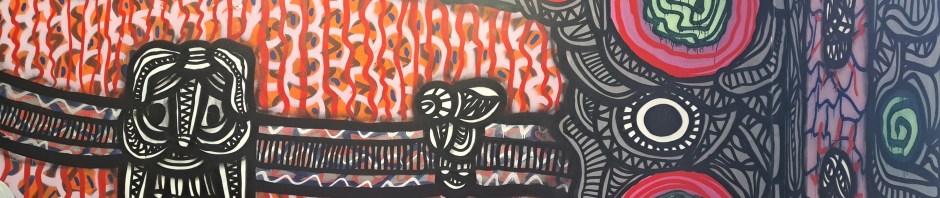
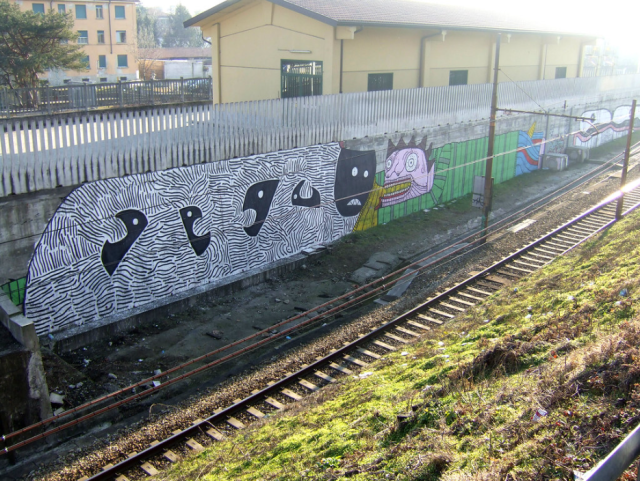
The street art of Blackwan and El Tilf is on show along the railway from Como to Milan and particularly concentrated around Camerlata.
If travelling by train between Como and Milan you will see a variety of graffiti on the walls of discarded factories or warehouses or decorating the concrete sides of railway cuttings and road flyovers. From out of this melange of visual stimulus, a regular traveller will soon discern certain examples that share a stylistic consistency with a strangely disquieting impact. These are the works of a duo of Como artists, Blackwan and El Tilf.
This form of urban art is in every sense marginal – displayed usually in so-called ‘liminal’ spaces, i.e. disused factories, abandoned warehouses, areas that have lost their original purpose and now stand as monuments to post industrialisation; or, alternatively, areas that border or support rail or road where no-one would normally have or desire access – marginal, transitional spaces.
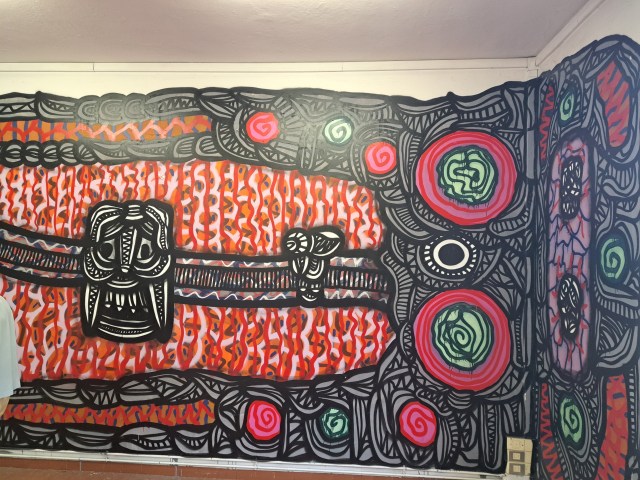
Attributed to Blackwan and El Tilf, Ex-Tintostamperia, Val Mulini, Como
Blackwan and El Tilf, two brothers from Como, do not seek publicity given that their decoration of public spaces is mostly illegal. Their art is anonymous, unsigned, non-commercial. But, because of its predominant public display, they may have more cerebral impact over larger numbers of people from varied social and educational backgrounds, than those artists whose content remains within the four walls of a public gallery. Yet this impact, being primarily accidental and almost subliminal, may pass unconsidered as just another part of the constant visual stimulation of everyday urban life – just other scenes of the urban video framed from within a moving train.
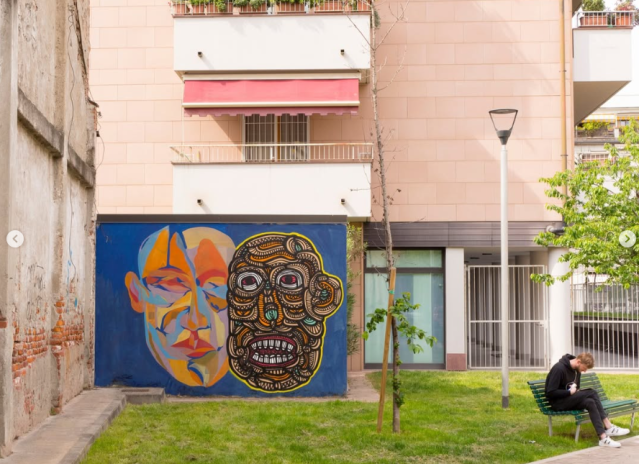
Work attrtibuted to Zolta (ZLT) and El Tilf, condominium in Milan
The stylistic consistency of the brothers’ work makes their common authorship recognisable if unacknowledged. The frequency of this style on the verges of the rail tracks around Camerlata and on down to Milan, or, as we will explore later, in local ex-industrial structures, gives their style of street art predominance in the Como area. The style is recognisable through figurative elements formed out of repeated geometric patterns and bands of colour – or left as pure monochrome. Their distortion of figurative elements, often grotesque, has a surrealistic effect – and the juxtaposition of orderly abstract design with these figurative distortions is unsettling. Their art resonates a subliminal sense of anxiety which, when viewed within often degraded urban settings, acts as a commentary on urban experience.
The brothers have been active since the 1990s starting out as secondary school graffiti artists who then developed their distinctive and highly individual style. Tilf himself has said ‘my drawings represent fantasy as their main theme, which I associate with everything around us…’.
Ex-Industrial sites
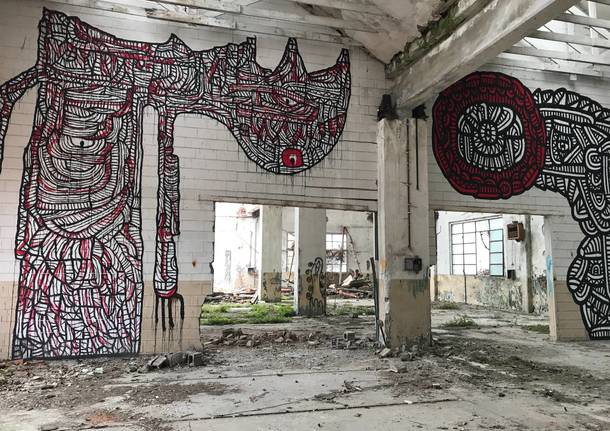
Blackwan and Tilf’s presentation of the murder of Giulio Regeni in Egypt, Ex-Isotta Fraschini, Saronno @Saronno News
The mural above, unsigned but probably by Tilf and Blackwan, is in the old factory of the luxury car maker Isotta Fraschini in Saronno. It represents the murder of the 28 year old student Giulio Regeni in Cairo by the Egyptian secret service in February 2016. The photo is courtesy of Saronno News.
For street artists like Blackwan and Tilf, being invited in to decorate the walls of ex-industrial sites, like the Ex Isotta Fraschini, has proven of great value to both them and the property owners. The artists might well choose to occupy these sites without invitation but legitimate access frees them up to express themselves without threat of prosecution. However the marginality of these sites, their loss of former function and their suspension between use, renovation or destruction makes them ideal ‘terrain vague’ – the french term for vacant, abandoned urban spaces that have lost their former function. In reclaiming these spaces, the artists can partly retain their transgressive stance as liberators converting these functionless areas into canvases expressing unregulated social freedom.
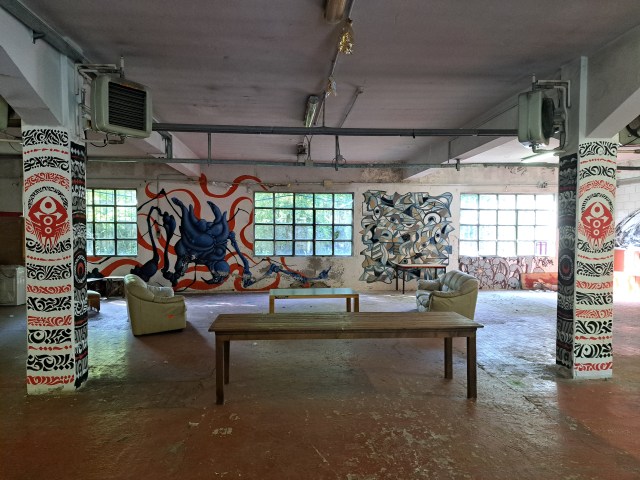
Ex-Tintostamperia, Val Mulini, Como
For the proprietors of these empty ex-industrial shells, the artists may open up a road to recovery – a way of drawing attention to long ignored spaces, reminding the public of their possible transformation from abandon to re-use, to their rehabilitation as practical spaces for habitation, community services or new industries. Such is the case in Saronno where the old car factory is now a site planned for redevelopment. A similar destitute site now richly decorated with the work of street artists, exists in Como – the Ex Tintostamperia in Val Mulini.
Ex Tintostamperia Val Mulini
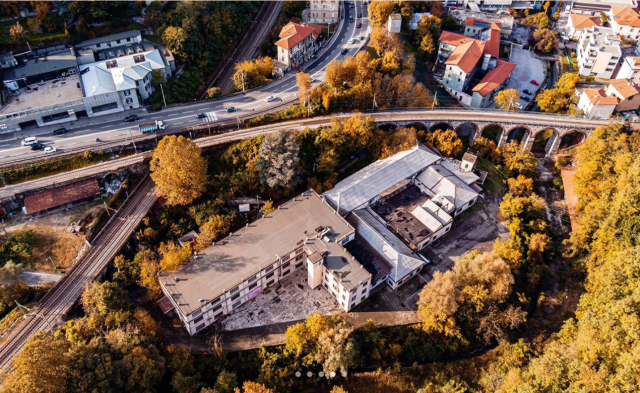
Site of the Ex Tintostamperia in Val Mulini
The Ex Tintostamperia occupies a site bounded by the Via Napoleana to its west with the two rail tracks leading to Como Lago or San Giovanni branching out to the north and south, with the stream known as Fiume Aperto bounding its eastern borders. In the past this stream powered mills (hence the name Val Mulini) and provided the water for factories like the Tintostamperia engaged in silk dyeing and printing.
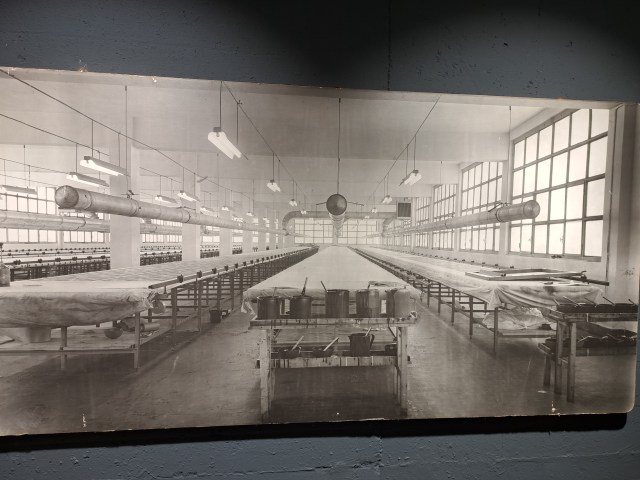
Image of the Tintostamperia when it was still operating with the massive tables for silk screen printing. This photo is on display in Como’s Museo di Seta
There are plans to regenerate the ex TintoStamperia in a similar way to Isotta Fraschini in Saronno. The plans are spearheaded by two key groups active in the local cooperative movement – the Confcooperative Insubria and the Consorzio Abitare. Back in 2022, they organised a series of cultural events under the general title of Gener-Azioni 22 to publicise the potential regeneration of the old factory. These included invitations to various street artists including Blackwan and El Tilf to come and decorate its abandoned walls.
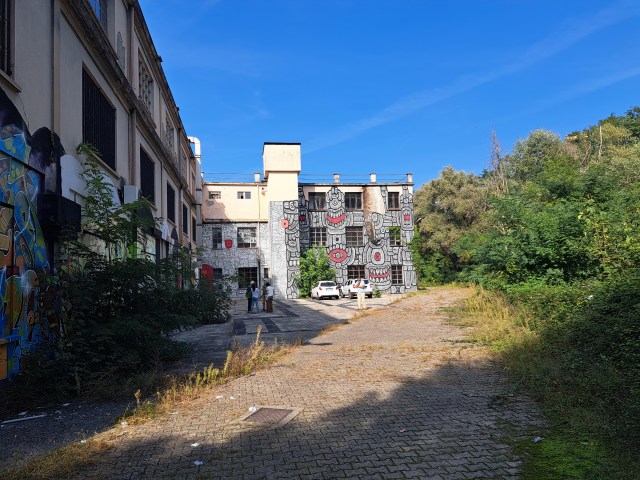 The results from an artistic perspective are spectacular with wall after wall covered in bright, startling designs making full use of colour range and space.
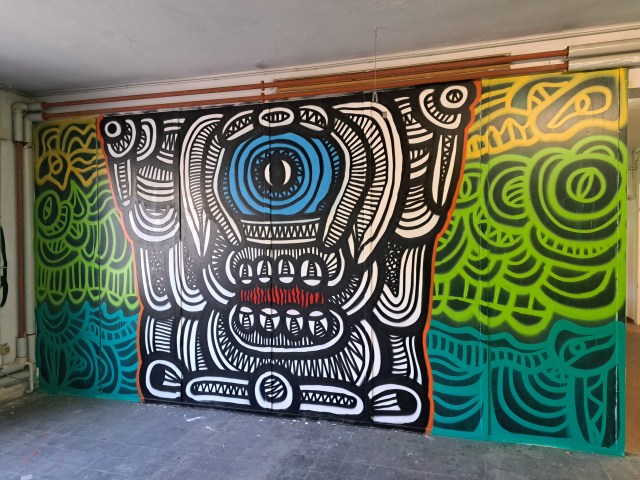
Ex Tintostamperia
The move indoors seems to have rendered these artists’ output less disconcerting than their exterior equivalents. They seem less raw and disturbing. Possibly this stems from the opportunity to work without the threat of arrest, to work unhindered, free to express their colour and design styles on a grand scale.
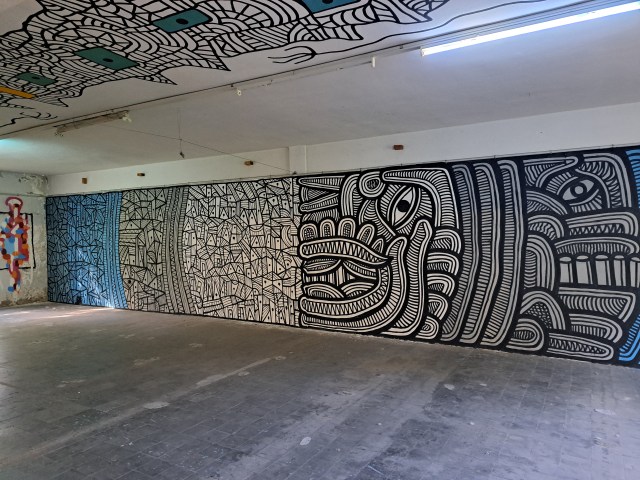
The expansiveness of the murals within the Ex Tintostamperia
The works do however still remain anonymous and, whilst many seem to share Blackwan/El Tilf’s characteristics, they are by no means the only designs on show.
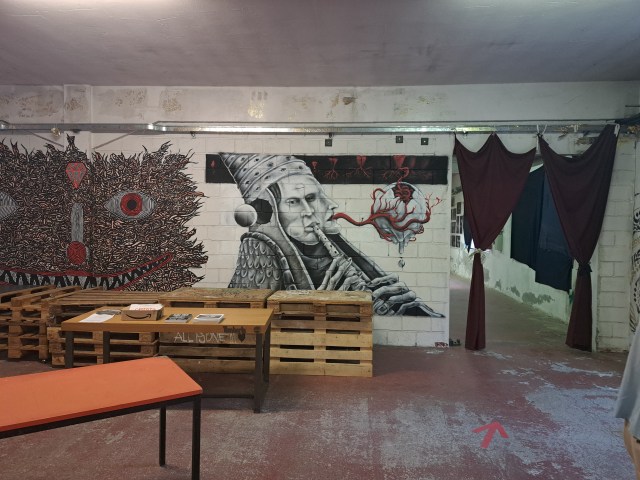
Two contrasting styles, Ex Tintostamperia
Other Como Street Artists
One other Como artist I have been able to identify as working alongside Tilf and Blackwan is Danilo Vadis who revealed some of the origins and background to the Como street art scene back in the early days when interviewed by Ivana de Innocentis published in the Urban Lives blog back ten years ago.
The following excerpts from that interview give some idea of how street art developed in Como.
Urban Lives: What was it like being born and raised in Como? What can you tell me about the local scene, from your perspective, of course?
Danilo Vadis: I was born in a town 7 km from Como called Montorfano, then I went to Como when I was 14 to attend high school, the local scene has always been quite varied, never renowned but with effervescent individuals or situations and I am referring to the underground scene in general (graffiti, street art, music, fanzines, self-management, etc.)
Urban Lives: When did you start street painting, with whom, where and why?
Danilo Vadis: I started making tags and things like that in my first year of high school, imitating older people, then I gave up because the world of tagging wasn’t for me and maybe also because I’ve never been very good at writing letters. Later, around 2005, I think, with Ema Jons, Tilf and Blackwan we started going to abandoned factories and experimenting with a few things. I had been painting for years just for myself in my parents’ garage, and having the opportunity to do it on a large scale on walls, appropriating abandoned spaces in the company of “guys like you and me” was quite a cool thing.
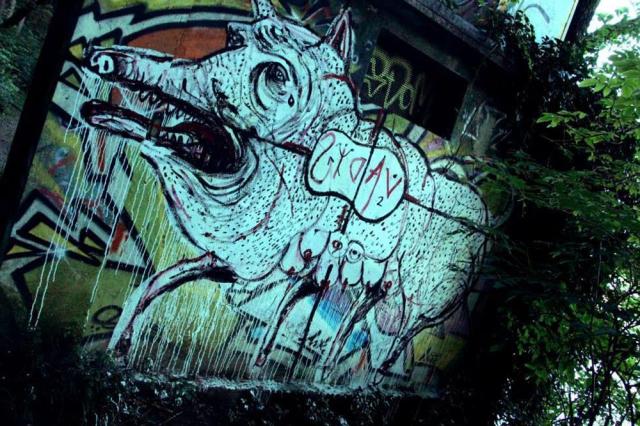
Danila Vadis ‘La Cana’ – a grotesque wild sow.
Urban Lives: And when did you start painting in general?
Danilo Vadis: I started painting in high school, I painted the bottles of the wine I drank.
Urban Lives: What work of yours are you most proud of?
Danilo Vadis: Not one in particular, I’m usually proud/engaged during the creation and immediately after, then it passes.
Urban Lives: You and the other guys from Como divide your time between organizing parties and events, punk concerts, independent music markets, and much more. How long have you been active? What would you like to organize in the future? (asked back in 2016)
Danilo Vadis: We’ve been active for a few years, each with their own things, some started first with writing and some did fanzines and mail art, some were skinheads, Ronaldo was one of the mods, but in truth we haven’t created a real collective or something codified apart from Disegni Matti which then changes/mutates every time. Future unknown.
Urban Lives: Many of you artists from Como have regular jobs: how do you find time to unleash your creativity? And to travel?
Danilo Vadis: I’ve had a lot of job changes, but I’ve always worked in the kitchen. About four months ago, I opened a trattoria with two other partners. In addition to serving food and drinks, we also organize exhibitions, concerts, and various art shows. Probably because art doesn’t pay much, we’ve made do with working. I don’t know much about the others; some work more, some less. I travel when I can, even on foot, but not by bike.
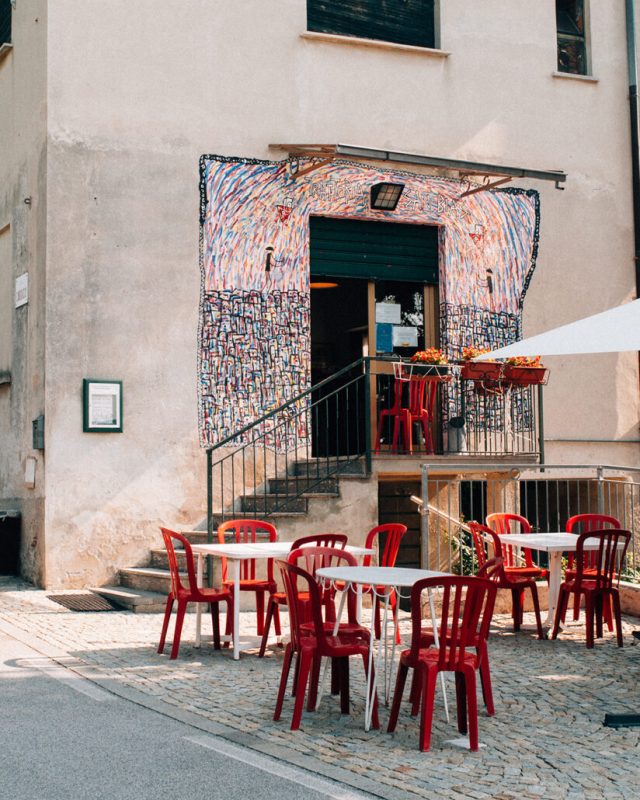
Danilo Vadis now runs the Tratttoria San Biagio in Orsenigo alongside two other partners.
Urban Lives: And what do you think of the national street art scene?
Danilo Vadis: I’m not very interested in the national or international scene, every now and then I look at some photos on the net or better still if I manage to see some nice piece live I still get enthusiastic.
Urban Lives: I’ve always been deeply impressed by the somewhat wild attitude and techniques of the Como scene. Can you tell us about it? Have you drawn inspiration from places or people?
Danilo Vadis: Everyone paints in their own way, but I think we all have a bit of this “punk” attitude, if you’ll pardon the term; we like to get dirty. I personally read the letters Vincent wrote to his brother Theo and I started eating oil paints. We turned to social centers because in those places we grew up and saw the first forms of true contemporary art, both in terms of themes, techniques, and approach. Then, some more or less chose their own personal, political, and social path.
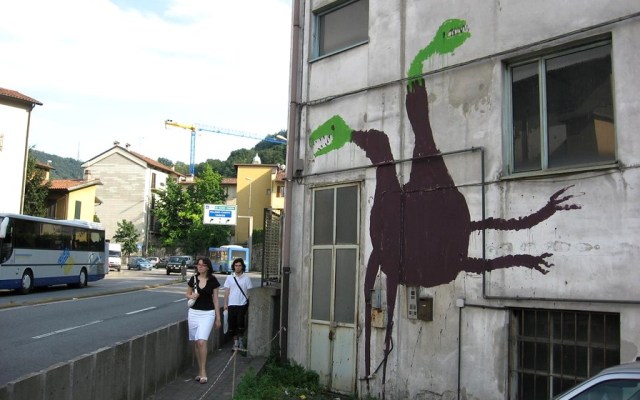
Ema Jons in Como
Another collaborator with Danilo Vadis, Tilf and Blackwan is Ema Jons, who was born in Como in 1985 but moved south to Palermo where most of his work is visible around the market area of Ballerò and Borgo Vecchio. He has however left some examples of his work in the city of his birth.
His art has developed from graffiti and murals into a series of figurative representations of so-called ‘freaks’ now marketed through Street Arts Gallery. This site describes his current painting as:
‘ raw, direct, and violent; the figures he depicts—his “freaks”—are formless creatures, beings that appear to lack a skeleton. They are distorted, weightless bodies that overlap and intertwine in a state of constant metamorphosis, forming a modern bestiary in which the animal and the human merge.”
Another street artist who may well have contributed to the interior decoration of some of Como’s ex-industrial sites is El Euro, based in Turin and known for favouring rural locations for his art as well as abandoned industrial sites. Included below is his memorial to Covid 19, created in 2020 but on a rural ruin rather than in Como.
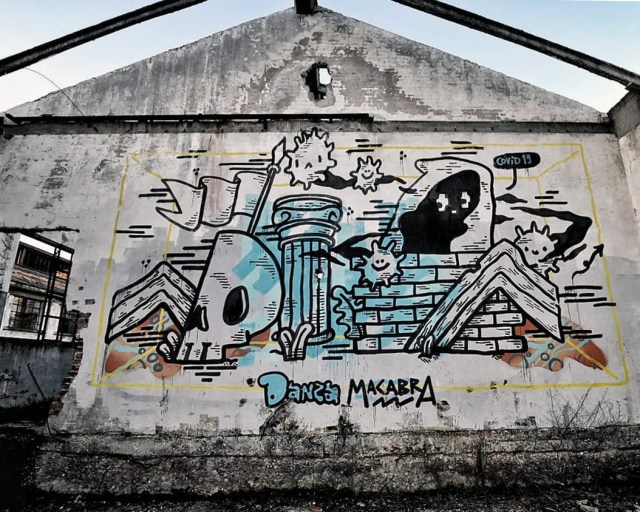
El Euro went on to infect a number of street signs with his paradoxically cuddly but malignant viruses as part of his Covid 19 concerns. The sign below, according to the Ekosystem database, is said to be in Como.
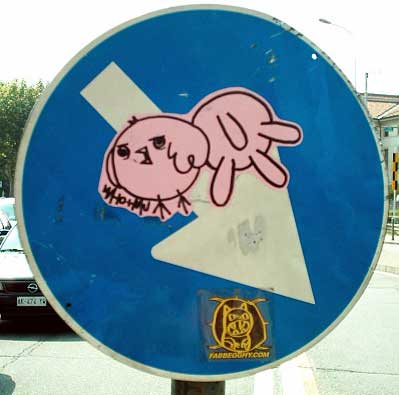
Cuddly birds and viruses – El Euro
Street art was possibly the best medium for commenting on the dramatic impact of the Covid pandemic. El Euro’s ‘Danza Macabra’ takes on the same name as the numerous frescoes adorning the walls of the ‘lazzzaretti’ or plague hospitals during the Black Death. His cuddly virus cartoons also infested numerous street signs.
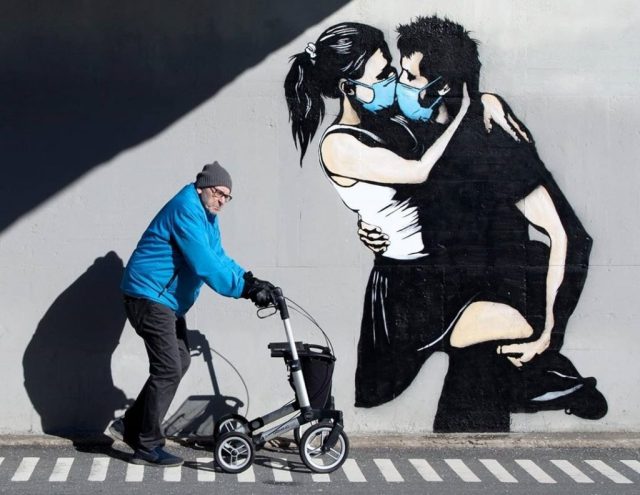
The power of street art,- attributed to French street artist Christian Guemy aka C215
Como’s Other Street Art
As noted in Danilo Vadis’s interview, streetart takes many forms. It was born out of a variety of interests with free scope for personal stylistic preferences and space for individual development. It never formed a collective or even a closely defined movement, more a collage of alternative forms of creative expression. And the streets of Como reflect that variety, ranging from our own anti-street artist, Mr. Savethewall, to the glossy, apolitical works of Pao and including the strange micro world of stickers and sticker bombing.
We interviewed Mr. Savethewall aka Pierpaolo Perretta back in July 2017. He is intrigued by the power and instant recognisability of iconic images, so much so that he has created his own – Mr. Frogman. Since 2017, Mr. Savethewall has met with commercial success as his frog prince has grown in popularity. He is definitely on the more commercial side of street art, so much so that he feels he has evolved beyond wall to canvas – thus ‘saving the wall’.

Mr. Savethewall’s commentary on the evolution of street art – from the street to the gallery.
Pao is similar in building up his reputation by developing a style that focuses on repeating a limited series of images. He has chosen penguins rather than frogs and has selected concrete bollards as the most suitable medium for his cutesy creations. His amazing output of penguin bollards included three in Como. They were located in Piazza Medaglie d’Oro and are still there but with their original bright colour coats from 2012 faded into obscurity.
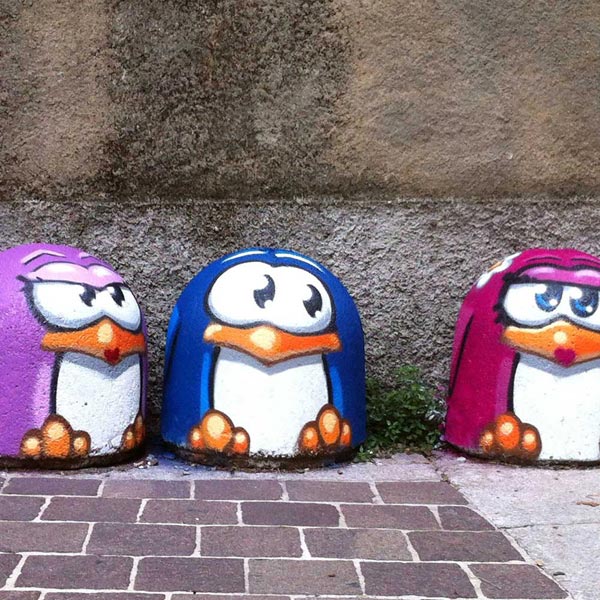
Cuddly art – Pao’s Penguins back before their colours faded like Ozymandias
Pao is also the creator of the mural that adorns the wall of the Ostello Bello on Via Fratelli Rosselli 9 facing on to the car park of the Carrefour supermarket.
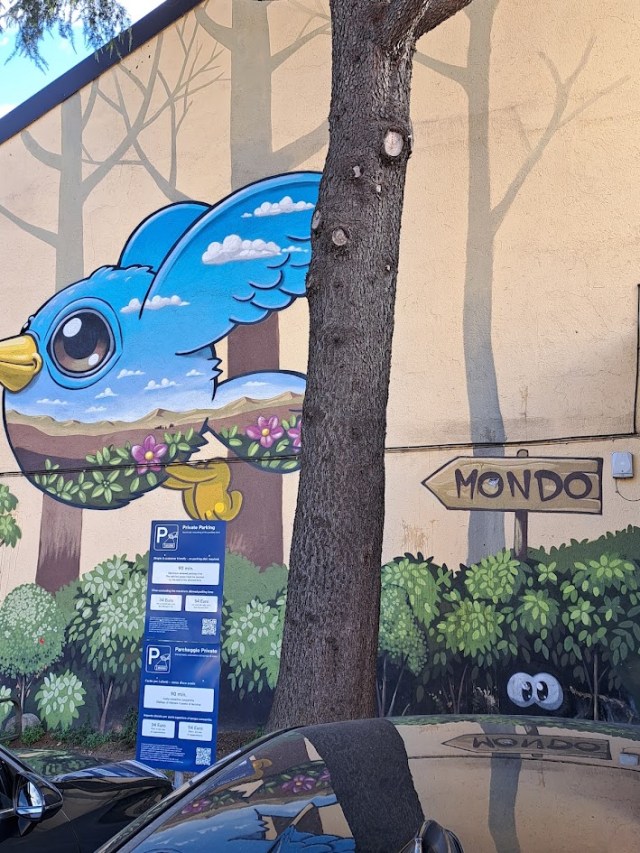
Pao’s mural on the wall of the Ostello Bello on Via Fratelli Rosselli, Como
This work is both signed and dated 2017 by the artist and is entitled “Whoever travels to discover new lands, discovers a world within themselves.” This is a most apt image on the wall of a building hosting travellers from all around the world.
Stickerbombing
Another somewhat strange form of street art is so-called stickerbombing, or seeking to cover the entire surfaces of a wall, window or street sign with stickers. This form of street art emerged in the 1990s alongside graffiti. Here below is a Como example of stickerbombing on the corner of Via Lambertenghi and Via Diaz.
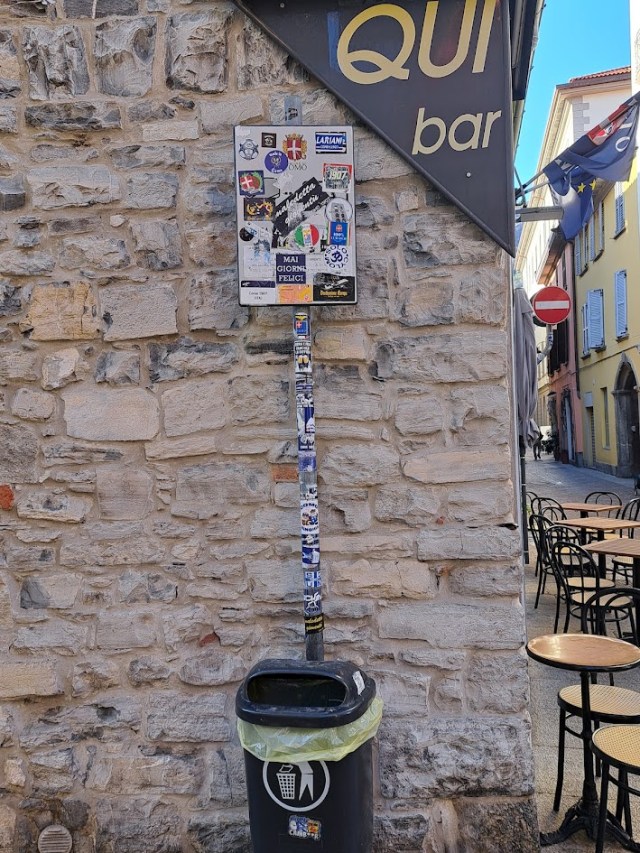
Stickerbombing, Como Via Diaz and Via Lambertenghi
Conclusion
Como has a rich tradition of artistic achievement which we have tried to cover in a number of our articles. It thus seems entirely apt that, even in the punk world of street art, Como should be so very well represented. We could even go as far as to suggest there is a ‘Como style’ of street art if not a Como school. The works of Blackwan, El Tilf et al have impact, sometimes pleasing or alternatively, unsettling but to be appreciated for their energy and originality. They are of course ephemeral in that those works outdoors will deteriorate over time and those indoors may themselves be destroyed if the art proves successful in calling for the regeneration of their liminal locations.
Undoubtedly thanks to artists like Banksy, street art has evolved from being considered vandalism to becoming an accepted form of artistic expression. Not all street artists have followed our Mr. Savethewall’s evolutionary trajectory with many we have featured remaining predominantly non commercial. Others have ‘saved the wall’ and entered galleries or else evolved a resolutely apolitical style that may still adorn public spaces but in an entirely innocuous way such as Pao. For my part and in spite or because of their somewhat disconcerting style, I very much prefer the work of those artists decorating the walls of the ex Tintostamperia in the Val Mulini, and I am certainly in whole hearted agreement with their support of the regeneration schemes they have helped promote. Access to the ex Tintostamperia is severely limited but I would recommend all interested in the work of these artists to visit their online presence at Disegni Matti (https://www.flickr.com/photos/disegnimatti/).
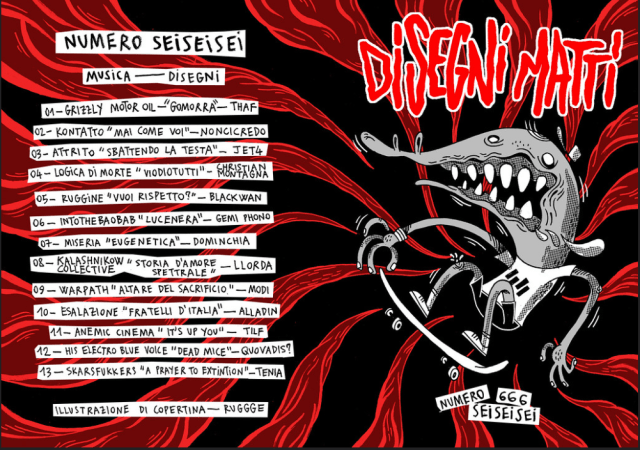
Disegni Matti – cover page for Issue 666
Further Reading
Our interview with Mr. Savethewall is at Mr. Savethewall – Como’s Spray-Can Artistic Campaigner
For more information on the renovation project for the Ex Tintostamperia., go to https://treincroci.com/
A photo collection entitled “Comostreetart” by Andrea Rosso, in collaboration with Gin Angri and Giovanni D’Apolito is published by ecoinformazioni and NodoLibri, 314 pages, €25
Urban Lives is a blog for those who want to discover more about street art with a series of interviews in addition to that with Danilo Vadis. https://urbanlives.it/
Blackwan’s Flickr Page: https://www.flickr.com/photos/theblackwan/
Danilo Vadis Facebook page: https://www.facebook.com/danilo.vadis/
Pao’s Instagram page: https://www.instagram.com/paopao_island/?hl=it
Refer to https://www.ekosystem.org/ for a database of street art by country, city and artist.
For more of El Euro’s images go to https://www.isupportstreetart.com/artist/el-euro/


Thank you for this interesting and thought provoking article. I had, perhaps like many others, dismissed graffiti / street art as something to be tolerated in our modern age. I once even ventured an opinion that, if one stood still long enough on any pavement in Milan, you yourself would be oversprayed by a graffiti artist! However, reading your article with an open mind made me reappraise the spectrum of cultural art, especially in those sites you have mentioned which are abandoned or exist in marginal spaces. In the right setting, probably not without permission across someone’s house in Freiburg, Germany, such art is often an interesting expression for all to contemplate. Best wishes and thank you again for your many articles.
LikeLike