On 26th September 2026, the public had a rare opportunity to visit the Pontificio Collegio Gallio in Como, as part of the series of initiatives entitled “Segrete Stanze” run by the Como delegation of the FAI (Fondo per L’Ambiente Italiano) . Organised by the FAI’s vice-head of their Como delegation, Tiziano Ramagnano, the “Secret Rooms” initiative provides an opportunity to visit places of historical interest, noble palaces and villas or other locations normally entirely inaccessible to the general public.
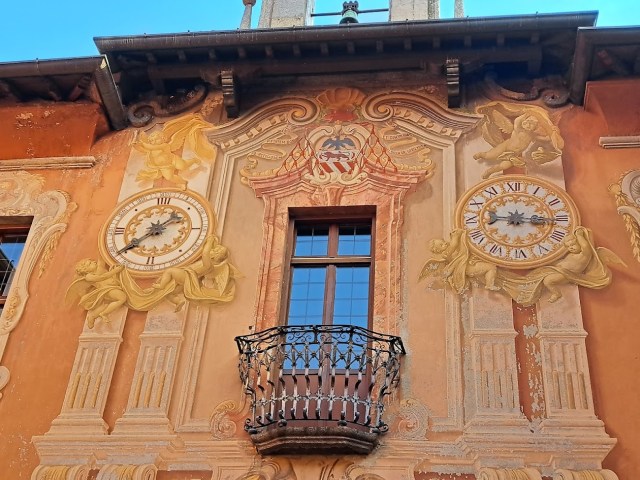
Balcony on the courtyard of the Collegio Gallio with the heraldic crest of Cardinal Tolomeo Gallio and the ancient double-faced clock
The highlight of a visit to the Collegio Gallio, an educational institution founded back in 1583 by Cardinal Tolomeo Gallio, is the rare chance to see one of the major works by Como artist Carlo Innocenzo Carloni – the fresco adorning the monumental staircase entitled ‘Hercules Introduced into Olympus’.
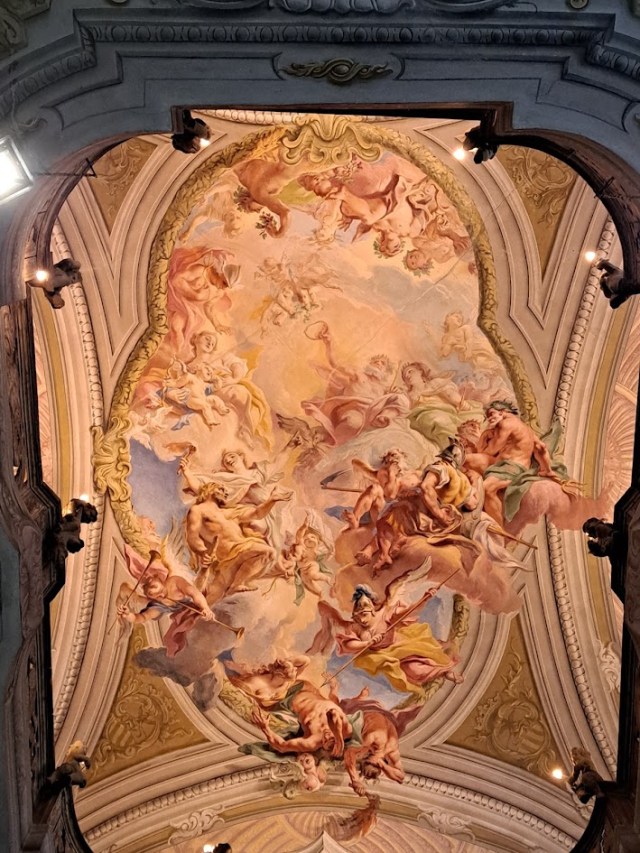
‘Hercules Introduced into Olympus’ by Carlo Carloni
Carlo Carloni (1687-1775) was just one of a group of accomplished artists and artisans originating from the Val D’Intelvi who have left their mark in noble palaces and churches across Italy and the rest of Central Europe. We have written previously in our article ‘Stucco and Scagliola’ about the remarkable concentration of creative talent to be found in the Val D’Intelvi within the late 17th and 18th centuries. Carloni’s father, Giambattista (1642-1721), his brother Diego (1674-1750) and himself worked extensively in decorating palaces and churches in Italy, Germany and Austria. However, from 1738, Carlo took up permanent residence in Como and focussed more on working locally within Lombardy and, alongside his brother, in bequeathing the richly redecorated parish church of Santa Maria in Scaria, the town of his birth in the Val D’Intelvi.
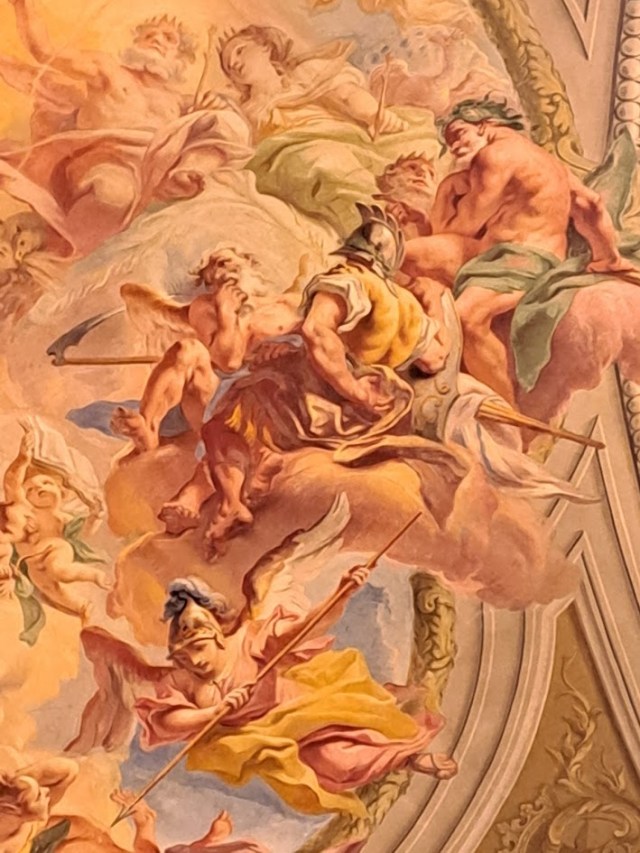
Detail from the ‘Hercules’ fresco showing Saturn, Mars and Poseidon with Athena-Nike below
By the time he came to settle in Como, Carloni had gained a successful reputation for himself on a par with the Venetian artist Giambattista Tiepolo (1696-1770) for exploring the lighter and airier Rococo style evolving from the late Baroque. Carloni had trained in his early years in Venice and, whilst never working directly with Tiepolo, he adopted some of the same palette choices and sense of space. They both followed a similar career progression undertaking commissions across Germany and Austria in addition to Northern Italy.
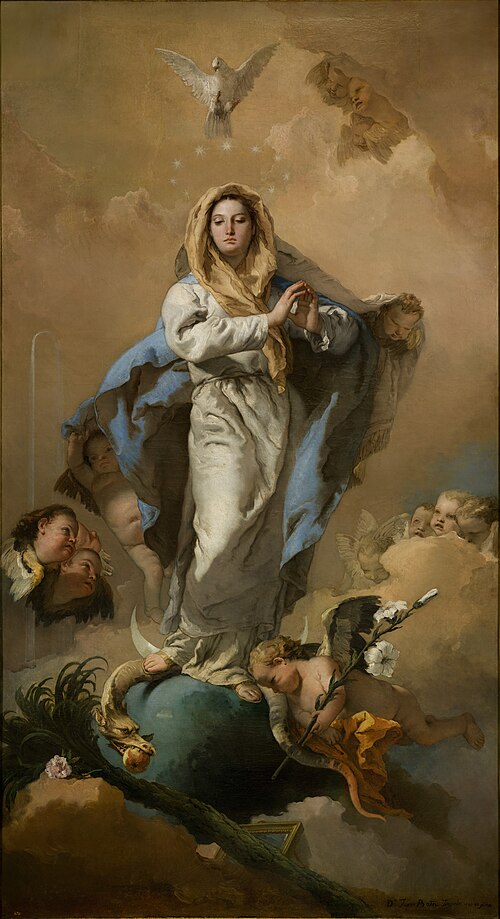
‘The Immaculate Conception’ by Venetian artist Giambattista Tiepolo, 1767-9
Returning to the Collegio Gallio, Carloni’s masterpiece fresco of Hercules is found on the ceiling above the the monumental staircase to the left of the building’s entrance. At the base of the staircase is a large wooden sculpture of Hercules by the Como sculptor Andrea Redaelli (1725). He is depicted with a torch in his left hand and his olive wooden club in his right. Originally the torch was an actual street lamp designed to illuminate Carloni’s fresco on the ceiling above.
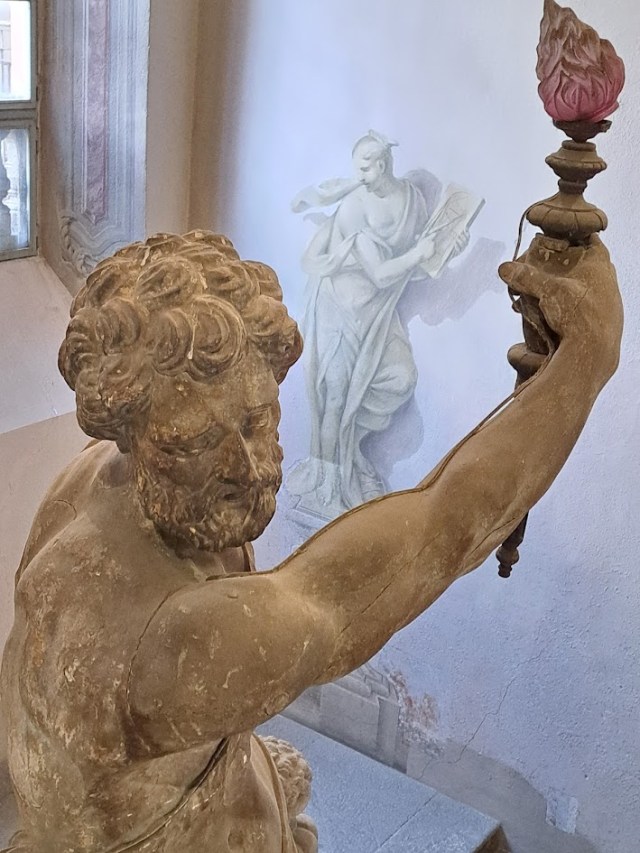
Wooden staue of Hercules at tthe base of the monumental staircase by Andrea Redaelli (1725). The figure on the wall represents geometry and is by Como-born quadraturist Giovanni Maria Giussani
Carloni’s original design was completed in 1726 but had to be redone in 1758 due to severe damage. The Collegio Gallio have records that show Carloni received 500 lire back in 1726 for the work with an additional payment of 220 lire for the later repairs. This sum would have represented about two years average wages for a skilled worker at the time.
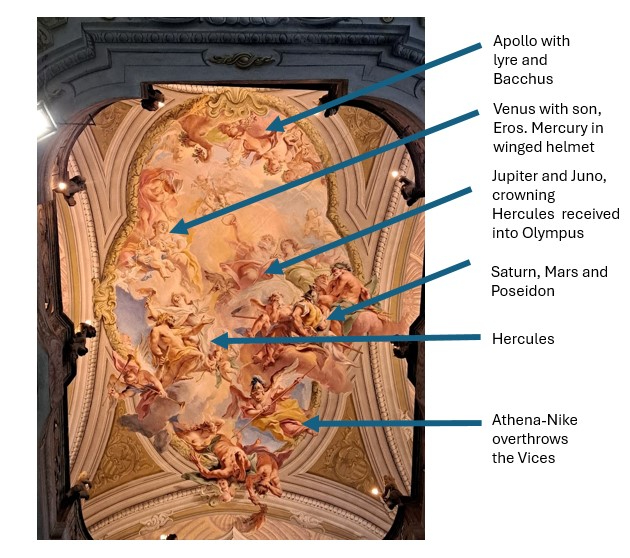
Diagram showing the separate elements of Carloni’s design
The diagram above breaks down ‘Hercules’s reception into Olympus’. To some extent it may seem strange that the Collegio Gallio, a Catholic institution, was prepared to commission a work illustrating pagan Roman mythology. However it would appear that the story of Hercules was an allegorical tale reproduced visually in many Italian, and particurlay in Viennese villas at the time. Carloni had worked in Vienna where he produced a famous fresco in the Upper Belvedere Palace again featuring Roman mythology in his representation of Prince Eugene as a new Apollo and leader of the Muses.
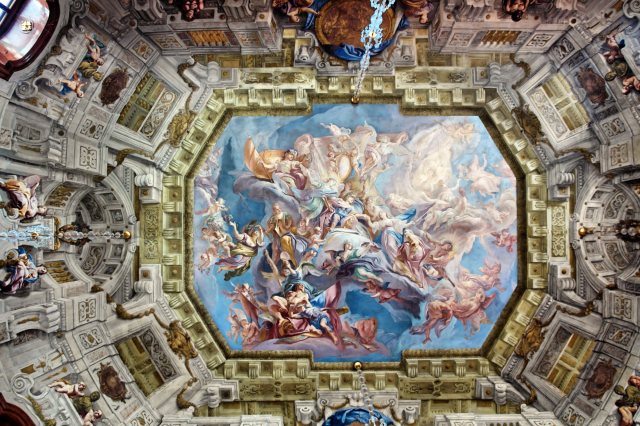
Carloni’s fresco in the Sala Carloni in the Upper Belvedere Palace in Vienna
The story of Hercules deciding to take the path of virtue in completing his twelve onerous feats of bravery thus renouncing vice and rewarded with marriage to Hebe, would have been an allegorical tale deemed entirely appropriate to the educational mission of the Collegio. Carloni had also produced other representations of Hercules’s acceptance into heaven with an oil on canvas in a private collection in Ticino, three drawings of Hercules welcomed by Hebe in a private collection in Munich, two versions of Hercules welcomed by Jupiter with one in Munich and the other in London’s British Museum and in addition, studies for his work in the Collegio Gallio including a ‘bozzetto’ (preliminary sketch) held in The National Gallery of Victoria, Australia and entitled ‘Hercules led by knowledge to Immortality’ – a title that confirms the educational message of the subject.
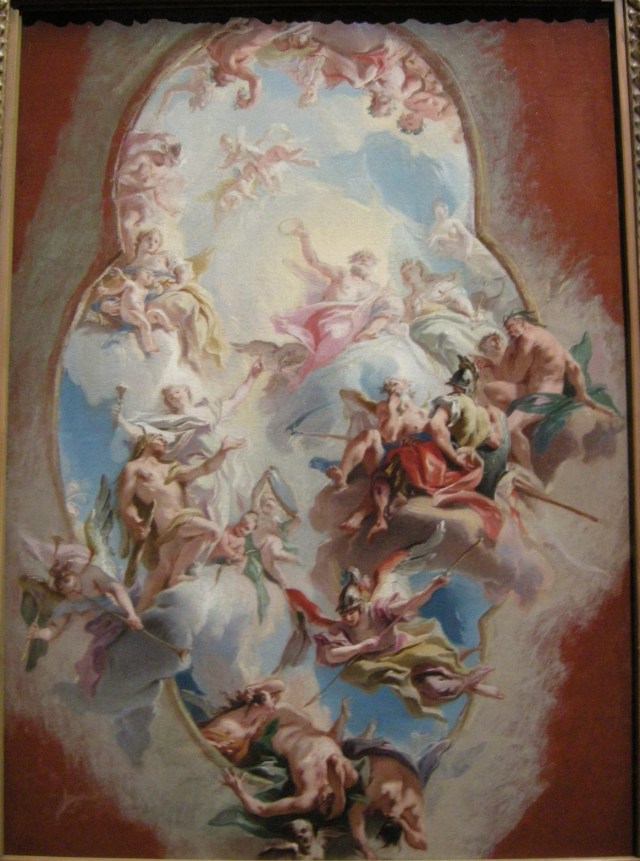
The ‘bozzetto’ of Carloni’s fresco in Collegio Gallio kept in the National Gallery of Victoria in Australia. It is an oil on canvas, 86.4 x 61.3 cm, dated 1726
There are other examples of Carloni’s work to be found in Como as in the Chiesa del Crocifisso on Viale Varese, the Chiesa di Sant’Eusebio on Via Volta and the Basilica San Fedele in Piazza San Fedele.
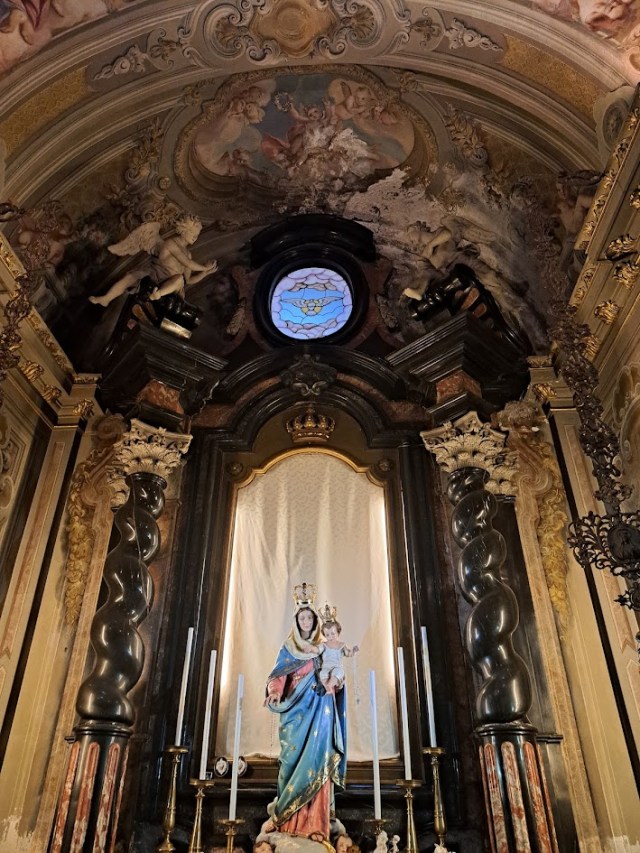
The altar showing the stucco work by Carlo’s brother Diego in the chapel decorated by the two brothers in the Chiesa del Crocifisso
Carloni’s work in the Chiesa del Crocifisso (whose formal name is the Santuario del Santissimo Crocifisso dell’Annunciata) was commissioned in 1725 when he and his brother, Diego, were entrusted to decorate the second chapel on the right known as the Chapel of the Most Holy Annunciation. Diego created all the stucco work while Carlo produced the artwork but left the framing and architectural trompe-l’oeil art to two so-called quadraturists, Carlo Giuseppe De Vincenti, known as Comaschino, and Giovanni Domenico Dobler.
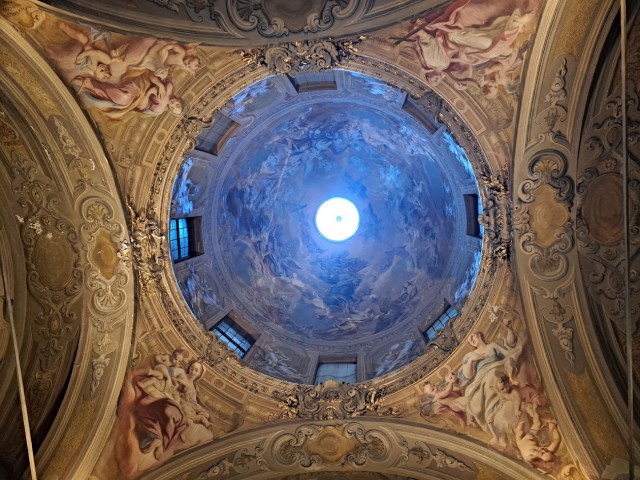
Carloni’s fresco in the Chiesa del Crocifisso showing the damage in the dome but the fine state of preservation below.
This photograph reveals the deterioration of Carloni’s fresco adorning the cupola but the quality of all the elements below remain well preserved. Unfortunately it is now difficult to appreciate his “Triumph of the Immaculate Conception and angels in glory” on the dome. Instead Carloni’s four pendentives on the corners of the dome representing Faith, Hope, Charity and Humility, the trompe l’oeil architectural effects, the stucco by Diego and the gilding are all in good order.
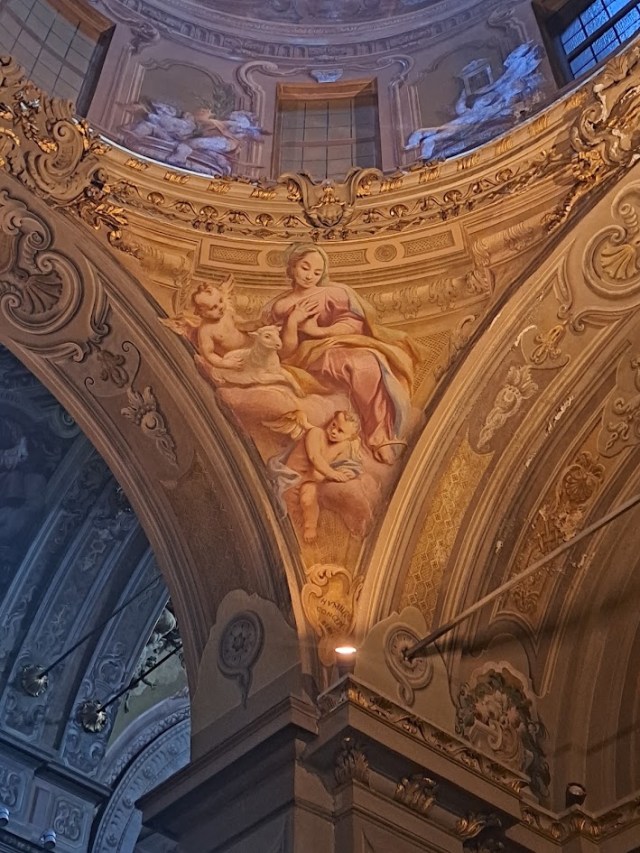
Carloni’s physical representation of Humility with lamb and trampled crown being one of the four pendentives representing four Graces.
The brothers Carlo and Diego also worked together on the decoration of the Cappella del Crocifisso in the Basilica San Fedele. Carloni is responsible for the four large oils on canvas depicting scenes from the passion of Christ while Diego surrounded the canvases in lavish stucco work. Carloni is said to have painted these between 1765 and 1767 but their darker, less airy style compared with the light Rococo of the Collegio Gallio suggests an earlier date. The Basilica San Fedele is almost always open for visitors but access to view Carloni’s work in the Chiesa di Sant’Eusebio is more problematic since the church is rarely open outside of religious ceremonies.
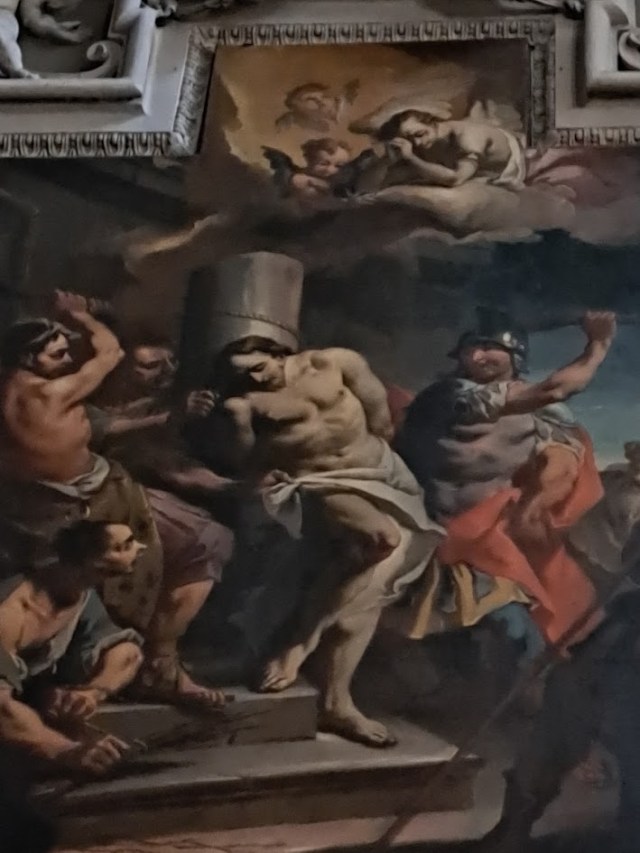
The Passion of Christ by Carlo Carloni, Basilica San Fedele, Como. Stucco work by his brother Diego
We are fortunate that Carloni’s work in the Collegio Gallio is so well preserved. Other examples of his work have recently been restored as in the case of two ‘affreschi strappati’ from the Villa Colleoni Capigliata in Calusco d’Adda. The two frescoes were removed from the walls of the Villa Colleoni in the 1950s, glued onto canvas and then installed to decorate the walls of the Palazzo Grassi in Venice. They were removed from display in the 1980s since their condition had deteriorated. It is only recently that they have both been restored and placed back on view. Carloni painted them from 1740 to 1745 taking as his subject scenes in the life of the Venetian condottiere, Bartolomeo Colleoni. The before and after images of one of these frescoes shown below depict the Condottiere Colleoni being received by Pope Paul II who had commissioned him to fight the Turks.
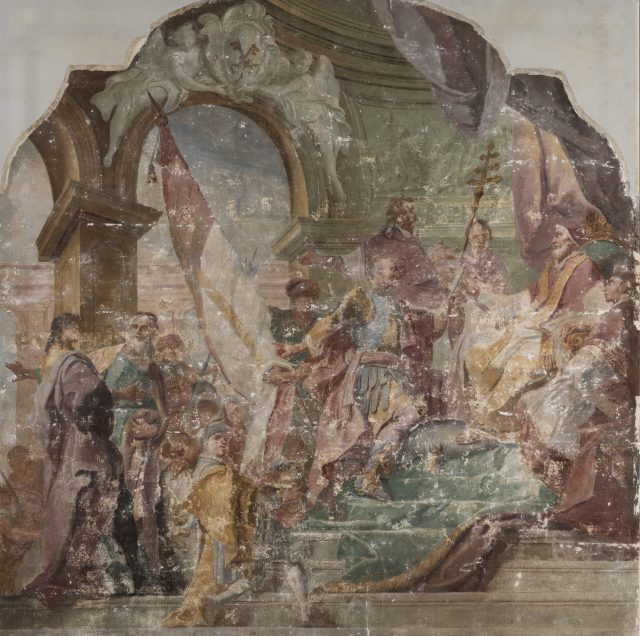
Before restoration: Carloni’s Bartolomeo Colleoni received by Pope Paul II, 1740ì1745
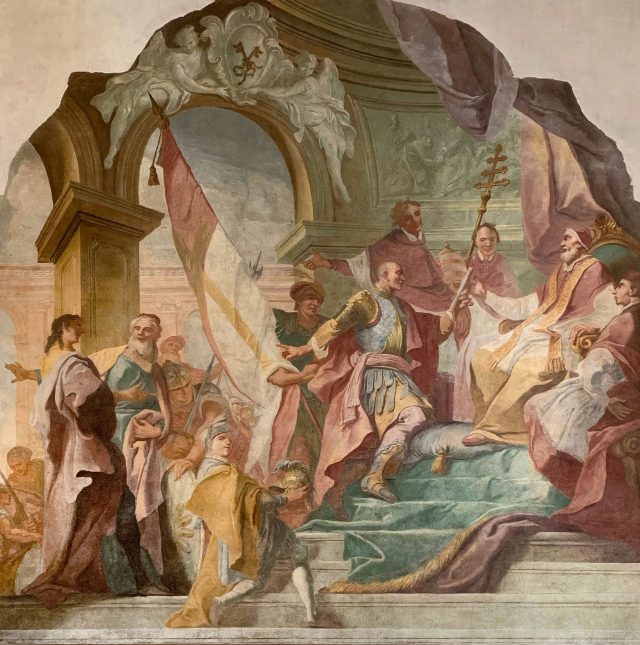
After restoration: on display at Palazzo Grassi, Venice
References
Le Anime di Carloni Mito, Allegoria e Fede, Tiziano Ramagnano La Provincia, 10/08/2026
Sheda FAI, Ponteficio Collegio Gallio, Tiziano Ramagnano
Further Reading
For more information about the Baroque artists from the Val D’Intelvi read Stucco and Scagliola – Two of Como’s Baroque Specialities
For more on Como’s baroque legacy read, Early Lombardy Baroque: Fratelli Recchi and Como and Early Lombardy Baroque
For more on the rooms made public by the FAI in the series of ‘Stanze Segrete’ read Como’s Hidden Gems – Palazzo Rusca, Palazzo Olginati Rovelli and Palazzo Vietti Rovelli


Such an interesting article. How I wish we could spend more time in Como and take part in these guided walks. We have always loved the fantastic trompe l’oeil on the front of that building but what amazing paintings are inside it!
LikeLike