
There is one architect in particular whom we should credit more than any other for influencing the way Como looks today. He is Federico Frigerio (1873-1959) who moved to Como soon after graduating from the Politecnico di Milano in 1896. He then worked incessantly from 1897 until 1945 producing or renovating many of the most significant buildings in the city’s historical centre. His influence on how the centre looks to this day is immense but, for all that, he remains relatively unknown.
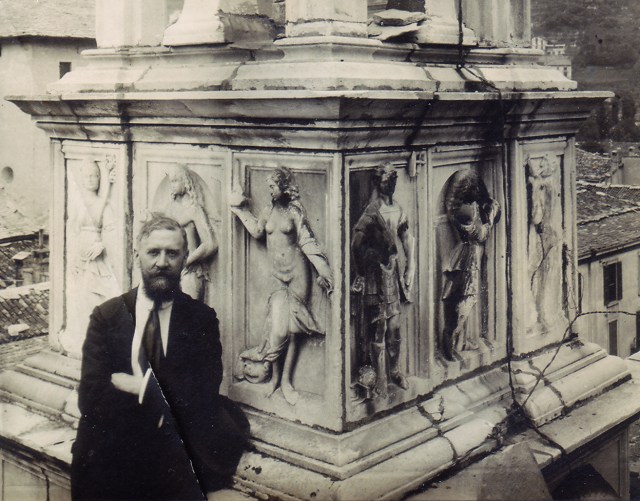
Federico Frigerio in front of the cathedral in Piazza Duomo
In terms of fame, Frigerio has undoubtedly been eclipsed by his contemporary Giuseppe Terragni, the rationalist architect of the Casa del Fascio. Terragni’s legacy is perhaps more immediately visible due to its revolutionary nature and its contrast with the predominant ‘eclectic’ style of the day. Frigerio was as revolutionary as Terragni in terms of technique and also adopted contemporary aspects of style but only those that respected tradition or sat unobtrusively within their immediate environment.
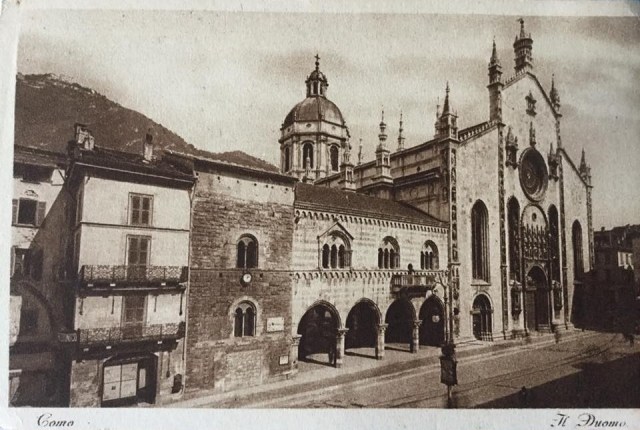
Piazza Duomo and Piazza Grimoldi before Frigerio’s vision of clearing the old buildings backing on to Piazza Grimoldi and thus freeing up the Broletto (and restoring its bell tower) and opening up the view to Chiesa San Giacomo.
Piazza Duomo and Piazza Grimoldi
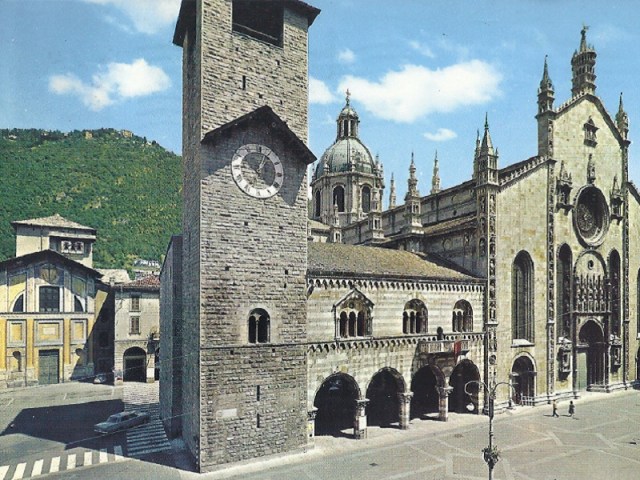 The way we see Piazza Duomo and the attached Piazza Grimoldi today is mostly thanks to Federico Frigerio. The illustration below marks each of his changes and interventions.
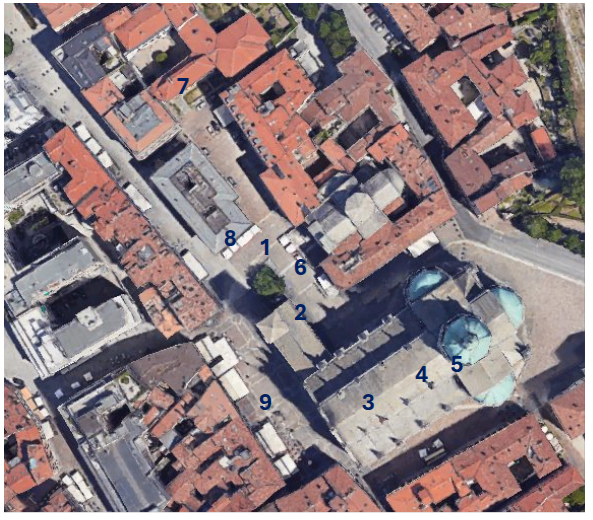
See below for the list of Frigerio’s interventions in Piazza Duomo and Grimoldi.
Frigerio’s greatest impact on the face of the city is at its heart – in Piazza Duomo. Over the years he personally transformed it and the accompanying Piazza Grimoldi. No. 1 – He opened up Piazza Grimoldi by pulling down the buildings attached to the Broletto. No. 2 – He then set about restoring the Bell Tower of the Broletto, ridding it of all non original features. No. 3 – He saved the Rose Window on the facade of the cathedral which was bowing out and threatened to collapse, putting at risk the whole of the cathedral’s facade. No. 4 – Along with other restoration inside the cathedral, he arranged for the hanging of the large Flemish tapestries down both sides of the nave. No. 5 – He restored the cupola of the cathedral following a fire in 1935, again returning it to its original design. No. 6 – He redesigned the facade of the Chiesa di San Giacomo. No. 7 – He worked on the interior courtyard of the Bishop’s Palace relocating stonework from the demolished monastery of San Giovanni Pedemonte and then redesigning the front of the palace in 1940. No. 8 – He designed the Banca Commerciale Italiana (later Cariplo Bank and now Emporio Armani) in a neo-renaissance Tuscan style in 1923 with building work completed in 1927. No. 9 – He redesigned the Caffé Bottegone in Liberty style.
Caffé Bottegone
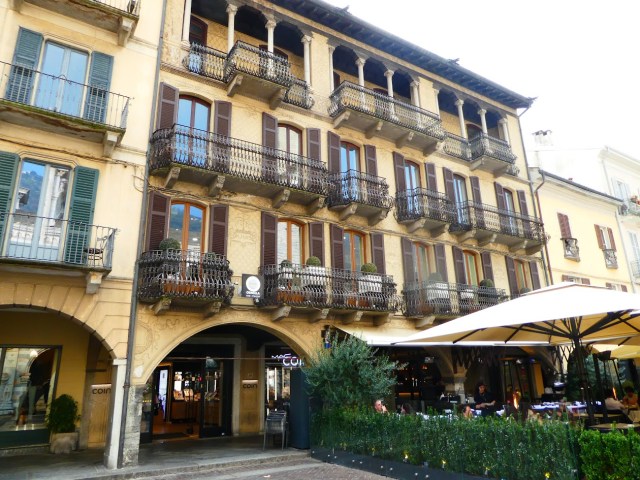
Caffè Bottegone, now the Cafè Da Pietro
The design in 1905 of the Caffé Bottegone (now spanning the entrance to Coin and the Cafè da Pietro in Piazza Duomo) is a great example of Frigerio’s ability to innovate in harmony with tradition. The modernity of his structure in the city’s principal piazza was a statement of Como’s growing confidence in facing the future. It was immediately adopted as a gathering for the city’s artists and writers. His continuation of the portico seen through the ground floor arches integrated the building with its more elderly neighbours whilst its Liberty styling on the floors above marked its modernity. It is just one example of his ability to combine innovation with tradition – a trade mark skill he would deploy in many other instances across the city in the coming years.
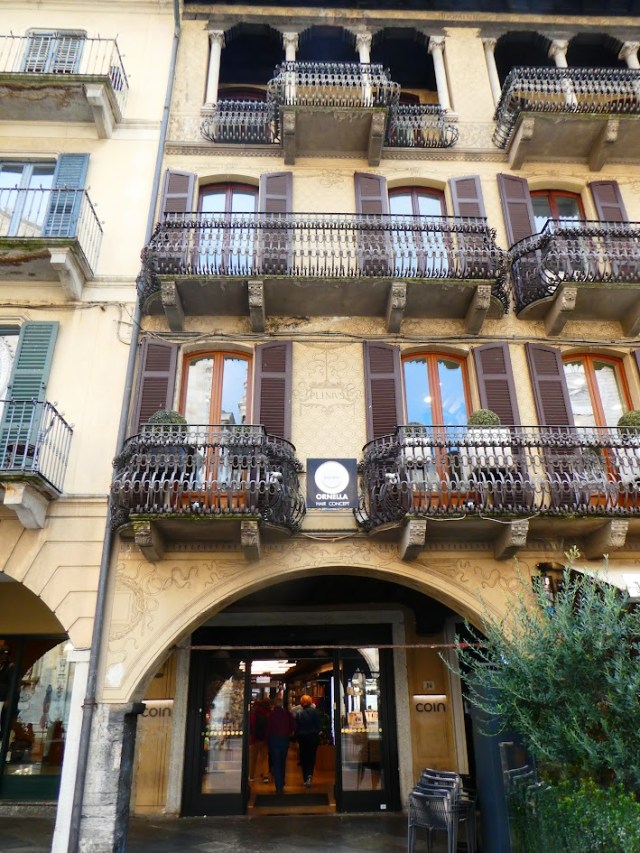
Caffè Bottegone – the arches of the portico provide continuity whilst the Liberty styling above showed modernity and innovatuion.
For the last seven or eight years, the ex-Banca Commerciale Italiana has remained closed ever since Cariplo closed its doors. Recently it has reopened as the new site for Emporio Armani which has now moved out of Piazza Cavour. Its the sort of shop that provides a generous floor space for each article on sale, signalling the fact that prices are high. The interior has undergone a total restoration of Frigerio’s original decorations and, fortunately, the staff are happy to see people enter purely to view them in their splendour without any other obligation.
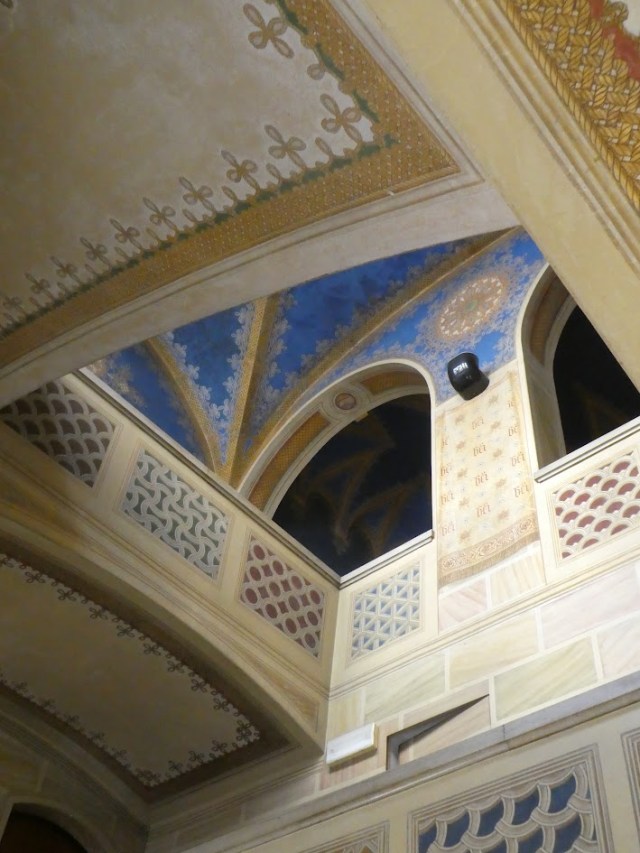
Staicase inside the ex-Banca Commerciale Italiana
The Politeama and Tempio Voltiano
Beyond the ‘Centro Storico’ there are two particular structures for which Frigerio is justifiably renowned. The Politeama, facing on to the Piazza Cacciatori delle Alpi, was built in 1909 and was the first building in Como to be constructed with reinforced concrete – a technique that had only been recently developed. Unfortunately the Politeama has been left closed since 2005 and both its interior and exterior require extensive renovation. It was, however, a revolutionary building in its day designed to provide a venue for popular entertainment including cinema and for housing exhibitions. It also contained a hotel and a restaurant. The building is owned by the town council who would like to find partners prepared to fund its restoration. An original photo of the interior shows just how splendid the building was at its inauguration.
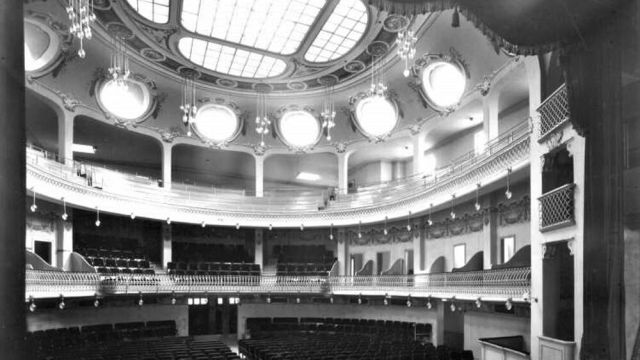
The interior of the Politeama
Two structures, both close to each other, dominate Como’s western section of the lakefront . One is Giuseppe Terragni’s War Memorial (1931-2) and the other is Federico Frigerio’s Tempio Voltiano (1925-8). The Tempio Voltiano was conceived to honour the work of Como’s most famous son, the scientist Alessandro Volta. It was financed by a local entrepreneur, Francesco Somaini, as a memorial to celebrate the centenary of Volta’s death in 1827. The heart of Frigerio’s design is neo-classical with the addition of various external decorative features which had become his trade mark. He is said to have taken inspiration from Rome’s Pantheon as an appropriate model for the commemoration of a famous figure such as Volta. It houses various artefacts associated with Volta’s research into electricity and the development of batteries.
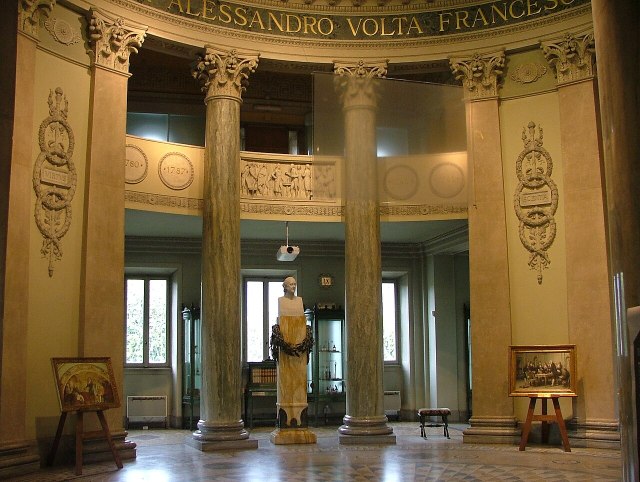
Interior of the Tempio Voltiano
As with the Politeama, Frigerio used reinforced concrete at the heart of the building’s structure which may explain why it lacks a degree of delicacy in its proportions that are commonly associated with neoclassical design. This heaviness is evident when compared with another neoclassical structure dedicated to Volta – his funereal vault in the cemetery at Camnago Volta.
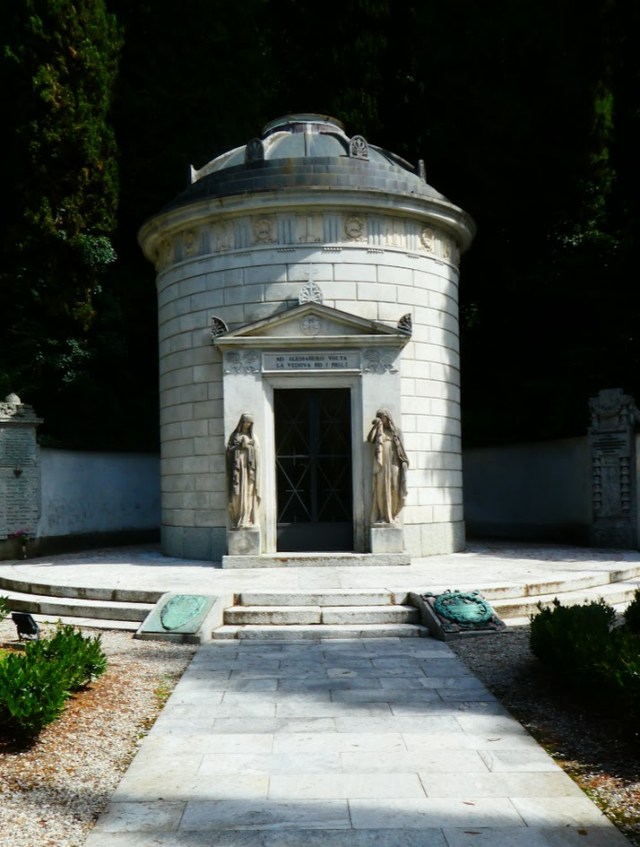
Volta’s tomb in Camnago Volta. Designed kikn 1831 by Melchiorre Nosetti
A Federico Frigerio Itinerary
Frigerio’s influence on the face of Como is almost all around us given his works of restoration, architectural design and external and interior decoration. But the following itinerary would give a good indication of the range and quality of his influence on his adopted city. The itinerary starts off opposite the Como Borghi train station and continues northwards to finish in front of the Palace Hotel on Como’s lakefront.
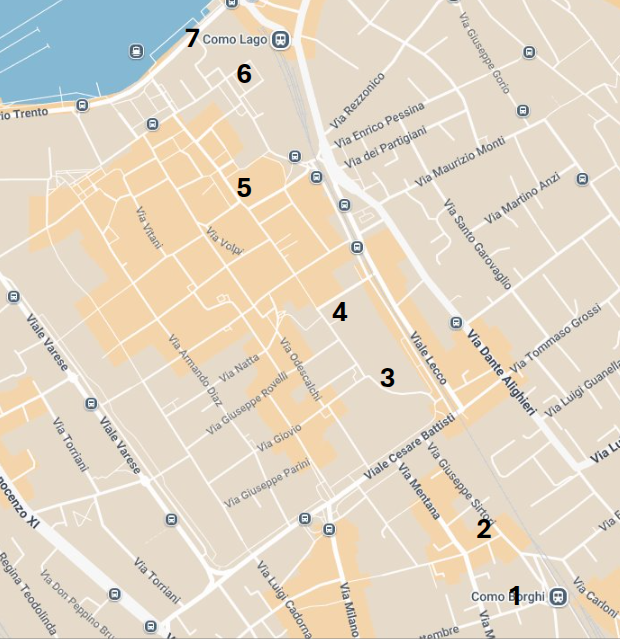
A Federico Frigerio Itinerary starting from Como Borghi to the Palace Hotel
No. 1 – Frigerio was the architect of the Casa Cattaneo (1910) in Piazzale Gerbetto opposite Como Borghi railway station. No. 2 – He designed the school ‘Magistri Cumacini’ in 1945 on the corner of Via Sirtori and Via Giulini. No. 3 – He was responsible for the presentation of the series of archeological remains in the Museo Archeologico (which unfortunately is still closed due to work on restoration). He was also responsible for the study and excavation of the Roman Porta Praetoria, close to the Porta Torre and in the basement of the Liceo Scientifico Alessandra Volta. No. 4 – He designed the building that now houses the Ufficio Postale on Via Vittorio Emanuele on the corner with Via Pertini. Originally this was the site of the Società Banacaria Italiana. No. 5 – Piazza Duomo and Piazza Grimoldi. See the account above of the various works by Frigerio in this principal piazza at the heart of the old town. No. 6 – Turn off Piazza Roma on the corner of the Just Art Cafè down Via Rodari to view Frigerio’s own home at the end of the street on the right. No. 7 – One of his first commissions was designing the exterior decoration of the Hotel Palace (then called Hotel Plinius). He also designed the interior and exterior decoration of the adjacent Albergo Terminus.

The doorway to the home of Federico Frigerio in Via Rodari
This is by no means a complete list of Frigerio’s work in Como but will hopefully give an idea of the quality and quantity of his various commissions. He perhaps more than anyone else over the last 200 years has had the greatest impact on the face of the city’s centre. His eclectic style may not be to everyone’s taste but it is hard to deny that his transformation of Piazza Duomo was a massive improvement. Along with these changes and the addition of the delightful Caffé Bottegone, he gave the city the confident face to confront its touristic future, and to celebrate its cultural past.

Tempio Voltiano, designed by Federico Frigerio and constructed from 1925 to 1928
Further Reading
Best source of further information on Federico Frigerio is local author Fabio Cani’s book ‘Federico Frigerio: Il lato tradizionale del nuovo‘. Published by Nodo Libri 2015.
Como Companion has articles on Giuseppe Terragni and the other rationalist architects as follows: Como’s Rationalist Architecture 1: Around the Stadium and Como’s Internationally Renowned Urban Visionary.
Como’s potential for cultural tourism is explored in Como: The Potential for Cultural Tourism.


 The Como Companion
Thank you again for a most interesting and useful post. As I walk through Como it will be all the more attractive by knowing a little about the man behind the architecture – David.
LikeLike
Thanks as always for your support
LikeLike