

Via Milano looking south with the bell tower of San Bartolomeo in the background
Given the charms of Como’s historical centre and the attractions of the lake, there may seem little reason for residents and visitors alike to venture beyond the city walls. But a stroll down Via Milano offers a fascinating and enlivening experience – one that could even be economically worthwhile. Via Milano is a mixed environment, with shops, cafes, restaurants, residences appealing to a broad range of tastes and budgets. In contrast, the historic centre’s commercial interests are becoming focussed on a closely defined and restricted range of customers. This ‘exclusivity’ is directed primarily at visitors rather than residents. Its ‘econocentric’ development in shops, housing and food is heading towards creating a living museum – beautiful but soulless. A trip down Via Milano is so stimulating because it has all that the historical centre is losing – variety, choice, contrasts, vitality and diversity. It is alive and energising. If the historic centre can be symbolised as a beautiful quiet Monet-style lily pond, then Via Milano is a fast flowing trout stream!
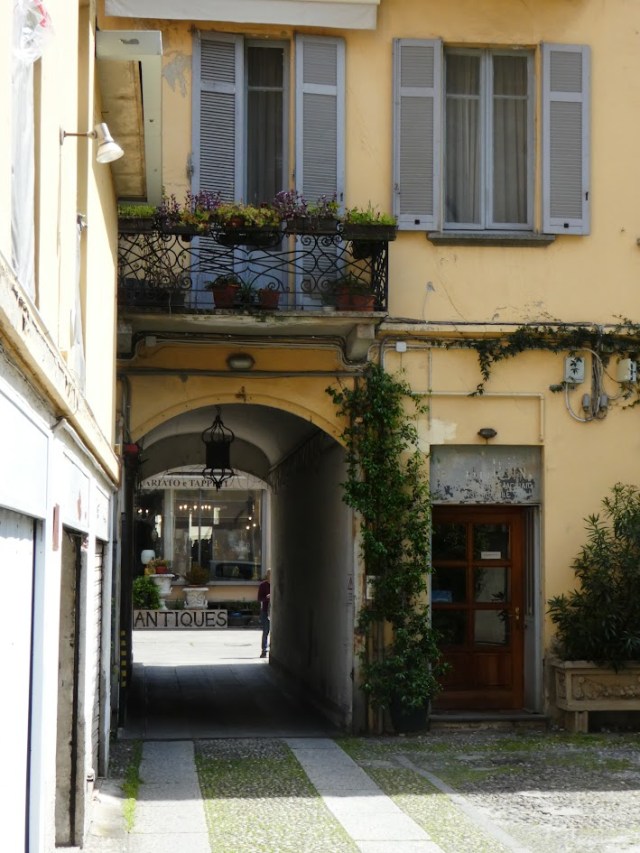
The eastern side of Via Milano is characterised by deep courtyards extending up to 100 metres back. This one houses an antiques shop at its base.
Just Taking a Stroll
You do not need an ostensible reason for visiting Via Milano. Just going for a stroll is cause enough since there is much to appreciate in just walking up the street and diving down any of the alleys or into one of the many courtyards. I recommend starting by walking up the east side under the porticos of the Le Due Corti Hotel.
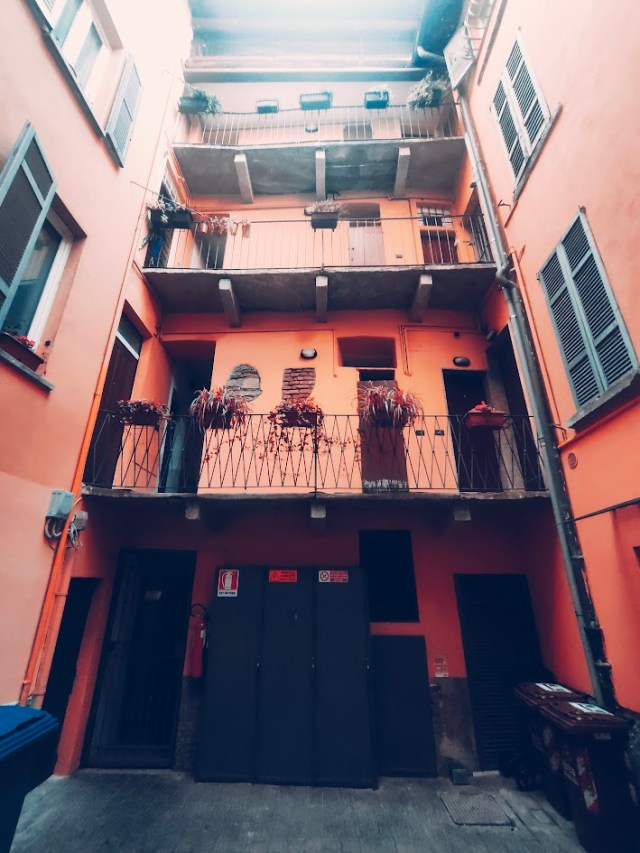
Casa di Ringhiera – traditional workers and artisan housing, Via Milano
Most of the building on this side is as old as in the historic centre but the absence of any grand urban villas or palazzi allows space for more humble residences including traditional ‘case di ringhiera’ characterised by balconies (ringhiera) shared by inhabitants. In the past these apartments would also have shared a single outside toilet placed at the end of each balcony. Many of the courtyards extend back almost 100 metres.

The northern end of Via Milano, the porticos below Le Due Corti Hotel
Via Milano’s urban environment is, like most of the city, in a state of constant evolution, but one that presently seems to be keeping modernity and tradition in fine balance. Whilst some of the older buildings are going through radical renovation and will undoubtedly go on the market at a high price, there are many others that remain more affordable. Rents for commercial properties are lower than in the historical centre and lower still for those found within the courtyards.

BLUE – shops, RED – Restaurants, YELLOW – history, GREEN – strolling
This means that some of the older commercial establishments are not being forced into closure but new independent units can afford to start up. A specialist independent wine and spirits outlet such as Enoteca CM Vini, located down a courtyard linking Via Milano with Via Cadorna, can afford to sacrifice passing footfall in exchange for a cheaper rent – and then rely on developing a reputation for quality of service to attract and retain their customer base. This is not to say that the same principles are not applied in the historic centre. – but not by all. There are those whose clientele are mainly transitory who have realised that quality is optional. They only need to promise without needing to deliver.
A stroll down Via Milano is in itself rewarding but there are more definite reasons for visiting either for shopping, eating or absorbing aspects of local history, as I hope to show.
Visiting to Shop
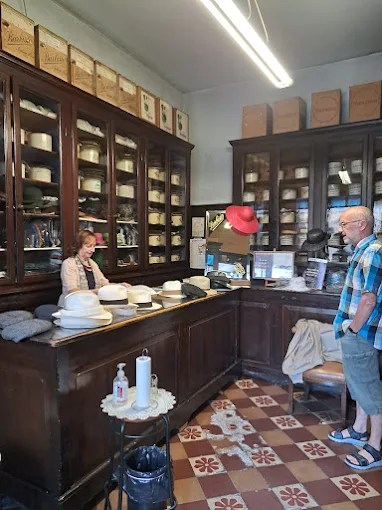
The interior of the Cappelleria Rossini – a shop founded in 1897 and entirely dedicated to the sale of hats.
The shops down Via Milano are a true mix, with a number of traditional and long established establishments such as the bread shop ‘Ul Pan de Com’ established in 1927, the Cappelleria Rossini in 1897 or Bogani art supplies in 1933. Yet there are also a number of much newer establishments such as the Enoteca CM Vini already mentioned or the singularly esoteric Japanese import emporium, Shin Crazy Comics.
For clothing, another branch of the ubiquitous upmarket Tessabit chain stands alongside the traditional less glamorous but certainly more practical and economic Zio Ghelfi, whose exterior is a reminder of the look of Italian high streets in the 60s or 70s.
Take a break from window shopping by stepping into the café-bar called Trani for a coffee in elegant surroundings.

Interior of the Trani Caffé specialising ikn products from Puglia
They specialise in pastries and other goods from Puglia and, as a relatively recent startup, bear witness to Via Milano’s capacity to allow independent commercial enterprises to establish themselves alongside their longer term neighbours. If Trani does not attract you there are a good number of alternative cafés along the street to tempt you in.

Zio Ghelfi, old style clothing shop alongside Tessabit.
Visiting to Eat
There are sound reasons for visiting Via Milano just to eat. Whilst the lake front may offer a very tempting location, few of the restaurants offer quality at an acceptable price. Via Milano offers economy and, its particular advantage, diversity. Whilst fixed price ‘Menu del Giorno’ deals are hard to find in the centre, they can readily be found along Via Milano. For example, the Ristorante Paradise has a range of midday formula on offer for those looking for traditional Italian cuisine or pizza.

Ristorante Pizzeria Paradise – not pretty but
Koi Ramen, the only Japanese restaurant in Como specialising in ramen noodle bowls, offers midday menus all served in their Hello Kitty style dining area – or even deliverable within the historic centre. Alongside this restaurant and the Shin Crazy Comics store, there is yet another Japanese establishment, Panfuwa, offering sweet and savoury soufflé pancakes.
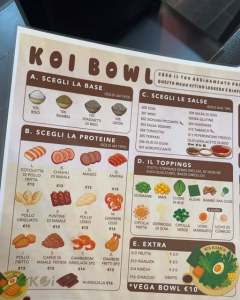
Advice at Koi Ramen on how to put together your ramen dish.
Traditional Italian dishes are served at the Enoteca 84 or at the nearby more upmarket Trattoria L’Antica on Via Cadorna.
For those visiting Como on a strict budget I would recommend they take full advantage of whatever breakfast is available if staying at a Bed and Breakfast, then strolling up Via Milano at midday for a Menu del Giorno of their choice. They might again return to Via Milano in the evening for an aperitif at Bar Tulipe where the cocktails are served with a selection of snacks described most frequently in the online reviews as ‘abundant’ (12 euros for lunch and 9 euros for ‘apericena’).
The diversity in the offer on Via Milano increases the further south you walk, particularly once you cross over the traffic lights beyond San Bartolomeo Church. Here you will find the Taj Mahal and Kashmir restaurants, and at the top end of the street near San Rocco there is a Nigerian restaurant called Jollof Lake Como run by the very welcoming Linda. As she states, her restaurant is the only Nigerian restaurant between Milan and Como.

Jollof Lake Como, run by Linda offering Nigerian and West African cuisine.
Visiting the Past

Francesco Capiaghi, ‘After the surrender 22nd March 1848
If strolling just beyond the Porta Torre at Piazza Vittoria, back on 22nd March 1848, we would have witnessed the surrender of the Austrian garrison to the committee that had organised the patriotic revolt in Como – the so-called Cinque Giornate (5 Days). Scenes from that surrender ceremony are depicted in the bronze panels around the base of the statue of Garibaldi in the middle of the piazza. Como’s rebellion was repeated also in Milan and Brescia but did not result in any lasting independence for Lombardy.

Via Giulini, the trattoria used to treat citizens wounded in the Austrian attacks on 21st March 1848
The day before the surrender, the 21st March 1848, the Austrians had broken out of their barracks and gave chase to the Como citizens up the length of Via Milano. Many civilians were injured and taken for treatment to the restaurant subsequently named the Trattoria di Soccorso on Via Giulini, more recently named L’Ultimo Caffé. This trattoria was still functioning up to three or four years ago but now lies vacant awaiting a fresh reincarnation.
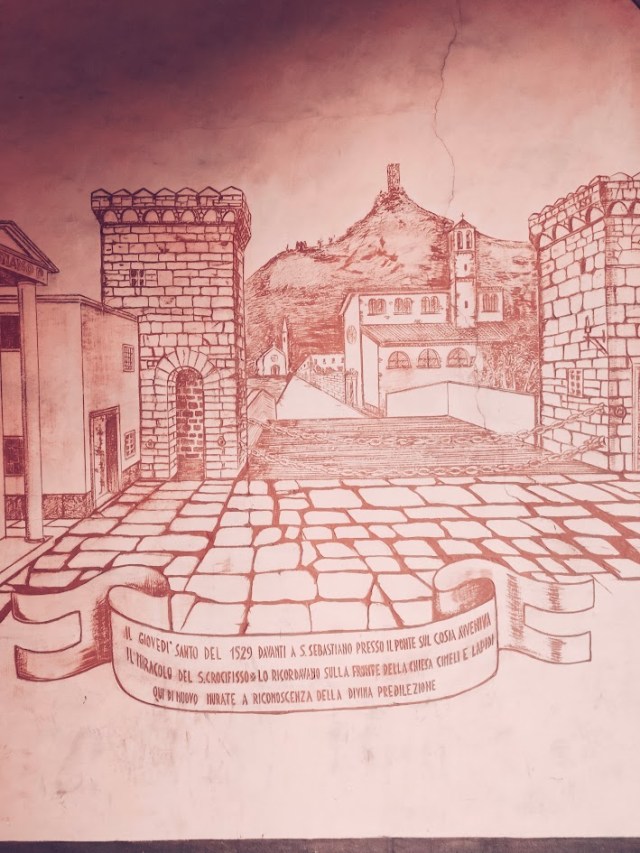
Mural within the court of the San Bartolomeo Church depicting the scene of the Anello del Miracolo. The scene is looking south across the bridge crossing the River Cosia with the Convent of Santa Clara on the right (no longer present) and the demolished church of Saint Protasio in the distance.
At the bottom end of the road, when we reach the Church of San Bartolomeo, we arrive at another site of historical (or mythological) interest. On the 25th March 1529, the annual Holy Thursday procession carrying the ancient crucifix housed in the Santuario del Santissimo Crocifisso in Viale Varese was halted at the bridge over the Cosia just south of San Bartolomeo. Further progress out of town to the Convent of Santa Clara (now just the name of a bus stop) was barred by a thick chain placed there by the Spanish authorities. Its purpose was to prevent French cavalry from crossing the river from the south to attack the city. The guards refused to remove the chain and merely suggested that the procession could proceed by ducking under. As the crucifix was lowered, it seemed to cause the chain’s housing in the pillars to shatter and thus allow the procession to continue unimpeded.

The Anello del Miracolo attached to a pillar on the outside of San Bartolomeo.
This supposed miracle went to reinforce the local population’s belief in the special powers of the crucifix in protecting the city. The Santuario S.S. Crocifisso in Viale Varese, which still houses the crucifix, became the site of a cult that gained adherence across Lombardy and the Canton Ticino that persists to this day. The crucifix was further adorned with a golden crown in a ceremony conducted by Milan’s Archbishop Schuster on 17th June 1945 giving thanks to the power of the Crucifix in saving Como from any effective bombardment during the war. (See also the cult of Saint Barbara who was also credited with the same power.)
Conclusion

@Comocomera, 19th century view looking north towards the city centre from outside SAn Bartolomeo
Via Milano’s commercial establishments do seem particularly friendly and welcoming, possibly because they are flattered by the effort any visitors have made to take themselves beyond the historic centre. I believe that effort is well worthwhile, not just because of the variety on offer on Via Milano but because of its contrasting vitality and atmosphere with the historic centre. Its balance of innovation and tradition reinforced by its diversity tend to highlight what the historic centre risks losing in its evolution towards a living museum. Urban environments are of course in a state of continual change but right now Via Milano seems in a more healthy condition than Como’s historic centre suffering under the pressure of increasing real estate and rental values. Some might argue that this increase in wealth has at least allowed for the renovation of a number of the old palazzi in the centre and this is adding to its overall aesthetic attraction, but these new residential units are destined for use by a transitory population who will only go to reinforce the trend towards a one market economy. Finally, to strain even further the stream and pond metaphor, the lily pond will undoubtedly continue to appear increasingly pretty but the still waters may atrophy unless charged with the clean fresh waters from its neighbouring chalk stream tributary. Viva Via Milano!
Further Reading
Read Como – Its Role in the Birth of a Nation for an account of Como’s Cinque Giornate.


 The Como Companion