

The charm and beauty of Lake Como
Covid dealt a blow to tourism throughout 2020 and 2021, only allowing for a reduced season from June in 2022. The restrictions on travel over this prolonged period created a pent up demand that saw record numbers of tourists visiting the lake in 2023. Expectations are high this year of achieving similar results but last year’s success has brought its own challenges. What is more, the traumatic restrictions on liberty over Covid lockdown seem to have had an impact on what visitors now look for from a holiday. Lake Como’s natural charms are secure but does Como possess the necessary infrastructure, professionalism and will to meet the challenges of success, to safeguard and publicise the qualities of the ‘brand’ and to satisfy the evolving demand for ‘experiential’ tourism?
The Impact of Covid
Lombardy was the worst affected region in Italy to be impacted by the Covid pandemic. Within the region, the province of Bergamo suffered the greatest number of fatalities. The mortality rate in the province of Como was less but tourism here was hit badly since it receives a high percentage of foreign visitors and their travel was more restricted than domestic visitors during the brief periods when lockdown measures were eased.

Table A (top) shows numbers of domestic visitors to Lombardy in 2019 (dark blue) and 2020 (light blue). Table B shows numbers for foreign visitors.
Table A above shows the figures for domestic visitors to Lombardy in pre-Covid 2019 (dark blue) compared with 2020 (light blue). Table B makes the same comparison but for foreign visitors. Domestic visitors even managed to achieve similar numbers in August 2020 to the same period in 2019 but this was far from the case for foreign visitors. Eight out of ten visitors to the province of Como come from abroad.
The Recovery
Last year, 2023, saw a massive recovery in visitor numbers across Lombardy with a 25% increase compared with pre-Covd 2019. Lombardy had 51 million visits of which 44 million stayed overnight. Of the overnighters, Milan was the most popular destination with 18.8 million total nights followed by Brescia with 13.1 million. The province of Como came third with 4.6 million closely followed by Sondrio with 4.4. million. Whilst foreign visitors to Milan represented 66% of the total, the figure for Como was 85%.The average length of stay in Como falls below the regional average at 2.7 days (2022 data) which shows little improvement over the 2.5 days registered back in 2014.

The lake retains its charms over the usually dry and sunny days of mid winter.
Day visits to Como – either by foreigners staying elsewhere or by those residing in the Milanese conurbation – doubled from 2014 to 2022 to arrive at a total of 3.9 million.
Como’s restaurateurs, hotels and holiday home owners were very pleased to see a record-breaking recovery in visitor numbers last year but the persistent difficulty in increasing the average length of stay and the high proportion of day visitors suggest there are some challenges ahead, in addition to protecting ‘the brand’.
The Brand
Why do an increasing number of people want to visit Lake Como? What in marketing terms is its brand, and to whom does it appeal?

Villa Balbiano originally built for the Giovio family but past on to Cardinal Tolomeo Gallio in the late 16th century.
There are a surprising number of Russian oligarch residents on Lake Como who tend usually to keep a low profile. But Mikhail Kusnirovich, 57 year old entrepreneur and owner of the GUM shopping mall on Moscow’s Red Square, recently afforded a rare interview to the local newspaper ‘La Provincia’. He has owned a second home in Tremezzo adjacent to the Villa Balbiano since 2005. He and his family fell in love with the lake for its ‘tranquillity, convenience, good climate and the unique colours of its lake and sky’. This may be a fair description of the Lake Como ‘brand’ if we also include an element of exclusivity (literally meaning ‘to exclude’). This brand definition may apply less to the northern end of the lake (Alto Lago) where the topography allows for more camping sites and beach facilities but is entirely accurate for the high end tourism focussed on the area between Menaggio, Varenna, Bellagio and Tremezzina whose facilities are primarily accessed via the city of Como itself.

Breakfast ‘alla americana’ in Como’s Piazza Cavour.
The natural beauty appeals to all visitors no matter how short their stay but the tranquillity and exclusivity appeal primarily to visitors from abroad (8 out of 10 visitors) with the highest numbers coming from Europe (Germany, France, Netherlands and United Kingdom). In recent years there has also been a big increase in visitors from America and particularly from Asia and the assumption is that these two will see the biggest growth in the future.
But Mikhail Kusnirovich foresees some problems with growth. In expressing his concern for the number of parties held over the season in the neighbouring Villa Balbiano he commented, “Two parties per season represents exclusivity. Two parties per day transforms a ‘Ferrari’ into a utility vehicle, “ resulting in the “loss of peace and tranquillity”. He went on to say “Lake Como must stay as a dream location, leaving those who visit with the wish to return. If it turns into a Miami Beach, this changes the rules of engagement…Don’t ruin its enchantment.”

Calm and tranquillity at risk from displays of excessive exuberance!
No doubt famous seasonal residents like George Clooney have given a massive hand in marketing the Como ‘brand’ but an unmanaged increase in visitor numbers may well kill off this particular golden egg-laying goose. Back in October 2023 rumours circulated that the Clooneys were putting their Villa Oleandra in Laglio up for sale based on Amal Clooney’s apparent preference for France. Their solid denial came as a massive relief to local businesses but the mere threat illustrated the fragility of the brand image.
The Challenges to Lake Tourism
The geography of the lake does not lend itself to mass tourism. The number of visitors in 2023 saw previously unknown pressures put on the area’s transport infrastructure via land and lake. There are 45 licensed taxis able to operate in Como and available to take visitors from the railway stations to their various destinations within and beyond the city. These were not enough. Many hotels and holiday home owners had to make their own arrangements for getting their guests to and from the 240 hotels and 6,000 holiday homes on the lake.

Pride of the Navigazione’s fleet, the restored steamboat Concordia
In 2023 up to 5,800,000 people were transported on the lake in the boats of the Navigazione Laghi – more than those travelling on either Lakes Garda or Maggiore. Unfortunately the Navigazione suffered technical issues with at least two of their high speed boats intended to transfer visitors quickly to Bellagio, Tremezzina or Menaggio. Long queues developed in front of the Como ticket office in spite of the possibility of purchasing tickets online (a service not sufficiently publicised).

The bus fleet may well boast latest full electric members presented in front of the Tempio Voltiano (the father of electricity) but the narrow roads present an insurmountable challenge to increasing passenger volumes.
The bus routes (C10 for the west side of the Como leg of the lake and C30 for the east to Bellagio) were overwhelmed. Although there may be the possibility of increasing the number of journeys if staffing levels permit, there is no option to increase the size of the buses given the nature of the roads. Travel was further impacted by the traffic jams caused by large vehicles trying to negotiate the narrow roads on the sections of the Via Regina from Colonno to Lenno.
The numerous transport issues caused frustration to visitors and residents alike and certainly threatened the sense of ‘calm and tranquillity’.
The Como municipality recently approved the issuing of an additional 23 taxi licences to bring the total number up to 68 but these may not all be granted in time for the current season. This is the first change in the number of taxi licences granted since the 1970’s – such is the pace of change on Lake Como. The Navigazione Laghi have brought two more high speed boats into operation this year and they hope to avoid further technical issues. Little though can be done to improve bus services other than some tinkering to improve integration with other transport services.
High end tourism requires well qualified staff to meet the levels of knowledge and service demanded by discerning visitors. Staffing across most industrial sectors, but particularly in the tourism and hospitality industry, has been a problem post Covid. Back in pre-Covid 2019, 30% of appointments in the tourism sector on Lake Como had been difficult to fill. That has now risen to 51% whilst the average across all sectors has risen to 45%. 10% of the workforce in the province – a total of 31,300 people – are employed in the tourism industry working within 7,636 different establishments – a total that has increased by a mere 1.2% over 2022. Many new establishments are hoping to open their doors in the near future but the challenge will be to find the numbers of appropriately qualified staff to work in them.
Current Tourism Objectives
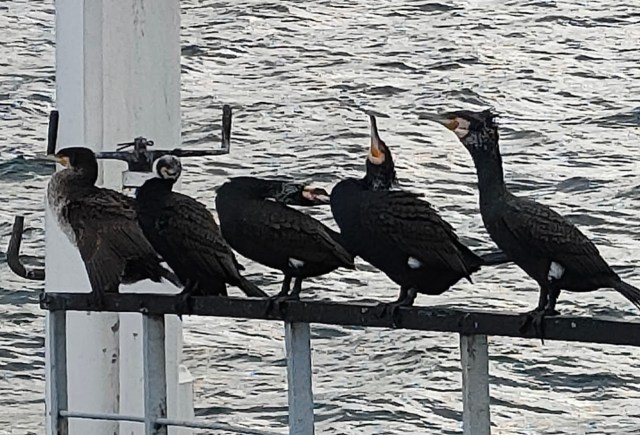
Climate change is encouraging the lake’s cormorants to stay on over the winter months but will ‘deseasonalising’ also work for foreign visitors?
Other than managing the issues raised above, the local tourist industry has set itself two main objectives. The Italian term for the main one is ‘destagionalizzazione’ a clumsy term equally clumsily translated as ‘deseasonalising’ or in other words, seeking to extend the season beyond its historic span from April to October. Some of the larger hotels have managed to stay open recently throughout the year or with an additional opening over the Christmas period but the majority do not.
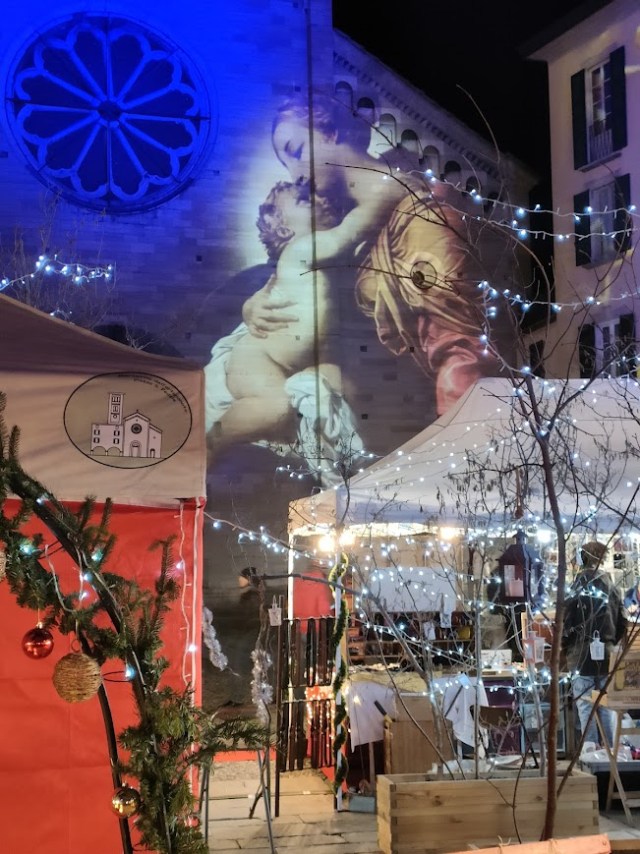
Christmas in Como is atmospheric. The days are ususually dry but the climate is not so favourable in early spring and late autumn.
Opening from late autumn to early spring means equipping your hotel sufficiently to keep your guests comfortable and entertained. The investment needed can be considerable and the modifications may also require prolonged closure. The vast majority of hotels on the lake are family-run businesses less able than the national or international chains to cushion these costs. Possible result? A decline in family run establishments in favour of chains. The chains are more able to manage the investments needed either to ‘deseasonalize’ or to set up any of the high end luxury units that the market now favours. But any attempt to increase the length of the season beyond the long balmy days of a prolonged summer runs into the realities of the climate. November in particular is usually a particularly wet month with the risk of incessant rain falling for four or five days at a time. So much for the ‘good climate’ espoused by Kusnirovich as part of the lake’s enchantment. The same risk of rain applies to spring as experienced this year over the Easter break.

Staircase of the hotel Il Sereno in Torno whose interior and exterior were designed by Patricia Urquiola – an example of one of the latest high end luxury hotels.
The Italian term for the other main objective is ‘delocalizzazione’ offering an equally clumsy translation as delocalising. What this represents is the aim of spreading the distribution of visitors beyond a focus on the Menaggio-Varenna-Bellagio-Tremezzina area and out of the city of Como itself. Apart from the recent and planned openings of some luxury hotels in and around Como (for example in Torno, Moltrasio and Brunate) this may mean seeking to develop new forms of tourism pointing to some possible future trends.
The Future
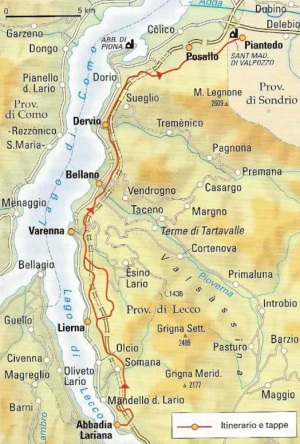
The multi day walk on the Via del Viandante on the Lecco leg of the lake
We can assume that high end tourism is set to increase in the near future with a greater presence of international hotel chains opening relatively small luxury units more adapted to providing comfort all year round.
One trend that might favour delocalisation is the post Covid move to what is called ‘experiential tourism’, namely holiday breaks designed around specific activities such as cycling, walking, cultural studies and food and wine tours. Lake Como is well qualified to provide for all these forms of holiday activity. Two long multi day walks flank either leg of the lake – the Via del Viandante on the Lecco side and the Via Francigena Renana running down from Coira (Chur), through Chiavenna to and beyond Como. And there are of course other scenic one or two day options for walking in the neighbouring mountains. Much more could be made of the cultural and historic heritage of the region but the potential is there. If we think of Lake Como as the gateway to the Valtellina then we can also boast a fine tradition of viticulture with a local cuisine to match. The large increase in holiday home rentals over hotels means there are many more visitors looking to eat out and in search of local traditional food.

Nothing can beat the simple pleasure of a well made plate of pizzocheri and a glass of everyday wine on a hillside hike.
The current estimates for the numbers of people engaging in one form or other of experiential tourism in Europe are as follows: 4.8 million in France, 5.6 million on Germany and 7.1 million in the United Kingdom – with Italy favoured as a destination. The potential is there. A growth in experiential tourism would support delocalisation and could potentially bring revenue to the string of small communities based in the mountains up from the lakeside. It would definitely increase the average length of stay and It would also democratise local tourism and counter the trend towards Como becoming a millionaires’ playground.


 The Como Companion
Don’t tend to agree on much with Russian oligarchs, but definitely do not want the beautiful and tranquil Lago di Como to become Miami Beach. Let’s hope the lake’s leaders plan well…
LikeLiked by 1 person
Pingback: Lake Como's Irresistible Allure: Tourism Surge Amid Local Exodus - Lake Como Property Market