 Over recent centuries Lake Como has gained increasing popularity as a holiday and travel destination. It comes as no surprise that the sparkling lake and the majestic mountains that surround it find themselves used as the setting in a wide selection of novels. On the one hand, Lake Como is commonly perceived as a romantic location and so is used as a fitting backdrop to amorous tales. Yet its location selected for the fascist era’s endgame confirmed its dramatic credentials for setting historical narratives. And the very depth of the lake beneath its shimmering superficiality symbolises the duplicity of darkness and danger for mystery, murder and intrigue.

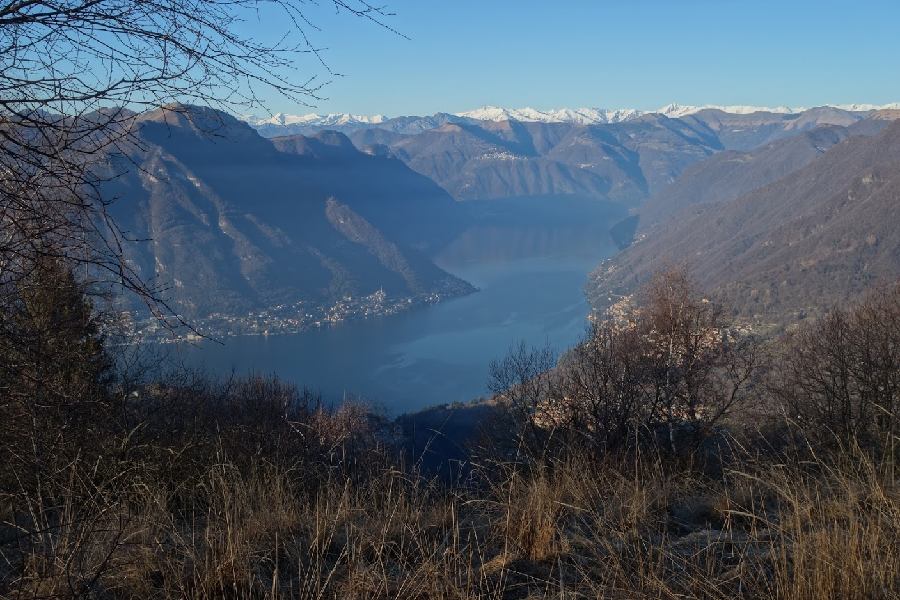
Lake Como from Schignano with the Sanctuary of Sant’Anna in the midground.
Here follows a selection of a number of works of fiction, listed under different genres, where Lake Como is used as one of the main settings for the plot. This selection offers a wide variety of writing styles and ultimately, of quality. They reveal different uses made of the setting and a range in the importance this plays in the effectiveness of the fiction. While not having had time to read all the works listed, I have dipped into a few in a highly subjective bid to evaluate how the lake is represented.

Romance
Holiday romances offer a rich vein for writers of romantic fiction so what could be better than selecting one or more of the following for your own holiday reading whilst relaxing on the shores of the lake.

Erica James, Summer at the Lake,; available on Amazon and Kindle
James, Erica: Summer at the Lake
From the publicity: This summer, escape to Lake Como – where the scene is set for romance, fate and second chances… Even in the dazzling summer sun, the past casts a poignant shadow… But can the magic of the Italian lake finally set them all free?
This is one of the books I actually read and enjoyed due to the rounded characterisation of the protagonists and the way the varied facets of the local landscape were used to reflect contrasts in moods and emotions – a skilful use of the pathetic fallacy. The writer makes accurate reference to places and to aspects of local culture such as smuggling. Above all the plot is engaging. Bravo! .

Hilary Boyd, The Affair; Available from Amazon and on Kindle
Boyd, Hilary: The Affair
The publicity states: On the glamorous shores of Lake Como, Connie meets Jared. She’s married. He’s young. But that doesn’t stop the heat rising between them. And so begins a long, hot, intoxicating summer where Connie succumbs to temptation – breaking her marriage vows.
At the end of summer, Connie returns to her husband, ready to put the affair behind her.
I didn’t read this one but can recognise from the publicity how Lake Como is depicted as this other-worldly location where normal patterns of behaviour and morality are subverted only to be re-established once escaping from the idyllic setting – a common trope within the ‘holiday romance’ genre.

Anita Hughes, Lake Como; available from Amazon and on Kindle
Hughes, Anita: Lake Como
From the publicity: Sisterhood, family, career, and sumptuous descriptions of Italian life fill the pages of this newest offering by Anita Hughes. Lake Como is a heartbreaking and heartwarming story of love, self-discovery, and the quest for truth.
This is one of the most annoying books I came to read seemingly born out of the kardashian School of Creative Writing. An impenetrable layer of superficiality smothers the book epitomised by the habit of identifying characters through the brand names of what they are wearing, not just on their initial stage entry but on almost every successive appearance in the plot. My intense irritation was further aggravated by the exclusive depiction of Lake Como as a playground for the super-rich.

Louis Begley, As Max Saw It; available from Amazon and on Kindle
Begley, Louis: As Max Saw It
From the publicity: With all the force and elegance of his earlier work, Louis Begley’s masterful new novel tells a gripping story of friendship and mortality.
The male protagonists renew acquaintanceship after many years when finding themselves guests at the same luxury villa on Lake Como. I did not read this book but it’s interesting to note how Lake Como holds a mystical fascination for a number of these American writers presumably because its natural beauty (an aspect far from being in short supply back in the USA) is overlaid with an air of sophistication emanating from the architectural elegance of its historical villas – two vital ingredients for the depiction of a fantasy land.
Broom, Isabelle: The Place We Met
From the publicity: Lake Como, Italy, New Year’s Eve. The perfect place to fall in love? Or the perfect place for everything to fall apart?
This is another book unread by me but the line of the publicity above implies a more than one-dimensional view of the role of our landscape in the narrative.

Paul Wright, Beside Lake Como with the cover illustration done by the author. It is available from Amazon and on Kindle.
Wright, Paul: Beside Lake Como
From the publicity: An affair emerges that gradually unravels the life of wealthy Italian Lucrezia Bonucci, and a much younger hard up English artist. Set in the scenic paradise called Lake Como, this is a disquieting work of fiction with an insight into the inequitable lives of a family of village bar owners.
This novel straddles the romance and crime genres and even throws in reference to the lake’s wartime past. It is written by local resident, Paul Wright, whose non-fiction we reviewed in An Expatriate’s Life on Lake Como. Having read the non-fiction it is easy to see where Paul Wright has included autobiographical detail alongside his fascination with local bars! His first hand knowledge allows him to portray a realistic evocation of family life on the lake into which he incorporates a plot with some rather fanciful dramatic turns. The overall effect is harmed though by a rather lax editorial review that has failed to eliminate syntactical issues in a few places. Maybe this is a case of rushing too fast to print. As a result, whilst admiring the way he portrays the setting for the plot, I do need to qualify my overall recommendation which is certainly not the case with his non-fiction trilogy set on the lake.
Crime

Autumn mist on the lake at Carate
We have already noted in Noir 2018: Moral Ambiguity and Death how Italy is in general well adapted to the ‘noir’ genre given its recent history of dark state duplicity, obscurantism and skulduggery. Lake Como has also been the scene of true crime sensations such as the Villa D’Este murder. Beneath its beguiling surface it hides the mystery of the Dongo gold and its depths also host numerous victims of the wartime internecine feuds, not to speak of the various fatal accidents behind which some may have stemmed from more sinister motives. Crime writers must be attracted to the dramatic potential in portraying the sublimity of the landscape as the setting for fiendish deeds.

E.Y. Chypchar, The Lake Como Girls; available from Amazon and on Kindle
e.y. Chypchar: The Lake Como Girls Book 1
From the publicity: Fourteen year old Summer is spending July and August at Lake Como, Italy with her mother. She doesn’t know it yet, but her parents are about to drop a bad-news-bomb that will change her life. All she wants to do is scuba dive in Lake Como with her cousin Francesca. But family and scuba diving take on a whole new importance when the cousins witness a crime and realise they’re the only ones who can prove a boy’s innocence.
The lake provides the context for the descriptions of scuba diving which in turn are critical to the narrative. In most of these novels, the lake forms the setting for disruptive events which can be positive or negative. The disruption is then only resolved once the protagonists end their stay and return home either to the original or a reformed order. In this novel, the plot’s issues are resolved ‘on location’. The beauty of the landscape is only once mentioned and then so as to contrast with the emotions of one of the protagonists. In other words, the landscape is presented in an unlaboured way with its primary characteristic – water – used as a vital part of the scuba diving action.
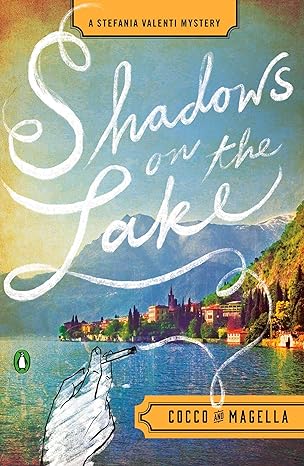
Cocco and Magella, Shadows on the Lake
Cocco, Giovanni and Magella, Amneris: Shadows on the Lake
This novel features a woman detective, Stefania Valenti, attached to the Como Questura, who sets out to resolve a cold case mystery of the murder of a German soldier whose skeleton is uncovered during the construction of a tunnel under Monte San Primo. One of the authors, Giovanni Cocco, is from Como. Local knowledge is used extensively to provide realistic and mostly accurate locations. The authenticity of the landscape is clearly important to the authors to the extent that they even include an afterword to explain where, for the purposes of the narrative, they have deviated from topographical accuracy. There are however two minor defects to the book. One is the complexity of the plot and the fact that the final resolution of the mystery does not measure up to the effort made in getting there. The second is the inclusion of a couple of chapters when our protagonist, Stefania Valenti, meets up with a potential love interest, Luca Valli, to go hiking around the lake. They add nothing to the plot (the love interest goes nowhere) and serve only to introduce readers to the local tourist sites around Tremezzina and Gravedona.

John Anthony Miller, Honour the Dead; available from Amazon and on Kindle
Miller, John Anthony: Honour the Dead
From the publicity: Six English survivors of the Great War – four men and two women – converge on Lake Como, Italy in 1921. The result: one corpse and one killer…
The Lake Como setting is presumably used to convey a calm backdrop to the psychological disturbances of the main protagonists, and as a likely location for a Swiss-style sanatorium. But it is unconvincing. Como is inconsistently referred to as a village and at other times as a city. If the author had ever visited Como, one glance at the cathedral would dispel any notion that this was ever a mere village. Essentially the setting for the plot is entirely arbitrary and this fault undermines any tension in the narrative.
Swan Thomas, The Da Vinci Deception
A novel about art forgery with action in a variety of setting but ending up with the final chase and the ‘rousing denouement’ taking place on Lake Como. I did not read this novel but I have the suspicion that the choice of Lake Como was made purely on the basis of its perception as a glamorous setting.
Historical fiction

Images of the Villa D’Este at Cernobbio at the time of Princess Caroline of Brunswick
Historical fiction must to a certain extent incorporate aspects of non-fiction such as verifiable past events, or real characters as protagonists in the plot, and, of course, the setting for the action. Como’s historical past is long and varied and so well suited as a setting for this genre. Mussolini’s final days and the local partisan uprising on the lake give it a further qualification as a picturesque yet tragic setting for drama.

Mark Sullivan, Beneath a Scarlet Sky; available from Amazon and on Kindle
Sullivan, Mark: Beneath a Scarlet Sky
From the publicity: Based on the true story of a forgotten hero, the USA Today and #1 Amazon Charts bestseller Beneath a Scarlet Sky is the triumphant, epic tale of one young man’s incredible courage and resilience during one of history’s darkest hours.
The book has been very successful and has even been used as the basis for a film. It is probably well written but its claims to veracity are bogus. The story does contain a number of factual elements and so may well qualify as a valid representation of wartime life in Milan and on Lake Como. But these separate elements are configured in a way to maximise dramatic impact at the expense of veracity. It includes many glaring historical inaccuracies which would not really matter if the author does not go to such pains to present the story as true. For example, the dramatic denouement is a nonsense. It has our hero, Pino Lella, the personal driver for a German general, transporting the general for delivery to the Americans over the Austrian border. The general in question is Hans Leyers, Albert Speer’s representative in Italy of the RUK who managed Italian industry’s supply of armaments and war production. He actually lived in Como during the Nazi occupation, but was nowhere near the Austrian border when he surrendered voluntarily to representatives of the American army at Como’s football stadium at 23.00 on April 26th 1945. That is a fact – Pino Lella’s account of driving the general to Austria is a fiction. None of this would matter if the publicity for the book did not insist on its truthfulness.

Roland Merullo, Once Night Falls; available from Amazon and on Kindle
Merullo, Roland: Once Night Falls
From the publicity: Italy, 1943. Luca Benedetto has joined the partisans in their fight against the German troops ravaging the shores of his town on Lake Como. While risking his life to free his country, Luca is also struggling to protect Sarah, his Jewish lover who’s hiding in a mountain cabin. As the violent Nazi occupation intensifies, Luca and Sarah fear for more than their own lives.
I certainly enjoyed this book and it stands as a fine example of what historical fiction can achieve in terms of conveying the very atmosphere and pressures on everyday people in situations of extreme adversity as were present for those living on Lake Como during the last war. Roland Merullo himself states in the Author’s Note. “ It seemed to me that (I had come across) the actual events of a great story: heroism, treachery, secrecy, suffering, dignity, romance and death – all set against the background of a country I had come to love.” And his results do match the potential he had identified when looking into the local history.
The plotting is complex but the separate strands skilfully come together as we arrive at the denouement. The chapters that feature Mussolini are extraneous to the main plot but do serve to remind us of the broader background to the story of Luca and his girlfriend Sarah. There are some slightly odd aspects like giving the name of the Archbishop of Milan as Federico Maniscalco rather than the actual Ildefonso Schuster and placing Bellinzona a mere five kilometres over the Como border, but so what. I could even detect a slight anti-communist and pro-Catholic prejudice in his presentation of the patriots but even that can be overlooked when considering the overall imaginative strength of the writing in depicting the daily misery of living alongside an invading force. Bravo!

Kate Ross, The Devil in Music
Ross, Kate: The Devil in Music
This novel is set on Lake Como during the start of the nineteenth century. The book is difficult to find now being out of print but I include it here because reviews on Goodread are largely very positive. They mention the author’s descriptive ability to capture the beauty of the lake and depict the life of those favoured aristocrats residing in their lakeside villas. This was the last of her novels before she tragically died prematurely due to cancer.
Conclusion
There is no commonality to be found in how Lake Como is presented across this brief selection of fiction. There are only different levels in how relevant the setting is to the narrative. The most successful integration of landscape for me was in Roland Merullo’s Once Night Falls. Here the setting may be beautiful but the author does not overlook the effort in climbing up the mountain paths for the elderly or overweight! But, leaving Alessandro Manzoni aside, I have still to find Lake Como’s equivalent to Thomas Hardy’s mystical spirit of the Wessex countryside. Any recommendations will be willingly received.
Further Reading
For lovers of true romance: Our articles Lake Como’s Star Crossed Lovers: 1) Osvaldo and Louisa and Como’s Star-Crossed Lovers: 2 – ‘Gianna’ and ‘Neri’ describe the doomed love affairs of two couples on different ends of the political spectrum and on opposing sides during the civil war during the nazi occupation.
For True Crime addicts: We have already mentioned above the high society shooting at the Villa D’Este but there is also the previous case of the honeymoon in Moltrasio that went tragically wrong.


 The Como Companion
A great post! Thanks for sharing. My next release is set in Como too – it’s historical crime (19th C).
LikeLike
Hi Pam, thanks as always for your ongoing support and encouragement! You must let me know when your next novel is released. I will look forward to reading it.
LikeLiked by 1 person
Thanks so much.
LikeLike
Hello Julian
Of all the books you mentioned in this post I was most inspired to read
the Roland Merullo one, Once Night Falls. We know the Mezzegra area
quite well, having also walked along the Greenway many times past the
church in the story. I knew that Mussolini was shot in front of the
villa in the village, but I wanted to know more of the area during the
war and I thought Merullo had crafted a very fine story incorporating
the actual history as well. It was a bit harrowing, but a very good
read. I don’t normally have a huge amount of time to sit and read
novels but unfortunately, due to breaking my leg in London two weeks
previously, I do for the next six weeks have a bit more time on my
hands! I read the book in a day and a bit, as I found it quite
difficult to put down.
Also, you might be interested to know, I have just found out that the
author appears to have written a sequel called The Light over Lake Como,
which comes out in June this year, so I shall certainly get a copy of that.
Kind regards.
MONICA
LikeLike
Hi Monica, the Roland Merullo novel was also my favourite and thanks for the pointer to his upcoming publication. In the meantime I hope your enforced inactivity ends soon!
LikeLike
Hello Julian, just to let you know that the Roland Merullo sequel, The Light over Lake Como, is available. I have just finished reading it and enjoyed it as much as the first one. I’m glad he wrote it because it finished the story – it took the characters and events up to the end of war in Italy. My only comment was that he seemed to foreshorten some of the distances between villages on the western side of the lake, but I think you mentioned previously in your review that the position of Bellinzona was moved. Artistic licence.
I hope you enjoy it.
LikeLike
Hi Monica, Thanks for the reminder. I have now downloaded the kindle version and am looking forward to the read!
LikeLike