
Saint Barbara shown with the Castello Baradello in the distance behind her left shoulder and the Porta Torre on her right. By an unknown Lombardy artist dated 1945.
Saint Barbara is one of those early female victims of the Catholic and Orthodox churches who owe their martyrdom to the initial resistance of Byzantium to the spread of Christianity. She is said to have been born in 273 CE in Nicomedia (now known as Izmit) close to Constantinople and known as Barbara because she was in Roman terms a ‘barbarian’, simply meaning a non-Roman. The legends of her origin and history are varied and confusing and this has detracted from her official status as a saint within the Catholic Church. But this has done nothing to reduce the cult associated with her name or the fact that she is still remembered in Como beyond 1945 to the present day.
The Saint Barbara Story
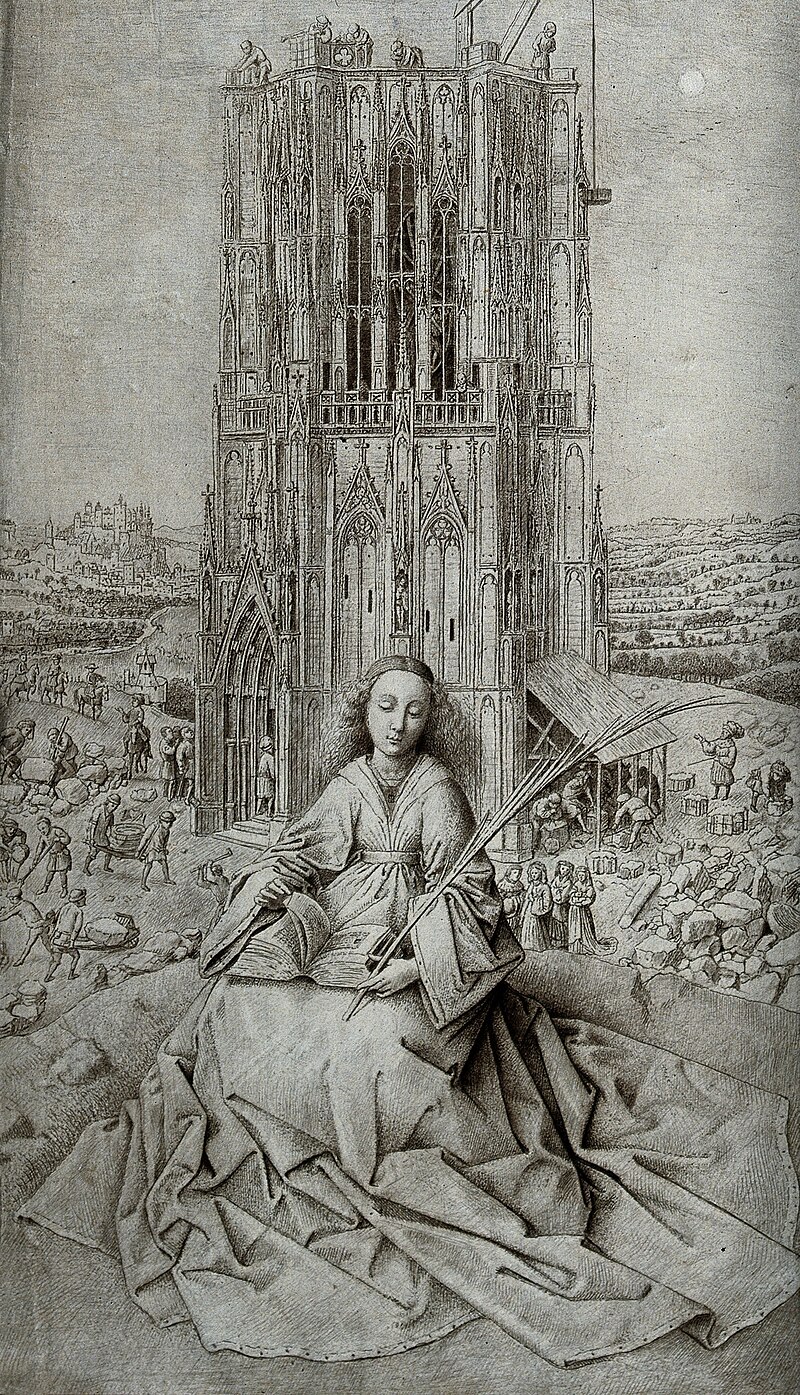
An etching made of the unfinished image of Saint Barbara by Jan van Eyck, 1437. It shows her in front of the tower being built by her father to imprison her to keep her away from unwanted suitors. Note the three windows requested by Barbara as a symbol of her devotion to Christianity.
The legend goes that Barbara’s father, Dioscorus, had planned for her to marry the prefect of Nicomedia but she refused. Her father, livid with anger at his daughter’s intransigence, had her arrested and sentenced to death for adopting Christianity. Her response was to break up all the pagan effigies in her father’s house and escape to the forest. However she was caught and imprisoned in the fortress of Nicomedia. The fortress subsequently caught fire yet Barbara stepped out of the flames uninjured. Her trial was set for December 2nd, 290CE where she called on her father and all those present to turn away from paganism – a call that resulted in torture and execution on December 4th. Her own father wielded the sword that beheaded his daughter but he in turn was immediately struck dead by a bolt of lightning.
From out of this legend, the cult developed whereby Barbara was called upon in defence against lightning, fire and sudden death. Her fortitude and resistance to her father’s demands in the face of torture was perceived as the saintly embodiment of the faith and courage to face danger. She was particularly called upon for protection against fire, cannons and explosives. To this day, the Italian army’s name for an armoury is a ‘Santa Barbara’. Just as the Venetian fleet in the Middle Ages flew pennants with the image of Saint Barbara as protection against the explosion of their onboard munitions, so the modern Italian navy also refer to an onboard munition store as a ‘Santa Barbara’.

Naval standard of the Venetian navy with Saint Barbara.
Barbara’s courage in facing up to danger meant that she was sought to grant protection to those doing dangerous jobs, such as soldiers, miners and in particular, fire fighters. She is the patron saint of firefighters in both France and Italy.
Fire fighters

Cardinal Oscar Cantoni in the company of the Commander of the Como Vigili del Fuoco, Antonio Pugliano at the service in the Church of San Giuseppe on 4th December commemorating the Fire Service and Saint Barbara.
Each 4th of December, on Barbara’s saints day, Como Province’s firefighters hold a service of thanksgiving to their patron saint. This takes place in the church closest to their Como headquarters on the edge of town in Via Valleggio. This year the service was conducted by Como’s Cardinal Oscar Cantoni in the company of the Fire Service Commander, Antonio Pugliano. Fire fighters are quite rightly held in high regard for those qualities attributed to Saint Barbara – that is their capacity to face danger with courage and serenity.
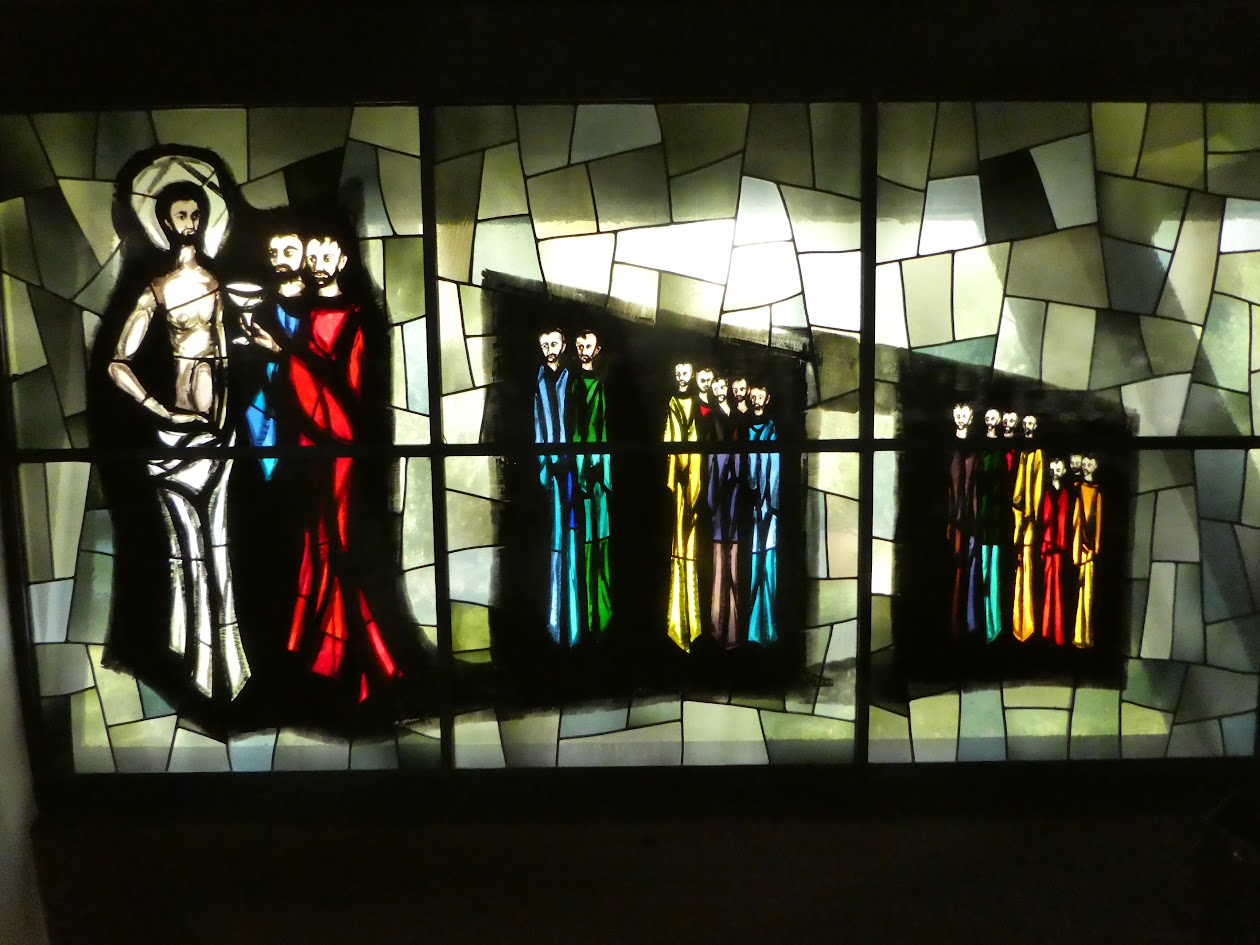
The church of San Giuseppe was built from 1963-5. It contains some interesting modern stained glass.
Back in 1935 the qualities of the local fire service were put to their most severe test when the cupola of the cathedral caught fire on the night of September 27th. It was not an easy fire to extinguish being so high up within such a complex structure. And in fact it took the fire service some time and a number of attempts before they were able to extinguish the flames before they spread to damage other parts of the building. They succeeded in ensuring Como avoided a Notre Dame moment. The citations for their bravery after the event commended them for “courage, zeal and self-denial” – the very same qualities associated with Saint Barbara.
The table below shows the activities of the modern day provincial fire service – activities ranging from the saving of life to the rescuing of trapped animals. The figures are for the number of emergency calls made per category of activity over the year from November 2023 to the end of October 2024.
| Emergency Calls | Total |
| Fires and explosions | 761 |
| Road accidents and victim rescue | 544 |
| Other road activity e.g. removing debris | 704 |
| People search and rescue, accidents at work | 1211 |
| Gas escape | 199 |
| Landslides and natural disasters | 344 |
| Rescue and recovery of animals | 285 |
| Water damage | 413 |
| Rescue from water | 38 |
| Various other types of help and assistance | 1060 |
| TOTAL | 5559 |
Munitions and bombardment
While we do not know the artist of the Como Saint Barbara, we do know the date it was painted – 1945. And it is not too fanciful to suggest that it may have been commissioned to give thanks for the fact that Como avoided any serious allied bombardment during the war. The allies pursued a policy of intense bombardment of lines of communication, military stores and fuel deposits across all of occupied Italy with Milan suffering particularly badly. The whole area in Como from the Stadio Sinigaglia, the Aeroclub and in Cernobbio from Villa Erba up to Maslianico on the Swiss border was used as storage for military equipment, fuel and various exports to and imports from Germany. Yet the city suffered no significant bomb damage. Believers may well have put this down to the intervention of Saint Barbara but realistically the cause was the allies’ fear of bombs falling on nearby Switzerland. It was the city’s proximity to the border that made it relatively immune to aerial attack.

The Polveriera (Munitions Factory) located safely away from habitation outside of Albate in the Valbasca. It was bombed in 1942 but has subsequently been restored as a bar and café open at weekends.
There was however one exception. In 1942, the allies bombed but did not seriously damage the munitions factory built in 1940 in the Valbasca – out in the countryside beyond Albate. Maybe Saint Barbara was looking out that day since by chance the site was housing hardly any arms or explosives at the time. The Polveriera survived and has now been restored as a bar and cafe with facilities for walkers and cyclists out enjoying this southern most part of the Parco Spina Verde.

The Sentry Box at the Polveriera is the only remaining evidence of its former use as a military establishment.
Elsewhere in the Province, Saint Barbara was less attentive – particularly on the night of 30th September 1944 when twelve allied bombers passed over Erba in two waves with a Nazi fuel store as their target. They returned the following day with eighteen bombers to complete their mission causing seventy seven civilian deaths over the two days.
Saint Barbara’s iconography

Medallion depicting Saint Barbara with the two symbols of martyrdom – the palm frond and the crown.
One factor leading to Saint Barbara’s misfortune was that she was renowned for her beauty. Thus all images of her attempt to portray a beautiful young woman. Her beauty led her appalling father, Dioscuro, to build a tower in which to imprison her and keep her safe from all unapproved suitors. Barbara insisted that the tower should have three windows at its top to symbolise the Holy Trinity. When her father learnt of this devotion to Christianity he set about killing her but Barbara miraculously escaped just by passing through the walls, only then to face capture, torture and eventual execution.
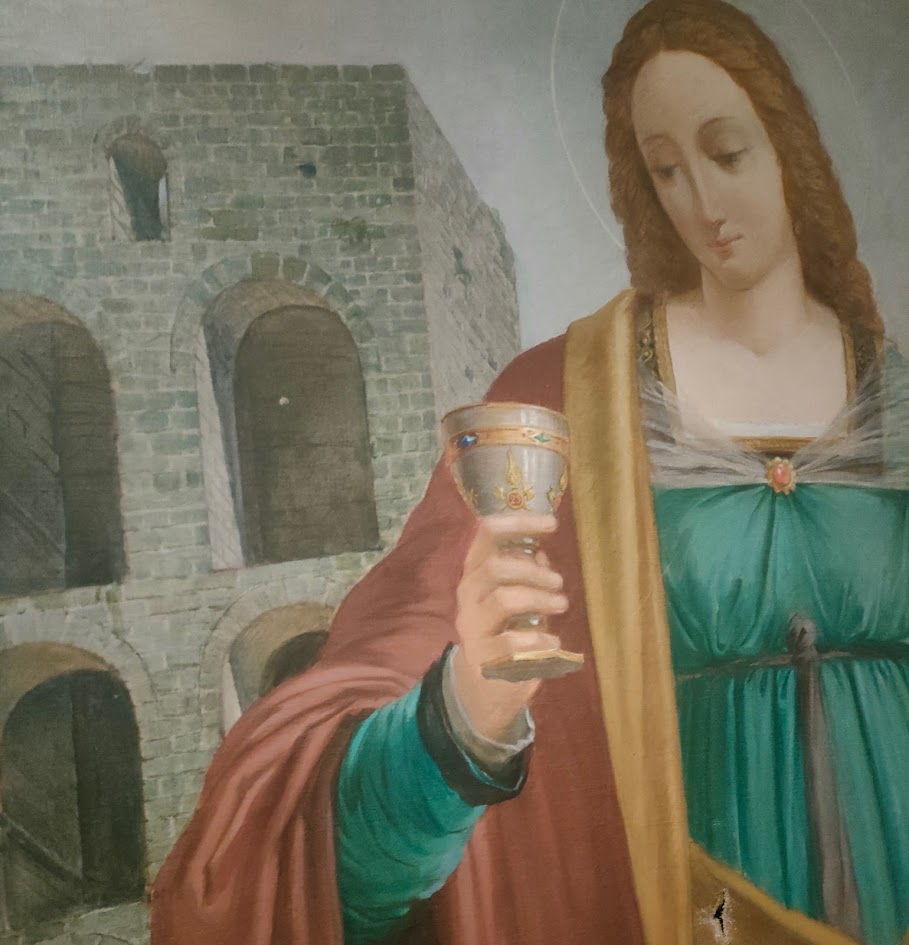
Detail of the painting of Saint Barbara showing the Porta Torre with its third window on the top storey.
Our Como picture shows Barbara with the tower of the Castello Baradello in the distance over her left shoulder and the Porta Torre over her right. The Porta Torre has the requisite third window on its upper storey in keeping with the Barbara cult.
Barbara is also often depicted holding a golden chalice in her right hand. This is a relatively common Catholic symbol of redemption as used in communion. She is almost always depicted as holding a palm frond in her left hand as the symbol of martyrdom. She may also be shown wearing a crown to symbolise her privileged status as a martyr within the pantheon of saints. Many images show her with a cannon at her feet since she is credited with both protecting those manning armories and working in munitions and those on the receiving end of bombardment and explosion.

Image from the Royal New Zealand Army Ordnance Corps who adopted Barabara as ttheir patron saint. This image includes a sword as used for her execution and a book under the golden chalice to commemorate her love of learning.
The belief in her capacity to command fire, either by providing protection from it or directing it towards her adversaries, arose because the fire lit to torment her during her period of torture was inexplicably and automatically extinguished. The lightning bolt that struck her father the moment after he had killed his daughter is also referred to as a bolt of fire. However fire does not feature in many representations of Barbara.
One of the more famous portrayals of Barbara is by Raphael who depicted her on the left side of the Sistine Madonna. She is seen looking down on the two putti at the base of the painting who have become stars in their own right. A corner of a tower can be seen over Barbara’s left shoulder.
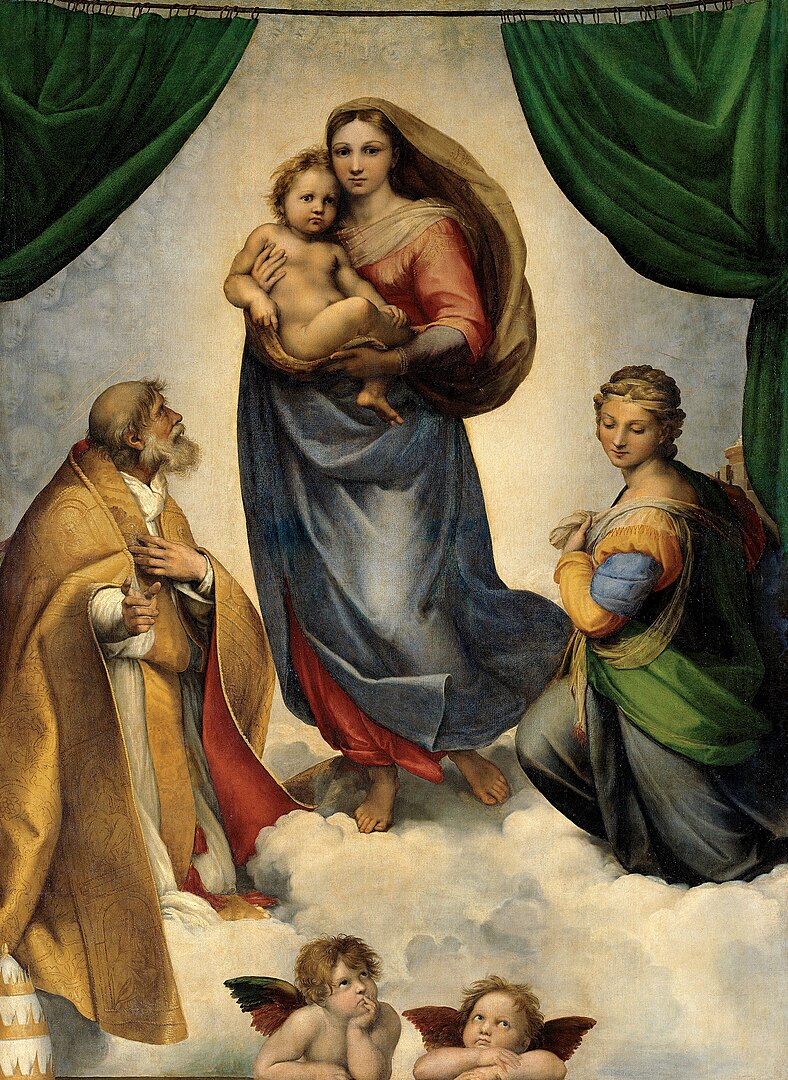
The Sistine Madonna by Raphael with Saint Barbara looking down on the now-famous putti. She is shown with the corner of a tower seen behind her.
Acknowledgments
The painting of Saint Barbara at Como is on display in the Basilica San Fedele as part of an exhibition entitled Capolavori Nascosti that runs until 6th January 2025.


 The Como Companion