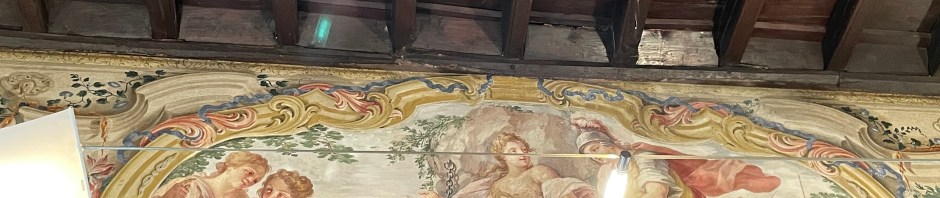

Courtyard of the Palazzo Rusca in Via Rusconi
The Como branch of the Fondo per l’Ambiente Italiano (better known as FAI) has been very active this year in giving the public occasional access to some of Como’s many hidden gems. Recently, under the general title of ‘Segrete Stanze’ (Secret Rooms) we have been able to visit three sites each with rooms decorated with important frescoes commissioned by their aristocratic owners in the 17th century. They are the so-called Sala Bianchi in Palazzo Rusca on Via Rusconi and rooms within the two adjacent palazzi on the north side of Piazza Volta, namely Palazzo Olginati Rovelli and Palazzo Vietti Rovelli. Out of a generous sense of public duty, the FAI were given permission to open up these rooms by their current institutional owners.

Fresco in the Basilica San Fedele, Como depicting the Madonna with San Sebastiano on her right and San Rocco on her left. The general population,in the 17th century suffering from famine, poverty and the threat of plague would pray to San Sebastiano to protect them from the plague, and to San Rocco for those already infected to cure them from the plague.
The significant frescoes in all three of these sites were commissioned in the 17th century when Como was under the domination of the Spanish. It was a time of intense insecurity initiated by the threat of Protestantism spreading down the Valtellina from the Swiss cantons. Once neutralised, the Spanish still had to contend with ongoing wars against the French which were mirrored in a variety of local proxy conflicts. The general population became increasingly impoverished by the high levels of taxation imposed to finance the wars. This in turn caused famine and reduced resistance to waves of plague that swept down from the north. The poor were the most susceptible to plague lacking the funds to maintain the nutrition or hygiene needed as defence.
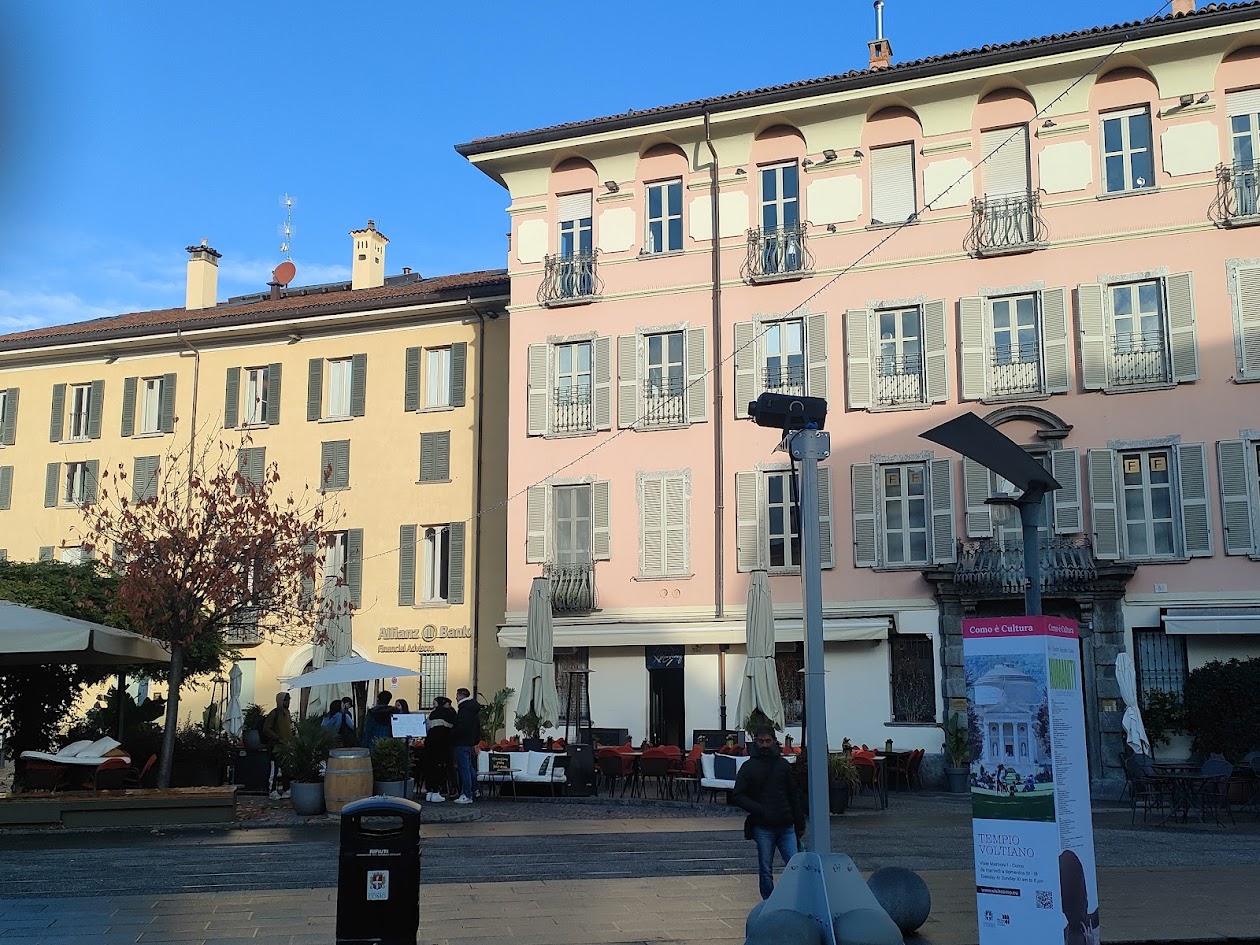
Palazzo Vietti Rovelli at No. 54 Piazza Volta on the left and Palazzo Olginati Rovelli at No. 56 on the right. Both buildings were owned by the Olginati family during the 17th century.
But this was also the era of the Baroque – an explosion of artistic expression revolutionising the interior and exterior decoration of both civil and religious buildings. As the local historian Ettore Maria Peron has stated ‘ the more the people suffered from famine and plague, the more the rich who governed them decorated their palaces with gold and art as a way to display their power.’ And our three palazzi were occupied by those in power.
Palazzo Rusca and the Sala Bianchi

Pope Innocenzo XI – Benedetto Odescalchi. The Sala Bianchi in Palazzo Rusca celebrates his election as Pope
Palazzo Rusca in Via Rusconi 27 is one of the city’s finest examples of an aristocratic residence. The Rusca family occupied the site from 1514 until it passed into the hands of the Marquis Innocenzo Odescalchi in 1786. The Ruscas were one of the most influential and significant families on the local military, civil and religious scene.
On the first floor of the palace, to the left on climbing the monumental staircase, is the main reception room of the palace known as the Sala Bianchi due to the large fresco painted over the entire vaulted ceiling by the Como painter Pietro Bianchi, nicknamed Il Bustino (since his family was originally from Busto Arsizio).
The subject of the fresco is the Exaltation of the Pontificate of Pope Innocent XI (Benedetto Odescalchi) and is dated as being painted in the last decade of the seventeenth century. Bianchi was active as a painter from around 1680 until he died in 1725. He worked for the Odescalchi family contributing decorations to the Odescalchi residences in Via Rodari, Como and Fino Mornasco. His work can also be seen in the Palazzo Imbonati in Cavallasca.
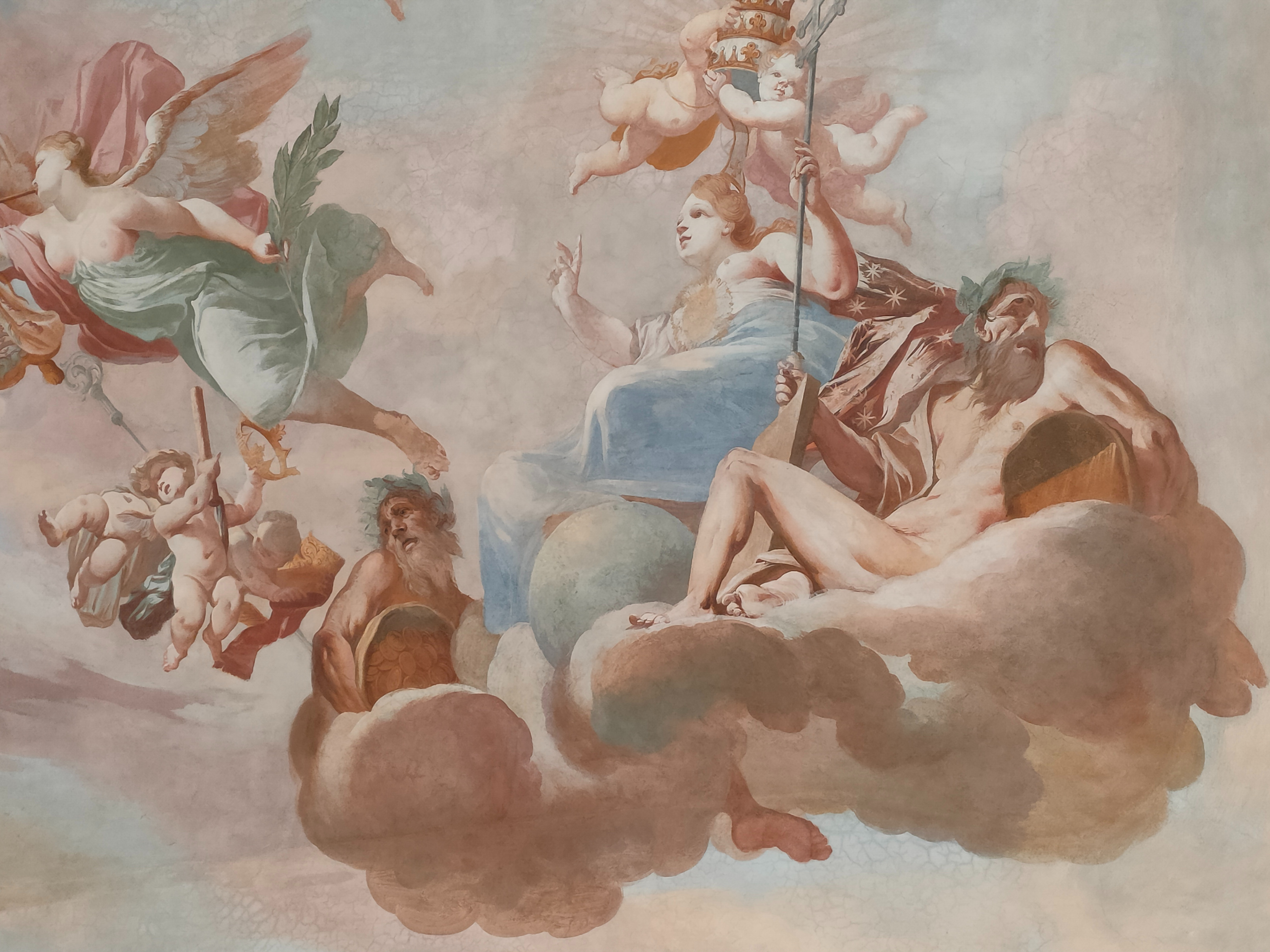
The central image of the bare-breasted woman representing the Church and Faith holding up the papal cross.
The fact that the Palazzo Rusca contains a fresco celebrating the Odescalchi shows how the Ruscas had very close political and family links with the Pope’s family. Four of the Rusca brothers had profited from gaining powerful political positions over the second half of the seventeenth century thanks to the patronage of the Odescalchi. The brother who is the most likely to have commissioned the work by Pietro Bianchi was Antonio Rusca who became one of the most powerful of the aristocratic class governing Como society. He became the Cavalry Captain of the Ferrara Legion, an administrator of the Sant’Anna Hospital, a decurion (a title derived from Latin for a cavalry officer with the contemporary meaning of a city council leader) from 1674 and the prefect overseeing the building of Como Cathedral from 1689.
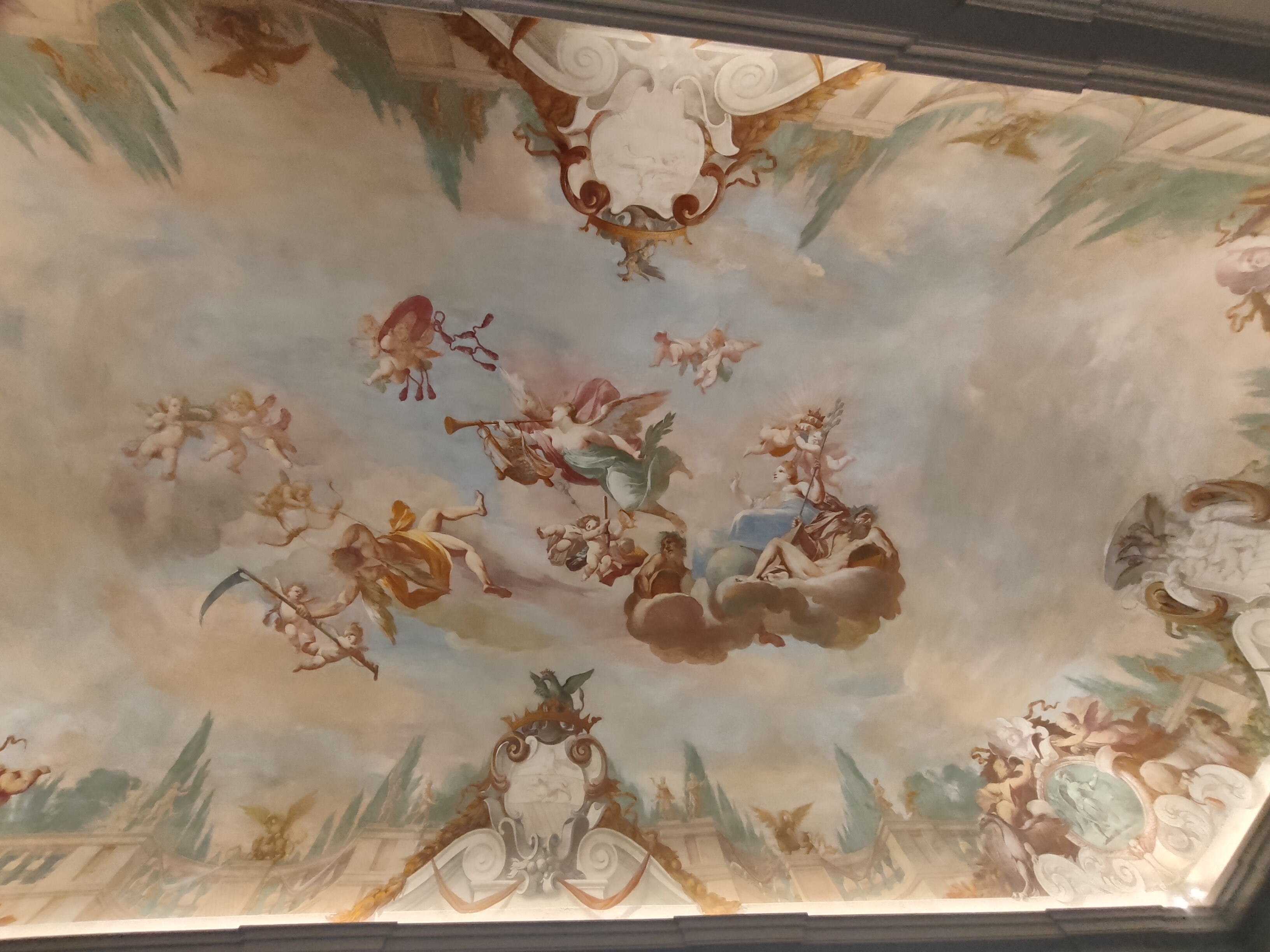 The fresco itself is made up of two parts with a central representation of twenty two figures painted against a background of a cloudy sky in pastel tones and a painted balustrade running along the entire perimeter, embellished with plants, bronze statues, festoons, medallions and heraldic coats of arms.
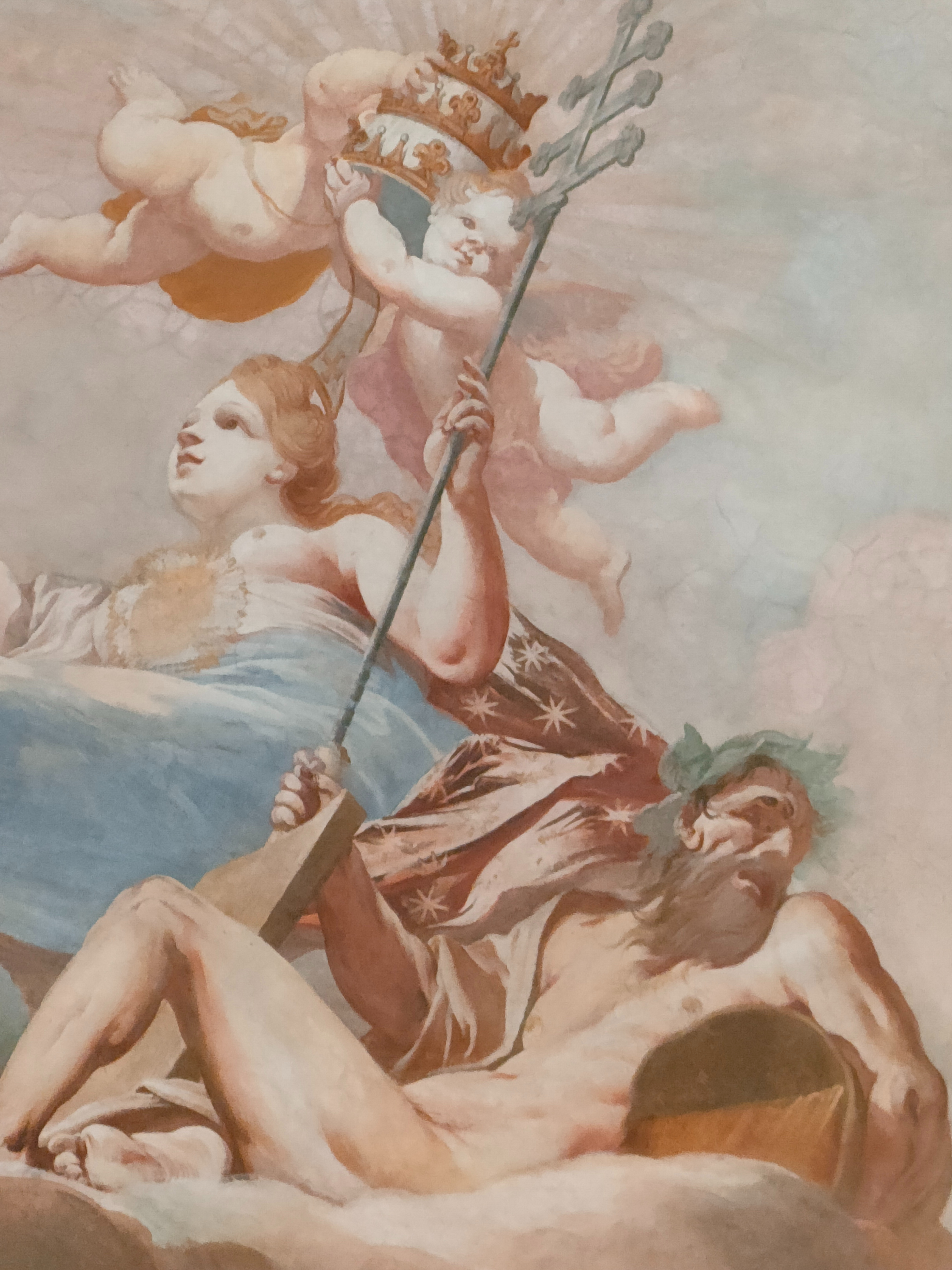
Detail of the figure of Church and Faith holding up the Papal Cross with putti delivering the Papal Crown
The main image in the centre of the ceiling represents the Church and Faith personified in the form of a bare-breasted woman in a blue robe and starry mantle. She is placed on a cloud holding a three-armed papal cross and receiving the pontifical tiara from two flying cherubs. At her feet there is a celestial globe and two naked bearded men crowned with laurel. The one on the right holds a stone tablet as a symbol of Law and Justice and a cornucopia. The one on the left also holds a cornucopia which is overflowing with gold coins as a symbol of Innocence.
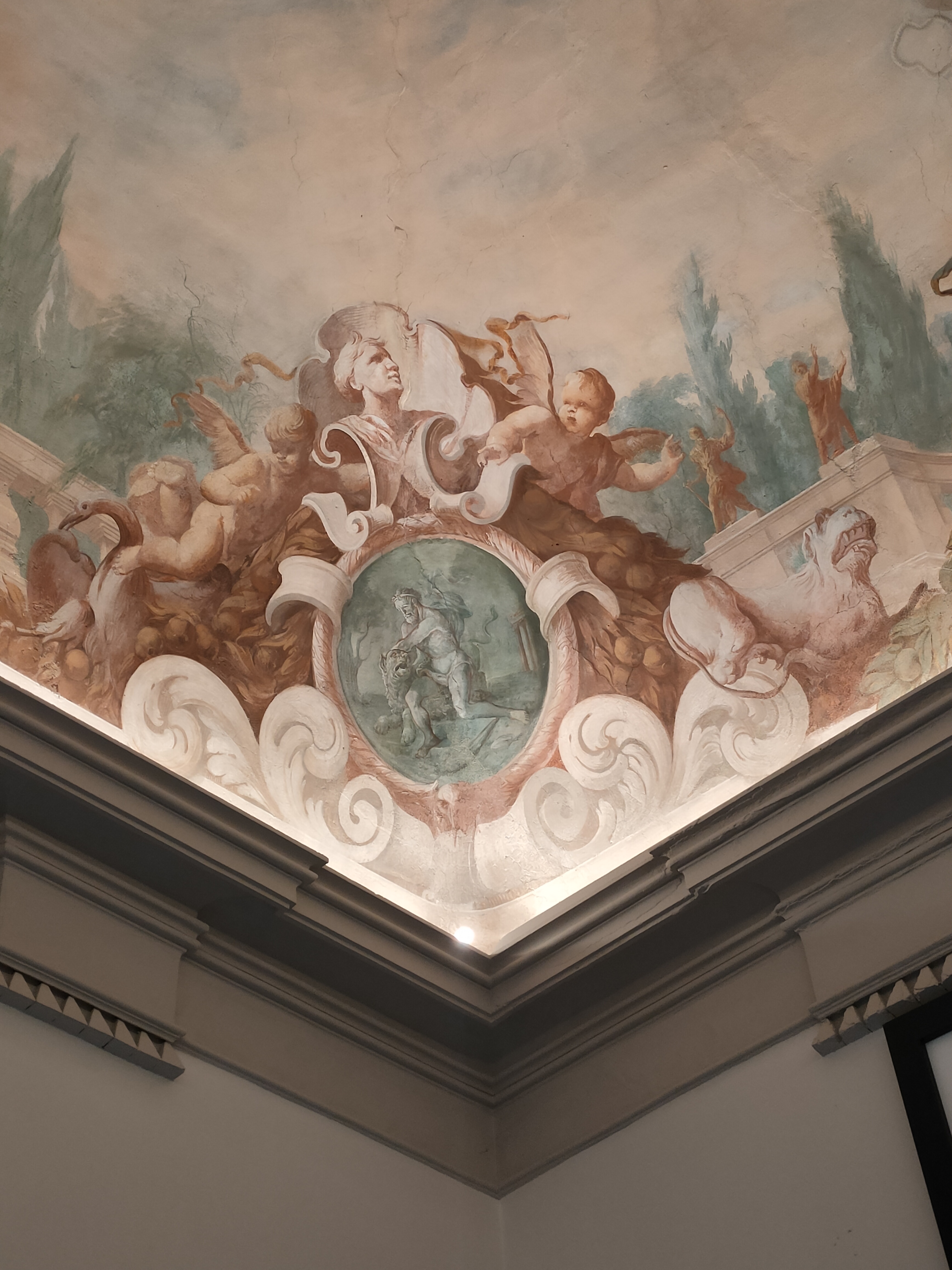
North west corner balustrade with medallion depicting Hercules defeating the Nemean lion.
Along the painted balustrade, the monochrome coat of arms of the Rusca family dominates the four sides, namely a crowned eagle with spread wings, a leopard lion flanked by six butcher’s broom leaves, all on oblique red and silver bands.
The four corners each have a circular monochrome medallion surrounded by cherubs, eagles and lions, and surmounted by shells with busts of male figures. The medallion in the north east corner represents the Torment of Prometheus – an eagle gnawing at the liver of the giant who dared to steal fire from the gods. The north west has Hercules defeating the Nemean Lion. The medallion in the south west corner is slightly damaged but portrays Perseus freeing Andromeda. The south-east medallion shows a scene that has not been identified in which a warrior faces a gryphon with his shield in hand.
Palazzo Vietti Rovelli
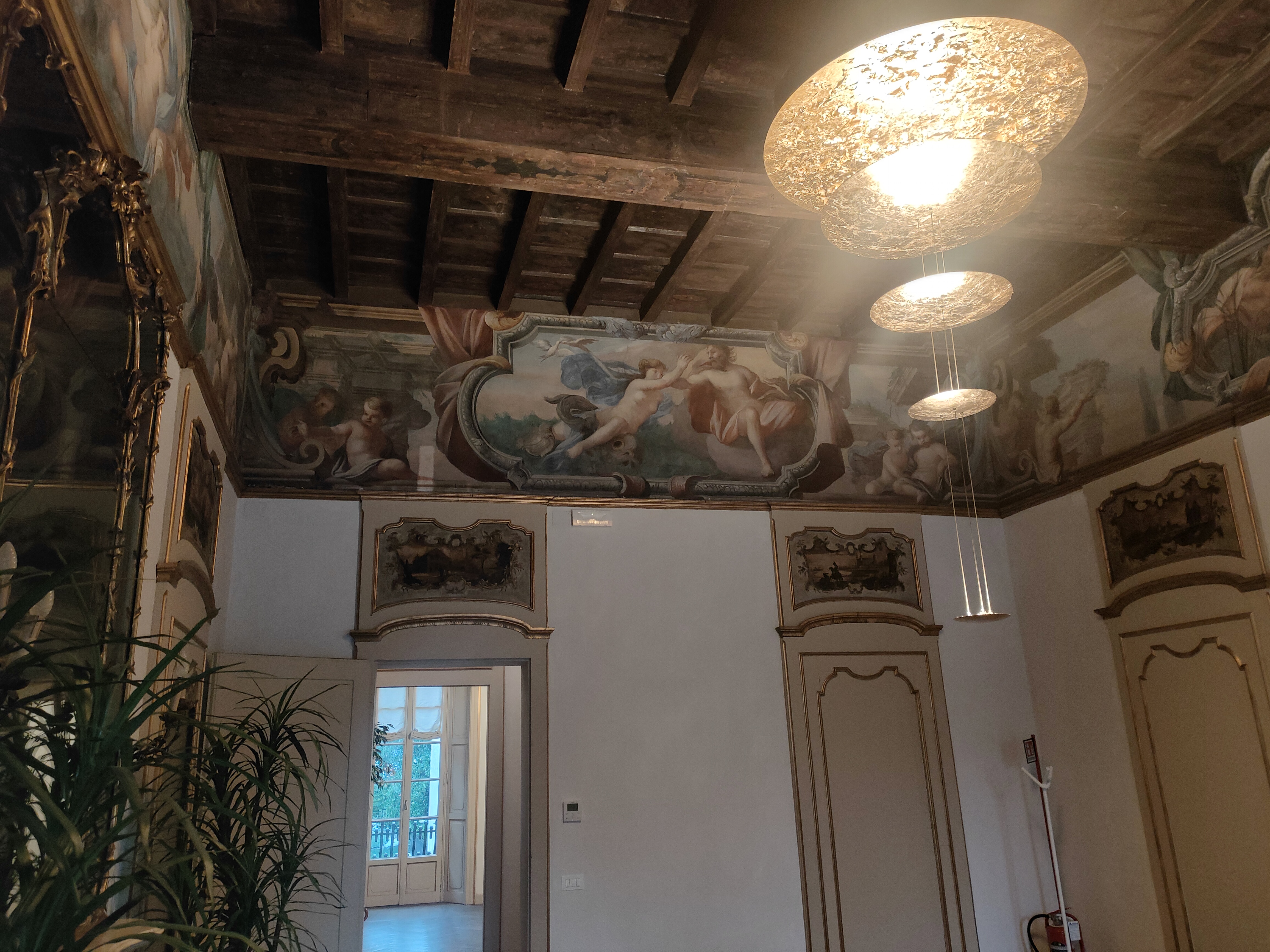
Palazzo Vietti Olginati, the Water Room fresco attributed to Pietro Bianchi
This palazzo is on the north side of Piazza Volta, at number 54, alongside its sister building – the Palazzo Olginati Rovelli at number 56 and on the corner of Via Cairoli. The relatively plain and modest exteriors of both buildings bely the beauty of the decoration to be found inside. The frescoed rooms on the first floor of both buildings are true hidden gems. Both buildings were owned by the Olginati family throughout the 17th century when the main frescoes were commissioned.
The aristocratic Olginati family held positions of power within Como’s ruling city council (the decurional body) since as early as 1449. Twelve family members came to hold that position by 1796. Dr. Alessandro Olginati (1575-1656) was in possession of the Palazzo Vietti Rovelli from at least 1641. He was a jurist who was voted onto the city council as decurion in 1645. The properties were passed on to his son, Giambattista (1619-1704) who was the authorised head (procurer) of the ancient Sant’Anna Hospital and who was also elected a decurion on the city’s governing council in 1664. Either father or son would have commissioned the frescoes still visible and in good condition today.

The Olginati family in the 17th century
The frescoed rooms in both buildings are all on the first floor. The artwork in one room of Number 54 (Vietti Rovelli) is attributed to Pietro Bianchi – the same artist responsible for the Sala Bianchi in the Palazzo Rusca. The art in the second room and in the decorated corridor is attributed to Francesco Torchio, an architect by training. These attributions have been made by Prof. Tiziano Ramagnano (FAI representative for Como) on the basis of stylistic similarities with other works in and around Como.
The Water Room
This is the room overlooking Piazza Volta with the frescoed frieze attributed by Tiziano Ramagnano to Pietro Bianchi, active between around 1680 and March 1725 (the year of his death) in Como, the Valtellina, Chiavenna and Canton Ticino. The frieze consists of four frames made up of architectural structures and cherubs in various poses. Within each frame there are four scenes all depicting marine themes. Starting from the south wall facing on to the piazza, Neptune is depicted commanding two white horses. On the west wall there is Neptune’s wife, Amphitrite, being pulled on a shell-shaped chariot by a sea monster. On the north wall Jupiter is escorted by an eagle reaching out to his daughter Venus travelling on the back of a sea monster. The east wall shows Arion escorted by Cupid and lying on a dolphin.

Arion escorted by Cupid
The Hall of Telemons
The frescoed frieze in this room has been attributed to Francesco Torchio who also decorated the palace’s corridor. It boasts a richly decorated ceiling crossed by a massive beam which seems to be supported by a pair of chained bronze Atlas figures or Telemons (supporters). They are kneeling on leftover plinths, while a bag of sand realistically dampens the load on their exhausted shoulders. The frieze, starting from the two Telamons, develops symmetrically with views of contemporary sixteenth-seventeenth century wine-coloured buildings, similar in colour and thick hatching to those in Palazzo Odescalchi on Via Rodari.

One of the Telemons kneeling on a broken plinth and seemingly supporting the central beam to the ceiling
At the end of each festoon hangs a medallion, also in bronze, with faces of men crowned with laurels. In the squares near the four corners – in the centre of eight fake golden grates, all leaves and spirals, – the emblems of the Olginati coat of arms stand out alternately: two lion’s branches crossed to form a St. Andrew’s cross and a single-headed eagle with spread wings.

Architectural scene in the frescoed frieze in the corridor.
Palazzo Olginati Rovelli
Palazzo Olginati-Rovelli at Number 56 on the corner with Via Cairoli has the honour of being an asset of the Italian Historic Houses Association (ADSI). This is because Giuseppe Garibaldi spent the night there following his victory over the Austrians in San Fermo on the 27th May 1859. So, in addition to the frescoed reception room – the hall – overlooking Piazza Volta, visitors can also taken in the richly decorated bedroom and antechamber which hosted the general for one night.
The Hall
The frescoed frieze in the hall dates back to the start of the 18th century with decoration in the late-Baroque or Rococo style. The frieze shows one scene on each of the long sides of the room and two scenes in each of the short sides. All scenes are framed by elaborate architectural trompe l’oeil structures embellished with scrolls, ribbons and floral motifs. It was common for separate artists to work on such friezes with one taking responsibility for the architectural framing and another for the figurative depictions.

Dido viewing the departure of Aeneas
It is believed that the artist responsible for the figurative aspects was Salvatore Bianchi who originated from Velate in the Province of Varese. He lived between 1653 and 1727 and was active from 1674 in Turin, Asti, Varese, Bergamo, Novara, Sondrio and Busto Arsizio, as well as in Como.
Starting from the long-sided south wall facing on to Piazza Volta, the scene depicted shows Perseus freeing Andromeda chained to a rock. The two scenes on the short-sided west wall show within the left frame an unidentifiable woman holding a chalice. The right frame depicts Judith with the severed head of Holofernes. The single scene on the north wall has Dido looking out on Aeneas’s departure. The two scenes on the east wall are of Cleopatra bitten by an asp and the death of Lucretia.

Perseus freeing Andromeda chained to a rock
The selection of these scenes is by no means random with all dealing with one or other aspect of female fate. Those on the east wall display suicide deaths of two women from Roman history, Cleopatra in 30 BCE and Lucretia in 509 BCE. The long sides facing north and south have scenes from Greek or Roman mythology with the arrival of one lover (Perseus) and the escape of another (Aeneas). On the short west side there is the unidentifiable subject and Judith from the Bible.
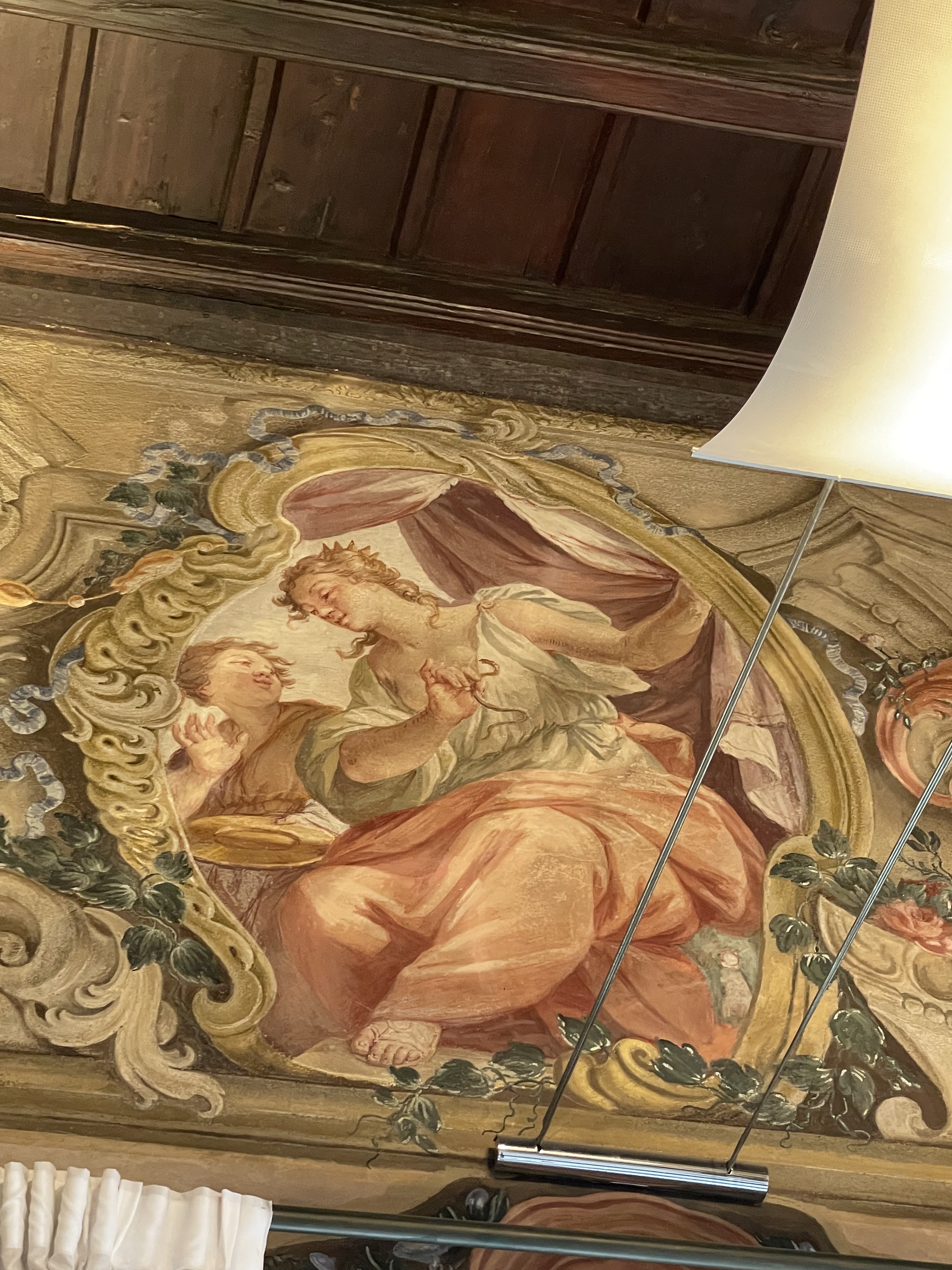
Cleopatra bitten by an asp
Garibaldi’s Bedchamber
The decoration in the antechamber and the actual bedroom – which is little more than an alcove – is contemporary to when Garibaldi spent the night there on the night of the 27th and 28th May 1859. It is very elaborate but cannot be attributable to any particular artist and isn’t in itself as interesting as the historical association of the room. The room overlooks Via Cairoli. Garibaldi spent the night there as the guest of Pietro Rovelli (1817-1889) after the general’s victory over the Austians up the hill in San Fermo. After that victory he descended down into Como with his army, the Cacciatori delle Alpi, following the Valfresca and entering Como at the Porta Sala – now renamed Piazza Cacciatori delle Alpi. He would have entered Piazza Volta along the Contrada di Porta Sala subsequently renamed Via Garibaldi in his honour.
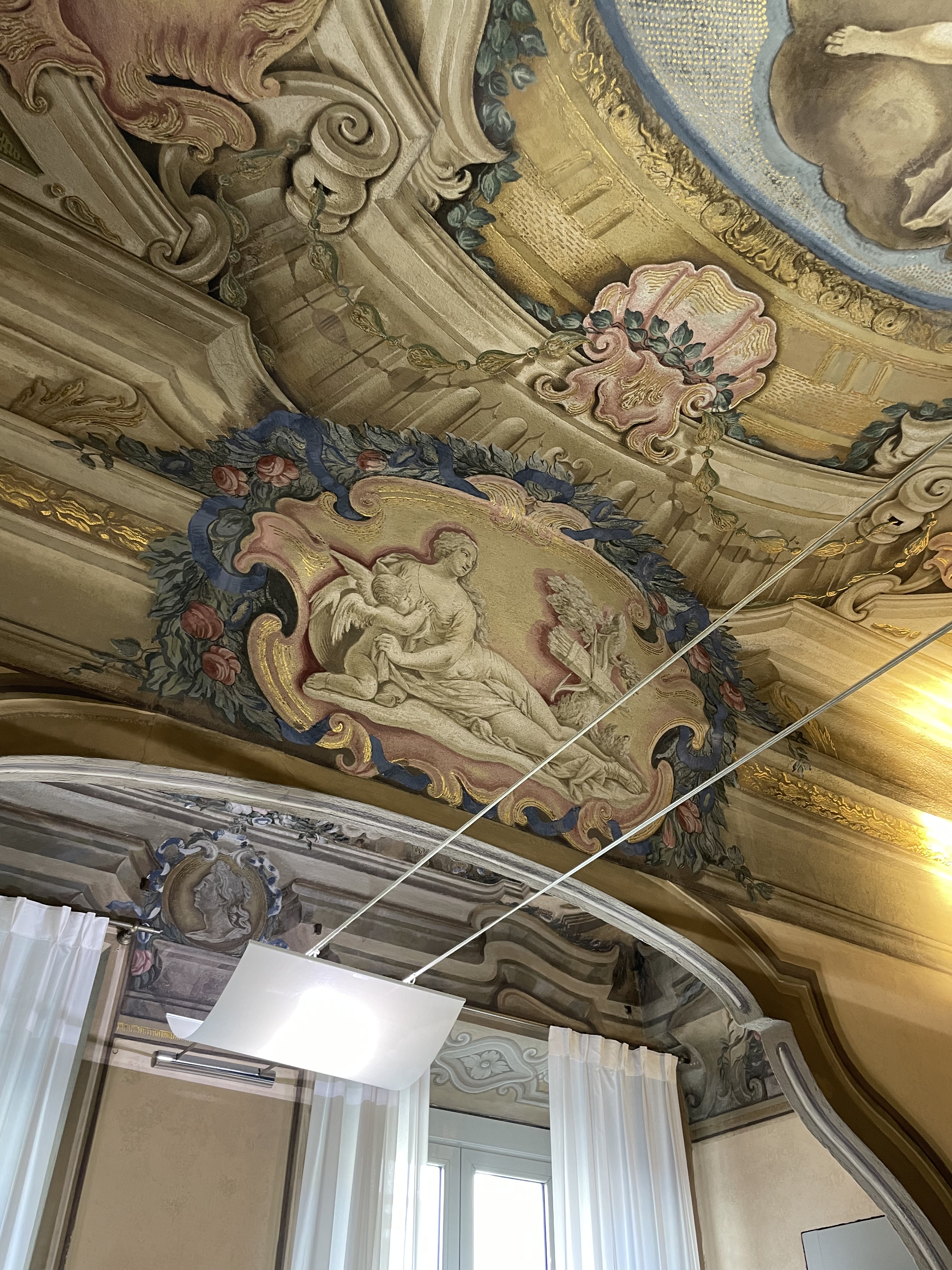
The decorated ceiling to Garibaldi’s antechamber
He arrived in Como at 10.00pm and, having stayed the night in the Palazzo Olginati-Rovelli, left early at 3.00am in the direction of Camerlata. He returned again to Como that same year in December staying on for his marriage to the 18 year old Marchesina Giuseppina Raimondi at Fino Mornasco on 24th January 1860. Following the ceremony , a mere two hours later, Garibaldi received an anonymous note informing him of Giuseppina’s prior relationship with two of his own Garibaldians causing him to seek an immediate annulment of the marriage. It is suggested that Pietro Rovelli was the actual author of the note being himself jealous of Giuseppina’s relation with the general.

Early photograph of Giuseppina Raimondi and Garibaldi
Garibaldi made happier return visits to Como in 1862 to celebrate the third anniversary of his victory at San Fermo and again in 1866 to stay at the Palazzo Olginati in Piazza Medaglie d’Oro to prepare for the Third War of Independence.
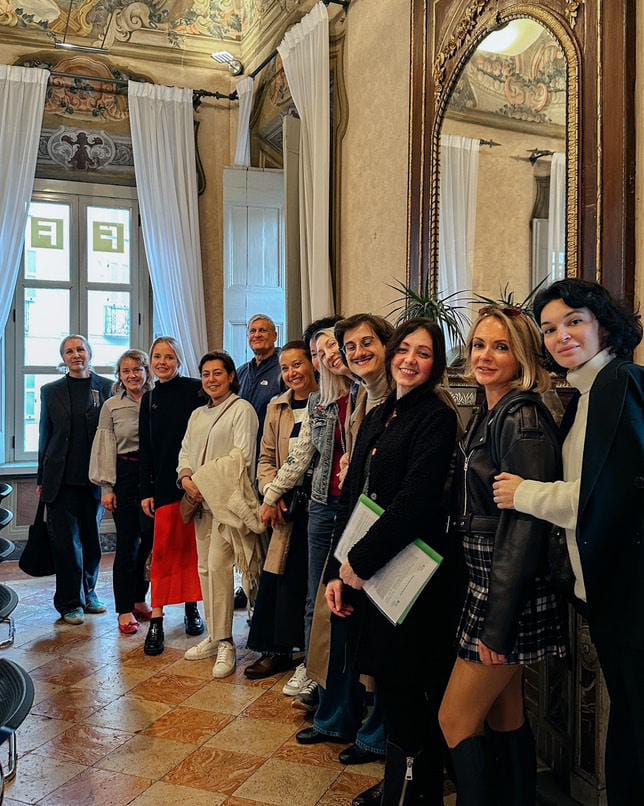
Members of the Como International Club in the Water Room on a guided tour of the Palazzo Olginati Rovelli in the company of Prof. Tizziano Ramagnano and the FAI
Acknowledgments
Many thanks are due to the Como branch of FAI and in particular to Prof. Tiziano Ramagnano for gaining access to these three (and other) beautiful sites and to the highly informative commentary provided during the site visits by Tiziano himself. FAI are also to be congratulated for reaching out to the English speaking immigrant community by linking up with the Como International Club in organising particular viewings with bilingual commentary for their members.
More information about the Como branch of FAI is available from https://fondoambiente.it/luoghi/rete-fai/delegazione-fai-di-como
Information about how to join the Como International Club is available from https://www.comointernationalclub.it/
Thanks are also due to the institutions who allowed access to the sites mentioned in this article out of a recognition of their civic duty to share awareness of and access to the cultural heritage for which they are the current custodians. They are the Consiglio Notarile who occupy the Sala Bianchi in Palazzo Rusca, Allianz who occupy the frescoed rooms within the Palazzo Vietti Rovelli and who have also contributed to the restoration of the frescoes within their offices and to Fineco who occupy the frescoed rooms within Palazzo Olgiati Rovelli.
Further Reading
Other articles in the series of Hidden Gems and Baroque art in Como can be found at:
Como’s Hidden Gems – The Sala Recchi
Early Lombardy Baroque: Fratelli Recchi
Como and Early Lombardy Baroque
Stucco and Scagliola – Two of Como’s Baroque Specialities
The following is an article about Como’s Pope – Benedetto Odescalchi – Como’s Pope and other Odescalchi

Putti in the Sala Bianchi


 The Como Companion
Pingback: Edifici tardorinascimentali e neoclassici a Como: il Palazzo Rusca, in Via Rusconi – LUOGHI del LARIO e oltre …
Pingback: Palazzo Olginati Rovelli, in Piazza Volta, a Como – LUOGHI del LARIO e oltre …