
Gina Ruberti
In ‘Love, War and Death on Lake Como’ (published January 2023) the Companion described the tragic drowning of Mussolini’s daughter-in-law, Gina Ruberti, on the night of 3rd May 1946. She was in a party of five who had gone out for a boat ride that evening. Only two of them returned alive. Apart from Gina, the party consisted of three British Army officers and the Italian fiancee of one of them. Following further research, in part prompted by some additional information provided by the daughter of one of the victims, I can now give a more accurate and complete account of what happened that evening, focussing more on the fate of the three British Army officers. The additional evidence of what happened that night comes from a military police report compiled soon after the tragedy and in the statements made by the only two survivors and their rescuers.
Setting the Scene

Como’s Mayor addresses the rally celebrating Liberation Day 2018
The German Occupation of Northern Italy officially ended in May 1945. By one year later, the allied army of occupation had managed to establish supervision of the liberated zone bringing to an end the period of extrajudicial killings meted out by some of the partisan bands on fascist sympathisers and Nazi collaborators. Good order was in the hands of the British Town Major No. 62, Major A.T. Gray, R.A. who worked to this end in collaboration with the key local representatives of the Italian State – the Prefect of the Province of Como and the Questore (Police Chief).

The Medloc Story
British Army engineers were working alongside both Italian and German technicians in seeking to repair the industrial and transport infrastructure so badly damaged through allied bombing raids.
Regular members of the British Eighth Army, who had been fighting in Italy since the invasion of Sicily in 1943, were being repatriated back to the United Kingdom. From as early as 25th July 1945, the Army had been able to set up so-called MEDLOC trains running from Milan to Calais via Switzerland to bring the troops home. MEDLOC stood for Middle East Direct Line of Communication. The Milan service ran up to four trains containing a total of 3800 troops a day at its peak. By February 1946, MEDLOC departures from Milan’s Central Station were down to two a day, Services also existed to bring troops stationed across Italy to Milan – these were called MEDLOC Feeders.
Milan May 3rd 1946
It was on the Medloc Feeder train that left Naples for Milan on 3rd May that two British Army Majors made their joint acquaintance for the first time. The elder was Major Poole, 40 years old, serving in the Royal Army Ordnance Corps. He was the OC (Officer in Command) of the Medloc feeder. The younger officer in his twenties was Major R. G.Parker. On arriving at Milan, Parker, accompanied by Poole, checked into the Excelsior Gallia Hotel just across from the station on Piazza Duca d’Aosta. He was billeted there to wait further orders as to when he would be repatriated on a MEDLOC train leaving Milan for Calais.

The Excelsior Gallia, Milan. Now part of the Marriott Group.
As previously agreed, Major Parker met up at 13.30 with a good friend of his – Captain T. V. Coffin who served in the Army Recovery Company of the Royal Electrical and Mechanical Engineers (REME). Captain Coffin mentioned that he kept a motor launch moored in a boat house on Lake Como and he would be delighted if the two officers would accompany him and his Italian fiancee that evening for a cruise on the lake. Majors Poole and Parker enthusiastically accepted and agreed to meet Captain Coffin again at the hotel at 20.00.
Captain Coffin’s fiancee was the 28 year old Marchioness Isabella De Marchi. They had become engaged six months previously. She had been expecting the boat trip would just be for the two of them and so was surprised, and possibly disappointed, to learn that they would be accompanied by the two British officers previously unknown to her. All four set out from the Excelsior Gallia shortly after 20.00 with Captain Coffin driving the Opel Kadett requisitioned from the Wehrmacht and officially assigned for his and his driver’s use. He had given his driver, Private Gilbert, the evening off.
Torno

The Villa Rocca Bruna, subsequently the Hotel Casta Diva and now known without reference to its history as the Mandarin Oriental.
Captain Coffin’s boat was kept moored in the boat house belonging to the Villa Rocca Bruna in Blevio (subsequently known as the Hotel Casta Diva but now rebranded as the Mandarin Oriental). When the party arrived at the villa, the men attended to refuelling the boat whilst Isabella entered the villa to invite her friend, Gina Ruberti, to join the party. Gina was taken by surprise by the invitation and took some persuading to join Isabella but finally agreed seeing how her friend would welcome additional female company. Captain Coffin was in turn surprised but made no objection to another passenger joining the party.
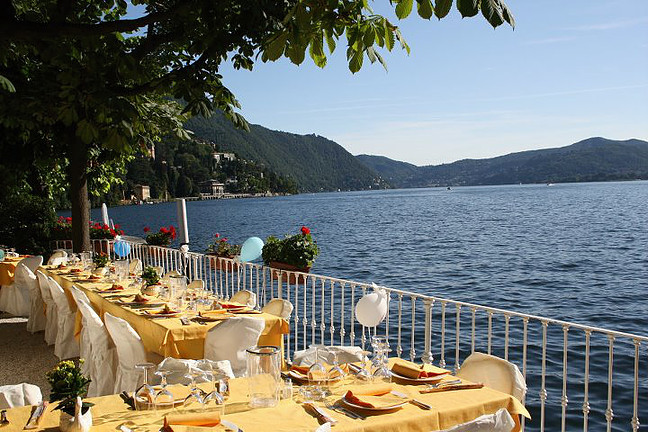
The Hotel Vapore has a splendid terrace overlooking the lake
Their first stop was at the nearby Hotel Vapore in Torno where they all disembarked and stayed for no more than thirty minutes – time for each of the men to drink a Strega (a fashionable liquor) and for Isabella to drink a vermouth. Gina did not drink anything.
Moltrasio, 21.30
At around 21.30 they decided to cross the lake to Moltrasio and stop off at the Hotel Imperiale. Here the men stood drinking Stregas at the bar while Isabella had a coffee and a cognac and Gina sat drinking tea. There would later be some dispute as to how much the men drank but Isabella would later testify ‘I do not know how much drink the three men had, I am sure none of them were drunk.’
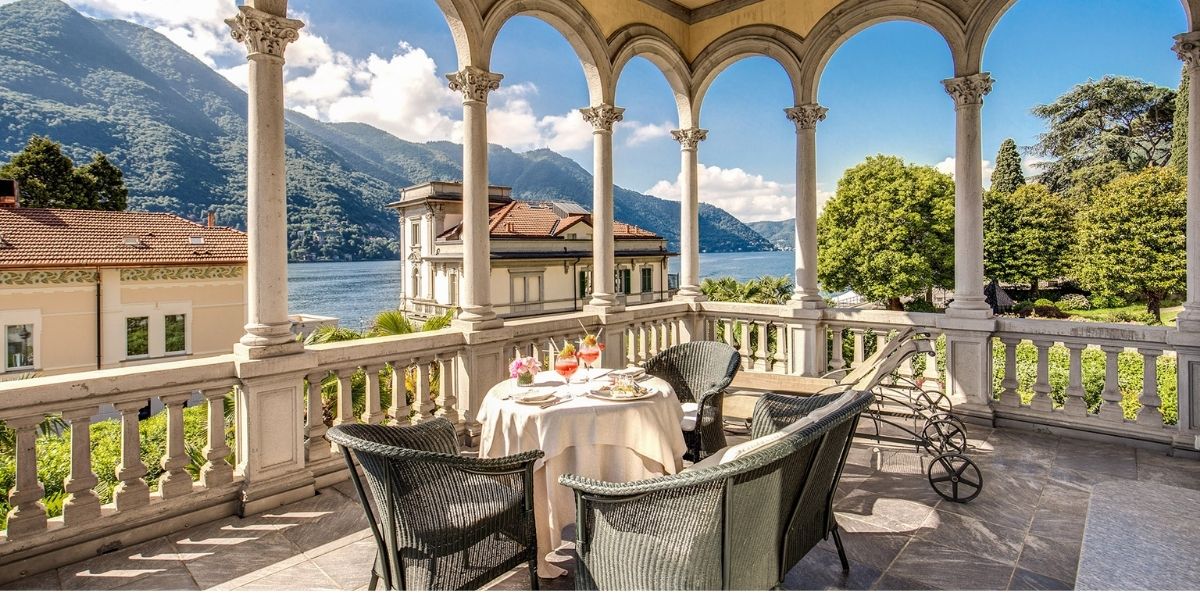
The Hotel Imperiale in Moltrasio
The party did not stay long with the skies darkening and the threat of a storm growing. Having settled the bill following some disagreement with the hotel management, the party set out to return to Blevio. Isabella later reported hearing a grating sound as the boat left the dock. This led to speculation that the hull suffered some damage at this stage but this theory was later discounted.
Lake Como
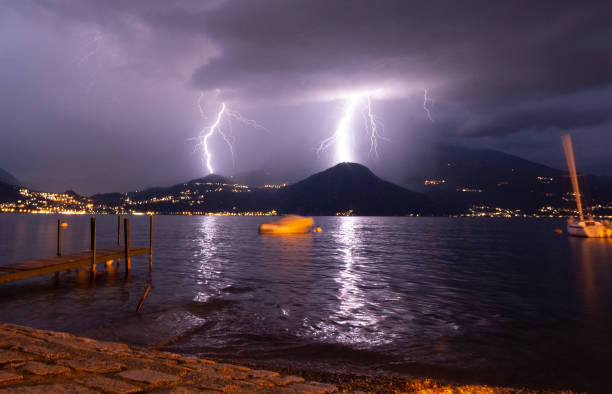
Lightning strikes at night in Lake Como, as seen from Varenna
Isabella and Gina were sat in the stern of the boat as they made their crossing when both realised their feet were getting wet. Captain Coffin told them to move up from the stern and sit on top of the engine housing at the prow. However the water level continued to rise at an ever faster pace. Major Poole looked around for some utensil to bail out the water but, without anything available, took up Major Parker’s suggestion to use his own shoes. With the engine at that point stalling, Captain Coffin tried to console his two women passengers whilst urging Major Parker to use the oar to try to keep the boat moving forward. However Parker had only managed about six strokes of the oar when there was a cataclysmic roar as the engine fell through a rent in the hull causing the boat to sink rapidly. The two women jumped into the water from the bow. Captain Coffin jumped in from the right hand side with Major Parker jumping from the left. As he surfaced onto the choppy waters, he heard a woman’s voice and swam towards it.
Torno, 23.15
50 year old Enrico Corti was returning home to Via Bensi in Torno when at around 23.15 he heard cries above the sound of the thunderstorm coming from on the lake. He launched a rowing boat with two neighbours, Franco Timoteo and Salvatore Bianchi, and set out in the direction of the cries. After ten minutes, and thanks to a flash of lightning, they saw Isabella De Marchi and rescued her from the water. Just a few minutes later they came across Major Parker seriously weakened by ingesting fuel oil and in a state of total exhaustion. They continued briefly to search for the three remaining members but paused to get the two survivors back to the Hotel Vapore in Torno. They then returned on the lake to resume their search but without any luck.
Major Parker was treated on the spot by a British military doctor and admitted to hospital in Como. He was later transferred to hospital in Milan in very poor shape. He did eventually recover and return to England.
Aftermath

Autumn mist on the lake at Carate. The lake has many varied moods particularly outside of the summer season.
At 11.00am on the following day, Salvatore Bianchi saw the body of a woman floating about three hundred metres off from the Villa Rocca Bruna. He retrieved the body which was brought into the villa to be identified later that day by Guido Ruberti, Gina’s father.
Captain Coffin’s military tunic was recovered from the lake near Blevio on 5th May. Both sleeves were turned inside out as if in a hurried attempt to take off the tunic. All pockets were unbuttoned and empty causing investigators to believe that someone had taken out all valuables before casting the jacket back in the water. Major Parker’s tunic was also found intact with no missing contents. The only other item to be recovered was a War Department duffle coat that had been worn by Isabella.
There was no sign then or since of the bodies of Major Poole and Captain Coffin.
The Accident Investigation
The Military Police investigation published its report on 18th May 1946 having interviewed and taken statements from all witnesses and the two survivors. It did not directly blame any of the party for the accident and also included comments from Isabella that sought to minimise blame on Captain Coffin for allowing the boat to be overloaded and refuting the suggestion that the men had drunk heavily during the trip.
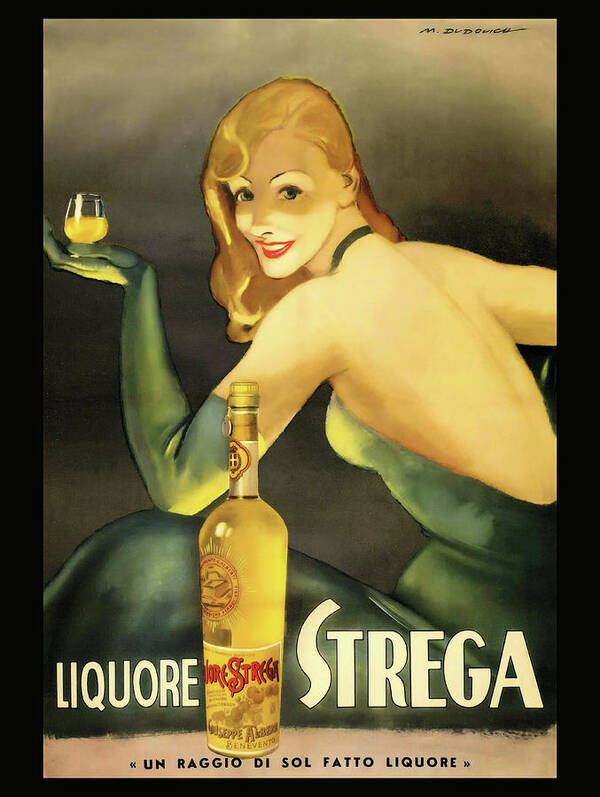
Contemporary advertising for ‘Strega’ (Italian for witch) – the drink favoured by the British Officers on their night out.
The report did suggest some blame on Captain Coffin for not seeking to get the boat officially requisitioned by the British occupation authorities as was the legal requirement for all boats operating on the lake. If done, the boat would have been submitted to an overall safety check by the local REME workshop. Private Gilbert, Coffin’s driver, testified that Coffin had owned a boat moored in Padova which had undergone a series of repairs to its hull. It was then found that these repairs and some mechanical adjustments had been done the previous February in Padova by German Workshop 938. It had then been transported by road to Lake Como, put on the water and given a four hour test by Hauptmann Wilhelm Trippe from the Padova 938 Workshop. The mechanical adjustments might well have included the fitting of a Ford V8 engine into the boat which was approximately 6 metres long by 1.5 metres broad.
The boat had been moored in the boathouse of the Villa Rocca Bruna from May 1st as witnessed by the caretaker of the villa, Luigi Invernizzi. Luigi was himself a keen boatman with a licence to pilot boats on the lake. He had looked over the boat with interest on its arrival and believed that the motor engine installed was too heavy for the bodywork of the boat. Craftsman Bennett from the local REME workshop claimed the boat was overloaded.
Thus in putting together the likely causes for the tragic sinking, the conclusions were:
- The boat was fitted with too heavy an engine.
- Multiple repairs had been undertaken to the hull, and the scraping noise reported by Isabella as the party left Moltrasio was most likely the sound of the woodwork beginning to crack.
- The boat was overloaded. There were five people on the boat and it was reported that two of the party, Majors Parker and Poole were stout men weighing just over 100 kg. (16 stone).
- The surface of the lake was very choppy.
- The rescue attempt by Enrico Corti and his colleagues was hampered by the dark and the raging storm.
Major Parker also believed that the engine had fallen through the hull of the boat and that this had caused the rapid acceleration in its sinking.

The ‘Breva’ motor launch built in 1933 by Cantiere Cranchi on Lake Como would have been similar in size and design to the boat owned by Captain Coffin.
Isabella’s claim that ‘none of the men were drunk’ was challenged in the statement from the Assistant Manager of the Hotel Imperiale on duty on the night of the tragedy. He stated that the three officers standing at the bar had each consumed within a relatively short period three double shots of Strega (the 40° liquor). They had then disputed the bill and finally agreed to pay once a ‘sconto’ had reduced it to Lit. 1,000 (the equivalent of 40 euros). While this level of consumption may not have affected the fate of the boat, it may well have hindered the officers’ capacity to survive in the water, firstly by making it more difficult for them to remove their heavy army tunics and secondly to maintain the effort needed to stay afloat. Isabella did in fact report both seeing Major Poole in the water and hearing him cry out, ”I can’t stand this any longer.”
Reference
National Archives Catalogue Number WO 32/22184: Report by Special Investigation Branch, Corps of Military Police, Central Mediterranean Forces. 18th May 1946.


My father, Captain Derek Cotton, was a POW at the Camp PG29 at Veano near Piacenza. With other prisoners he escaped after the armistice signed by Badoglio on 10th September 1943, and tredged through the mountains making contact with the family of Signora Maria Baio who co-ordinated much resistance activity in the area. With help from her and other contacts, he eventually managed to cross the border with the help of other Antifascisti escapees on 13th November 1943 long after the Germans had taken control of the border crossings. He managed to cross in Chiasso but I am not sure where (whether in the forest, or via someone’s back garden – I rather think the latter).
I should very much like to find the spot and visit in person if possible.
Can anyone help?
Thank you, Michael Cotton
LikeLike
Hi Michael
Give me a few days and I will see if I can find any reference to your father from local sources. I am assuming the info you already possess either came directly from your father or from the debriefing documents held in the National Archive. As you state, by November 1943 the Nazis had the Como/Chiasso border under tight control and so most clandestine crossings were forced up and over Monte Bisbino. That is the most likely but not the only possible route taken by your father.
LikeLike
Michael, please pass me your email and I can reply with some info already found
LikeLike