
Lake Pusiano with the village of Pusiano on its northern shore and Mount Resegone in the background.
At the foot of majestic Lake Como a string of much smaller lakes stretches out between Como itself and Lecco – each possessing their own charm. In order from west to east they are Lake Montorfano, Alserio, Pusiano, Segrino, Annone and Garlate. They were all formed as retreating glaciers left morainic deposits that dammed up the streams and rivers descending from the Alps. Such is the case of Lake Pusiano formed by the River Lambro.
Lake Pusiano

The park along the banks of the lake in Bosisio Parini is a popular spot for a weekend passeggiata
 Normally the surface of Lake Pusiano is particularly still perhaps due in part to its maximum depth of 27 metres – compared with the 425 metre maximum depth of Lake Como. This gives a perfect surface for the various rowing clubs in the area, including our own Canottieri Lario, to use it as their main base for training and competitive racing. The sense of tranquillity evoked by its calm waters is further emphasised by its contrast with the dramatic backdrop of Mount Resegone behind Lecco. All go to make Lake Pusiano, known as the Pearl of Brianza, a popular location locally for a relaxing weekend passeggiata or for a picnic along its shores.
Isola dei Cipressi
Adding further to the lake’s charm is the small oval-shaped island off its northern shores known as Isola dei Cipressi, so named after the one hundred and thirty monumental cypress trees growing there. Its literal ‘isolation,’ whilst remaining within shouting distance of the mainland, makes the island in some ways comparable to Isola Comacina, at least in terms of its atmosphere if not its scale. Gerolamo Gavazzi, the current owner of the island, identifies precisely what this magical quality is in the opening sentence of the preface to his book dedicated to his island. He states, “Islands have always held a strong fascination. The surrounding water creates a sense of protection for those within their shores, and a sense of adventure for those who view them from afar.”
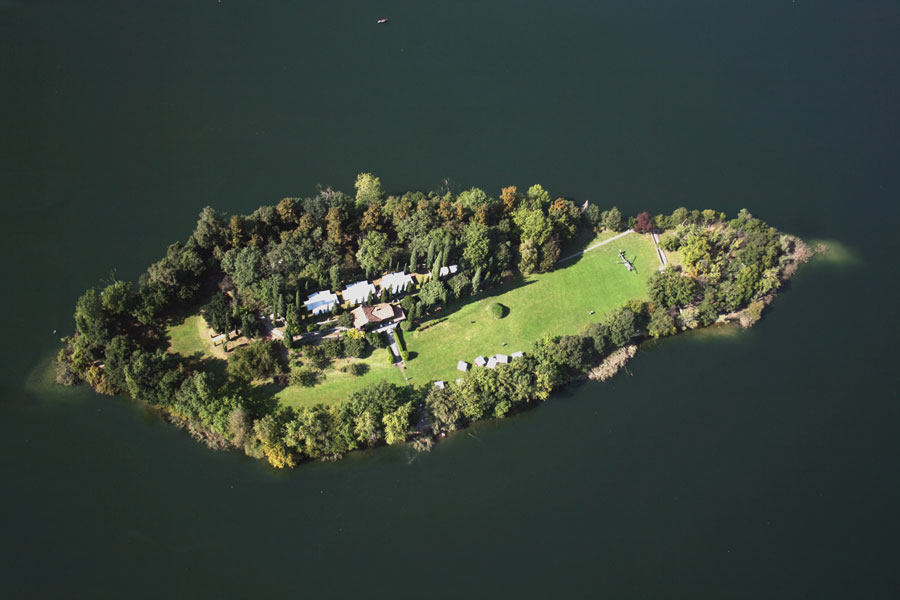
The oval shaped Isola dei Cipressi with its 130 cypress trees and abundant wildlife.
Unlike Isola Comacina, Lake Pusiano’s island was never the site of full time occupation after the demise of the original Neolithic residents who lived there around twelve thousand years ago. Its changes of ownership from the Middle Ages to today reflect the various changes in the dominant power of the time.

Lake Pusiano, the Pearl of Brianza
From the 14th to the 17th century it was owned by one branch or other of the church. The aristocratic Carpani family, who came to own large tracts of land around Erba, took ownership of the lake and island from 1483 and also set about building the splendid Palazzo Carpani in Pusiano. From the late eighteenth century, the lake, island and palace passed on to the Molo and D’Adda families who owned it until the early 19th century when it was passed on to a series of viceroys representing either the Austrian or French domination of Lombardy. It became the property of the local municipality of Bosisio in 1869 but was sold five years later to the ancestors of the current tenants, Antonio and Egidio Gavazzi – wealthy silk industrialists from the nearby Valmadrera. The state took ownership, as with all internal waters, in the 1920s allowing former owners rights of tenancy as in the case of the Gavazzi family who still retain tenancy of the island to this day.
The main commercial interest of the different owners over the years was in the granting of fishing rights and the obligation by law to guarantee a certain level of supplies of fish to Milan.

Palazzo Carpani in Pusiano – originally built in 1688 by Bartolomeo Carpani and once the summer home of Prince Beauharnais.
The island of course was also a glorious summer retreat but it never offered any truly comfortable overnight accommodation until relatively recently. Perhaps its best known historical occasional resident was Prince Eugene of Beauharnais, the stepson of Napoleon, who served as the French viceroy to Lombardy from 1805 until 1814. He was a young, handsome and heroic military commander renowned for his numerous amorous adventures. He spent much time in the Palazzo Carpani in Pusiano as well as on the island where he had a small one room structure built there for his ‘convenience’.

Prince Eugene of Beauharnais, Duke Leuchtenbergh and Prince of Eichstadt, Napoleon’s stepson and Viceroy of Italy from 1805 to 1814.
Beauharnais’s one room shelter was later extended, and an ice house built within the ground. In 1831 a fish canal was built running the width of the island’s eastern end. This served as a place to deposit caught fish, preserving them alive until required. 1831 also saw a change in fortune for the grand Palazzo Carpani which was then converted into a silk spinning and weaving factory. A general decline began to set in symbolised by the felling of the island’s original set of cypresses that had been planted in the 1770s by the Marquis Giuseppe Antonio Molo.
Looking at the lake and visiting the island today you would not believe that both had reached a sad state of neglect and decline by the 1970s and 80s. The River Lambro and the lake had been allowed to become heavily polluted with domestic and industrial effluent. No-one seemed to care about enforcing the local by-laws governing local planning, fishing or general maintenance of the area. The island had become a dumping ground for waste. All started to improve from 1991 when local laws started to be enforced, controls were placed on abusive building and strict fines imposed on any household or business allowing untreated waste into the waters. The Gavazzi family undertook a massive programme for clearing the island, replanting the trees and returning the environment to its former status as a favoured spot for migrating birds.

Isola dei Cipressi
Fish stocks in the lake have also returned to former levels in terms of overall quantities but the numbers of the favoured quality varieties such as trout and perch have not yet fully recovered.
A Gulp of Cormorants, a Creep of Tortoises and a Troupe of Wallabies
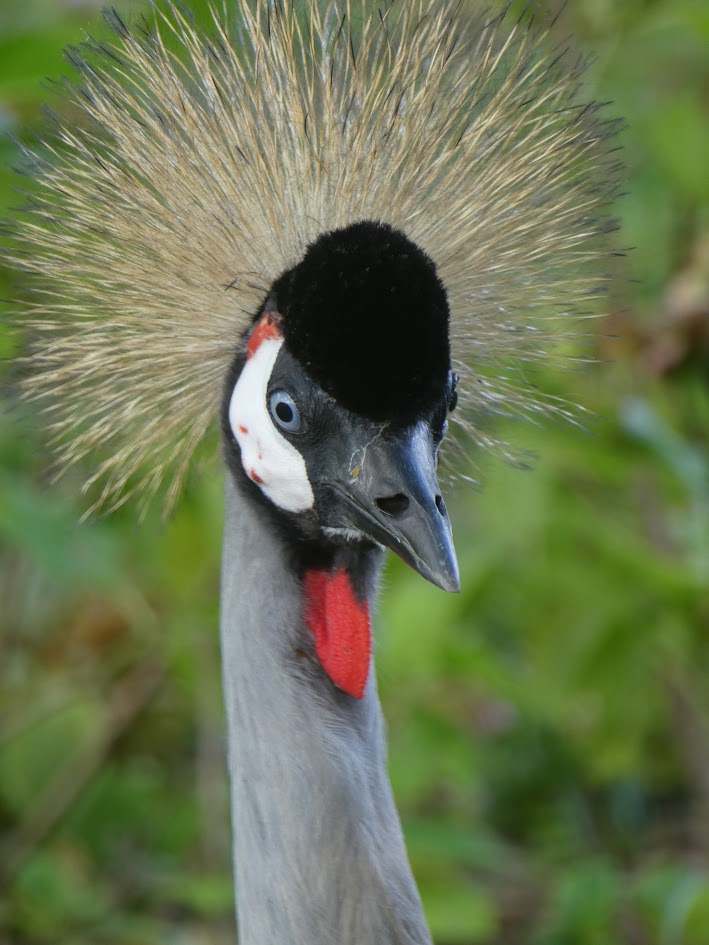
A pair of African Crowned Cranes patrol the island
Isola dei Cipressi is now the permanent home for a pair of African Crowned Cranes who majestically stroll the grounds with their heads held high. They share company with a pair of peacocks and a considerable number (a ‘creep’ to use the appropriate collective noun) of tortoises, some of which are quite sizeable. They are joined by a large flock (a ‘gulp’) of cormorants who nest over the winter months and, as result, lay down a carpet of guano that reinvigorates the gardens. And until relatively recently they were all joined by a ‘troupe’ of wallabies – the diminutive cousins of kangaroos. This troupe was 13 members strong but unfortunately the Italian state had them classified alongside their relatives as dangerous and so they were removed.
In 1991 the zoo in Milan closed and Gerolamo Gavazzi agreed to rehouse their two wallabies on his Isola dei Cipressi. There they flourished so well that numbers grew to thirteen until 30 years later a court order demanded their ‘exile’ to a reservation in the Province of Grosseto in Tuscany.

Wallabies are related to kangaroos but are much smaller and less aggressive.
The order was forcefully contested at every stage but the final decision of the Appeal Court in Rome (the Corte di Cassazione) upheld their eviction. The fate of the wallabies reached the attention of the national media and, with the support of the local newspaper, a petition called upon the Minister of Health to put a stay of execution on their removal. All to no avail since the underlying official concern was the closeness of the troupe to the island’s visitors with the risk they could act as agents in transmitting viruses from wild animals to humans. Essentially the wallabies were victims of the paranoia over virus transmission resulting from Covid and its devastating impact on Italy and worldwide.
Further Information
The days of degradation of the lake, its island and the Palazzo Carpani are long past. One section of the lake covered in reeds is now marked off as a nature reserve, its waters are clean and full of fish. The Palazzo Carpani has received massive investments in recent years from charitable funds to restore it to its glory days during the time of Prince Eugene of Beauharnais. It now houses the municipality, local library and other local institutions. Ville Aperte Brianza open it to the public twice a year. Visitors are also welcome to the Isola dei Cipressi by contacting the Pro Loco Bosisio Parini who organise transport and catering if needed. The rowing clubs still take advantage of its still waters to train their athletes and hold competitions whilst the cormorants thrive by feeding on the lake’s abundant stock of fish.

Gerolamo Gavazzi had this tree house built overlooking the lake for the pleasure of his family
Websites: Bosisio Parini Pro Loco, Isola dei Cipressi, Palazzo Carpani.
Bosisio Pro Loco can be contacted via prolocobosisio@gmail.com
Link here to the other Brianzolan lake featured in Como Companion – Lake Montorfano, which we describe as a glorious spot for wild swimming.
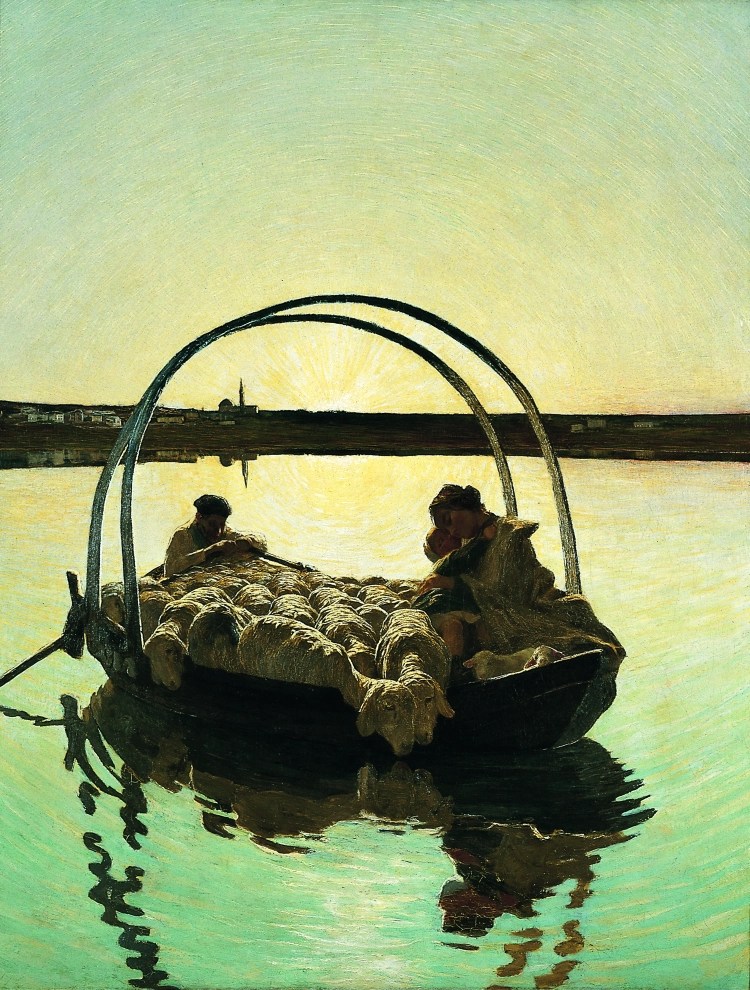
‘Ave Maria a trasbordo’, Giovanni Segantini 1886. Segantini moved from Milan to Pusiano in 1881. One of his best known pictures is this depiction of a lucia loaded with sheep on Lake Pusiano with the village of Bosisio Parini in the background. The painting now hangs in the Segantini Museum, Saint Moritz.


 The Como Companion