
The ‘Mona Lisa’ by Leonardo Da Vinci on display in the Louvre.
The two most renowned artists of the Italian Renaissance are Michelangelo, employed by the Medici of Florence, and Leonardo Da Vinci employed by Ludovico ‘Il Moro’ Sforza, Duke of Milan. During Leonardo’s time in Milan he became well acquainted with the River Adda and the lake and mountains around Lecco. So much so that, on his return to the area in the early 1500’s he decided to set two of his best known paintings amongst the landmarks on Lake Como’s eastern leg. At least this is where many experts now identify the landscape depicted in the background of the ‘Mona Lisa’ and his ‘Virgin of the Rocks‘.

Identifying the geological features which locate the background to the picture in the valley of the River Adda and on the Lecco leg of Lake Como
Back in May this year there was a flurry of publicity around the claims made by an American cultural geologist Ann Pizzorusso stating she had identified the background setting of the Mona Lisa. She identified the background to the picture as depicting Lake Garlate, and the Azzone Visconti Bridge which stands at the northerly end where this lake joins Lake Como at Lecco. Her arguments for making this claim are based on the geological formation of the rocks and mountains surrounding the lake as shown on both the left and right hand sides of the portrait. These are typical karst formations that can be found in soluble limestone mountains such as Mount Resegone, Le Grigne and Monte San Martino in the Province of Lecco.
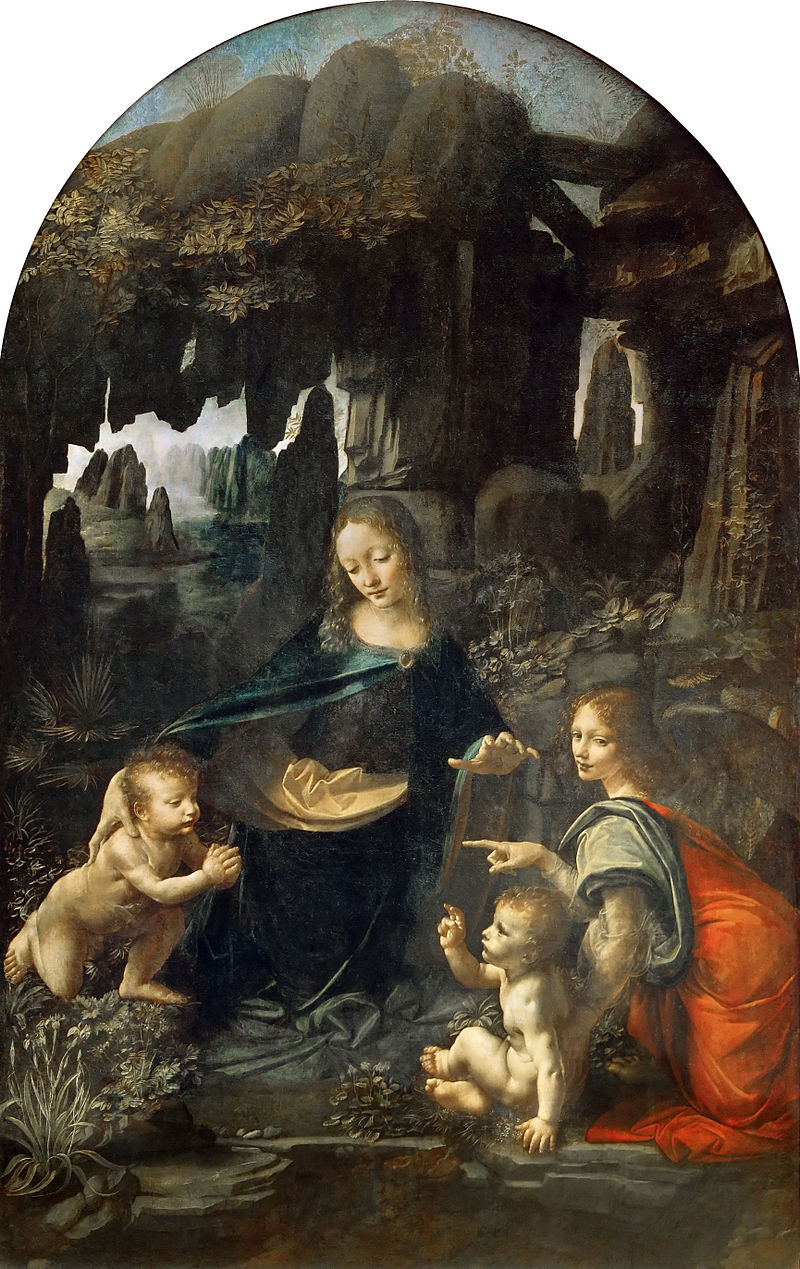
Leonarda Da Vinci’s ‘Virgin of the Rocks’ held in the Louvre.
Ann Pizzorusso also places Leonardo’s ‘Virgin of the Rocks’as set amongst the limestone peaks behind Mandello Del Lario. Her analysis was published in her book ‘Tweeting Da Vinci’ published in 2014. Her theory is based on the knowledge that Leonardo did not invent either vegetation or landscape in his works. On this basis she dismisses the version of the Virgin of the Rocks held by the National Gallery in London as a copy of the original held in the Louvre since only the Paris-held version references actual vegetation, typically that to be found in the Lecco area, rather than the fantastical vegetation depicted in the National Gallery version.
Ann Pizzorusso’s flamboyant recent declaration of the setting used in the background to the ‘Mona Lisa’ was reported widely from the USA in the New York Post, to Italy in the Corriere della Sera and in UK’s Guardian and even the Daily Mail – but she was merely giving further weight to similar conclusions arrived at in former years by a series of Italian academics – most notably, Riccardo Magnani. Magnani, now aged 61, is a graduate from the prestigious Università Bocconi in Milan. Although he graduated in finance, he has since become a respected Leonardo expert. He published his theory on the setting of the Mona Lisa back in 2017 claiming that ‘the truth is under the eyes of all capable of looking without any cultural training’. He is categorical in claiming the lake is Lake Garlate with the Azzano Visconti Bridge at its head looking north to the mountain ranges behind Lecco.

Leonardo’s ‘Mona Lisa’ on the left alongside Francesco Melzi’s version entitled ‘ Ritratta di Dama’ on display in Madrid’s Prado Gallery
Magnani’s theory on the setting of the Mona Lisa was further supported by another Leonardo expert, Luca Tomio who presented a very similar analysis in a convention in Milan in October 2018. Tomio claimed that the view in the painting’s background is seen from a vantage point above Vaprio D’Adda. What has helped all three of these experts in determining the Lake Como setting was a comparison of Leonardo’s original with a copy made by his friend and student (and possible lover), Francesco Melzi. Melzi’s version is known as ‘Ritratto di Dama’ and is on display in Madrid’s Prado Gallery. Tomio dates both this and the Leonardo original as being painted between 1511 and 1512 when master and student returned to Lombardy to stay in the Villa Melzi in Vaprio D’Adda. He also believes both works share a similar style of depicting mountains as can be seen in other studies by Leonardo of Mount Resegone and Le Grigne completed in the summer of 1511.
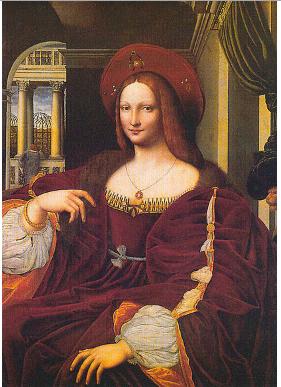
Isabella D’Aragona Sforza
But who is the actual subject of the ‘Mona Lisa’ portrait. In the same way there have been different theories put forward for its setting, there is also debate about who is actually represented with the enigmatic smile. Leonardo’s portrait is better known in Italy as ‘La Gioconda’ because some believe it depicts Lisa Gherardini – the wife of a wealthy Florentine merchant called Francesco Del Giocondo. If the painting really is of Lisa Gherardini, then the Lake Como setting is entirely inappropriate. However an alternative theory is that the portrait depicts Isabella d’Aragona Sforza – the niece of the King of Naples, Ferdinando I d’Aragona and the wife of Il Moro’s son, Gian Galeazzo Maria Sforza. Theirs was a diplomatic marriage intended to secure agreement between the Napolitan Bourbon dynasty and the Dukedom of Milan. Whether the painting was completed around 1503 or 1512, in either case Isabella would have been widowed since Gian Galeazzo died early in 1494, and she would have been either 33 or 42. Further evidence placed in support of the Lake Como theory is the similarity of the Mona Lisa’s hairstyle to the fashions of the day in Lombardy. Photography work carried out in Paris by Pascal Cotte has also revealed twelve pins in the Gioconda’s cap which again was a tradition around Lake Como at the time.

Lucia Mondella, the heroine from Lecco from Alessandro Manzoni’s ‘The Betroved’ (I Promessi Sposi)
Leonardo Da Vinci had moved to Milan in 1483 and worked for Ludovico Sforza until 1499 on many of the civil and military engineering projects sponsored by the Sforzas. He is said to have returned to Lombardy on future occasions as in his stay in Villa Melzi in 1511. The waterway via the River Adda linking Milan to Lake Como was critical for both transporting goods and irrigating the agricultural land in the Pianura Padana. Leonardo designed ferries to cross the river and was involved in studies for improving the river’s overall navigation. These included the Paderno Canal (Naviglio di Paderno) designed to circumvent one of the non navigable sections of the river and also linking the Martesana Canal to the network of canals within Milan itself. He thus knew the area well from Milan up to the Lecco side of Lake Como. His Codice Atlantico makes reference to the mountains around Lecco and to Mandello del Lario in particular. He is believed to have put forward ideas for building a canal to run alongside the River Lambro running out from Lake Pusiano down to Milan. While we may never know for certain who is the subject of Leonardo’s masterpiece or whether it references the landscape of Lake Como or Florence, it remains indisputable that the Adda Valley and Lecco’s mountainous sides of Lake Como are singularly beautiful and a fitting subject for an artistic genius such as Leonardo.

A page from Leonardo’s monumental Codice Atlantico showing notes on improvements to the navigability of the River Adda.
Further Information
More information on the valley of the Adda is available from https://www.ecomuseoaddadileonardo.it/ and https://turismo.parcoaddanord.it/punti_di_interesse/muva-museo-della-valle-delladda/

Some of the attractions to be found along the cycle path following the banks of the River Adda.


 The Como Companion