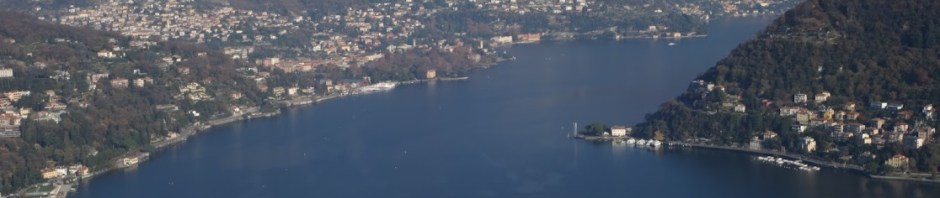
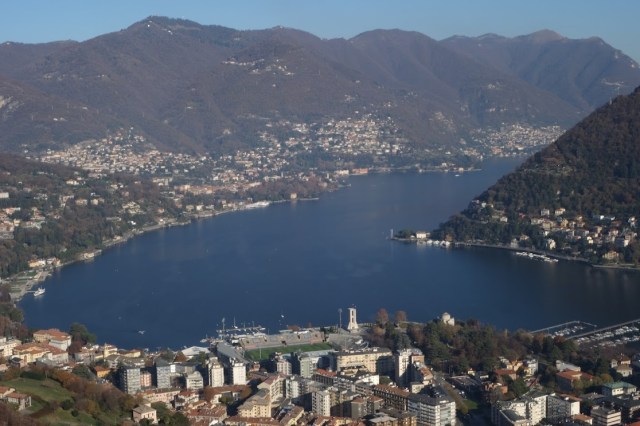
Como in the foreground and Cernobbio on the left hand side of the lake
On the 19th July 1944, Cernobbio’s Commisario Prefettizio, Angelo Martinelli, wrote the following letter to the Prefect of the Province of Como, Renato Celio:
The geographical position of Cernobbio – precisely due to its proximity to Milan -, the fame it has acquired over many years and, last but not least, its well-known tourist organization for supplies, well-stocked shops, health services, etc., etc. ., have put the town, in relation to the displacement situation, in a particularly difficult situation.The Italian and German commands have drawn heavily on hotels, villas and private homes; commercial organizations, semi-public or otherwise, have created offices; large Milanese companies, especially after the bombings of August 1943, have transformed hotels and villas into offices and company canteens, so that a frantic and sometimes ruthless hunt for apartments and rooms has developed. The current situation does not allow us to have even one space left available and it would be really appropriate for Cernobbio to be forgotten for the moment. It must be kept in mind that the water, gas and electricity systems are based on a presence of 5/6000 people, while currently the inhabitants are almost double that figure. For these reasons Cernobbio cannot logically increase the already overwhelming number of its residents, nor can its houses be further congested. It is hoped that by taking the above into due consideration, we will desist from any new requisitions and requests in the town of CERNOBBIO.
From the start of the allied bombing campaign over Milan that reached a crescendo in August 1943, Cernobbio had housed individuals, families, businesses and state organisations seeking a degree of safety from constant bombardment. Martinelli’s letter identifies the reasons why Cernobbio was particularly selected as a refuge, due to the number of holiday homes, the tourism infrastructure and, not least, its pleasant location on the lake. Its location close to the Swiss border offered some degree of assurance against allied bombing with the allies keen to avoid the risk of shells falling inadvertently within neutral Swiss territory. For others as well, the town offered the reassuring possibility to make escape over the border if necessity required it.
But the principal demand for accommodation in Cernobbio came from abroad – from the moment of the Nazi occupation of Northern Italy that immediately followed the Badoglio government’s armistice with the allies announced on September 8th 1943.
In ever increasing numbers arriving at their zenith in September 1944, the Nazis either sequestered or requisitioned rooms, apartments, hotels and entire villas across the town. There were three Nazi organisations primarily heading this occupation. The Luftwaffe requisitioned the Hotel Villa D’Este as a military hospital. Sections of Heinrich Himmler’s SS and SD sequestered Villa Fargion (now known as Villa Carminati) as their base for the Frontier SS controlling border activities. The RUK (Albert Speer’s department of the Reich government responsible for war provisions and armament production) took over Villa Erba. Both the SS/SD and the RUK extended their occupation of the town from September 1943 to April 1945.
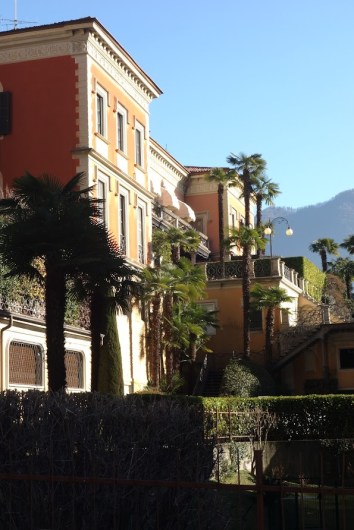
Villa Carminati (formerly Villa Fargion)
Villa Carminati became the barracks and prison for the Frontier SS known as Como West – Grenzbefehlsstelle. This division of the SS was responsible for managing the frontier with Switzerland from the Val Ossola to the far corner of the Valtellina. Its location in Cernobbio reflected the importance of the official crossing of the border by road and train at Chiasso. The Como West group controlled all access to and from Switzerland. The rail link from Como to Chiasso in Switzerland, managed from Cernobbio, was critical for the transport of food and war materials produced in Italy for distribution in Germany. The other formal and clandestine routes into Switzerland became increasingly important to the Germans as the war progressed proving eventually absolutely critical in the final days of ‘Operation Sunrise’ – the surrender negotiations between Karl Wolff, the Head of the SS in Italy, and the allied delegations in Berne. Como West became used as the bridge in the passage of secret agents organised by the SD and reporting officially to the head of Grenzbefehlsstelle, SS Hauptsturmführer Joseph Voetterl.
One of the protagonists representing the SS in ‘Operation Sunrise’, Baron Parrilli, had a very low opinion of Joseph Voetterl as shown in this quote from ‘La Resa degli Ottocentomila’ – the account of Baron Parrilli’s wartime exploits written by Feruccio Lanfranchi. These comments by Parrilli followed on from being denied return access to Switzerland via the border at Chiasso:
“In reality, the “higher orders” did not come from Garda, but from the nearer Lake Como: the ban on allowing Baron Luigi Parrilli to enter Switzerland had been given by the commander of the border SS, Captain Giuseppe Voetterl, who had created a sort of fortified citadel in Cernobbio, requisitioning some villas and establishing his residence in the most beautiful and spacious Villa Geltrude Locatelli; another building, Villa Levi, had been reserved for guests. Captain Voetterl left nothing to be desired! I went to Villa Locatelli to ask him the reason for the ban. He greeted me with cold haughtiness, stating that the pass I had was valid for a trip or two at most. My back and forth with Switzerland didn’t convince him and he decided to stop it: that’s all. The officer’s tone especially irritated me. I replied, dryly: “Well, if you have any doubts, call Fasano, Rosenfels private switchboard: you will receive precise orders from General Wolff himself.”
The German occupation of Como had commenced on 12th September 1943 with their primary objective to stop the massive flow of fugitives crossing over the border into Switzerland via Ponte Chiasso. Joseph Voetterl was in command of the Frontier SS charged with controlling the border. He immediately took over the Villa Carminati sequestered from its owner, Eugenio Fargion.
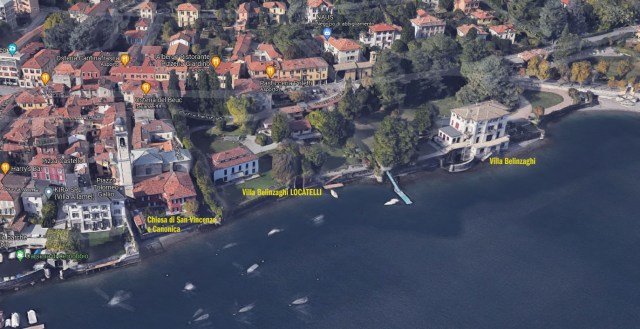
The lakefront at Cernobbio with Villa Belinzaghi (occupied by the RUK) to the right and Villa Belinzaghi Locatelli (occupied by the Frontier SS) closer to the San Vincenzo church.
A month later on 15th October 1943, he took possession of the entire Villa Belinzaghi Locatelli on the lakefront having requisitioned it from its owner, the Countess Nora Belinzaghi. Villa Locatelli became the preferred location for receiving and hosting the numerous high Nazi officials and agents on their way to or from Switzerland.

A letter from Joseph Voetterl to the Prefect of the Province of Como confirming the latter’s right to proceed with the sequester of property and goods belonging to Giuseppe and Guglielmo Levi following their arrest and imprisonment in Milan for the crime of being Jewish
Many of those seeking refuge across the Swiss border were both foreign and Italian Jews who, following the Nazi occupation, faced the serious risk of deportation to one of the Nazi-run extermination camps in Eastern Europe. The Frontier SS worked in collaboration with local bands of fascists such as the Monte Rosa Legion who readily took responsibility for capturing Jews and others defined as ‘enemies of the state’. The captured Jews would then be brought to Villa Locatelli/Carminati and handed over to Joseph Voetterl who was responsible for approving their imprisonment (usually in Milan’s San Vittore prison) and onward deportation to extermination camps. He would then relay his decision by letter to the Como Prefecture giving the fascist state confirmation of its right to sequester all of the prisoners’ goods and property.
The persecution of Jews provided a source of funds for the fascist state evidenced by the law passed in February 1939 that put limits on how much property and industrial activity Italian citizens of Jewish origin could own. All goods above the set legal limit could be sequestered and proceeds from sale granted to the state. An organisation known under the acronym of EGELI was set up to manage and dispose of all goods and property sequestered under this law.
In selecting facilities for the Frontier SS, Joseph Voetterl took advantage of those properties in Cernobbio belonging to Jews that had or could be sequestered under the fascist law. The largest one of these was the Villa Carminati. It had been owned as a second home on the lake by Eugenio Fargion, but had been sequestered by EGELI around September 1943. Eugenio Fargion himself had managed to reach safety in Switzerland over the summer of 1943. His sister Elisa and her husband Gastone Levi had themselves also spent that summer in the villa but had not managed to follow Eugenio over the border. They were later arrested on their return home to Ferrara. They were then deported to Auschwitz and faced execution on the very day of their arrival there on the 26th February 1944.

The location of Villa Carminati on Via Della Libertà
The fascist state later sought to take possession of Villa Carminati from Voetterl’s Frontier SS. A decree was passed by the Milanese Prefecture on 10th February 1945 confirming the right of the RSI (Mussolini’s puppet Socialist Republic of Italy) to take possession of the villa. A judicial delegation arrived at the villa on 3rd March to enforce the state’s right of ownership. However Voetterl’s division refused their entry and also refused any suggestion to move out. EGELI continued to make claim to the property as belonging to the state with the Nazis having no right to possession. Voetterl continued to ignore the RSI’s claim. The Frontier SS continued to use Villa Carminati as an administrative base and centre of detention until abandoned as part of the general Nazi retreat in late April 1945. It was immediately occupied by allied troops.
Baron Parrilli was right in claiming that Voetterl was building up a citadel in Cernobbio with mention of the Villa Levi being occupied for guests of the Frontier SS. This villa, at No.3 Via Cavour, had been sequestered from its Jewish owner, Vittorio Levy. The Nazis occupied it from October 1943 until April 1945. Vittorio’s son, Dr. Aldo Levy, wrote a letter to the Cernobbio Municipality on 12th July 1945 seeking compensation for rent not paid during that period.
EGELI records list two additional properties sequestered from Vittorio Levy and occupied by the German command, namely Via Cinque Giornate, 150 and Via Bernasconi 7C. The latter villa was later redefined as requisitioned rather than sequestered in a note from the Cernobbio Municipality dated 25th August 1944.
Another large sequestered property occupied by the Nazis was the holiday home of Mary Sforni just across the border of Cernobbio with Como at Tavernola. The EGELI records show that the entire villa, its gardens, outhouses, boathouse and landing stage were occupied by the SS – Joseph Voetterl’s division. Mary Sforni herself had moved to Florence with her husband, the scientist Tullio Terni, and her children in 1941. She survived the war hiding out in the Tuscan countryside at Tutignano.
The German command occupied many other properties in Cernobbio but these were for the most part requisitioned through orders to the local municipality, through its Commissariato Alloggi. Owners of requisitioned properties were due compensation not paid by the Nazi occupiers but by the municipality itself. Compensation was based on a rental value based on predefined tariffs. As an illustration, when Aldo Levy after the end of the war claimed for non-payment of rent due to sequestration of his father’s property on Via Cavour, he sought compensation from the municipality based on rents charged for similar sized properties at 9,900 lira per month. Rates were fixed at the beginning of the period of Nazi occupation in September 1943 and did not vary up until liberation in April 1945 – a period that saw considerable inflation and devaluation of the Italian lira.
The German command passed all the invoices they received for rent to the municipality which, under the terms of the occupation, was obliged to pay for the accommodation and for all other services rendered to the Nazi occupiers. The Cernobbio Municipality would then in turn seek funding to cover these costs of occupation from the Como Prefecture. A note passed from Cernobbio’s Commissario Prefettizio dated 25th January 1945 to Renato Celio, the Prefect of the Province of Como who succeeded Franco Scassellati, specified that the annual expenditure for maintaining the German occupation during the previous year amounted to 2,304,907.55 lira and that this had been covered by funding from the Province of Como of 2,305,000 lira. The note also asked for an immediate advance of 700,000 lira to meet demands already received in January for 407,625 lira with more invoices in the pipeline. The Municipality were even charged for the cost of feeding prisoners of the Frontier SS retained in the Villa Carminati.
Villa D’Este

Villa D’Este, requisitioned to serve as a military hospital for the Luftwaffe.
The largest of Cernobbio’s requisitioned properties was the Hotel Villa D’Este acquired initially for Joseph Voetterl but then passed to the German Luftwaffe for use as a military hospital known by the Nazis as the Luftwaffen Lazarett.
Initially the Nazis in the name of the SS requisitioned the use of fifty rooms in the hotel from the 16th September 1943 – almost immediately following their occupation of Northern Italy. They then requisitioned the hairdressing saloon within the hotel owned by Signora Cervieri from 1st November 1943. The following month they requisitioned the entire hotel at an annual cost of 115,000 lira with an order from Hauptmann, PlatzKommandator Como for the hotel and its dependance to be left empty by 1st February 1944. By then, the SS and Joseph Voetterl had clearly agreed to allow the German Army (the Wehrmacht) rather than the SS to make use of the site.

Monte Bisbino with Villa D’Este on the lakefront. The path up to Monte Bisbino was one of the most common routes for making a clandestine crossing over the border into Switzerland.
Prior to the Nazi possession of the entire site, the Director of the Villa D’Este, Augusto Besana, sent a letter on the 28th December 1943 addressed to the then Prefect of the Province of Como, Franco Scassellati, in which he complained how the Germans had already transported furniture from the hotel to furnish private residences and offices in and around Como. In spite of the hotel being denuded of its furniture, the Cernobbio Municipality received various requests from residents demanding reimbursement for furniture requisitioned by the Nazis for the Luftwaffen Lazarett.
In later months the hotel’s garages and the apartments above them were requisitioned for Nazi use at a cost per month of 22,000 lira for the garages and 3,400 lira for the apartments. The apartments were used as accommodation for the hospital’s doctors. Other rooms in the town were requisitioned for use by the German nursing staff.
Joseph Voetterl, in giving up the use of the Villa D’Este for the Frontier SS, set his eyes on the Villa Belinzaghi Locatelli on the lakefront but closer to the town centre. This villa was requisitioned from 15th October 1943 at an annual cost to the municipality of 150,000 lira. This became the main headquarters of the Frontier SS where they would receive high ranking Nazi and fascist officials. Baron Parilli stated that Voetterl himself lived there although other sources state he retained his residence in Como’s Hotel Barchetta.
In between the Villa Belinzaghi Locatelli and the Villa D’Este was the similarly named Villa Belinzaghi, also formally owned by the Countess Nora Belinzaghi. This was occupied by a group belonging to the Reich Ministry of Armaments and War Production (the RUK) headed by General Hans Leyers in Italy. The RUK group who occupied Villa Belinzaghi focussed on managing aircraft production. They moved into forty rooms of the villa at a cost to the municipality of 14,500 lira a month.
Villa Erba

Villa Erba, requisitioned with its extensive park and gardens by the Armament Office of the Wehrmacht
The impressive holiday home and park of the Visconti di Modrone family, Villa Erba, immediately attracted the attention of the German and RSI military authorities. Initially it was occupied by the Republican National Guard (GNR) which had been established in December 1943 by Mussolini. However they would be ousted by a requisition order from the Nazis that resulted in the Cernobbio Commissariato Alloggi sending out a notification on the 16th August 1944 commanding the GNR to vacate the villa by the 27th of the month. The entire villa, its park and the Villa Vecchia (Villa Gastel) had been requisitioned on the orders of the Director of the Italian Army Weapons Office, General Ritter Von Horstig. The administrators for Edoardo Visconti di Modrone and his sister Ida wrote a letter to the municipality on 13th October 1944 seeking to secure agreement over the rent they should receive in compensation for giving up the complete property with the exception of two rooms in Villa Gastel used to store the furniture of Ida’s husband. They pointed out that the Nazis had also constructed six wooden barracks in the park.
Von Horstig had identified the strategic advantage of Cernobbio in close proximity to the all-important rail link with Germany via Chiasso as an ideal location for the warehousing of arms either for or from the Reich. Not only was the Villa Erba’s park used as a fuel repository but most of the buildings running alongside the River Breggia towards Maslianico were used for military warehousing.
The Frontier SS, the RUK and the Military Hospital had been quick to establish their presence in Cernobbio shortly after the Nazi occupation in September 1943. In the ensuing months, the demands for accommodation continued to grow particularly after the fall of Rome in June 1944 which caused the relocation of many Nazi offices to the north. Although the Nazis favoured Lake Garda and Verona to locate their administrative offices, the attraction of setting up on Lake Como close to the Swiss border increased as their imminent defeat became more obvious to them and the fascist hierarchy.
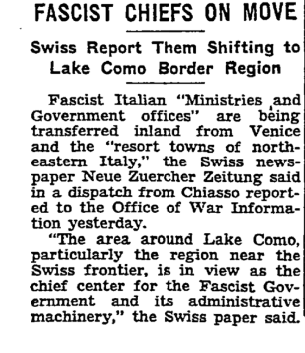
New York Times report dated 22nd August 1944 on the RSI decision to move many of its administrative offices to the area around Como and Cernobbio.
A conference held by the SS in April 1944 at the Villa D’Este outlined plans for extending the foreign secret service branch of the SD (Amt VI) in Milan and Cernobbio with the purpose of sending agents into Switzerland and into the allied occupied half of Italy. Joseph Voetterl hosted the AMT VI administration in the Villa Locatelli and set out to requisition further lodgings for the increase in staff.
The number of large hotels in Cernobbio provided an obvious solution for housing temporary visitors and a provisional base until accommodation was requisitioned for those staying on permanently. The Prefect of Como Province, Franco Scassellati, had established the charging regime for hotel accommodation back in January 1944 as follows:
- Where less than half the total number of rooms were rented, the cost was per room
- Where over half the rooms were rented, the cost was as fixed by the Ministry of Popular Culture
- Where all the rooms were occupied, the cost was fixed by the ‘Commando Presidio Germanico’ in agreement with the podestà.
Invoices for German occupation were passed on to the Como Prefecture from the Albergo Asnigo, Miralago, Centrale, Regina Olga and the Terzo Grotto. This latter hotel was requisitioned by the Nazis in its entirety from September 1944. The apartment belonging to the former Director of the Hotel Villa D’Este, Augusto Besana, in the Villa Besana Ciani was requisitioned for Germans previously housed in the Albergo Miralago.
A number of individual rooms and apartments were also requisitioned across Cernobbio. In August 1944 two rooms and a bathroom in Via Carlo Porta 5, and belonging to the Suore di San Giuseppe, were rented out to six German nursing nuns working at the Villa D’Este. A further six rooms at this address were requisitioned in October. Back in August an empty apartment of five rooms belonging to Pastore De Micheli on the second floor of Via Regina 55 was requisitioned. Three rooms and a sitting room in a property owned by the Tessitura Seriche Bernasconi were rented out to the Nazis in September 1944.
There are instances where the Nazis requisitioned property for possession by Italians. For example, tin September 1944 the Nazis ordered the requisition of an apartment in Via 24 Maggio 21 to be occupied by the Rizioli family. In the same month an apartment of five rooms at Via Perlasca 1, belonging to Giuseppe Vismara was rented out to the Dotti family on orders of the German command and presumably at the expense of the Province. This may have been to compensate for the fact that the Nazis had requisitioned in turn the entire seven-roomed villetta belonging to Alfredo Dotti at Via Cavour 5. Alfredo Dotti was later rehoused after the German surrender by virtue of a requisition by the allied command of a property in Via Privata Lupi belonging to Carlo Cavalleri, the proprietor of the Albergo Centrale.

New York Times report dated September 6th 1944 based on intelligence provided by Italian partisans of a meeting held bt senior Nazi commanders at Villa Carminati.
By September 1944, the eventual defeat of the Nazis was evident to all, but this seemed to provoke even further expansion of the Nazi occupation of Cernobbio with a fresh blitz on requisitioning entire houses. In that month they acquired a ten room villa at Via 24 Maggio 6A and the nearby villa of 14 rooms down the road at Number 2. In the same month they requisitioned the entire house at No. 1, Via Cavour as well as the Dotti home mentioned above at Number 5 and a seventeen room villa at No. 2, Via Porta. The month previously they had moved in to Villas Noseda and Bindi. In October they took over the house of the Fromenini sisters at Via Regina 57.
By January 1945, with Nazi leaders in Italy putting out ever more committed peace feelers towards the allied intelligence agencies in Switzerland, their requisition of Cernobbio properties finally came to an end. The German Wehrmacht Platzkommander Von Mulber had put in an order to requisition the Villa Tarsis belonging to Count Giacomo Tarsis di Castel D’Agogna on the 16th January. This property consisted of fourteen rooms plus outhouses at No. 10, Via 20 Settembre. However four days later Von Mulber had changed his mind and withdrawn the requisition order.
Zona Franca

A look down on the Villa D’Este in the foreground and the Villa Belinzaghi to the right with Como in the distance.
With such a high concentration of Nazi offices and personnel in Cernobbio, it was not surprising that Voetterl tried to define the entire Como/Cernobbio area as a so-called ‘zona franca’ outside of the normal areas of conflict between the nazis, allies and partisans. Renato Celio, the Prefect for the Province of Como, had the same ambition given the increasing number of leading fascists making a home for themselves, their families and close friends around the lake. Both Nazis and partisans had a shared interest in maintaining the passage between Milan and Lugano free for the movement of couriers transporting intelligence, funding and even contraband to and from Switzerland, whether via the clandestine route over Monte Bisbino or across the official border crossing at Chiasso. The one significant exception to this informal agreement was the RSI and in particular, the Como Federale Paolo Porta who, as head of the local Brigata Nera ‘Cesare Rodini’, continued to seek to round up and eliminate the local partisan groups. Voetterl and Celio had attempted to get Porta replaced but their plan had been thwarted with Porta being supported by the more hardline SS Commander Willy Tensfeld based in Monza. There are even suggestions that Joseph Voetterl was acting selectively as a double agent on behalf of the American OSS (Office of Strategic Services).
The end of the war came to Cernobbio when Villa Locatelli was occupied by Lugano-based American Army Officer Emilio Daddario on April 27th. Joseph Voetterl was allowed to vacate the building with the 200 officers and soldiers at his command to journey up the Valtellina finally to reach the Alto Adige. He then made his escape to Argentina. Once the Nazis had vacated Villa Carminati, it was occupied by allied troops until they left on 17th September 1945. Villa D’Este was taken over by the American Army for a time to serve as a centre for their troops’ rest and recuperation.
The end of the war was followed by months of confusion caused by the displacement of so many people across Continental Europe. Only gradually and slowly could Cernobbio return to normal such that the demand for accommodation was still a grave problem as expressed in a letter from the Mayor of Cernobbio to the Prefect of Province of Como, dated 2nd January 1947:
‘Due to the absolute lack of housing in the territory of this Municipality, which has been subject to continuous requisitions first by the German Armed Forces – then by the Allied Forces, as well as for civilian refugees and victims of other Provinces, please include this Municipality itself in the list from which the Legislative Decree of the provisional Head of State 18 October 1946, n. 290. Sentences or orders issued monthly by the Magistrate No. zero. Housing destroyed by war. No. zero. Accommodation requisitioned currently No. 54’
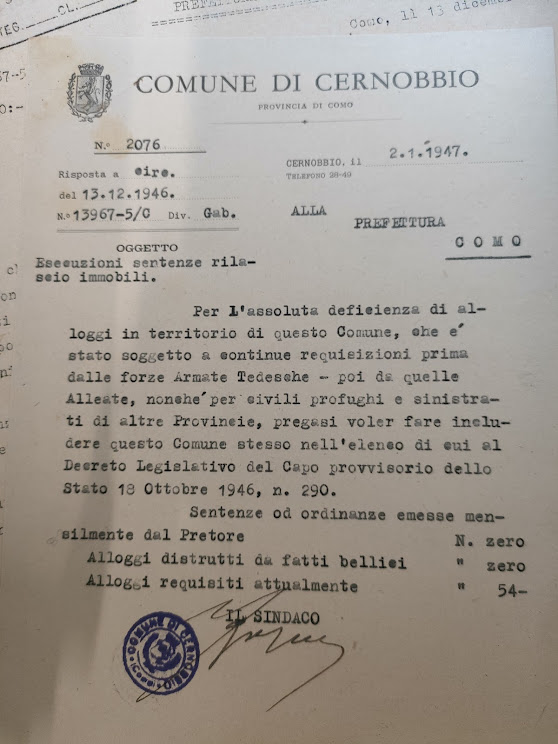
A letter from the Mayor of Cernobbio to the Prefect of the Province of Como outlining the continual number of requisitioned properties even by January 1947
Sources
Archivio Storico di Cernobbio, Class 8 – Carteggio 146, Fascicolo 8; Class 8.4, Fascicolo 9
EGELI Archive, Intesa San Paolo, N. 998, Carteggio 158, Fascicolo 3
Fossati Daviddi, I. R. (2003). Cernobbio 1943-45 Dalla Memoria alla Storia. Istituto Storia Contemporanea.


 The Como Companion
Hello Julian
Another most interesting read. I had to read it twice to make sure I
had understood correctly that the Nazis requisitioned properties, but
the owners were compensated by the Municipality of Cernobbio! It is
difficult to find the value of the lira at that period, so I wonder
whether the compensation was realistic or a mere gesture.
I look forward to your future posts.
Kind regards.
MONICA
LikeLike
Hi Monica
The website https://inflationhistory.com/ is good for giving the historical equivalents of lira to euro. For example, the average compensation for a requisitioned room was 450 Lira per month. According to that website, this figure would have been worth just under €150 in 1943. However the value would have fallen to just over €17 by 1945. The 40 rooms requisitioned from the Villa Belinzaghi by the RUK at 14,000 lira per month would have had a value of €4,656 in 1943 falling to a value of €532 by 1945.
LikeLike
Dear Comocompanion, my name is Lorenzo and I read with great pleasure your two articles mentioning Villa Carminati, which I assume is the house I am living now. I am trying to find more informations on its origins and previous owners and there ia in fact a dark shadow upon the Nazi occupation, would be great to connect and exchange some infos if you are keen to … Whatusp 345 72 45 904 phone +41 76 776 25 86
LikeLike
Hi Lorenzo
Villa Carminati is a beautiful building with quite a history. I would love to share what I know about it. Perhaps we could get together after the holiday period, around middle of January? I’ll message you on Whats App so you have my contact information. Best regards, Julian
LikeLike
Ciao Julian, looking forward to your message in the middle of January. Happy holidays ! Lorenzo
LikeLike