The symbol of a twin-tailed mermaid can be seen on a number of Como’s buildings, most clearly on the keystone of the doorway into No. 16 Via Odescalchi. The same symbol can be seen above the rear doorway of the Basilica San Fedele and, in more decorous fashion, on the walls of the Cathedral and within the town’s main cemetery. The design is of a very particular type of mermaid – one with two tails, and its origins and significance are far from clear although the figure, undoubtedly feminine, has a name – the Melusina.

The Melusina on the keystone above the doorway to Via Odescalchi, 16
Keystone Carvings in Como
Our Melusina in Via Odescalchi is carved into the keystone of the arch surrounding the principal doorway to the urban villa (or palazzo). Its purpose would have been very similar to the mezuzahs pinned to the lintels of Jewish homes to protect the inhabitants from evil. The Melusina would have been supposed to offer a similar protection as well as bringing prosperity and even fertility to the household. The Via Odescalchi keystone also includes what has been defined as a masonic symbol at its base symbolising liberty.

Crest of Adamo del Pero iabove the entrance to his palazzo at No. 6 Via Adamo del Pero
Most other keystone carvings in the city depict the heraldic crest of the resident family. The clearest of these is found in Via Adamo del Pero above the entrance way to Del Pero’s home. The family crest depicts a series of pears as befits his family name.
 Other crests exist above doorways on both sides of Via Balestra and above the entrance to Palazzo Odescalchi on Via Rodari but are so worn with age that it is impossible to make out their designs. These all date from the Renaissance period and adorn doorways decorated in contrasting bands of Varenna and Musso marble, as was quite commonly used on many of Como’s Renaissance palazzi. The more recent crest above the doorway of the bar at the theatre end of Via Porta shows an anchor and the staff of Mercury – a caduceus- leading to the idea that the householder was a merchant involved in shipping on the lake.

Decorative Melusinas on Como’s Cathedral. Left, on the southern wall, centre and right on the Porta della Rana.
Elsewhere Como’s melusinas are placed on religious buildings with those on the cathedral appearing less suggestive and more decorative. The two carved on the Porta della Rana, the work of Tommaso and Jacopo Rodari c. 1507, are more decorative (and decorous) renderings of the earlier medieval symbol. The carvings of the Rodari brothers on the cathedral combine both religious and mythological symbols, as in the case of the Melusina on the Porta della Rana who displays her wings but not her bifurcated tale. In all these cases, they are more bowdlerized versions than the older San Fedele’s melusina.
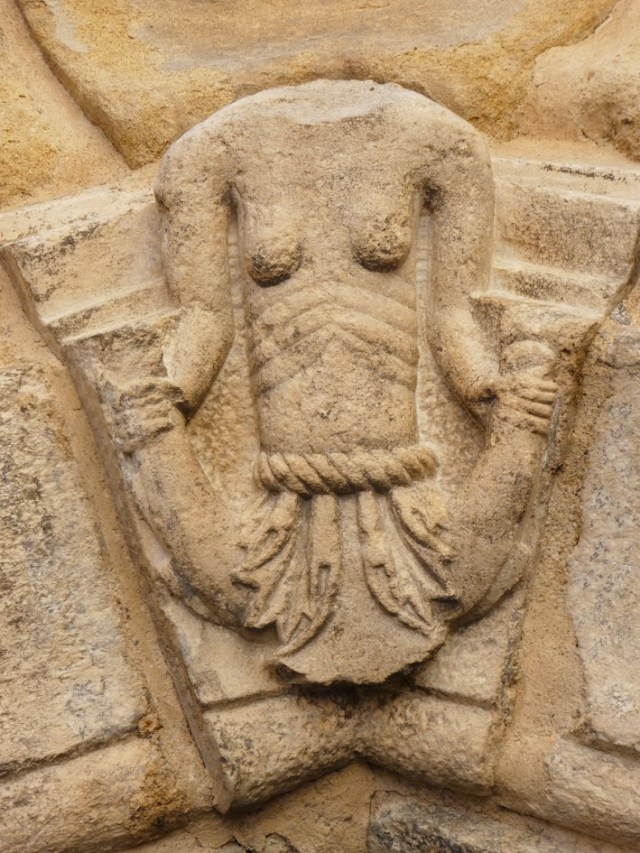
Melusina on the keystone above the doorway to Basilica San Fedele on Via Vittorio Emanuele.
The most recent Melusinas can be found in the Cimitero Monumentale on the western borders of the town. The cemetery was built from 1811 in the neoclassical style with two wings opening up right and left of the main entrance. Both wings form an arcade with a series of symbols displayed at the apex of each arch. One of these symbols is that of the Melusina represented in a simplified form to make best use of her symmetry to create a circle from her twin tails. She also holds what looks like fruit in her hands, possibly in line with her association with fertility and prosperity but, in the cemetery’s case, not longevity.

Melusina in the Cimitero Monumentale
Perhaps the best known contemporary use of the Melusina is in the ubiquitous logo of the American coffee chain, Starbucks. The founders of Starbucks took the company name from a character in Herman Melville’s novel, Moby Dick. In line with the novel’s blend of reality and myth, they adopted the Melusina as their company logo. After the original iteration in 1971, the logo has gone through a series of modifications which initially stressed the symmetrical qualities of the design before gradually divesting her of her legs. No doubt the designers behind this evolution presented sound marketing arguments for her bowdlerisation (in that she now reveals nothing of her lower body) but maybe they were also concerned over the potential ‘inappropriateness’ of the twin tailed maiden. If so, this was not a concern to the Catholic church in the 1500s although the Protestant leader of the Reformation, Martin Luther, is said to have denounced the Melusina as an agent of the devil.

Top left, the original 1971 logo. Top right, 1987 version. Bottom right, 1992. Bottom left, present day.
Melusina’s Origins
The Melusina and the myths that surround her were formed in ancient history as part of a magical world of mermaids, water sprites and forest nymphs. She may well have been identified with possessing some form of sexual power facilitating fertility and procreation. By placing her image above a household entrance, she may have been called upon to provide the inhabitants with a degree of protection from malign spirits as well as a boost to their libido.
The first appearance of Melusina in literature came out of late 14th and early 15th century France. As a British Library blog reports, she was born out of that period when mythological or magical accounts intersected with attempts at historical reporting. The story teller was Jean D’Arras who compiled a series of tales from around 1382 to 1394 called ‘spinning yarns’ in that they were said to be told by ladies as they collectively sat around their spinning wheels. In his account Melusine (as known in France) was the daughter of the King of Scotland and his fairy wife. She fell out with her father and entombed him within a mountain. As payback, the King’s fairy wife condemned Melusine to turn into a serpent from the waist down – but only each Saturday.

Melusine depicted by Julius Hubner, 1844. Here we see Raymond spying on Melusine on a Saturday when she was transformed into a mermaid.
Thus her fable was born out of Celtic and Gallo-Roman mythology and promulgated under the Plantagenet thiefdom over Western France and the British Isles. The heart of her influence was in the region of Poitiers. It is here she is said to have won the heart of a poor but noble gentleman called Raymond, Lord of Forez in Poitou. He stumbled across Melusine in a forest as she combed her golden tresses, dressed in a flowing white gown and sat beside a fountain. Enchanted by her beauty, he naturally fell immediately in love. She agreed to their marriage on the one condition that he allowed her to remain totally secluded every Saturday and he was not to make any attempt to see her then.
As a result of this marriage, the Poitou region began to prosper with forests cleared and land cultivated. Cities grew and castles were built including her own, the Castle of Lusignan. To this prosperity Melusine also brought fertility bearing ten sons to Raymond. Some of these became Kings and others became tyrants and some gained fame for exploits during the Crusades.
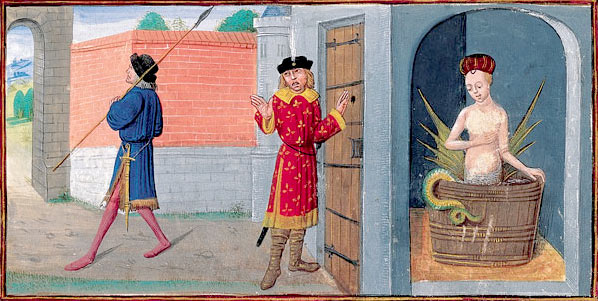 All of this mostly good fortune came to an end the moment Raymond could not resist seeing what Melusine did every Saturday. Spying on her through a keyhole, he saw her lower body transformed into a serpent. Later he could not help berate her by calling her ‘Serpent’. At this point Melusine developed wings and flew away.
The tale comes with a number of embellishments resulting from her ‘mixed race’ heritage in being half fairy and half human. But her lasting significance is in her fertility and her capacity to bring prosperity to Raymond’s family and to the region around Poitou.
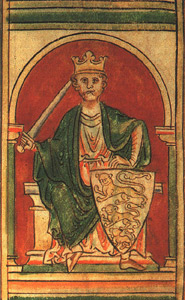 Another interesting fable mixing mythology with early historical accounts and also including mentions of the Crusades was the 14th century account of Richard Coer de Lyon, a magical telling of the life of this Plantagenet King of Western France and England. In this version, King Richard’s father, Henry II, does not marry Eleanor of Acquitaine but someone called Cassodorien, the daughter of the King of Antioch. They have three children, namely Richard (the later King), John (responsible for Magna Carta) and a daughter named Topyas. History records Richard’s exploits and also those of bad King John but Topyas is never mentioned because she was whisked away by her mother who sprouted wings and took to flight when she was forced one day to sit through an entire Mass.

The Melusine myth has intrigued musicians and authors throughout the centuries.Cécile McLorin Salvant at The Met Cloisters: Mélusine | MetLiveArts
The Melusine myth became well established in medieval times across France, Germany, Luxembourg and Cyprus with a number of embellishments and variations but with some commonality relating to her ability to bring prosperity. The myth has fuelled many creative endeavours over the centuries up to our own days with the most recent perhaps being the work of the French American jazz singer Cécile McLorin Salvant.
Melusina in Venice and Moltrasio

Orio and Melusina lived in Sotoportego dei Preti in Venice. Touching the heart-shaped stone above the entrance is said to bring good luck.
The Venetian version has Melusina starting life as a mermaid who gets caught up in the nets of a local fisherman called Orio. She was of course both beautiful and captivating resulting in the two falling in love and Melusina promising to give up her sea life, tuck away her tail and live as a normal human being at least for everyday of the week except Saturday. Needless to say the young man was supposed not to witness this weekly metamorphosis but he did. However the weekly curse was cured when the two married and subsequently went on to live happily together with their three children until Melusina died a natural death. Following on from her death, Orio continued to find his home and children miraculously well cared for whenever he returned from work. At least until one day he returned home early to see a snake on the floor of his kitchen. He killed the snake out of fear for his children. From that point on, the house was never tidy on his return home and Orio came to realise that he had inadvertently killed the serpent spirit of his dead wife.
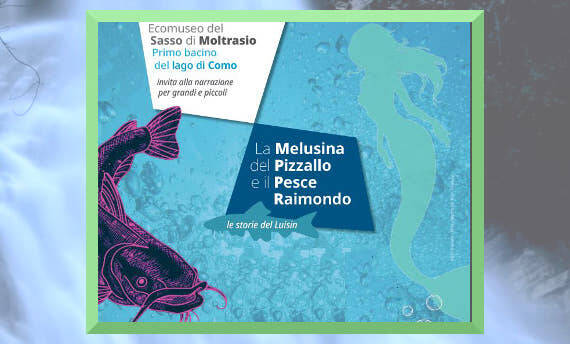
The Moltrasio version of the Melusina myth
The Eco-Museo of Moltrasio recently held a story telling event around the town where they enacted their own local version of the Melusina myth but with some radical differences. The setting for the drama was no longer a fountain in the middle of a forest but the lovely waterfall on the southern edge of the town – the Cascata Cam. Moltrasio’s Melusina is saved by a local fisherman called Luisin (similar to the name of Melusina’s Castle of Lusignan). He was out fishing for trout in the pool of the waterfall but instead caught a massive catfish called Raimondo (the original Melusina’s husband) who had previously swallowed Melusina alive. Luisin thus managed to free Melusina from the spell that kept her entrapped inside Raimondo.


 The Como Companion
Good stuff and very interesting from a historical perspective. Particularly interesting to know the background behind the Starbucks logo. That said, I’ll be on the lookout for signs of
LikeLike